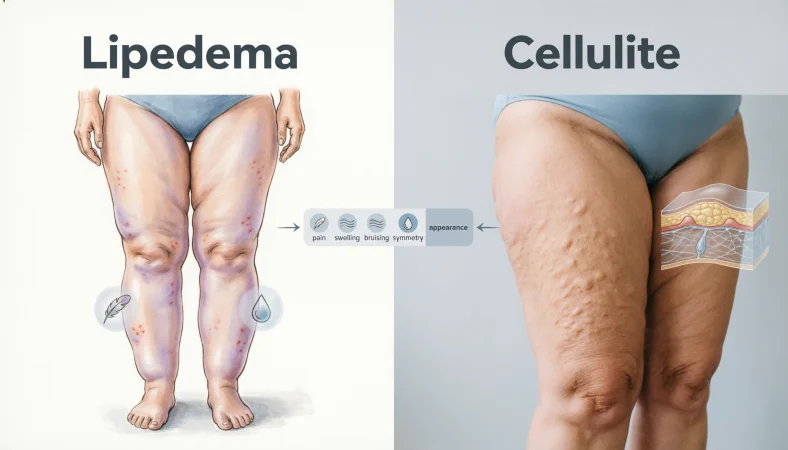
Lipedema and cellulite can both make the skin of the thighs, hips, buttocks, or legs look uneven or dimpled, but they are not the same thing. Lipedema is a chronic disorder involving abnormal fat distribution and can cause pain, tenderness, swelling, and easy bruising. Cellulite is a common cosmetic skin appearance caused by fat pushing against connective tissue.
If you’re trying to decide between lipedema or cellulite, the biggest clues are pain, swelling, bruising, body symmetry, and where the tissue changes occur. Cellulite usually causes harmless dimpling without pain, while lipedema can cause symmetrical enlargement, tenderness, heaviness, swelling, and easy bruising. A healthcare professional should evaluate symptoms that are persistent, painful, or worsening.
A dimpled or uneven appearance on the thighs doesn’t automatically mean cellulite. That assumption can matter because lipedema can resemble ordinary body fat or cellulite while involving very different symptoms and management needs. Cleveland Clinic describes lipedema as abnormal fat accumulation that commonly affects both sides of the lower body, whereas cellulite is a common cosmetic condition involving the appearance of fat and connective tissue beneath the skin. Understanding the distinction can help you describe your symptoms more accurately when speaking with a qualified healthcare professional.
Lipedema vs Cellulite: What’s the Difference?
Lipedema is a chronic condition involving abnormal accumulation and distribution of fat, most often affecting both sides of the lower body. The buttocks, hips, thighs, and lower legs may be affected, and the arms can sometimes be involved. The feet and hands are usually spared. Symptoms may include pain, tenderness, swelling, heaviness, and easy bruising.
Cellulite is a common cosmetic condition in which fat pushes against connective tissue beneath the skin, producing a puckered, lumpy, or dimpled appearance. It most commonly appears around the thighs, buttocks, hips, and abdomen. Cellulite is generally not painful and does not usually affect overall physical health.
| Feature | Lipedema | Cellulite |
| Basic nature | Chronic fat distribution disorder | Common cosmetic skin appearance |
| Typical areas | Hips, buttocks, thighs, lower legs, sometimes arms | Thighs, buttocks, hips, abdomen |
| Symmetry | Often affects both sides similarly | Symmetry is not a defining feature |
| Pain | Can be painful or tender | Usually not painful |
| Bruising | Easy bruising can occur | Not a typical defining feature |
| Swelling | Can occur | Not a defining feature |
| Feet | Usually spared | Not specifically characteristic |
| Skin appearance | May become uneven or dimpled | Dimpled, puckered, or lumpy |
| Effect of weight loss | Lipedema affected areas may respond differently from ordinary fat | Weight changes may alter appearance but do not necessarily eliminate cellulite |
| Medical evaluation | Often requires clinical assessment | Usually recognizable by appearance |
The table shows why appearance alone isn’t enough.
Cellulite is extremely common, particularly after puberty.
Lipedema can involve symptoms beyond appearance, including pain and easy bruising.
A person can also have lipedema and cellulite at the same time.
A healthcare professional can help determine whether symptoms suggest lipedema, cellulite, lymphedema, venous problems, or another condition.
Is Lipedema vs Cellulite a Medical, Appearance, or Usage Issue?
Unlike a spelling comparison, the difference between lipedema and cellulite is a medical distinction.
Calling every dimpled area cellulite can overlook other possible explanations. At the same time, seeing uneven skin does not automatically mean someone has lipedema.
Are Lipedema and Cellulite Interchangeable?
No.
The terms should not be used interchangeably.
Cellulite describes a characteristic skin appearance. Lipedema describes a chronic condition involving abnormal fat distribution and associated symptoms. Cleveland Clinic specifically distinguishes lipedema from cellulite and notes that lipedema can involve sensitivity, swelling, bruising, and pain, while cellulite is generally painless.
Formal and Informal Usage
In everyday conversation, people may use terms such as “dimpled skin,” “lumpy legs,” or “cellulite” loosely.
Medical discussions require more precision.
If someone has persistent pain, swelling, unusual bruising, or disproportionate enlargement of the legs or arms, describing those symptoms to a healthcare professional is more useful than simply saying that they have cellulite.
Academic and Clinical Usage
Medical literature uses lipedema as the name of a specific disorder. Clinical evaluation considers the distribution of tissue, symptoms, medical history, physical findings, and possible associated conditions.
Cellulite is generally discussed in dermatology and cosmetic medicine as an appearance involving subcutaneous fat and connective tissue.
What Does Lipedema Look and Feel Like?
Lipedema commonly produces disproportionate enlargement of the lower body. The buttocks, hips, thighs, and lower legs may become larger while the feet remain relatively unaffected. The arms can also be involved in some people. It often affects both sides of the body in a similar pattern.
Appearance is only part of the picture.
People with lipedema may experience tenderness or pain, a feeling of heaviness, swelling, and easy bruising. The tissue can feel different beneath the skin, and the surface may develop an uneven appearance as the condition progresses.
Workplace Example
Imagine someone whose legs become increasingly heavy and uncomfortable after standing for several hours at work. They also notice symmetrical enlargement and frequent bruising.
Those symptoms deserve more attention than simply assuming the person has cosmetic cellulite.
Academic Example
In a health education context, a student might describe lipedema as a chronic condition characterized by abnormal fat distribution, often affecting the lower body symmetrically.
That description is more accurate than calling lipedema simply “severe cellulite.”
Technology Example
Online symptom checkers and AI tools may identify overlapping terms because both conditions can involve uneven skin. However, a digital tool cannot reliably establish a medical diagnosis from appearance alone.
Usage Recap
Lipedema should be considered when changes involve more than skin texture.
Pain, tenderness, swelling, easy bruising, heaviness, and symmetrical lower body enlargement are important symptoms to discuss with a healthcare professional.
What Does Cellulite Look Like?
Cellulite usually appears as dimpling, puckering, or uneven skin. It is most common around the thighs and buttocks but can also occur around the hips, abdomen, breasts, and upper arms.
Mild cellulite may only become visible when the skin is pinched. More pronounced cellulite can remain visible while standing or sitting.
Cellulite is extremely common. Cleveland Clinic reports that approximately 80 percent to 90 percent of women who have gone through puberty have cellulite. It can also occur in people who are lean or physically fit.
Workplace Example
An employee may notice dimpling on the thighs but have no pain, swelling, tenderness, or unusual bruising.
That pattern is more consistent with ordinary cellulite than with a condition involving painful fat accumulation.
Academic Example
A health sciences assignment might describe cellulite as an uneven skin appearance caused by the interaction between subcutaneous fat and connective tissue.
That explanation is more precise than saying cellulite is simply “extra fat.”
Technology Example
A fitness application might show body composition information while an image based tool identifies visible skin dimpling. Neither result alone establishes whether someone has lipedema.
Usage Recap
Cellulite is primarily an appearance.
It is common, generally harmless, and usually painless. Weight, age, genetics, hormones, skin structure, and muscle tone can influence how noticeable it becomes.
When You Should NOT Assume Lipedema or Cellulite
There are several situations where self classification can be misleading.
1. Do Not Assume Every Dimple Is Lipedema
Dimpled skin is common and often represents cellulite.
2. Do Not Assume Pain Automatically Means Lipedema
Pain can have many possible causes. A healthcare professional should assess persistent or unexplained pain.
3. Do Not Assume Body Size Determines the Diagnosis
Cellulite can occur in people of many body shapes and sizes, including lean people. Lipedema can also occur alongside other patterns of body fat.
4. Do Not Diagnose From Photographs Alone
Images can show surface appearance but cannot reliably establish the underlying cause of tissue changes.
5. Do Not Assume Diet Will Resolve Lipedema
Lipedema affected fat may respond differently from ordinary body fat, and dieting is not considered a cure for lipedema.
6. Do Not Assume Cellulite Is a Dangerous Disease
Ordinary cellulite is generally harmless and does not require medical treatment unless someone wants cosmetic improvement.
7. Do Not Confuse Cellulite With Cellulitis
The names are similar, but cellulitis is a bacterial skin infection. It can cause redness, warmth, swelling, pain, and sometimes fever and requires medical attention.
8. Do Not Delay Care for Rapidly Changing Symptoms
A suddenly swollen, hot, red, or painful leg can have causes that require prompt assessment. Infection and other medical conditions need to be considered.
Common Mistakes and Decision Rules
| Accurate Statement | Common Misclassification | Explanation |
| Dimpled thigh skin can be cellulite | Every dimple means lipedema | Cellulite is very common |
| Painful, tender symmetrical leg changes deserve assessment | Painful cellulite is always harmless | Persistent pain may warrant clinical evaluation |
| Lipedema often affects both sides | Any large leg is lipedema | Size alone cannot establish the condition |
| Cellulite is primarily cosmetic | Cellulite is a dangerous disease | Ordinary cellulite is generally harmless |
| Feet are usually spared in lipedema | Foot swelling proves lipedema | Foot involvement can point toward other causes |
| Cellulitis can cause warmth and fever | Cellulite and cellulitis are the same | Cellulitis is an infection |
Decision Rule Box
- If the main issue is harmless skin dimpling without pain or unusual swelling, cellulite may be a more likely explanation.
- If there is symmetrical enlargement accompanied by pain, tenderness, heaviness, swelling, or easy bruising, discuss lipedema with a healthcare professional.
- If a leg becomes suddenly red, hot, painful, and swollen, particularly with fever or flu like symptoms, seek prompt medical care rather than assuming it is either condition.
Lipedema and Cellulite in Modern Technology and AI Tools
Artificial intelligence is increasingly used for health information, symptom searches, image analysis, and wellness applications. These technologies can help people organize questions, understand terminology, and identify information worth discussing with a clinician.
They should not be treated as a substitute for a medical examination.
The visual similarity between cellulite and some stages of lipedema makes automated identification particularly challenging. Lipedema diagnosis is generally based on clinical history and physical examination, while additional tests may be used to rule out other conditions or investigate related problems. Cleveland Clinic notes that there is no single standard test used to diagnose lipedema.
A useful approach is to use technology for education and preparation, not definitive self diagnosis.
For example, an AI tool can help someone create a symptom history that includes when swelling started, whether both sides are affected, whether bruising occurs easily, whether the tissue is painful, and whether symptoms change over time. That information can then be discussed with an appropriate healthcare professional.
Etymology and Medical Terminology
The word lipedema combines roots associated with fat and swelling. It is also commonly spelled lipoedema in British usage and in some international medical contexts. The NHS uses the spelling “lipoedema.”
The word cellulite comes from a term associated with changes in the tissue beneath the skin and developed into the modern description of the characteristic dimpled appearance.
These names are useful, but their meanings should not be reduced to appearance alone.
An Expert Style Explanation
When two conditions look similar, the most useful distinction is often not the appearance itself but the pattern of symptoms, distribution, progression, and clinical findings.
That principle is particularly important with lipedema because visual similarity to ordinary cellulite can contribute to confusion.
Two Practical Case Studies
Case Study 1: Dimpling Without Pain
Consider a person who notices dimpling on both thighs. The skin has a cottage cheese or orange peel appearance, but there is no pain, unusual swelling, tenderness, or easy bruising.
The appearance is compatible with cellulite, which is common and generally harmless. A healthcare professional can confirm the appearance if the person wants an assessment or cosmetic treatment advice.
The practical result is that the person should not automatically interpret ordinary skin dimpling as evidence of lipedema.
Case Study 2: Symmetrical Enlargement With Pain and Bruising
Now consider someone whose hips, thighs, and lower legs have become disproportionately enlarged on both sides. The tissue feels tender, the legs feel heavy, and bruises appear easily.
That combination warrants discussion with a healthcare professional because these features are associated with lipedema and are not simply typical descriptions of cellulite.
The practical result is not an automatic diagnosis. Instead, the symptom pattern gives the person a stronger reason to seek an appropriate clinical evaluation.
Treatment Differences
Treatment depends heavily on what is actually causing the symptoms.
Managing Lipedema
There is currently no cure for lipedema, but treatment can help manage symptoms and improve function. Depending on individual circumstances, management may include physical activity, compression garments, healthy eating, skin care, and therapies designed to address swelling and mobility. Cleveland Clinic also describes lymphatic drainage and complex decongestive therapy as possible approaches.
In selected cases, procedures such as liposuction may be considered by appropriately trained specialists. Treatment decisions should be individualized because surgical procedures have risks and require appropriate assessment.
Managing Cellulite
Cellulite does not generally require medical treatment.
People who want to reduce its appearance may consider exercise, healthy lifestyle habits, topical products, or professional cosmetic procedures. Results vary, and many approaches are temporary rather than permanent.
Recent Cleveland Clinic guidance also emphasizes that there is no proven method that permanently eliminates cellulite. Some professional treatments can make dimpling less noticeable for a period of time.
Error Prevention Checklist
Always Consider Lipedema When
There is symmetrical enlargement of the legs.
The tissue is painful or unusually tender.
The legs feel heavy.
Easy bruising is present.
The feet appear relatively unaffected despite enlargement higher on the legs.
Symptoms are persistent or progressively changing.
Never Assume Cellulite When
There is unexplained persistent pain.
There is significant swelling.
The affected areas bruise unusually easily.
The legs are changing disproportionately.
Symptoms are rapidly worsening.
The skin becomes hot, red, painful, or associated with fever.
The last situation is especially important because cellulitis, which is a bacterial infection, can require prompt antibiotic treatment.
Related Health Distinctions You Should Understand
If you’re researching lipedema and cellulite, several related topics are worth understanding.
Lipedema vs Lymphedema
These are different conditions, although they can occur together. Lipedema primarily involves abnormal fat distribution, while lymphedema involves impaired lymphatic drainage and fluid accumulation.
Cellulite vs Cellulitis
Despite the similar names, cellulite is a cosmetic skin appearance while cellulitis is a bacterial infection.
Lipedema vs Ordinary Body Fat
The distribution, symptoms, and clinical pattern matter. Lipedema should not be diagnosed solely from the amount of body fat.
Cellulite vs Loose Skin
Loose skin and cellulite can create different surface appearances. Skin elasticity and changes in underlying tissue can influence both.
Swelling vs Fat Accumulation
Swelling can result from fluid accumulation, inflammation, circulation problems, or other medical causes. It should not automatically be classified as fat.
Bruising vs Normal Skin Changes
Frequent or unusually easy bruising deserves discussion with a healthcare professional, particularly when combined with other symptoms.
Cosmetic Concern vs Medical Symptom
A cosmetic concern may involve appearance alone. Pain, swelling, tenderness, functional problems, or rapidly changing symptoms deserve greater medical attention.
Frequently Asked Questions
How can I tell if I have lipedema or cellulite?
Cellulite usually presents as painless dimpling or puckering of the skin. Lipedema may involve symmetrical enlargement of the lower body together with pain, tenderness, heaviness, swelling, or easy bruising. A healthcare professional is needed for proper assessment.
What does lipedema look like compared with cellulite?
Both can create an uneven or dimpled appearance. Lipedema is more likely to involve disproportionate enlargement and symptoms such as pain, swelling, heaviness, and easy bruising. Cellulite is primarily characterized by puckered or dimpled skin and is generally painless.
Can you have lipedema and cellulite at the same time?
Yes. The conditions are not mutually exclusive. A person can have cellulite as a common skin appearance while also having lipedema.
Is cellulite painful like lipedema?
Ordinary cellulite is generally not painful. Lipedema can cause pain and tenderness, although symptoms vary between individuals.
Does lipedema affect the feet?
Lipedema usually affects the legs while sparing the feet. Foot involvement can suggest another condition or an additional problem and should be assessed clinically.
Can losing weight get rid of lipedema?
Weight management can be part of overall health care, but lipedema affected fat may not respond to diet and exercise in the same way as ordinary body fat. Lipedema should therefore not be treated as simply a weight loss problem.
Conclusion:
The question of lipedema or cellulite cannot be answered reliably from skin texture alone.
Cellulite is an extremely common and generally harmless cosmetic appearance caused by the interaction of subcutaneous fat and connective tissue. Lipedema is a chronic condition involving abnormal fat distribution and can include symptoms such as pain, tenderness, swelling, heaviness, and easy bruising.
The most useful distinction is therefore the complete symptom pattern rather than the presence of dimpling.
If you only notice cosmetic dimpling without other symptoms, cellulite may be the more likely explanation. If you notice symmetrical enlargement together with pain, tenderness, swelling, heaviness, or easy bruising, it is reasonable to discuss the symptoms with a qualified healthcare professional.
And if a leg becomes suddenly red, hot, swollen, and painful, particularly with fever or flu like symptoms, don’t assume it is cellulite or lipedema. Those symptoms can occur with cellulitis, a bacterial infection that may require prompt treatment.