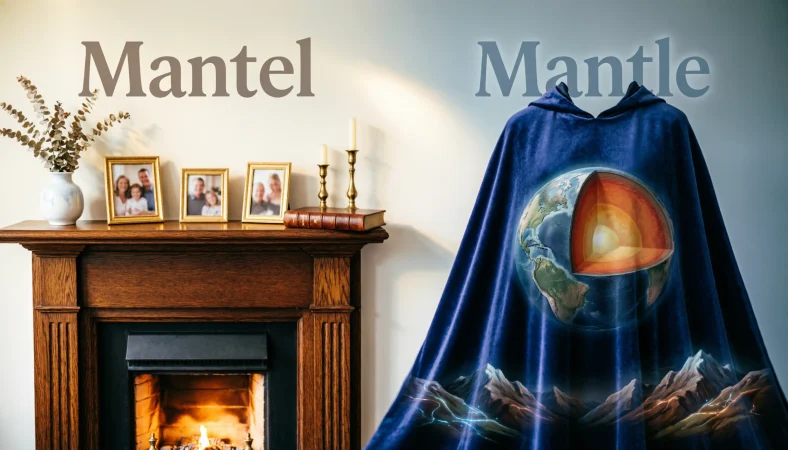
Mantel or mantle depends on meaning. A mantel is the shelf or structure above a fireplace, while a mantle is a cloak, covering, role, or figurative responsibility. The two words sound alike and share related historical roots, but they are not interchangeable in standard modern English.
The question of whether to write mantel or mantle causes surprisingly common mistakes because the two words are pronounced alike in most varieties of English. Their spellings differ by only one letter, yet their meanings are distinct.
A mantel is a noun referring to the shelf or projecting structure above a fireplace. You might decorate a mantel with photographs, candles, books, or seasonal decorations.
A mantle is also primarily a noun, but it has several meanings. It can mean a loose cloak or covering, a layer surrounding something, or a position of authority or responsibility that someone takes over. In expressions such as “take up the mantle,” the word is always mantle, not mantel.
The distinction matters because choosing the wrong spelling can change the meaning of a sentence or make otherwise polished writing look careless. The good news is that the difference becomes easy to remember once you connect each spelling with its most useful meaning.
Mantel vs Mantle: What’s the Difference?
The simplest way to distinguish the two words is to connect mantel with a fireplace and mantle with a covering, role, or layer.
Mini recap
Mantel belongs with the fireplace.
Mantle refers to a covering, layer, role, or responsibility.
If you can picture a shelf above a fire, choose mantel.
If you mean something being covered, inherited, carried, or assumed, choose mantle.
Is Mantel vs Mantle a Grammar, Vocabulary, or Usage Issue?
The confusion is mainly a vocabulary and usage issue, rather than a grammar problem.
Both words are grammatically correct. The problem is choosing the word whose meaning fits the sentence.
They are not interchangeable in standard English. Although they sound identical in ordinary speech, their written forms carry different meanings. This makes the distinction especially important in formal writing, where readers rely on spelling to understand precise meaning.
In casual conversation, the difference may go unnoticed because pronunciation does not normally reveal which word the speaker intends. In writing, however, the spelling is visible immediately.
Academic writing requires particular care. A science student writing about the Earth’s internal structure should use mantle, because the mantle is a geological layer. A student describing a historic fireplace should use mantel.
The same principle applies in professional communication. A sentence about decorating a fireplace needs mantel, while a sentence about assuming responsibility for a project needs mantle.
The distinction therefore has little to do with formal versus informal English. Both words can appear in formal and informal contexts. What changes is the meaning.
How to Use Mantel Correctly
Mantel is a noun associated with a fireplace. In its most familiar modern use, it means the shelf or projecting structure positioned above a fireplace.
For example:
“The family displayed their wedding photographs on the mantel.”
Here, mantel identifies a physical part of a room.
Workplace example
Imagine a property management company preparing a description of a renovated home:
“The restored stone fireplace features an original wooden mantel.”
The word is mantel because the sentence describes a physical fireplace feature.
Academic example
An architecture student might write:
“The Victorian fireplace has an ornately carved mantel made from dark wood.”
Again, the meaning is architectural rather than figurative.
Technology example
Technology can involve the word indirectly when digital products recreate domestic environments:
“The virtual room includes a fireplace with framed photographs arranged along the mantel.”
Even though the setting is digital, the object being described is still the shelf above the fireplace.
Usage recap
Use mantel when you mean a fireplace shelf or fireplace structure.
Think of furniture, architecture, decoration, and interior design.
A useful memory association is simple: mantel equals fireplace.
How to Use Mantle Correctly
Mantle has a much broader range of meanings. Its original sense is associated with a cloak or covering, and modern English has developed several related uses.
One important figurative meaning is a role, responsibility, or position that someone assumes or inherits.
For example:
“After the founder retired, Maria took up the mantle of leadership.”
The word does not refer to clothing literally. It represents the responsibilities associated with leadership.
Workplace example
Consider a company announcing a change in management:
“Daniel assumed the mantle of chief executive after the previous leader stepped down.”
The correct spelling is mantle because the sentence describes a position and its associated responsibilities.
Academic example
A geology textbook might state:
“The mantle lies between Earth’s crust and core.”
Here, mantle refers to a major layer inside Earth.
Another academic example could be:
“The researcher examined how heat moves through the mantle.”
The meaning is scientific rather than figurative.
Technology example
The word can also appear in technology writing:
“The new generation of developers has taken up the mantle of open source innovation.”
This is figurative. The developers have inherited a responsibility or tradition.
Usage recap
Use mantle for a cloak, covering, geological layer, or figurative role.
It is especially common in phrases involving responsibility, succession, leadership, and inheritance.
When you see “take up the mantle,” the spelling is always mantle.
When You Should NOT Use Mantel or Mantle
Knowing when not to use each word is one of the fastest ways to eliminate mistakes.
1. Do not use mantel for leadership
Incorrect:
“She took up the mantel of leadership.”
Correct:
“She took up the mantle of leadership.”
The phrase refers to assuming responsibility, not standing near a fireplace.
2. Do not use mantle for a fireplace shelf
Incorrect:
“He placed the clock on the mantle.”
Correct:
“He placed the clock on the mantel.”
The clock is sitting on a physical fireplace shelf.
3. Do not use mantel for Earth’s geological layer
Incorrect:
“The Earth’s mantel is beneath the crust.”
Correct:
“The Earth’s mantle is beneath the crust.”
In geology, mantle names the layer between the crust and core.
4. Do not use mantle for interior decoration
Incorrect:
“She decorated the mantle with family photographs.”
Correct:
“She decorated the mantel with family photographs.”
The context is a fireplace.
5. Do not use mantel in “take up the mantle”
The established expression is take up the mantle, meaning to accept a role, responsibility, tradition, or position previously held by someone else.
6. Do not assume pronunciation determines spelling
Because the words are generally homophones, listening alone may not help you choose the correct spelling.
You must identify the intended meaning.
7. Do not treat the words as stylistic alternatives
Choosing mantel instead of mantle is not simply a matter of writing style. It can produce a genuine vocabulary error.
8. Do not rely on autocorrect
Spellcheckers can sometimes recognize a correctly spelled word even when it is the wrong word for the context. Both mantel and mantle are legitimate English words, so automated correction cannot always detect the semantic mistake.
Common Mistakes and Decision Rules
| Correct sentence | Incorrect sentence | Explanation |
| She placed the portrait on the mantel. | She placed the portrait on the mantle. | A fireplace shelf is a mantel. |
| He accepted the mantle of leadership. | He accepted the mantel of leadership. | A role or responsibility is a mantle. |
| The mantle surrounds Earth’s core. | The mantel surrounds Earth’s core. | The geological layer is the mantle. |
| They decorated the mantel for Christmas. | They decorated the mantle for Christmas. | The sentence refers to a fireplace shelf. |
| She took up the mantle of responsibility. | She took up the mantel of responsibility. | The established figurative expression uses mantle. |
Decision Rule Box
- If you mean the fireplace shelf or structure, use mantel.
- If you mean a cloak or covering, use mantle.
- If you mean a geological layer, use mantle.
- If you mean a role, responsibility, tradition, or position inherited from another person, use mantle.
When uncertain, ask yourself one question: Am I talking about a fireplace?
If the answer is yes, mantel is almost certainly the word you need.
If the answer is no, and you are describing a covering, layer, responsibility, or inherited role, mantle is usually correct.
Mantel or Mantle in Modern Technology and AI Tools
Modern technology has created new contexts in which both words can appear, but it has not changed their fundamental meanings.
A digital interior design application may generate an image of a fireplace with decorations arranged on its mantel. A virtual reality environment can contain the same architectural feature.
By contrast, technology journalism frequently uses mantle figuratively when describing leadership or succession.
For example:
“The startup took up the mantle of responsible artificial intelligence development.”
Here, mantle represents a responsibility or mission.
Artificial intelligence systems can also make the confusion more visible. A language model may produce a sentence containing either word when context is incomplete, especially if a prompt supplies the phrase orally rather than in writing. Human review remains valuable because spelling alone is not enough to determine whether a homophone is semantically appropriate.
The lesson is broader than these two words. Modern writing tools are excellent at recognizing patterns, but writers still need to understand meaning.
Etymology: Why Are Mantel and Mantle So Similar?
The similarity between mantel and mantle is not accidental.
Both words are historically connected with terms relating to a cloak or covering. Over time, English developed different forms and meanings, with mantle retaining the broader sense of a cloak or covering.
Mantel became associated with the fireplace structure. Its history is connected to the architectural sense of a projecting framework around a fireplace.
This shared historical background helps explain why the words look and sound so similar today.
Their modern meanings, however, have separated clearly enough that standard English treats them as distinct vocabulary items.
Understanding their history can therefore make the spelling easier to remember rather than more confusing.
An Expert Perspective on Mantel and Mantle
A useful way to understand homophones is to remember that pronunciation does not guarantee meaning.
“Good word choice depends on meaning, not merely sound.”
That principle applies particularly well to mantel and mantle. A writer who hears the word first must mentally identify the intended concept before selecting the spelling.
This is why strong editing focuses on context rather than spelling alone.
Two Practical Case Studies
Case Study 1: Interior Design Copy
A home design company prepares a description for a renovated Victorian property.
Original sentence:
“The designer installed brass lamps along the mantle.”
The intended object is the shelf above the fireplace.
After correction:
“The designer installed brass lamps along the mantel.”
Result: The sentence now identifies the architectural feature accurately, eliminating a vocabulary error that could undermine the credibility of otherwise polished property copy.
Case Study 2: Leadership Article
A business publication describes a new chief executive.
Original sentence:
“The incoming executive took up the mantel of leadership.”
The intended meaning is that the executive inherited a position and its responsibilities.
Corrected version:
“The incoming executive took up the mantle of leadership.”
Result: The correction restores the standard idiom and makes the intended figurative meaning immediately clear to readers.
These examples demonstrate an important point: neither spelling is inherently more correct than the other. Accuracy depends entirely on context.
Error Prevention Checklist
Always use mantel when:
- You mean the shelf above a fireplace.
- You are describing fireplace decoration.
- You are discussing the architectural structure surrounding a fireplace.
- You are describing an object physically positioned above a fireplace.
Never use mantle when:
- The sentence specifically refers to a fireplace shelf.
- You are describing where photographs or decorations sit above a fire.
- You mean a physical mantelpiece.
Always use mantle when:
- You mean a cloak or covering.
- You mean Earth’s geological mantle.
- You mean a figurative role or responsibility.
- You use the expression “take up the mantle.”
- You describe someone inheriting a tradition, mission, or position.
Related Grammar Confusions You Should Master
Learning mantel or mantle is useful because it illustrates a larger category of English problems: words that sound alike but have different meanings and spellings.
Other distinctions worth mastering include:
- affect vs effect, where grammatical function and meaning determine the correct choice
- compliment vs complement, where praise differs from completion or compatibility
- principal vs principle, where a person or primary item differs from a fundamental rule
- stationary vs stationery, where lack of movement differs from writing materials
- their vs there vs they’re, where possession, location, and contraction must be separated
- advice vs advise, where a noun differs from a verb
- practice vs practise, especially in varieties of English that distinguish noun and verb spellings
- fewer vs less, where countability influences standard usage
- lie vs lay, where verb forms and grammatical objects create the main difficulty
- compliment vs complement, particularly in professional and academic writing
The broader lesson is that spelling questions often become easier once you identify the underlying meaning.
FAQs
What is the difference between mantel and mantle?
A mantel is the shelf or structure above a fireplace. A mantle can mean a cloak, covering, geological layer, or figurative role or responsibility. They sound alike but have different meanings.
Is the shelf above a fireplace called a mantel or mantle?
The correct spelling is mantel. A mantel is the shelf or projecting structure associated with a fireplace.
Is it take up the mantel or take up the mantle?
The standard expression is take up the mantle. It means to accept or inherit a role, responsibility, tradition, or position.
Is Earth’s layer called the mantel or mantle?
Earth’s geological layer is the mantle. It lies between the crust and the core and plays a major role in the planet’s internal structure.
Why do mantel and mantle sound the same?
They have historically related forms and are generally pronounced alike in modern English. Their meanings and spellings developed separately over time.
Can mantel and mantle be used interchangeably?
No. They are distinct words with different meanings. A writer should select the spelling according to context.
How do you remember whether to use mantel or mantle?
Associate mantel with a fireplace. Associate mantle with a covering, Earth’s interior, or a responsibility someone takes over.
Is mantle always a noun?
In ordinary modern usage, mantle is most commonly a noun. It can refer to a cloak, covering, geological layer, or figurative responsibility. Its historical and specialized uses can be broader.
What does it mean to assume the mantle?
To assume the mantle means to take on a role, responsibility, tradition, or position associated with another person or group.
Which is correct in formal writing, mantel or mantle?
Both are correct words, but only one will be correct in a particular sentence. Formal writing requires semantic accuracy rather than preference for one spelling.
Conclusion
The choice between mantel or mantle becomes straightforward once you focus on meaning rather than pronunciation.
Use mantel for the shelf or structure above a fireplace.
Use mantle for a cloak or covering, Earth’s geological layer, or a figurative role, responsibility, tradition, or position.
The quickest memory trick is this: fireplace means mantel; responsibility, covering, or geology means mantle.
Because both words are valid English spellings, a spellchecker may not catch a mistake. The safest approach is to pause and identify what the sentence actually describes. Once that habit becomes automatic, this commonly confused pair becomes much easier to handle accurately in academic, workplace, technical, and everyday writing.