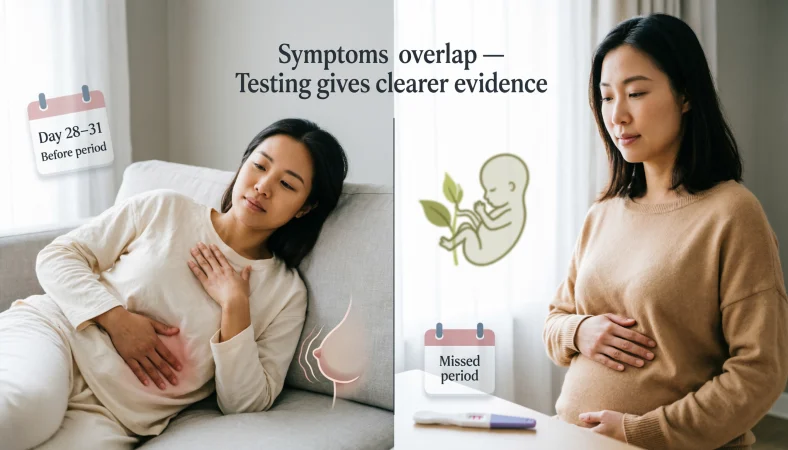
PMS or pregnancy can cause surprisingly similar symptoms, including breast tenderness, tiredness, bloating, mood changes, and cramping. PMS refers to recurring physical and emotional symptoms before a menstrual period, while pregnancy begins after conception and produces hormonal changes that can cause overlapping symptoms. Symptoms alone cannot reliably confirm pregnancy.
That overlap is what makes the question so difficult. A person who feels unusually tired, notices sore breasts, experiences mild cramps, or becomes more emotional may wonder whether a period is approaching or whether pregnancy has occurred.
Unfortunately, there is no single symptom that can reliably distinguish the two.
Timing can provide useful clues. PMS typically occurs during the days or weeks before menstruation and usually improves once the period begins. Early pregnancy can produce some of the same symptoms, but a missed period is one of the earliest and most reliable signs when menstrual cycles are normally regular.
The most dependable way to find out is a pregnancy test rather than trying to interpret symptoms individually.
PMS vs Pregnancy: What’s the Difference?
PMS stands for premenstrual syndrome. It is a collection of physical and emotional symptoms that occur before a menstrual period. Common symptoms include bloating, breast tenderness, headaches, fatigue, mood changes, irritability, appetite changes, and cramping. Symptoms can vary substantially from one person to another and from one cycle to the next.
Pregnancy is a biological state that begins after conception and implantation and involves continuing hormonal and physical changes. Early pregnancy can cause fatigue, breast tenderness, nausea, increased urination, constipation, changes in appetite, and other symptoms. Not everyone experiences the same symptoms, and some people notice very few symptoms early on.
| Feature | PMS | Early pregnancy |
| Meaning | Premenstrual syndrome | Pregnancy following conception |
| Typical timing | Before a menstrual period | Begins after conception and continues |
| Breast tenderness | Common | Common |
| Bloating | Common | Can occur |
| Fatigue | Common | Common, particularly early in pregnancy |
| Mood changes | Common | Can occur |
| Cramping | Can occur | Can occur |
| Nausea | Less characteristic | Common early pregnancy symptom |
| Increased urination | Not a defining PMS symptom | Can occur early |
| Period | Usually begins as expected | Usually missed if cycles are regular |
| Best way to distinguish | Symptoms follow a recurring premenstrual pattern | Pregnancy test provides evidence of pregnancy |
Quick recap
PMS and early pregnancy can feel remarkably similar.
PMS generally follows a recurring pattern before menstruation and improves when the period begins.
Pregnancy can produce overlapping symptoms but usually causes a missed period when cycles are regular.
Symptoms alone cannot establish whether someone is pregnant.
A pregnancy test is more useful than symptom comparison.
Is PMS vs Pregnancy a Grammar, Vocabulary, or Usage Issue?
Unlike a spelling distinction, this is primarily a medical information and symptom interpretation issue.
PMS and pregnancy are not interchangeable terms. PMS describes a group of symptoms associated with the menstrual cycle. Pregnancy describes a physiological condition.
The distinction matters because saying that someone “has pregnancy symptoms” based solely on breast tenderness or fatigue can imply more certainty than the evidence supports.
The same caution applies to PMS. Someone experiencing cramps and mood changes cannot automatically conclude that menstruation is about to begin. Symptoms can overlap with pregnancy and other conditions.
In formal medical writing, it is preferable to describe symptoms precisely rather than treating them as proof of a diagnosis.
For example:
“Breast tenderness can occur with both PMS and early pregnancy.”
This is more accurate than:
“Breast tenderness means pregnancy.”
Casual conversation often relies on shorthand. Someone might say, “I feel like my period is coming,” or “I think I have pregnancy symptoms.” Such statements are understandable, but they don’t establish the underlying cause.
Academic and health writing should be more cautious. A symptom is an observation. A diagnosis requires appropriate evidence and, where relevant, clinical assessment.
How PMS Typically Appears
PMS refers to symptoms that occur before menstruation. According to the NHS, common symptoms include mood swings, irritability, tiredness, sleep problems, bloating, cramping, breast tenderness, headaches, skin changes, and appetite or food craving changes.
One of the most useful clues is pattern.
If similar symptoms appear before menstruation month after month and then improve after the period starts, that recurring pattern is more consistent with PMS.
ACOG describes a clinical pattern in which symptoms occur during the five days before a period for at least three consecutive menstrual cycles, resolve within four days after menstruation begins, and interfere with normal activities. Keeping a daily symptom record for several cycles can help a healthcare professional assess the pattern.
Workplace example
Suppose an employee notices that breast tenderness, bloating, irritability, and fatigue appear during the days before menstruation every month. The symptoms then settle shortly after the period begins.
That recurring timing is useful information when discussing possible PMS with a healthcare professional.
Academic example
A research report might describe PMS as a cyclical collection of physical and emotional symptoms associated with the premenstrual phase.
The important concept is not simply the presence of a symptom but its timing, recurrence, severity, and effect on daily life.
Technology example
Period tracking applications can help users record symptoms alongside menstrual dates. Over several cycles, a record may reveal whether particular symptoms consistently occur before menstruation.
However, tracking software cannot diagnose PMS or pregnancy by itself. Its value is in organizing information that can later be discussed with a healthcare professional.
PMS usage recap
PMS is about a recurring premenstrual pattern.
Symptoms can include physical and emotional changes.
The symptoms usually ease after menstruation starts.
A symptom diary can help identify patterns over multiple cycles.
How Early Pregnancy Can Appear
Early pregnancy symptoms vary considerably.
The NHS identifies a missed period as the earliest and most reliable sign of pregnancy when someone normally has regular monthly cycles. Other possible signs include nausea, tiredness, sore breasts, increased urination, constipation, increased vaginal discharge without irritation, and changes in taste, smell, appetite, or food preferences.
The timing of symptoms matters, but it can be difficult to use timing alone because menstrual cycles aren’t identical for everyone.
Nausea and vomiting associated with pregnancy often begin around four to six weeks of pregnancy according to NHS guidance, while ACOG notes that pregnancy related nausea and vomiting commonly starts before nine weeks.
This means that nausea can be a useful pregnancy clue for some people, but its absence does not rule pregnancy out.
Workplace example
An employee who is unusually tired and has tender breasts may wonder whether these changes are related to an approaching period or pregnancy.
Without additional information, neither explanation can be established from those symptoms alone.
A pregnancy test is a more appropriate next step if pregnancy is possible.
Academic example
A health education resource might explain that early pregnancy symptoms overlap with premenstrual symptoms because hormonal changes can produce similar physical sensations.
The important distinction is that pregnancy is confirmed through appropriate testing rather than symptom interpretation alone.
Technology example
Pregnancy tracking applications may estimate gestational age or record symptoms, but an application cannot independently confirm pregnancy merely because someone reports nausea, cramps, or breast tenderness.
A properly used pregnancy test detects human chorionic gonadotrophin, commonly called hCG. The NHS states that hCG begins to be produced around six days after fertilisation.
Pregnancy usage recap
Early pregnancy symptoms vary greatly.
A missed period is an important early clue when cycles are normally regular.
Nausea, tiredness, breast tenderness, and increased urination can occur in pregnancy.
Symptoms do not replace pregnancy testing.
When You Should NOT Assume PMS or Pregnancy
There are several situations where symptom guessing can lead to an inaccurate conclusion.
1. Do not assume sore breasts mean pregnancy
Breast tenderness can occur with PMS as well as early pregnancy.
2. Do not assume cramps mean a period is coming
Cramping can occur before menstruation, but abdominal discomfort can have many causes.
3. Do not assume fatigue proves pregnancy
Fatigue is common in early pregnancy, but it is also a recognized PMS symptom.
4. Do not assume a late period automatically means pregnancy
Pregnancy is one cause of a late period, but stress, changes in weight, excessive exercise, hormonal contraception, perimenopause, and certain health conditions can also affect menstrual timing.
5. Do not assume the absence of nausea rules out pregnancy
Not everyone experiences all pregnancy symptoms.
6. Do not assume a negative test taken too early is definitive
Pregnancy tests can be less reliable when taken too early. The NHS advises testing from the first day of a missed period, or at least 21 days after the last unprotected sex if the expected period date is unknown.
7. Do not assume PMS is harmless when symptoms seriously disrupt life
Severe recurring premenstrual symptoms may warrant assessment for PMDD or another condition.
8. Do not ignore concerning symptoms
Severe or unusual symptoms, particularly when pregnancy is possible, deserve medical attention rather than self diagnosis.
Common Mistakes and Decision Rules
| Correct approach | Incorrect assumption | Explanation |
| Take a pregnancy test if pregnancy is possible and a period is late. | Assume symptoms alone prove pregnancy. | Symptoms overlap considerably. |
| Track symptoms across several cycles. | Judge PMS from one difficult month. | PMS is associated with a recurring pattern. |
| Consider a missed period as an important clue. | Treat every late period as proof of pregnancy. | Many factors can delay menstruation. |
| Repeat testing when appropriate after an early negative result. | Assume one early negative test always rules out pregnancy. | Testing too early can reduce reliability. |
| Discuss persistent severe symptoms with a healthcare professional. | Dismiss disabling premenstrual symptoms as normal. | Severe symptoms may require assessment and treatment. |
Decision Rule Box
- If pregnancy is possible and your period is late, use a pregnancy test rather than symptoms to decide whether pregnancy is likely.
- If symptoms repeatedly appear before menstruation and improve after the period starts, record the pattern and discuss possible PMS with a healthcare professional if it affects your life.
- If symptoms are severe, unusual, persistent, or concerning, seek medical advice rather than trying to distinguish PMS from pregnancy yourself.
PMS and Pregnancy in Modern Technology and AI Tools
Period trackers, fertility applications, symptom diaries, digital pregnancy tests, and AI health assistants have made reproductive health information more accessible.
These technologies can be useful for organization, but their roles are different.
A period tracker can record menstrual dates and symptoms. Over time, this may make recurring patterns easier to see.
An approved pregnancy test provides a biological measurement of hCG. That is fundamentally different from an application estimating pregnancy based on symptoms.
AI tools can explain why symptoms overlap, help users prepare questions for a clinician, or organize information about cycle timing. They should not be treated as a substitute for diagnostic testing or professional medical assessment.
This distinction is particularly important because symptoms such as fatigue, bloating, breast tenderness, and mood changes have low specificity. A system that sees several of these symptoms cannot reliably determine the cause without appropriate evidence.
Technology is therefore most useful when it supports informed decision making rather than pretending to provide certainty where none exists.
Etymology and Medical Terminology
PMS is an abbreviation for premenstrual syndrome.
The word “premenstrual” combines “pre,” meaning before, with “menstrual,” relating to menstruation. The term therefore describes a syndrome associated with the period before menstruation.
Pregnancy derives from Middle English and ultimately relates to Latin terminology associated with being with child or carrying a fetus.
These terms describe fundamentally different concepts.
PMS refers to a collection of symptoms occurring in relation to the menstrual cycle.
Pregnancy refers to the physiological state following conception and implantation.
Understanding the terminology helps prevent a common reasoning error: treating a symptom label as though it were a diagnosis.
An Expert Perspective on PMS and Pregnancy
A useful principle in interpreting reproductive symptoms is:
“A symptom is evidence of a change, not proof of its cause.”
That principle is particularly important when symptoms overlap.
Breast tenderness can be real without telling you exactly why it is happening. Fatigue can be significant without establishing pregnancy. Bloating can occur without indicating either condition.
The most useful information usually comes from combining timing, menstrual history, symptom patterns, pregnancy possibility, and appropriate testing.
Two Practical Case Studies
Case Study 1: Symptoms Before an Expected Period
Consider someone whose period is due in several days. They experience bloating, mild cramps, breast tenderness, irritability, and fatigue.
These symptoms are compatible with PMS. They are also not sufficient to exclude pregnancy if conception was possible earlier in the cycle.
If the symptoms follow the same pattern before menstruation over several cycles and disappear after the period begins, that pattern provides useful evidence when discussing PMS with a healthcare professional.
The key result is not a diagnosis from symptoms. It is recognition of a recurring pattern.
Case Study 2: A Missed Period With New Symptoms
Now consider someone with normally regular cycles whose period does not arrive and who develops unusual fatigue and breast tenderness.
A missed period makes pregnancy more plausible, but it still does not establish pregnancy by itself because late periods have multiple possible causes.
The practical next step is pregnancy testing. Most home pregnancy tests can be used from the first day of a missed period. If the expected period date is unknown, the NHS advises testing at least 21 days after the last unprotected sex.
These examples show why timing and testing are more informative than symptom matching alone.
Error Prevention Checklist
Always use PMS when:
- You are describing a recurring group of symptoms associated with the premenstrual phase.
- Symptoms regularly appear before menstruation.
- Symptoms improve after menstruation begins.
- You are discussing a recognized premenstrual syndrome rather than pregnancy itself.
Always consider pregnancy testing when:
- Pregnancy is possible.
- A normally expected period has been missed.
- You have pregnancy concerns that cannot be resolved through symptom interpretation.
- An earlier test may have been taken too soon.
Never assume pregnancy solely because:
- Your breasts are tender.
- You feel tired.
- You are bloated.
- You have mild cramps.
- Your mood has changed.
Never assume PMS solely because:
- You have cramps.
- You have breast tenderness.
- You feel emotional.
- Your period is late.
Symptoms overlap, so context and appropriate testing matter.
Related Reproductive Health Questions You Should Understand
Understanding PMS and pregnancy becomes easier when you also understand several related concepts.
Menstrual cycle timing
Knowing when menstruation normally occurs provides essential context for interpreting symptoms.
Ovulation
Ovulation is the release of an egg from an ovary and is central to understanding the fertile window.
Fertile window
Pregnancy is most likely around the time of ovulation, although the exact timing can vary.
Implantation
Implantation occurs when a fertilized egg attaches to the uterine lining. It is part of the process that establishes pregnancy.
Pregnancy tests
Home pregnancy tests detect hCG and are more useful for confirming pregnancy than symptoms alone.
PMS and PMDD
PMDD is a more severe premenstrual disorder that can significantly interfere with daily life.
Missed periods
A missed period can have several causes besides pregnancy, including stress, weight changes, hormonal contraception, perimenopause, and certain medical conditions.
Early pregnancy symptoms
These can include fatigue, nausea, breast tenderness, increased urination, constipation, and changes in taste or smell.
Pregnancy dating
Pregnancy is medically dated from the first day of the last menstrual period rather than simply from the day conception occurred.
Menstrual symptom tracking
Recording symptoms over multiple cycles can reveal patterns that are difficult to recognize from memory alone.
FAQs
How can I tell if my symptoms are PMS or pregnancy?
You usually cannot tell reliably from symptoms alone because PMS and early pregnancy can cause overlapping symptoms such as fatigue, breast tenderness, bloating, mood changes, and cramps. If pregnancy is possible, an appropriately timed pregnancy test is more reliable than symptom comparison.
What are the main differences between PMS and early pregnancy symptoms?
PMS generally follows a recurring pattern before menstruation and tends to improve once the period begins. Early pregnancy can cause similar symptoms but may also involve a missed period, nausea, increased urination, changes in taste or smell, and continuing symptoms.
Can PMS cause pregnancy like symptoms?
Yes. PMS can cause breast tenderness, fatigue, bloating, mood changes, headaches, appetite changes, and other symptoms that can resemble early pregnancy.
Is a missed period always a sign of pregnancy?
No. Pregnancy is one possible cause, but stress, weight changes, excessive exercise, hormonal contraception, perimenopause, and some health conditions can also cause late or missed periods.
How soon can I take a pregnancy test after a missed period?
Most pregnancy tests can be taken from the first day of a missed period. If you do not know when your period is due, the NHS advises testing at least 21 days after the last unprotected sex.
Can you have PMS symptoms and still be pregnant?
Yes. Symptoms that resemble PMS can occur during early pregnancy, including breast tenderness, fatigue, bloating, and mood changes. Because of this overlap, symptoms alone cannot reliably distinguish the two.
Can early pregnancy cause cramps like PMS?
Mild abdominal discomfort or cramping can occur in early pregnancy, but cramping also commonly occurs before menstruation. Cramping by itself cannot determine whether someone is pregnant.
Does nausea always mean pregnancy?
No. Nausea can occur during pregnancy, but nausea has many other possible causes. Pregnancy related nausea commonly begins during the early weeks of pregnancy, but not everyone experiences it.
What should I do if my pregnancy test is negative but my period has not arrived?
If the test was taken early, the result may be less reliable. The NHS advises waiting a few days and testing again if pregnancy is still suspected. If a second test is negative and your period has still not arrived, speak with a GP.
When should I seek urgent medical advice if I might be pregnant?
Seek prompt medical advice for concerning symptoms such as unusual vaginal bleeding combined with significant abdominal or pelvic pain, particularly if pregnancy is possible. Ectopic pregnancy can sometimes initially resemble other reproductive symptoms and requires medical assessment.
Coclusion
The question of PMS or pregnancy cannot usually be answered accurately by comparing symptoms alone.
PMS commonly produces breast tenderness, bloating, cramps, fatigue, mood changes, headaches, appetite changes, and other symptoms before a period. Early pregnancy can produce many of the same sensations.
The strongest clue is often timing. A recurring pattern that appears before menstruation and improves when the period starts is consistent with PMS. A missed period is an important early pregnancy sign when cycles are normally regular, but late periods can have many other causes.
If pregnancy is possible, testing is more informative than trying to decode individual symptoms. Most home pregnancy tests can be used from the first day of a missed period, while someone who does not know when their period is due can test at least 21 days after the last unprotected sex.
If symptoms are severe, persistent, unusual, or affecting daily life, professional medical advice is appropriate. PMS can be treated, and symptoms that suggest a pregnancy complication should not be dismissed as ordinary PMS.