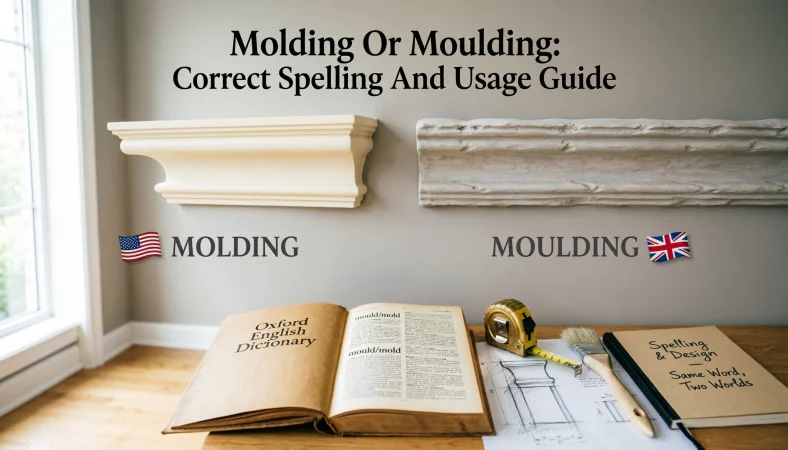
Molding and moulding have the same meaning and refer to the process of shaping material or a decorative strip used in construction and design. The main difference is regional spelling. Molding is the standard American English form, while moulding is preferred in British English and many other varieties. Neither spelling is inherently incorrect.
The question “molding or moulding” often appears when writers are unsure which spelling to use in American, British, Canadian, Australian, or international English. Both forms refer to the same underlying concept, but the spelling changes depending on the variety of English being used.
Molding is the standard American English spelling. It can describe the process of shaping a material into a particular form, or it can refer to a decorative architectural feature such as trim around doors, windows, ceilings, and walls.
Moulding is the traditional British English spelling of the same word. It is also widely used in other English varieties influenced by British spelling conventions.
The confusion can create practical problems. A writer may use one spelling in an article aimed at an American audience and another spelling in a British publication. A homeowner searching for decorative trim may also encounter both spellings in product listings, renovation guides, and architectural resources.
The good news is that this is mainly a regional spelling distinction. The meaning does not normally change.
If your audience uses American English, molding is the natural choice. If your audience uses British English, moulding is generally preferred.
Molding Vs Moulding: What’s The Difference?
Molding and moulding are both forms of the same word. They can function as nouns or as forms related to the verb mold or mould.
As a noun, molding or moulding can refer to a shaped or decorative strip used in architecture, furniture, interior design, or construction.
As a verb related form, molding or moulding can describe the process of shaping, forming, or creating something from a material.
The central distinction is spelling rather than meaning.
| Feature | Molding | Moulding |
| Main English variety | American English | British English |
| Basic meaning | Shaping material or decorative trim | Shaping material or decorative trim |
| Part of speech | Noun or verb form | Noun or verb form |
| Standard usage | American English | British English |
| Construction usage | Very common | Very common |
| Interior design usage | Very common | Very common |
| Technical usage | Common in American sources | Common in British sources |
| Meaning difference | Usually none | Usually none |
The two spellings normally describe the same thing.
Molding is preferred in American English.
Moulding is preferred in British English and related varieties.
The choice should be based on your audience and the spelling system you are following.
Quick Recap
Molding and moulding have the same basic meaning.
Molding is the American English spelling.
Moulding is the British English spelling.
The difference is primarily regional rather than grammatical.
Is Molding Vs Moulding A Grammar, Vocabulary, Or Usage Issue?
The difference between molding and moulding is primarily a spelling and regional usage issue.
It is not a meaningful difference in grammar. Both forms can be used as nouns, and both are associated with the process of shaping material.
Are Molding And Moulding Interchangeable?
In meaning, yes.
If an American writer says:
The molding around the door needs to be replaced.
a British writer might write:
The moulding around the door needs to be replaced.
The meaning is essentially identical.
However, they are not always interchangeable within a particular style system. American publications normally favor molding, while British publications generally favor moulding.
Consistency matters.
Formal Vs Informal Usage
Both forms can be used in formal and informal writing. The important factor is regional spelling.
For example, an American architectural report may use:
The decorative molding was damaged.
A British architectural report may use:
The decorative moulding was damaged.
Neither sentence is more formal than the other. The difference reflects the spelling convention of the English variety.
Academic Vs Casual Usage
Academic writers should follow the spelling system expected by their institution, publication, or intended audience.
An American university paper would generally use molding.
A British university paper would generally use moulding.
In casual conversation, the distinction rarely matters because the two words usually sound the same.
How To Use Molding Correctly
Molding is the standard American English spelling.
It has several common meanings, particularly in construction, manufacturing, interior design, and material science.
As a construction term, molding can refer to decorative trim attached to walls, ceilings, doors, windows, cabinets, and other architectural features.
For example:
The homeowner replaced the old crown molding with a simpler design.
Molding can also describe a manufacturing process.
For example:
The factory uses plastic molding to create the components.
In this sense, the word refers to shaping material through a particular production method.
Workplace Example
An interior designer might tell a client:
The new molding will give the room a more traditional appearance.
Here, molding refers to decorative architectural trim.
A manufacturing manager might instead say:
The molding process needs to be adjusted to reduce defects.
In that context, molding refers to production.
Academic Example
An engineering student might write:
Injection molding is widely used to manufacture plastic components.
This is standard American English terminology.
A materials science paper could also discuss how heat, pressure, and material properties affect the molding process.
Technology Example
Molding is an important term in modern manufacturing technology.
Injection molding, compression molding, blow molding, and other techniques are used to create products ranging from automotive components to consumer goods.
Modern computer aided design software also allows engineers to design molds and simulate manufacturing processes before physical production begins.
Molding Usage Recap
Use molding when writing in American English.
- It can refer to decorative architectural trim.
- It can also refer to industrial processes that shape materials.
- It is the preferred American spelling in both technical and general writing.
How To Use Moulding Correctly
Moulding is the standard British English spelling.
It has the same fundamental meanings as molding.
In British interior design and construction writing, moulding commonly refers to decorative architectural trim.
For example:
The original moulding around the windows was carefully restored.
In manufacturing contexts, British sources may also use moulding to describe processes that shape materials.
For example:
The company specializes in injection moulding.
The extra letter is a spelling convention rather than a difference in the manufacturing technique.
Workplace Example
A British interior designer might write:
The client requested decorative moulding around the fireplace.
The spelling reflects British English conventions.
Academic Example
A British engineering paper might state:
Injection moulding is commonly used for high volume plastic production.
An American paper covering the same process would generally use injection molding.
Technology Example
Manufacturing technology frequently uses moulding terminology in British English.
Computer aided manufacturing systems, industrial design software, robotics, and automated production lines can all involve moulding processes.
The technology remains the same even when the spelling changes.
Moulding Usage Recap
Use moulding when following British English spelling conventions.
It can describe decorative architectural features or industrial shaping processes.
It is particularly common in British construction, design, engineering, and manufacturing writing.
Molding Or Moulding In American And British English
The easiest way to remember the difference is to connect the spelling with the broader spelling systems of English.
American English often removes the letter u from words that retain it in British English.
Consider several familiar examples:
| American English | British English |
| Molding | Moulding |
| Mold | Mould |
| Color | Colour |
| Favor | Favour |
| Labor | Labour |
| Honor | Honour |
| Neighbor | Neighbour |
This pattern explains why American writers use molding while British writers use moulding.
The difference is not unique to this word.
It is part of a much broader history of spelling variation between major English varieties.
When You Should NOT Use Molding Or Moulding
There are several situations where choosing either spelling without considering context can lead to problems.
1. Do Not Mix Regional Spellings
If your article follows American English, use molding consistently rather than switching between molding and moulding.
2. Do Not Use Moulding In American Content Without A Reason
Moulding is understandable to American readers, but molding is the expected American spelling.
3. Do Not Use Molding In British Content Without Considering Your Style Guide
British publications generally expect moulding.
4. Do Not Treat The Two Forms As Different Materials
Molding and moulding normally describe the same process or architectural feature.
5. Do Not Change The Spelling In A Quotation
If a British speaker or publication uses moulding, preserve that spelling when quoting the original source, subject to your editorial policy.
6. Do Not Assume One Form Is More Correct Globally
English has multiple standard varieties. American and British spelling conventions can both be correct.
7. Do Not Mix American And British Spellings In One Article
Inconsistent regional spelling can make otherwise polished content look poorly edited.
8. Do Not Choose Based Only On Search Volume
If you’re writing for a specific country, audience relevance should generally matter more than simply selecting whichever spelling appears more frequently worldwide.
Common Mistakes And Decision Rules
| Correct sentence | Incorrect sentence | Explanation |
| The contractor installed new molding. | The contractor installed new moulding. | Molding is preferred in American English. |
| The contractor installed new moulding. | The contractor installed new molding. | Moulding is preferred in British English. |
| The house has decorative crown molding. | The house has decorative crown moulding. | The first version follows American spelling. |
| The house has decorative crown moulding. | The house has decorative crown molding. | The first version follows British spelling. |
| The factory uses injection molding. | The factory uses injection moulding. | American manufacturing terminology generally uses molding. |
| The factory uses injection moulding. | The factory uses injection molding. | British manufacturing terminology generally uses moulding. |
Decision Rule Box
- If you are writing in American English, use molding.
- If you are writing in British English, use moulding.
- If your audience is international, choose one spelling system and use it consistently.
- If a publication or organization provides a style guide, follow its regional spelling requirements.
Molding And Moulding In Modern Technology And AI Tools
Modern technology has not changed the basic spelling distinction between molding and moulding.
Manufacturing software, computer aided design systems, three dimensional modeling tools, robotics, and automated production systems use terminology based on the regional spelling conventions of their audience.
AI tools can also generate either spelling.
For example, an American focused manufacturing article might discuss injection molding, while a British publication covering the same technology might discuss injection moulding.
The underlying process remains the same.
This matters for technical content because consistency helps readers understand that two apparently different terms can refer to the same manufacturing technique.
AI generated content should therefore be reviewed for regional consistency. If an article begins with American spelling, randomly switching to British spelling can create unnecessary confusion.
Authority And Trust: The Etymology Of Molding And Moulding
The words mold and mould have a long history in English and are related to older Germanic and French linguistic forms associated with shaping or forming.
Over time, English developed regional spelling differences.
American English commonly adopted simplified spellings in several groups of words. British English retained forms containing additional letters in many cases.
That historical development produced the modern distinction between mold and mould, and consequently between molding and moulding.
The pronunciation of the two forms is generally the same or extremely similar.
The spelling is what signals the regional variety.
An Expert Style Principle
“When two spellings carry the same meaning, consistency with the chosen English variety is more important than treating one regional form as universally correct.”
That principle applies particularly well to molding and moulding.
Two Practical Case Studies
Case Study One: Home Renovation Content
Imagine an American home improvement website publishing an article about decorative trim.
Its heading says:
How To Choose Crown Molding For Your Home
Throughout the article, it consistently uses molding.
That consistency tells American readers that the article follows their expected spelling system.
Now imagine the same article switching randomly between molding and moulding. Readers may wonder whether the words describe different products.
The concrete result of maintaining one spelling is greater clarity and a more polished editorial appearance.
Case Study Two: International Manufacturing
Consider a company producing plastic components for customers in both the United States and the United Kingdom.
Its American documentation refers to injection molding.
Its British documentation refers to injection moulding.
The production process itself has not changed.
Only the regional spelling has changed.
This demonstrates why technical teams often need to localize terminology rather than assume that one spelling is universally preferred.
Molding Or Moulding Error Prevention Checklist
When To Use Molding
- You are writing for an American English audience.
- Your publication uses American spelling.
- You are preparing American manufacturing documentation.
- You are writing about American interior design, construction, or architecture.
- Your style guide specifies American English.
- You want to use the standard American spelling of molding.
When To Use Moulding
- You are writing in British English.
- Your publication follows British spelling.
- You are writing for a British construction or manufacturing audience.
- You are preparing British manufacturing documentation.
- Your style guide specifies British English.
- You are targeting readers in the UK or other regions that commonly use British spelling.
Never Mix Molding And Moulding When
- You are writing one continuous article or blog post.
- You are creating a professional technical document.
- Your publication requires consistent regional spelling.
- You are preparing manufacturing, construction, or interior design documentation.
- You are optimizing content for a specific American or British English audience.
- Your brand style guide requires consistent terminology and spelling.
Related Grammar Confusions You Should Master
If you want to improve your command of American and British spelling differences, these related topics are useful:
- Color and colour
- Honor and honour
- Labor and labour
- Center and centre
- Theater and theatre
- Traveler and traveller
- Labeled and labelled
- Canceled and cancelled
- Organize and organise
- Tire and tyre
These examples demonstrate that English spelling differences often follow recognizable regional patterns.
FAQs
Is molding or moulding correct?
Both are correct spellings. Molding is the standard American English form, while moulding is the standard British English form and is also used in several other English varieties.
What is the difference between molding and moulding?
There is normally no difference in meaning. Both can refer to the process of shaping material or to decorative architectural trim. The primary difference is regional spelling.
Is molding American or British English?
Molding is the standard American English spelling. British English generally uses moulding.
Is moulding American or British English?
Moulding is primarily the British English spelling. It is also used in other English varieties that follow British spelling conventions.
Is crown molding or crown moulding correct?
Both are correct depending on the English variety. American English uses crown molding, while British English uses crown moulding.
Is injection molding or injection moulding correct?
Both forms are correct. American technical writing normally uses injection molding, while British technical writing generally uses injection moulding.
Why does American English spell molding without a u?
American English uses simplified spellings in several groups of words where British English retains the letter u. This creates pairs such as mold and mould and molding and moulding.
Should I use molding or moulding for an international audience?
Either can work, but consistency is important. If your main audience is American, use molding. If your audience is primarily British or follows British conventions, use moulding.
Is molding a noun or a verb?
Molding can be a noun referring to decorative trim or the shaping process. It can also function as the present participle of mold.
Is moulding a noun or a verb?
Moulding can be a noun referring to decorative trim or a shaping process. It can also function as the present participle of mould.
Conclusion
The answer to the molding or moulding question is straightforward once you identify the English variety you’re using.
Molding is the standard American English spelling.
Moulding is the standard British English spelling and is also used in several other varieties that follow British conventions.
Both forms can refer to decorative architectural trim, the process of shaping material, or manufacturing techniques such as injection molding or injection moulding.
The meaning generally remains the same. What changes is the spelling convention.
If you’re writing for American readers, choose molding. If you’re writing for British readers, choose moulding. For an international audience, either can work, but you should choose one regional spelling system and apply it consistently.
The most important rule is simple: molding belongs to American English, while moulding belongs to British English.
Once you understand that pattern, the spelling becomes much easier to remember. It is not a question of one form being right and the other being wrong. Both are legitimate within their respective varieties of English.