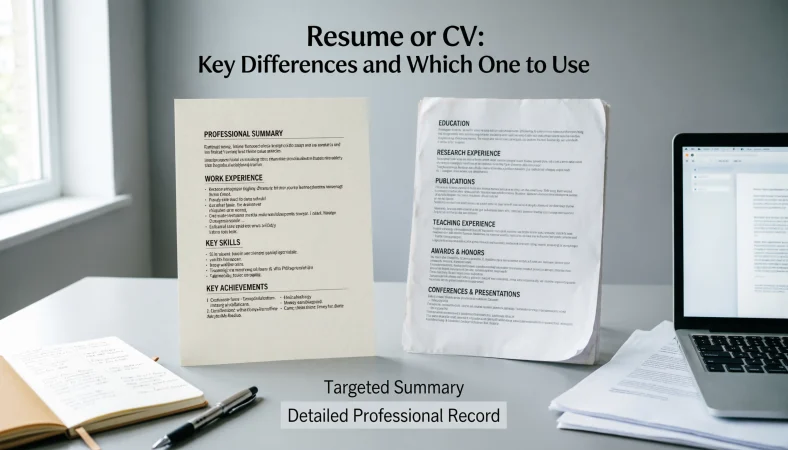
A resume is a concise document tailored to a specific job, while a CV is usually a more detailed record of your education, experience, research, publications, and professional achievements. The terms can overlap depending on the country, but employers may expect a different document based on location, industry, and application requirements.
The question “resume or CV” creates confusion because the two terms are sometimes treated as exact synonyms and sometimes as completely different documents. The correct choice depends heavily on where you are applying, what type of position you want, and what the employer requests.
A resume is generally a focused career document designed to demonstrate why you are suitable for a particular position. It usually emphasizes relevant work experience, skills, achievements, education, and qualifications. A resume is normally shorter and customized for each job application.
A CV, short for curriculum vitae, traditionally provides a broader and more detailed record of a person’s academic and professional history. It can include education, research, publications, presentations, teaching experience, awards, professional memberships, and other accomplishments.
The distinction causes real mistakes because job seekers sometimes submit a lengthy academic CV when an employer expects a concise resume. Others may spend hours shortening an academic CV when a detailed document is actually appropriate.
There is another complication. In countries such as the United States, resume and CV often refer to different documents. In some other English speaking countries, particularly the United Kingdom, the terms can be used much more interchangeably for ordinary employment applications.
Understanding this regional difference is essential before preparing your application.
Resume vs CV: What’s the Difference?
A resume is a noun referring to a concise summary of professional qualifications and experience. Its purpose is usually to persuade an employer that the applicant deserves further consideration.
A CV is also a noun. The abbreviation comes from the Latin phrase curriculum vitae, meaning the course of a person’s life. In professional contexts, it generally refers to a detailed record of academic and professional achievements.
The biggest practical distinction is purpose and level of detail.
| Feature | Resume | CV |
| Primary purpose | Targeted job application | Detailed professional or academic record |
| Typical length | Often one or two pages | Can be several pages |
| Level of detail | Selective | Comprehensive |
| Customization | Usually customized for each role | Often maintained as a broader master document |
| Work history | Relevant experience emphasized | Detailed history may be included |
| Publications | Usually limited or omitted | Often included |
| Research | Usually summarized | Can be extensive |
| Academic achievements | Selected | Detailed |
| Common use | Corporate and general employment | Academic, research, medical, and scholarly careers |
| Regional meaning | Distinct document in some countries | Distinct document in some countries |
Quick Recap
A resume is usually concise and targeted.
A CV is often more comprehensive and detailed.
In some countries, resume and CV mean essentially the same thing.
Always follow the terminology and requirements used by the employer.
Is Resume vs CV a Grammar, Vocabulary, or Usage Issue?
The difference between resume and CV is primarily a vocabulary and usage issue, rather than a grammar problem.
The terms describe professional documents, but their exact meanings vary across countries and industries.
Are Resume and CV Interchangeable?
Sometimes, but not always.
In the United States, a resume generally refers to the concise document used for most employment applications. A CV usually refers to a longer academic or professional record, particularly for positions in universities, research institutions, medicine, and certain specialized fields.
In the United Kingdom and some other regions, CV is the dominant term for a document used to apply for jobs. A person may call a document a CV even when its length and content resemble what an American employer would call a resume.
This means that geography matters.
Formal vs Informal Usage
There is no simple formal versus informal distinction.
A CV is not automatically more formal than a resume. Instead, each document serves different professional purposes depending on the context.
For example, an academic applying for a university position may need a detailed CV. A marketing professional applying to a private company may be expected to submit a concise resume.
Academic vs Casual Usage
In casual conversation, people may use the terms loosely.
Someone might say, “Send me your CV,” even when they simply mean a document containing work experience and qualifications.
In academic environments, however, CV generally has a more specific meaning. An academic CV can document years of research, teaching, publications, conferences, grants, awards, and professional service.
When to Use a Resume
Use a resume when the employer wants a focused summary of qualifications relevant to a particular position.
A strong resume doesn’t attempt to tell your entire professional story. Instead, it selects the information that supports your candidacy.
For example, if you are applying for a digital marketing position, your resume might emphasize campaign performance, search engine optimization, content strategy, analytics, advertising, and relevant software.
You wouldn’t necessarily include every job you’ve ever held.
Workplace Example
Imagine an applicant seeking a project management position.
A targeted resume might highlight:
Project leadership
Budget management
Team coordination
Client communication
Project completion rates
Relevant certifications
The document gives the hiring manager a quick overview of the applicant’s suitability.
Academic Example
A student applying for an internship might use a resume containing education, coursework, projects, volunteer experience, technical skills, and selected achievements.
The document does not need to include every academic activity the student has completed.
Technology Example
Technology professionals frequently tailor resumes for specific positions.
A software developer applying for a backend development role might emphasize programming languages, databases, cloud platforms, system architecture, and relevant projects.
A different version of the same person’s resume might emphasize user interface development when applying for a frontend position.
Usage Recap
Choose a resume when the application requires a concise professional summary.
Customize it around the target position.
Prioritize relevant achievements rather than including every detail of your career.
When to Use a CV
Use a CV when the position requires a detailed academic or professional record.
This is especially common for university faculty positions, research roles, academic fellowships, certain medical positions, and scholarly applications.
A CV may contain sections for education, research interests, publications, conference presentations, teaching experience, grants, awards, professional memberships, certifications, and academic service.
Workplace Example
A physician applying for a hospital or academic medical position may need a detailed CV documenting education, residency, certifications, research, publications, presentations, and professional memberships.
A short resume would not necessarily provide enough context.
Academic Example
A university professor applying for a faculty position might have a CV containing years of publications, research projects, teaching experience, conference presentations, grants, awards, and supervision activities.
Trying to compress this information into one page would remove important evidence of academic experience.
Technology Example
A technology researcher applying for a university research position may use a CV to document published papers, conference presentations, patents, research projects, grants, teaching responsibilities, and technical expertise.
Usage Recap
Choose a CV when the employer expects a comprehensive record.
Academic and research careers commonly require detailed CVs.
Follow the application instructions instead of assuming that every professional role requires the same document.
Resume or CV for Different Careers
The best choice often becomes obvious when you consider the type of career involved.
Corporate Jobs
A resume is commonly appropriate when applying for positions in business, sales, marketing, finance, administration, consulting, and many technology companies.
The goal is to communicate relevant qualifications quickly.
Academic Jobs
A CV is usually more appropriate for university teaching and research positions.
Academic employers often need to evaluate publications, research history, teaching experience, conferences, grants, and scholarly contributions.
Medical Careers
Medical applications can require detailed CVs because professional history, training, certifications, research, publications, and clinical experience may all be relevant.
Creative Careers
Creative professionals may use a resume alongside a portfolio.
A graphic designer, photographer, writer, or filmmaker may need a concise professional document that directs employers toward examples of actual work.
Government Careers
Government applications can vary considerably. Some agencies require specialized formats or detailed employment histories.
The job announcement should always take priority over general advice.
When You Should NOT Use a Resume or CV
Choosing the wrong document can make an application less effective, especially when the employer has provided explicit instructions.
1. Do Not Send a Resume When a Detailed Academic CV Is Required
A short resume may omit research, publications, teaching, or professional service that the employer needs to evaluate.
2. Do Not Send an Academic CV When a One Page Resume Is Requested
A long document can make it harder for recruiters to identify the qualifications relevant to the position.
3. Do Not Assume Your Country Uses the Same Terminology as Another Country
The word CV may mean a different thing in another employment market.
4. Do Not Submit the Same Resume to Every Employer
A generic resume can overlook keywords and achievements relevant to the particular position.
5. Do Not Include Every Detail on a Targeted Resume
More information isn’t always better. Irrelevant material can distract from your strongest qualifications.
6. Do Not Remove Important Academic Achievements From a CV
A scholarly CV is designed to provide comprehensive evidence of professional development.
7. Do Not Ignore the Employer’s Instructions
If an employer specifically requests a CV, resume, portfolio, application form, or another document, follow the stated requirement.
8. Do Not Confuse a Resume With a Cover Letter
A resume or CV documents qualifications. A cover letter explains your interest and connects your experience to the position.
Common Mistakes and Decision Rules
| Correct sentence | Incorrect sentence | Explanation |
| I submitted a resume for the marketing position. | I submitted an academic CV for a one page corporate application. | A targeted resume is usually more appropriate for this context. |
| She updated her academic CV. | She removed all of her publications from her academic CV. | Publications can be important evidence of scholarly work. |
| The employer requested a CV. | I ignored the employer’s request and sent a resume. | Application instructions should take priority. |
| He tailored his resume to the position. | He used exactly the same resume for every job. | Tailoring improves relevance. |
| Her CV includes research and teaching experience. | Her academic CV contains only two previous jobs. | An academic CV is normally more comprehensive. |
Decision Rule Box
- If you mean a concise document tailored to a specific job, use a resume.
- If you mean a comprehensive record of academic or professional achievements, use a CV.
- If the employer specifies a document type, follow the employer’s terminology and instructions.
- If you are applying internationally, check how the destination country uses the terms.
Resume and CV in Modern Technology and AI Tools
Technology has changed how resumes and CVs are created, reviewed, stored, and submitted.
Applicant tracking systems can scan application documents for terms associated with job requirements. Recruiters may also use digital platforms to organize candidate information and identify relevant qualifications.
AI tools can help applicants identify missing keywords, improve clarity, organize sections, and compare a resume with a job description.
However, automation should support judgment rather than replace it.
A keyword filled resume may perform poorly with a human recruiter if it sounds unnatural or contains unsupported claims. Similarly, an AI generated CV can become excessively long if the writer fails to distinguish relevant information from unnecessary detail.
The strongest approach combines technology with human editing.
Your document should remain accurate, specific, readable, and truthful.
The Etymology of Resume and CV
The word resume comes from French résumé, meaning a summary. In professional English, it developed into the term used for a concise summary of qualifications and work experience.
The term CV is an abbreviation of the Latin curriculum vitae, traditionally translated as “course of life.”
The different origins reflect an important conceptual distinction. Resume emphasizes summary, while curriculum vitae emphasizes the broader record of a professional life.
This distinction isn’t absolute in modern English because regional employment practices have shaped how the words are used.
An Expert Style Perspective
A useful career writing principle is:
The strongest application document is not the longest one. It is the document that gives the right reader the right evidence at the right level of detail.
That principle explains why both resumes and CVs remain useful.
A hiring manager for a corporate position may need to understand your suitability within seconds. An academic committee may need to examine years of scholarly activity.
The documents serve different information needs.
Two Practical Case Studies
Case Study One: Corporate Job Application
Consider a marketing professional with ten years of experience applying for a digital marketing manager position.
The applicant creates a focused two page resume highlighting campaign management, organic search performance, paid advertising, conversion improvements, team leadership, and analytics.
The document removes unrelated early career positions and emphasizes measurable achievements.
The concrete result is a clearer match between the applicant’s experience and the advertised position.
The important lesson is not that every resume must be two pages. It is that the content should be selected according to the employer’s needs.
Case Study Two: Academic Job Application
Now consider a university researcher with eight years of experience.
The researcher has published journal articles, presented at conferences, supervised students, taught courses, participated in research projects, and received academic awards.
A short resume would leave out much of the evidence an academic hiring committee needs.
Instead, the researcher prepares a detailed CV organized into education, research, publications, teaching, presentations, grants, awards, and professional service.
The concrete result is a document that allows the committee to evaluate the applicant’s full academic record.
Error Prevention Checklist
Always Use a Resume When
[ ] The employer requests a concise job application document.
[ ] The position is in a corporate or general professional environment.
[ ] The application emphasizes selected experience and relevant achievements.
[ ] You need to tailor your qualifications to one particular role.
Never Use a CV When
[ ] The employer specifically requests a short resume.
[ ] A lengthy academic history is irrelevant to the position.
[ ] The application instructions specify a particular resume format.
[ ] You are using a long document simply because you think more pages look more impressive.
These guidelines are not universal rules. Employer instructions and regional conventions always take priority.
Related Grammar Confusions You Should Master
The difference between resume and CV is primarily about vocabulary and professional usage, but several related career terms can also cause confusion.
1. Resume vs Cover Letter
A resume documents qualifications, while a cover letter explains interest and suitability.
2. CV vs Curriculum Vitae
These are generally the same term, with CV being the abbreviation.
3. Resume vs Portfolio
A resume summarizes experience, while a portfolio demonstrates actual work.
4. Skills vs Qualifications
Skills describe abilities, while qualifications can include credentials, education, certifications, and professional achievements.
5. Experience vs Achievements
Experience describes what you have done, while achievements emphasize measurable or meaningful results.
6. Objective vs Professional Summary
An objective focuses on career goals, while a professional summary presents relevant qualifications and value.
7. Internship vs Apprenticeship
Both provide practical experience, but their structures, durations, and training arrangements can differ.
8. Job Description vs Job Specification
A job description generally explains the position and responsibilities, while a job specification focuses on the qualifications and characteristics expected from applicants.
9. Reference vs Recommendation
A reference provides information about your professional background, while a recommendation usually expresses support for your candidacy.
10. Curriculum Vitae vs Academic Profile
An academic profile may summarize scholarly work, while a CV generally provides a more comprehensive documented record.
FAQs
What is the difference between a resume and a CV?
A resume is generally a concise, targeted summary of professional qualifications, while a CV is traditionally a more comprehensive record of academic and professional achievements. However, terminology varies by country.
Is a CV the same as a resume?
Not always. In the United States, a CV usually refers to a detailed academic or professional record, while a resume is typically shorter and targeted to a specific job. In some countries, the terms are used interchangeably.
Should I use a resume or CV for a job application?
Check the employer’s instructions first. If the company requests a resume, submit a resume. If it requests a CV, follow that requirement. Regional conventions also matter.
Is a CV longer than a resume?
Usually, yes when the terms are being distinguished. An academic CV can be several pages because it may include publications, research, teaching, conferences, grants, awards, and professional service.
Should a resume be one page?
Not necessarily. One page can work well for students and early career applicants, while experienced professionals may need two pages. Relevance and clarity matter more than an arbitrary page count.
What should be included in a CV?
Depending on the profession, a CV may include education, employment history, research, publications, teaching, presentations, awards, grants, certifications, professional memberships, and academic service.
What should be included in a resume?
A resume commonly includes contact information, a professional summary, relevant work experience, education, skills, certifications, and selected achievements. The exact sections should reflect the target role.
Is a CV better than a resume?
Neither is inherently better. A resume is generally more effective for targeted employment applications, while a detailed CV is more appropriate when an employer needs a comprehensive academic or professional record.
Final Verdict
The choice between resume or CV depends on the application, industry, country, and employer’s expectations.
Choose a resume when you need a concise, targeted summary of your most relevant qualifications. Focus on achievements and experience that directly support the position.
Choose a CV when you need to present a comprehensive academic or professional record. This is especially important for research, university, medical, and scholarly positions.
The most important rule is simple: follow the employer’s instructions first.
If the terminology is unclear, research the conventions of the country and industry where you are applying. A CV in one country may resemble what another country calls a resume.
Ultimately, the goal of both documents is the same: to present your professional qualifications clearly and help the reader understand why you are a strong candidate. The difference is primarily how much information you provide, how selectively you present it, and what the intended audience expects.