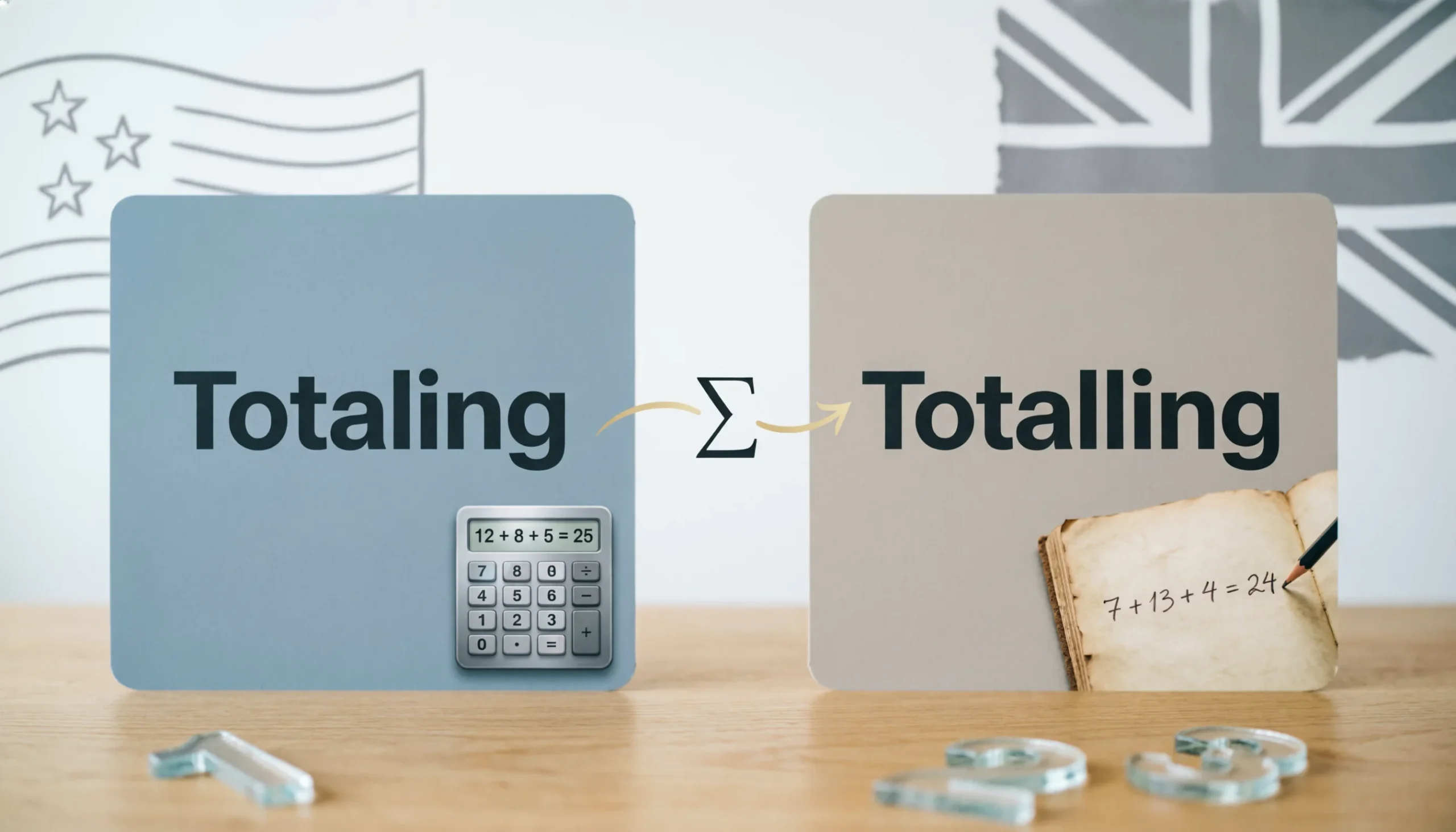
Both totaling and totalling are correct spellings of the present participle and gerund form of “total.” The main difference is regional spelling. Totaling is standard in American English, while totalling is standard in British English and many other varieties that follow British spelling conventions.
If you’re wondering whether to write totaling or totalling, the answer depends mainly on which form of English you are using. Both words come from the verb “total,” meaning to add amounts together and reach a final sum.
American English generally uses totaling, while British English usually uses totalling. This small spelling difference can cause real mistakes in school assignments, business documents, financial reports, websites, and software interfaces when writers switch between regional standards without realizing it. Understanding the spelling rule makes the choice much easier.
Totaling or Totalling: What’s the Difference?
Totaling and totalling are both forms of the verb total. They can function as a present participle or a gerund depending on how they appear in a sentence.
The difference is not meaning. It is primarily a matter of regional spelling convention.
In American English, the preferred spelling is totaling. In British English, totalling is generally preferred.
For example:
“Your expenses are totaling $850.”
This spelling is typical of American English.
“Your expenses are totalling £850.”
This spelling follows British English conventions.
Both sentences communicate the same basic idea.
Mini Recap
Totaling is the usual American English spelling.
Totalling is the usual British English spelling.
Neither form is inherently more correct.
The important thing is to remain consistent with your chosen English variety.
Is Totaling or Totalling a Grammar, Vocabulary, or Usage Issue?
The difference between totaling and totalling is mainly a spelling and usage issue, rather than a difference in grammar or vocabulary.
Both forms represent the same word and perform the same grammatical functions.
Consider these examples:
“The costs are totaling $5,000.”
“The costs are totalling £5,000.”
The grammatical structure is identical. The only noticeable difference is the spelling of the word.
Are They Interchangeable?
In terms of meaning, yes. A reader familiar with either form will normally understand the other.
However, they aren’t always interchangeable when following a specific editorial standard. An American publication may expect totaling, while a British publication may expect totalling.
Formal and Informal Usage
Both forms are appropriate in formal writing. The choice does not depend on whether the writing is formal or informal.
A financial report, academic paper, business email, or casual message can use either form as long as the spelling matches the intended English variety.
Academic and Casual Usage
Academic institutions may follow a particular style guide or national spelling standard. If you’re writing for an American university, totaling is generally the safer choice. If you’re writing for a British institution, totalling is usually preferred.
The same principle applies to professional publications.
When to Use Totaling
Totaling is the preferred spelling in American English.
Use it when your content is written primarily for readers in the United States or follows American spelling conventions.
Workplace Example
“The department’s expenses are totaling approximately $48,000 this quarter.”
Here, totaling describes the amount reached by adding the expenses together.
Academic Example
“The scores from all five tests are totaling 425 points.”
The word describes the combined score.
Technology Example
“The application is totaling the values entered by the user.”
In this example, totaling describes an action performed by software.
Usage Recap
Choose totaling when following American English conventions.
It is especially appropriate for United States based business documents, educational material, websites, reports, and software content.
When to Use Totalling
Totalling is the preferred spelling in British English and is also common in other varieties influenced by British spelling conventions.
Workplace Example
“The invoices are totalling more than £12,000.”
This would be natural in British business writing.
Academic Example
“The examination results are totalling 760 points.”
The word describes the combined result.
Technology Example
“The system is totalling the values entered into each field.”
The meaning is exactly the same as the American spelling.
Usage Recap
Choose totalling when your audience follows British English spelling conventions.
It is commonly suitable for British publications, educational material, government documents, and organizations that use British spelling.
Why Does Total Become Totalling in British English?
The difference comes from a broader spelling convention involving final consonants.
British English often doubles a final consonant when adding a suffix beginning with a vowel, especially in certain verbs.
For example:
“cancel” becomes “cancelling”
“travel” becomes “travelling”
“label” becomes “labelling”
American English often uses a different convention with these words:
“cancel” becomes “canceling”
“travel” becomes “traveling”
“label” becomes “labeling”
The spelling of totaling and totalling fits into this broader regional pattern.
There are exceptions and differences among style guides, so writers should not assume that every word ending in l follows exactly the same rule.
When You Should NOT Use Totaling or Totalling
The biggest mistake is not choosing the “wrong” version. It is choosing a spelling that conflicts with the English standard your audience expects.
Here are common situations where you should reconsider your choice.
1. Do Not Mix Regional Spellings
Avoid using totaling in one paragraph and totalling in another unless you’re intentionally discussing the spelling difference.
Consistency improves professionalism.
2. Do Not Change Spelling Based on Formality
Some writers mistakenly think one form is formal and the other informal.
That isn’t the distinction.
The difference is primarily regional.
3. Do Not Assume British Spelling Is Always More Correct
British English is not inherently more correct than American English.
Both are established varieties of English.
4. Do Not Assume American Spelling Is Universally Preferred
American spelling is not a universal standard either.
Choose the convention appropriate for your audience.
5. Do Not Mix House Styles
Companies, universities, publishers, and government organizations may have specific editorial standards.
Follow the organization’s preferred style.
6. Do Not Change the Meaning
Changing one l to two ls does not change the definition.
The spelling choice should not be treated as a vocabulary distinction.
7. Do Not Use Both Forms for Variety
Writers sometimes change spelling to avoid repetition. That is unnecessary here.
Consistency is better than artificial variation.
Common Mistakes and Decision Rules
Decision Rule
- If you’re writing in American English, use totaling.
- If you’re writing in British English, use totalling.
- If your organization has a style guide, follow that guide.
- If your audience is international, choose one standard and use it consistently.
Totaling or Totalling in Modern Technology and AI Tools
Modern software has made this spelling distinction more visible.
Spreadsheets, accounting platforms, dashboards, data analysis tools, and AI writing systems frequently use the word when describing calculations.
For example:
“The system is totaling the selected values.”
A British interface might instead display:
“The system is totalling the selected values.”
Both descriptions refer to the same computational action.
AI writing tools can also produce either spelling depending on the language setting, training patterns, prompt context, or regional preferences. If you’re preparing content for a specific market, it is worth checking the language setting before publishing automatically generated text.
For websites targeting American users, consistency with American spelling can strengthen editorial quality. For British audiences, British spelling should be maintained throughout the page.
The Etymology of Total
The word total entered English through French and ultimately traces back to Latin totus, meaning “whole” or “entire.”
Over time, the word developed into both a noun and a verb.
As a noun, a total refers to the complete amount.
“The total is $500.”
As a verb, total means to add amounts together or reach a particular combined amount.
“The expenses total $500.”
The forms totaling and totalling developed from this verb according to different English spelling conventions.
An Expert Style Explanation
The spelling difference is regional, not semantic. The safest choice is the one that matches the English variety used consistently throughout the document.
This principle is especially useful for professional writers because consistency matters more than treating one spelling as universally correct.
Two Practical Case Studies
Case Study 1: American Business Report
Imagine an American company preparing a quarterly expense report.
The report contains sentences such as:
“Travel expenses are totaling $18,400.”
“Operating costs are totaling $74,000.”
“Combined expenses are totaling $92,400.”
Using totaling consistently gives the report a coherent American English style.
If the same report repeatedly alternated between totaling and totalling, the financial figures would still be understandable, but the document could appear poorly edited.
Case Study 2: British Academic Assignment
Consider a British university student writing about research expenses.
The student writes:
“The individual costs are totalling £2,750.”
“Additional charges are totalling £430.”
“The final expenditure is totalling £3,180.”
Using totalling maintains consistency with British English.
The practical result is straightforward: the spelling aligns with the expected regional convention and avoids unnecessary editorial corrections.
Error Prevention Checklist
Always Use Totaling When
You are following American English.
- Your publication targets readers in the United States.
- Your company’s style guide uses American spelling.
- Your academic institution follows American English.
- Your software interface is written in American English.
Never Use Totalling When
Your document must strictly follow American spelling conventions.
Your organization explicitly requires American English.
You are editing an American publication that uses one l in this form.
Likewise, do not automatically reject totalling when writing for a British audience. In that context, it may be the preferred spelling.
Related Grammar Confusions You Should Master
Understanding regional spelling can help prevent several other common English mistakes.
Related topics worth learning include:
- Canceling or cancelling
- Traveling or travelling
- Labeling or labelling
- Modeling or modelling
- Signaled or signalled
- Center or centre
- Color or colour
- Organize or organise
- Realize or realise
- Program or programme
These examples demonstrate an important principle: English contains multiple established spelling standards.
Frequently Asked Questions
Is totaling or totalling correct?
Both are correct. Totaling is generally preferred in American English, while totalling is generally preferred in British English and related spelling systems.
Is totaling the American spelling?
Yes. Totaling is the standard American English spelling in most contemporary usage.
Is totalling the British spelling?
Yes. Totalling is the common British English spelling.
Does totaling mean the same as totalling?
Yes. Both words have the same meaning. They describe adding amounts together or reaching a combined total.
Should I use totaling in a US essay?
Yes. If your essay follows American English conventions, totaling is normally the appropriate spelling.
Should I use totalling in a UK essay?
Yes. If your essay follows British English conventions, totalling is generally the preferred spelling.
Why does British English use two ls in totalling?
British spelling commonly doubles the final consonant in certain words when suffixes are added. Totalling follows this convention.
Is totaling or totalling more professional?
Neither is inherently more professional. Professional writing depends on consistency, accuracy, clarity, and adherence to the appropriate style guide.
Can I use totaling and totalling in the same document?
You generally should not. Choose the spelling that matches your English variety and use it consistently throughout the document.
Which spelling should international websites use?
There is no single answer for every website. Choose the regional English standard that matches your primary audience, then apply it consistently across the site.
Conclusion
The choice between totaling or totalling is much simpler once you understand that the difference is regional rather than grammatical.
Use totaling for American English and totalling for British English and other varieties that follow similar spelling conventions. Neither spelling changes the meaning of the word, and neither is universally superior.
The most important rule is consistency. Identify your target audience, follow the appropriate English standard, and use the same spelling throughout your document.
For American readers, choose totaling. For British readers, choose totalling. When in doubt, check the style guide governing your publication, school, workplace, or website.