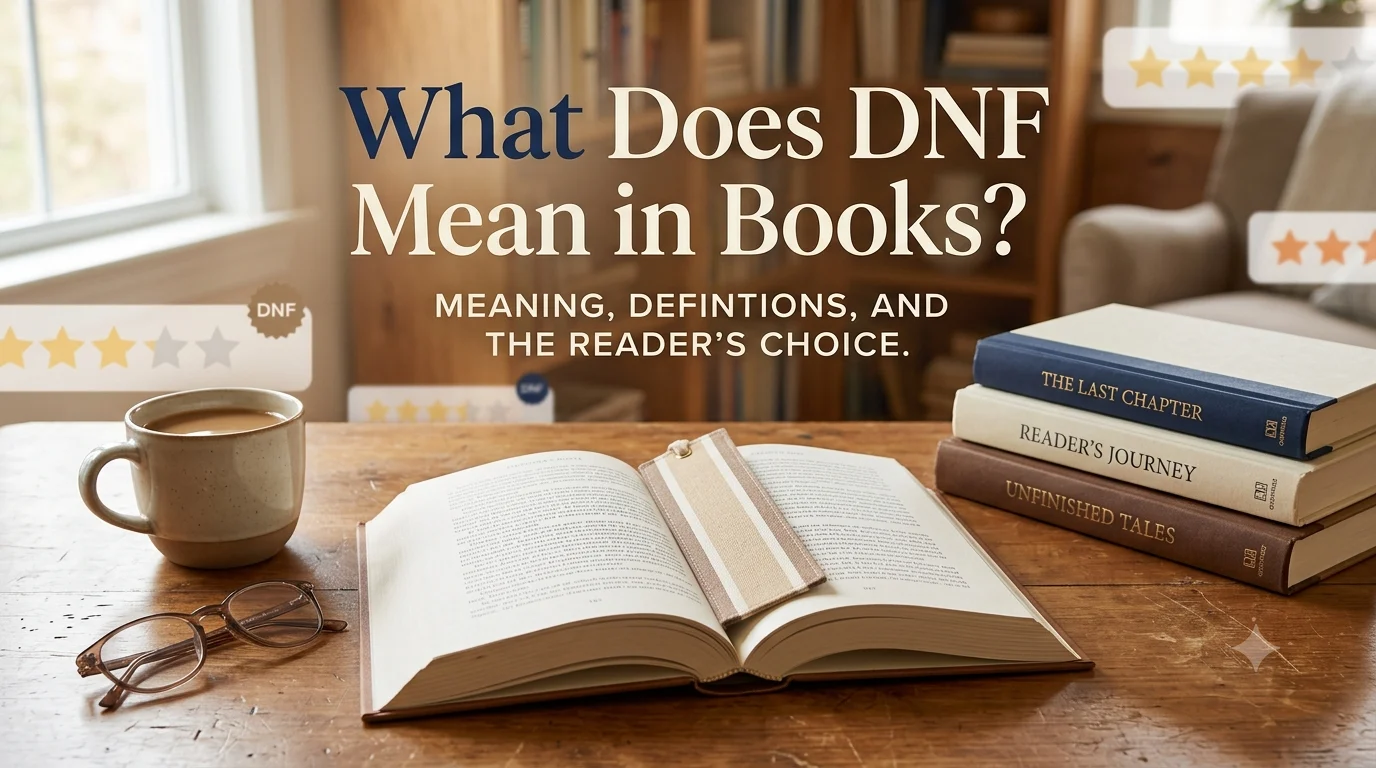
Quick Definition: In the world of books, DNF stands for “Did Not Finish.” Readers use this abbreviation when they stop reading a book before reaching the end, usually because they lost interest, disliked the writing, or simply weren’t enjoying the experience. DNF is widely used on platforms like Goodreads, BookTok, BookTube, StoryGraph, and book clubs.
If you’ve ever seen someone say, “I had to DNF that book,” they mean they did not finish reading it.
Rather than forcing themselves to complete a book they aren’t enjoying, many readers choose to stop and move on to another title. In today’s reading community, DNF has become an accepted and even encouraged practice that promotes reading for enjoyment instead of obligation.
DNF in books means “Did Not Finish.” It describes a book that a reader chose to stop reading before completing. The term is commonly used in book reviews, reading challenges, Goodreads ratings, BookTok videos, and online reading communities.
Examples include:
- “I DNF’d the novel at 35% because the pacing was too slow.”
- “This fantasy book became a DNF for me.”
- “Life’s too short to finish every book DNF and move on! 📚”
Origin
The abbreviation DNF originated long before it became popular in reading communities.
Originally, DNF was widely used in sports and racing, where it stood for “Did Not Finish.” It described participants who started a race but failed to complete it due to injury, equipment problems, or other circumstances.
Over time, online communities borrowed the abbreviation for different hobbies and interests.
Book bloggers, Goodreads reviewers, and online book forums eventually adopted DNF to describe books they stopped reading before the final page.
As platforms like Goodreads, BookTube, Bookstagram, BookTok, and StoryGraph grew in popularity, the term became a standard part of readers’ vocabulary.
Today, DNF is recognized across nearly every online reading community.
Introduction
Every reader has experienced it at least once. You start a book with high expectations, only to find yourself struggling through the first few chapters. Maybe the characters don’t connect with you, the story feels slow, or the writing style simply isn’t your taste.
That’s where the term DNF comes in.
In modern reading culture, DNF has become one of the most recognizable abbreviations among book lovers. Whether you’re scrolling through Goodreads reviews, watching BookTube recommendations, or browsing BookTok videos on TikTok, you’ll likely encounter readers discussing which books they finished and which ones they chose to DNF.
Choosing not to finish a book is no longer considered a failure. Instead, it’s often viewed as a practical way to spend more time reading books you truly enjoy.
In this guide, you’ll learn what DNF means in books, why readers use it, how it became popular, examples of its usage, common misconceptions, and how it compares to other book-related terms.
Popularity
DNF has become one of the most frequently used abbreviations in the book world.
You’ll commonly see it on:
- Goodreads
- StoryGraph
- BookTok (TikTok)
- BookTube (YouTube)
- Bookstagram (Instagram)
- Reddit book communities
- Facebook book clubs
- Reading challenge groups
- Personal reading journals
Why DNF Became Popular
Readers embrace DNF because it encourages:
- Reading for enjoyment
- Honest book reviews
- Better use of reading time
- Personal reading preferences
- Less pressure to finish every book
Many modern readers believe:
“Not every book is for every reader.”
This mindset has made DNF a normal and respected part of reading culture.
How It Is Used
DNF appears in many different reading situations.
Book Reviews
Readers often mention where they stopped reading.
Example:
“DNF at 42%. The pacing wasn’t for me.”
Goodreads Ratings
Some readers leave ratings even if they didn’t finish the book.
Example:
“DNF after Chapter 7.”
Others choose not to rate unfinished books at all.
Reading Challenges
Someone might write:
“My first DNF of the year.”
Meaning they chose not to complete one of their reading challenge books.
Book Recommendations
Readers often warn others.
Example:
“This was a DNF for me, but you might enjoy it if you like slow-burn fantasy.”
Notice the respectful tone.
Personal Reading Logs
Many readers keep track of:
- Books read
- Currently reading
- Want to read
- DNF books
This helps organize reading habits.
Examples
Example Conversation Table
| Conversation | Meaning |
| “I DNF’d it at page 120.” | I stopped reading the book. |
| “That mystery became a DNF.” | I didn’t finish it. |
| “Not bad, just a DNF for me.” | It wasn’t my personal taste. |
| “My only DNF this month.” | The only unfinished book. |
| “I rarely DNF books.” | I usually finish every book. |
Friendly Examples
- “I DNF’d it because I couldn’t connect with the characters.”
- “This wasn’t for me, so it became a DNF.”
- “No shame I DNF books all the time.”
- “I gave it 100 pages before making it a DNF.”
- “Life’s too short to force yourself through every book. 📚”
Professional Examples
Book reviewers and librarians may use DNF in a more neutral tone.
Examples:
- “The reviewer marked the novel as DNF due to pacing issues.”
- “Several reviewers listed the title as a DNF after the midpoint.”
- “The book received mixed reactions, with a noticeable number of DNF reviews.”
Funny Examples
Readers often joke about DNF experiences.
Examples:
- “My bookmark deserved better than this DNF. 😂”
- “Chapter 3 and I mutually agreed to part ways. 📖😆”
- “The plot twist was… me closing the book. DNF!”
- “My TBR pile thanked me for the DNF. 📚”
Comparison with Similar Terms
Many reading abbreviations look similar but have different meanings.
| Term | Meaning | Usage |
| DNF | Did Not Finish | Stopped reading |
| TBR | To Be Read | Books planned for future reading |
| ARC | Advance Reader Copy | Early review copy |
| BOTM | Book of the Month | Monthly featured book |
| HEA | Happily Ever After | Romance ending |
| CR | Currently Reading | Reading now |
| RTC | Review to Come | Review coming later |
DNF vs Skimming
| DNF | Skimming |
| Stop reading entirely | Continue reading quickly |
| No ending reached | Finish the book |
| Common in reviews | Usually not mentioned |
DNF vs Paused Reading
| DNF | Paused |
| No plan to continue | Intend to return later |
| Considered unfinished | Reading temporarily delayed |
Alternate Meanings
Outside the book community, DNF has several different meanings.
| Meaning | Context |
| Did Not Finish | Books |
| Did Not Finish | Sports and racing |
| Do Not Feed | Animal signs |
| Digital Network Function | Technology |
| Distribution Network Framework | Engineering |
| Dungeon Not Found | Gaming (humorous) |
Always use the surrounding context to determine the correct meaning.
Professional or Polite Alternatives
If you don’t want to use the abbreviation DNF, you can say:
- I didn’t finish the book.
- I stopped reading halfway through.
- The book wasn’t the right fit for me.
- I decided not to continue reading.
- It didn’t match my reading preferences.
- I chose to set it aside.
- I couldn’t stay engaged with the story.
- I moved on to another book.
These alternatives sound especially appropriate in formal reviews or academic discussions.
Common Mistakes
Readers sometimes misunderstand DNF.
Mistake 1: Thinking DNF Means the Book Is Bad
Not necessarily.
A DNF often reflects personal taste rather than poor quality.
Mistake 2: Feeling Guilty About DNFing
Many readers feel they must finish every book.
In reality, reading should be enjoyable.
Mistake 3: Rating Every DNF Harshly
Some readers give one-star ratings simply because they didn’t finish.
It’s often more balanced to explain why you stopped instead of assuming the book lacks quality.
Mistake 4: Assuming Everyone Will DNF the Same Book
Reading preferences vary greatly.
A book one reader DNFs may become another reader’s favorite.
Mistake 5: Confusing DNF With Taking a Break
Setting a book aside temporarily isn’t necessarily a DNF unless you’ve decided not to continue.
Quick Tips
- DNF means “Did Not Finish.”
- It’s perfectly acceptable to stop reading a book you’re not enjoying.
- Explain why you DNF a book if you’re writing a review.
- Remember that personal preference isn’t the same as objective quality.
- Respect other readers’ opinions even if they loved a book you DNF’d.
- Keep a DNF shelf on Goodreads or StoryGraph if you like tracking your reading.
- Don’t feel pressured to finish every book.
- Reading should be enjoyable, not a chore.
FAQ
1. What does DNF mean in books?
DNF stands for “Did Not Finish.” It means a reader stopped reading a book before completing it.
2. Is DNF a negative review?
Not always. A DNF simply indicates the reader chose not to finish the book. It doesn’t automatically mean the book is poorly written.
3. Why do readers DNF books?
Common reasons include slow pacing, uninteresting characters, confusing writing, lack of engagement, or simply realizing the book isn’t a good fit for their tastes.
4. Should I rate a book I DNF?
There isn’t a universal rule. Some readers rate DNF books based on the portion they read, while others avoid rating unfinished books and instead explain why they stopped.
5. Is DNF common on Goodreads?
Yes. Many Goodreads users mark books as DNF or mention it in their reviews to explain why they didn’t finish.
6. What’s the difference between DNF and TBR?
DNF refers to a book you started but didn’t finish. TBR (“To Be Read”) refers to books you plan to read in the future.
7. Can a DNF become a finished book later?
Absolutely. Some readers revisit DNF books months or years later and end up finishing or even enjoying them.
8. Is it okay to DNF a book?
Yes. Most reading communities encourage readers to prioritize enjoyment and not feel obligated to finish every book they start.
Conclusion
Understanding what does DNF mean in books helps you navigate today’s reading culture with confidence. In the book community, DNF simply means “Did Not Finish,” indicating that a reader chose to stop reading a book before reaching the end.
Far from being a sign of failure, DNF has become an accepted part of modern reading. It allows readers to spend their time on books that genuinely interest them while acknowledging that not every story will resonate with every person. Whether you’re active on Goodreads, StoryGraph, BookTok, or a local book club, you’ll likely encounter the term often.
Remember that a DNF is a personal reading decision, not a universal judgment on a book’s quality. Reading is a deeply individual experience, and giving yourself permission to set aside a book that isn’t working for you can make your overall reading journey more enjoyable and rewarding.