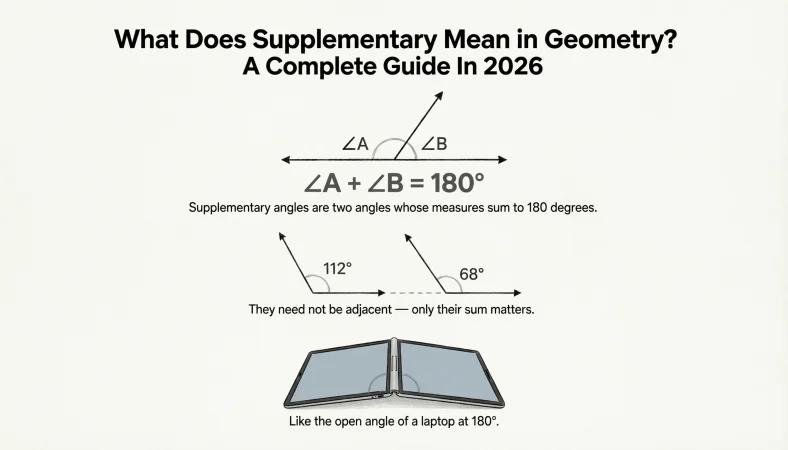
Definition: In geometry, supplementary means that two angles add up to exactly 180°. These angles are called supplementary angles. They may be adjacent (next to each other) or separate, but their combined measure is always 180 degrees. The term supplementary describes the relationship between two angles whose measures total 180°.
Supplementary angles are two angles whose measures add up to 180 degrees. They do not have to be next to each other, but together they always form a straight angle when adjacent.
Formula
Angle A + Angle B = 180°
For example:
| Angle 1 | Angle 2 | Supplementary? |
| 70° | 110° | ✅ Yes |
| 90° | 90° | ✅ Yes |
| 35° | 145° | ✅ Yes |
| 60° | 100° | ❌ No (160°) |
| 45° | 135° | ✅ Yes |
Simply remember:
Supplementary = Sum equals 180°.
Geometry is full of important terms that describe relationships between shapes, lines, and angles. One of the most fundamental concepts students encounter is supplementary angles.
Whether you’re preparing for a school exam, studying for standardized tests, or simply brushing up on your math knowledge, understanding what supplementary means in geometry is essential. The concept appears in middle school, high school geometry, trigonometry, engineering, architecture, and many real-world design applications.
The good news is that supplementary angles are easy to recognize once you know one simple rule:
If two angles add up to 180°, they are supplementary.
This guide explains everything you need to know, including definitions, examples, comparisons, common mistakes, practical tips, FAQs, and real-life applications.
Origin
The word supplementary comes from the Latin word suplementum, meaning something added to complete another thing.
In mathematics, this definition makes perfect sense.
One angle is added to another until the total becomes 180°, completing a straight angle.
The terminology has been used in geometry for centuries and remains a standard mathematical term around the world.
Popularity
Supplementary angles are among the first angle relationships taught in mathematics because they are foundational for many advanced concepts.
They appear in:
- Elementary geometry
- Middle school math
- High school geometry
- Trigonometry
- Coordinate geometry
- Engineering
- Architecture
- Construction
- Computer graphics
- Physics
Students frequently encounter supplementary angles when learning about:
- Parallel lines
- Transversals
- Straight angles
- Linear pairs
- Polygon angle sums
- Proof writing
Because of their importance, supplementary angles are commonly included in standardized exams and competitive mathematics tests.
How It Is Used
The word supplementary is used whenever mathematicians describe two angles whose measures total 180°.
Here are the most common situations.
Linear Pair
When two adjacent angles form a straight line, they are automatically supplementary.
Example:
- Angle A = 130°
- Angle B = 50°
130° + 50° = 180°
These form a linear pair.
Solving Unknown Angles
Suppose one supplementary angle measures 75°.
The other angle is:
180° − 75° = 105°
Parallel Lines
When a transversal crosses parallel lines, several supplementary angle relationships appear.
These relationships help solve unknown angle values quickly.
Polygon Problems
Supplementary angles often appear while calculating interior and exterior angles of polygons.
Real-Life Uses
Supplementary angles appear in:
- Road intersections
- Building construction
- Roof design
- Bridge engineering
- Furniture manufacturing
- Graphic design
- Mechanical engineering
Anywhere straight lines meet, supplementary angles exist.
Examples
Understanding examples is the easiest way to master supplementary angles.
Friendly Examples
Imagine opening a book completely flat.
One side forms a 70° angle.
The other side must be:
180° − 70° = 110°
Together they create a straight line.
Your classroom ruler lies flat on your desk.
A pencil crosses it making a 40° angle.
The angle on the opposite side is:
180° − 40° = 140°
Suppose one angle is 😊 95°.
The supplementary angle is:
85°
Because:
95° + 85° = 180°
Professional Examples
Engineering
An engineer designs two connected beams.
One beam forms a 135° angle.
The connected angle must measure:
45°
Architecture
An architect calculates wall intersections.
One angle measures:
102°
The adjacent supplementary angle equals:
78°
Surveying
Surveyors often calculate supplementary angles when measuring straight property boundaries.
Funny Examples
Imagine a pizza slice leaning dramatically 🍕.
If one side creates a 150° angle, the remaining angle on the straight line is only 30°.
The pizza didn’t change geometry it simply created supplementary angles!
A sleepy student says,
“My angle got tired and needed a supplement.”
Not exactly! 😄
In geometry, supplementary doesn’t mean vitamins it means adding up to 180°.
Comparison with Similar Terms
Many geometry terms sound similar but have different meanings.
| Term | Total Degrees | Description |
| Supplementary Angles | 180° | Two angles whose sum is 180° |
| Complementary Angles | 90° | Two angles whose sum is 90° |
| Vertical Angles | Equal | Opposite angles formed by intersecting lines |
| Adjacent Angles | Any value | Angles sharing a side and vertex |
| Linear Pair | 180° | Adjacent supplementary angles forming a straight line |
| Straight Angle | 180° | A single angle measuring exactly 180° |
Supplementary vs Complementary
| Feature | Supplementary | Complementary |
| Total | 180° | 90° |
| Forms | Straight angle | Right angle |
| Common Formula | A + B = 180° | A + B = 90° |
| Adjacent Required? | No | No |
Easy memory trick:
- Complement = Complete a right angle (90°).
- Supplement = Complete a straight angle (180°).
Alternate Meanings
Outside geometry, supplementary has different meanings.
| Field | Meaning |
| Education | Additional learning material |
| Medicine | Extra nutritional support or supplements |
| Law | Added information to an existing document |
| Sports | Extra regulations or rules |
| Business | Additional documents or reports |
Although the word changes by context, it always carries the general idea of adding something extra to complete or support another thing.
Professional or Polite Alternatives
Unlike slang terms, mathematical terminology is already professional.
Depending on the context, teachers may say:
- Angles totaling 180°
- Angles forming a straight line
- Straight-angle pair
- Supplementary angle pair
- Linear pair (when adjacent)
All are acceptable in textbooks and classrooms.
Common Mistakes
Many students confuse supplementary angles with other geometry concepts.
Mistake 1: Confusing Supplementary with Complementary
Incorrect:
70° and 20° are supplementary.
Correct:
70° + 20° = 90°
These are complementary, not supplementary.
Mistake 2: Thinking Supplementary Angles Must Touch
False.
Supplementary angles do not have to be adjacent.
Example:
30°
150°
Even if drawn separately, they remain supplementary.
Mistake 3: Forgetting the Total
Some students mistakenly add:
80° + 70° = 150°
Since the sum isn’t 180°, they are not supplementary.
Mistake 4: Assuming Every Straight Angle Uses Equal Angles
Not true.
A straight angle can be divided into:
- 5° and 175°
- 40° and 140°
- 1° and 179°
Any pair totaling 180° works.
Mistake 5: Mixing Linear Pairs with All Supplementary Angles
Every linear pair is supplementary.
However, not every supplementary pair forms a linear pair, because supplementary angles don’t have to be adjacent.
Quick Tips
Remember these easy tricks.
- Supplementary angles always total 180°
- Think of a straight line
- Adjacent angles forming a straight line are supplementary
- Separate angles can also be supplementary
- Formula:
- Angle 1 + Angle 2 = 180°
- Unknown angle:
- 180° − known angle
- Linear pairs are always supplementary
- Don’t confuse supplementary (180°) with complementary (90°)
Memory Trick
Think of the number 180 whenever you hear the word supplementary.
A useful phrase is:
“Supplementary makes a straight line.”
FAQ
What does supplementary mean in geometry?
Supplementary means two angles add up to exactly 180 degrees.
Do supplementary angles have to be adjacent?
No.
They may be adjacent or completely separate.
What is an example of supplementary angles?
70° and 110°
Because:
70° + 110° = 180°
Are all linear pairs supplementary?
Yes.
Every linear pair forms a straight line and totals 180°.
Can supplementary angles be equal?
Yes.
90° and 90° are supplementary because together they equal 180°.
What is the difference between supplementary and complementary angles?
Supplementary angles total 180°, while complementary angles total 90°.
How do you find a supplementary angle?
Subtract the known angle from 180°.
Example:
180° − 58° = 122°
Why are supplementary angles important?
They help solve geometry problems involving straight lines, parallel lines, polygons, engineering, construction, architecture, trigonometry, and many real-world measurements.
Conclusion
Understanding what does supplementary mean in geometry is one of the building blocks of learning mathematics. Simply put, supplementary angles are two angles whose measures add up to exactly 180°. Whether they sit side by side as a linear pair or appear separately in a diagram, the defining feature is always the same: their sum equals a straight angle.
This concept is used throughout geometry, algebra, trigonometry, engineering, architecture, and everyday design. By remembering the simple formula Angle 1 + Angle 2 = 180°, you’ll be able to identify supplementary angles quickly, solve unknown angle problems confidently, and avoid common mistakes such as confusing them with complementary angles.
Keep practicing with different angle pairs, use the memory trick “supplementary makes a straight line,” and you’ll master this essential geometry concept in no time.