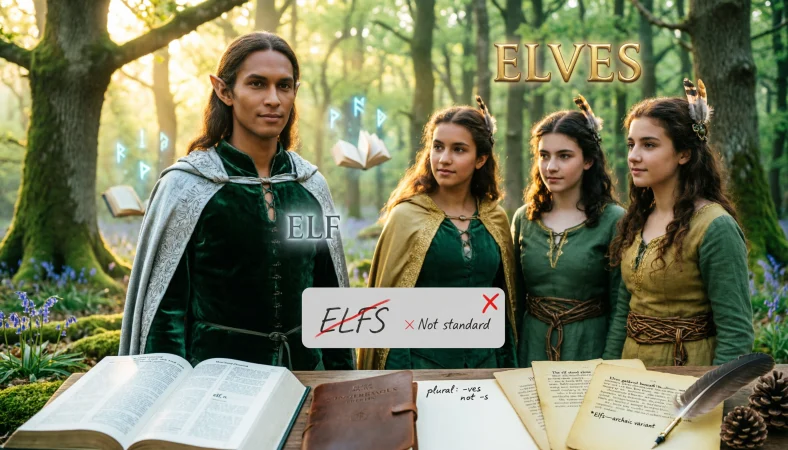
The correct modern plural of elf is elves. The form elfs occasionally appears, but it is generally considered nonstandard in modern edited English. The change from f to v follows a historical plural pattern found in words such as leaf and leaves, shelf and shelves, and wolf and wolves.
The question “elves or elfs” is a common English spelling and grammar question because many English nouns simply take s when they become plural. A writer who knows words such as roof and roofs may naturally assume that elf should become elfs. In standard modern English, however, that isn’t the usual rule.
An elf is a noun referring to a mythical or imaginary being traditionally portrayed in folklore as a magical creature. Modern stories often depict elves as small beings with pointed ears, although their appearance and characteristics vary considerably across cultures and fictional traditions. Cambridge and Oxford both list elves as the plural form of elf.
Elfs is occasionally found in written English, but it is not the accepted standard plural for the mythical creature in ordinary modern usage. Merriam Webster specifically notes that although elfs can occasionally appear in print, elves is the accepted modern plural.
This distinction matters in school assignments, professional writing, fiction, articles, fantasy writing, and Christmas content. Using elfs may make an otherwise polished sentence look like a spelling mistake.
The safest rule is simple: when you mean more than one elf, write elves.
Elves Vs Elfs: What’s The Difference?
The central issue is plural formation.
Elf is a singular countable noun. It refers to one mythical or fictional creature.
Elves is the standard plural form. It refers to two or more elves.
Elfs is an occasional variant found in print, but it is not the standard modern plural expected by major English dictionaries.
| Feature | Elf | Elves | Elfs |
| Part of speech | Noun | Noun | Noun |
| Number | Singular | Plural | Plural form found occasionally |
| Meaning | One mythical or fictional being | More than one elf | Intended as plural of elf |
| Standard modern usage | Yes | Yes | Generally no |
| Dictionary preferred form | Elf | Elves | Not the preferred modern plural |
| Example | An elf entered the forest. | Several elves entered the forest. | Several elfs entered the forest. |
| Recommended for formal writing | Yes | Yes | No |
Quick Recap
Elf is singular.
Elves is the standard plural.
Elfs may occasionally appear, but it is generally not recommended in modern standard English.
For school, professional, academic, and general writing, choose elves.
Is Elves Vs Elfs A Grammar, Vocabulary, Or Usage Issue?
The difference is primarily a grammar and spelling issue involving irregular plural formation.
English has several ways of forming plurals. The most familiar pattern adds s or es:
book becomes books
box becomes boxes
But English also contains older irregular patterns.
For example:
leaf becomes leaves
wolf becomes wolves
shelf becomes shelves
The plural of elf belongs to this historical group.
Are Elves And Elfs Interchangeable?
No, not in standard modern English.
If you are writing:
The elves live in the forest.
you should not normally replace elves with elfs.
The accepted modern plural is elves. Merriam Webster explicitly identifies elves as the accepted modern form and describes elfs as an occasional spelling found in print.
Formal Vs Informal Usage
The difference becomes particularly important in formal writing.
In a casual message, someone might type:
Santa has lots of elfs.
The intended meaning is obvious, but the plural is still nonstandard.
In a professional article, school paper, published story, or educational resource, the preferred sentence is:
Santa has lots of elves.
There is little reason to choose elfs in ordinary modern writing.
Academic Vs Casual Usage
Academic writing should use elves.
For example:
Medieval literature contains numerous references to elves and other supernatural beings.
The same applies to historical writing, literary criticism, folklore studies, and educational material.
Casual writing also normally uses elves. The difference is simply that an informal spelling mistake may be less noticeable or less consequential.
How To Use Elves Correctly
Elves is the standard plural form of elf.
Use it whenever you are referring to more than one elf.
For example:
The elves gathered around the fire.
The children imagined that several elves lived in the woods.
The story features elves, dwarfs, dragons, and humans.
The word appears in many different contexts, including folklore, fantasy literature, Christmas traditions, movies, games, and children’s stories.
Cambridge defines elves simply as the plural of elf, while its dictionary examples show the word being used in fantasy, folklore, and Christmas contexts.
Workplace Example
Imagine a publishing company discussing a children’s Christmas book:
The editor asked the illustrator to make the elves more visually distinct.
This is the correct plural because the sentence refers to multiple fictional characters.
Academic Example
A folklore researcher might write:
Traditional stories portray elves in many different ways.
Here, elves refers to a broad category of supernatural beings across stories and traditions.
Technology Example
Video games frequently feature elves as playable characters or fictional populations.
A game developer might write:
Players can choose between humans, elves, and dwarfs.
Again, elves is the standard plural.
Elves Usage Recap
Use elves for more than one elf.
It works in fantasy, folklore, Christmas, academic, professional, and casual contexts.
It is the standard plural recognized by major dictionaries.
Why Does Elf Become Elves?
This is where the history of English makes the spelling easier to understand.
The plural elves is not an arbitrary modern spelling. It reflects an older pattern in English in which certain nouns ending in an f sound developed a v sound in their plural forms.
Consider:
leaf becomes leaves
wolf becomes wolves
shelf becomes shelves
calf becomes calves
half becomes halves
Elf follows a similar pattern:
elf becomes elves
Merriam Webster explains that the pattern is connected to the way the final voiceless f sound became a voiced v sound in plural forms. It also points out that English has exceptions, including roof and chief.
This is important because you should not treat every noun ending in f as automatically changing to v.
English has exceptions.
For example:
roof becomes roofs
chief becomes chiefs
belief becomes beliefs
So the best approach is to learn the established plural rather than assume that every f ending noun follows exactly the same pattern.
Elves In Folklore And Popular Culture
The word elf has a very long history.
Oxford identifies its origin as Old English and Germanic, with connections to Germanic words associated with supernatural beings. (Oxford Learner’s Dictionaries)
Merriam Webster likewise traces elf to Old English ælf and notes related forms in Old Norse and Middle Low German.
The concept of elves has changed significantly over time.
Older Germanic traditions did not necessarily portray elves as the cheerful Christmas characters familiar to modern audiences. Folklore included ideas of supernatural beings that could be mischievous, dangerous, helpful, or mysterious.
Modern popular culture has developed many different versions.
Fantasy literature may depict elves as tall, elegant, long lived, and magically powerful.
Christmas stories often portray elves as small, cheerful workers helping Santa Claus.
Children’s stories may present elves as playful woodland creatures.
Video games can create entirely fictional elf cultures with their own languages, kingdoms, histories, and abilities.
Despite these differences, the plural remains elves.
When You Should NOT Use Elfs
There are several situations where using elfs is especially likely to be considered an error.
1. Do Not Use Elfs In Academic Writing
Use elves in essays, research papers, dissertations, and literary analysis.
2. Do Not Use Elfs In Professional Publishing
Editors and readers generally expect elves in standard English.
3. Do Not Use Elfs In Christmas Content
Christmas writing almost always uses elves:
Santa’s elves are preparing the gifts.
4. Do Not Use Elfs In Fantasy Writing Without A Specific Reason
If you’re writing a normal fantasy story, elves is the expected plural.
5. Do Not Assume Every F Ending Noun Takes S
English plural formation has historical exceptions.
6. Do Not Change Elves To Elfs Because It Looks Simpler
The spelling elves is established standard usage.
7. Do Not Correct Elves To Elfs
If someone writes elves, they are using the standard plural.
8. Do Not Treat Elfs As The Preferred Modern Form
Major dictionaries identify elves as the standard plural.
Common Mistakes And Decision Rules
| Correct sentence | Incorrect sentence | Explanation |
| The elves entered the village. | The elfs entered the village. | Elves is the standard plural. |
| Santa’s elves are making toys. | Santa’s elfs are making toys. | The established Christmas plural is elves. |
| The novel features several elves. | The novel features several elfs. | Modern standard English uses elves. |
| Three elves appeared in the story. | Three elfs appeared in the story. | Elves is the accepted plural. |
| The game includes elves and humans. | The game includes elfs and humans. | Fantasy writing normally uses elves. |
| The scholar studied legends about elves. | The scholar studied legends about elfs. | Academic writing should use the standard form. |
Decision Rule Box
- If you mean one mythical creature, use elf.
- If you mean more than one, use elves.
- If you are tempted to add s to elf, remember that the standard plural changes f to v.
- Use elfs only when reproducing a historical, unusual, or deliberately nonstandard form where the original spelling matters.
Elves And Elfs In Modern Technology And AI Tools
Modern technology has created many new places where the word elf appears.
Fantasy video games frequently include elves as characters, enemies, races, or fictional civilizations.
Artificial intelligence systems also generate fantasy stories, character descriptions, role playing scenarios, game concepts, and fictional worlds featuring elves.
This makes spelling accuracy particularly important for AI generated content.
An AI system may occasionally produce elfs because it is generating language probabilistically rather than applying a simple dictionary lookup to every word. A human editor should therefore review generated content when accuracy matters.
For example, if an AI generated article says:
The kingdom was inhabited by several elfs.
the sentence should normally be edited to:
The kingdom was inhabited by several elves.
The correction is straightforward.
The technology does not change the grammatical rule.
Authority And Trust: What Dictionaries Say
Major English dictionaries consistently support elves as the plural.
Merriam Webster lists elf with the plural elves and explains that elfs can occasionally occur but is not the accepted modern form.
Cambridge also lists elves as the plural of elf.
Oxford’s Advanced Learner’s Dictionary gives the same plural. (Oxford Learner’s Dictionaries)
This agreement across major reference works makes the decision clear for standard modern English.
An Expert Style Principle
“When an irregular plural is established by long usage and recognized by major dictionaries, writers should use the established form rather than create a regular plural by analogy.”
That principle explains why elves is preferred even though elfs might seem logically possible.
Two Practical Case Studies
Case Study One: The Christmas Writer
Imagine a writer preparing a Christmas article titled:
How Santa’s Elves Help Prepare Christmas
Throughout the article, the writer consistently uses elves.
This immediately signals standard English usage and avoids distracting readers with an unusual plural.
If the article instead repeatedly used elfs, readers might assume the writer had made a spelling mistake.
The practical result of using elves is greater credibility and smoother reading.
Case Study Two: The Fantasy Game Developer
Imagine a game developer writing documentation for a fantasy role playing game.
The game contains three fictional groups: humans, elves, and dwarfs.
The documentation states:
Players can form alliances with several elven kingdoms.
This is grammatically clean because elves is the plural noun and elven is the corresponding adjective.
If the documentation used elfs, the error would appear repeatedly across menus, descriptions, character pages, and promotional material.
The practical result of using the established form is consistency across the entire game’s language system.
Elves Or Elfs Error Prevention Checklist
Always Use Elves When
- You mean more than one elf in standard modern English.
- You are writing an academic paper or formal document.
- You are creating professional or SEO-friendly content.
- You are discussing Christmas elves and holiday traditions.
- You are writing fantasy fiction or describing multiple fantasy characters.
- You are discussing folklore, mythology, or traditional stories.
- You are writing about elves in video games, movies, or books.
- You are creating educational or dictionary-style content.
- You want the standard plural form of elf.
Never Use Elfs When
- You are writing standard modern English and need the conventional plural of elf.
- You are submitting formal academic work.
- You are preparing edited professional or SEO content.
- You are writing a dictionary definition or grammar explanation.
- You are describing multiple fantasy elves or fictional characters.
- You are referring to Santa’s elves or Christmas elves.
- You want to follow standard English spelling and grammar conventions.
Use Elfs Only When
- You are intentionally reproducing a historical, archaic, or unusual spelling.
- You are discussing “elfs” as an example of nonstandard usage.
- A proper name, fictional work, game, book, or other source deliberately uses Elfs.
- You are quoting a source where Elfs appears exactly as written.
- The spelling is part of a specific title, brand, character name, or fictional terminology.
Related Grammar Confusions You Should Master
Understanding elves is useful because it introduces a broader category of irregular English plurals. These related distinctions are worth studying:
- Leaf and leaves
- Wolf and wolves
- Shelf and shelves
- Calf and calves
- Half and halves
- Knife and knives
- Wife and wives
- Life and lives
- Roof and roofs
- Chief and chiefs
These examples show why English plural formation cannot always be reduced to one universal rule.
Some words ending in f change to v.
Some retain f and simply take s.
Learning the established plural of each word is often the safest approach.
FAQs
Is elves or elfs correct?
Elves is the correct standard modern plural of elf. Elfs occasionally appears in written English, but major dictionaries identify elves as the accepted modern form.
What is the plural of elf?
The standard plural of elf is elves.
For example:
One elf
Two elves
Why is the plural of elf elves instead of elfs?
Elf follows an older English plural pattern in which certain words ending in an f sound developed a v sound before the plural ending. Similar examples include leaf and leaves and wolf and wolves.
Is elfs ever correct?
Elfs can occasionally be found in print, but it is generally not the preferred standard plural in modern English. It may appear in historical material, unusual usage, or deliberate nonstandard writing.
Why do elves have a V instead of an F?
The v reflects a historical sound and spelling development in English. Several nouns ending in f developed related plural forms ending in ves, although this pattern has exceptions.
Is elves the plural of elf in British English?
Yes. British English uses elves as the standard plural, just as American English does. Cambridge and Oxford both list elves as the plural.
Is elf a singular or plural word?
Elf is singular.
For example:
An elf lives in the forest.
The plural is:
Several elves live in the forest.
Conclusion
The answer to the elves or elfs question is straightforward: elves is the standard plural of elf.
The singular is:
elf
The standard plural is:
elves
Although elfs occasionally appears in print, it is generally considered nonstandard or unusual in modern edited English. Merriam Webster, Cambridge, and Oxford all support elves as the standard plural.
The reason for the unusual spelling is historical. Elf belongs to a group of English nouns whose plural forms developed a v sound and spelling, much like leaf and leaves, wolf and wolves, and shelf and shelves.
That does not mean every noun ending in f follows the same pattern. English has plenty of exceptions, such as roof and roofs and chief and chiefs.
So when you’re writing about Santa’s helpers, fantasy characters, folklore, video games, or mythical creatures, the safest choice is always elves.
Remember the simple pattern:
One elf, two elves.
Once that form becomes familiar, this common English spelling question becomes much easier to answer.