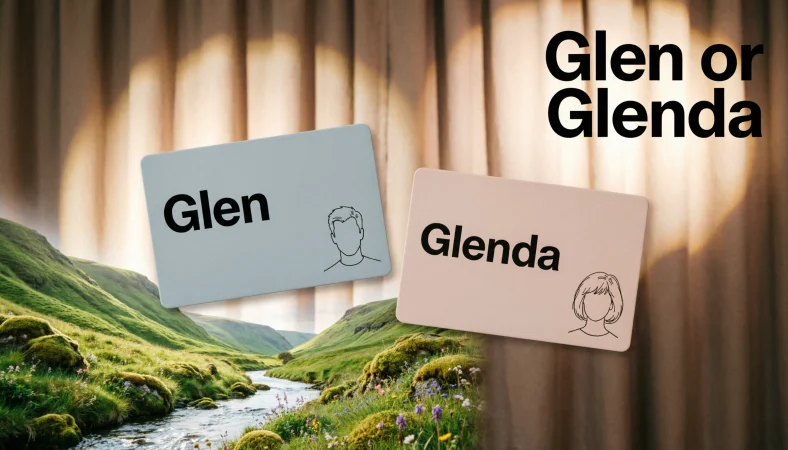
Glen or Glenda refers primarily to two distinct personal names, Glen and Glenda, rather than two interchangeable English words. Glen is traditionally a masculine given name associated with a narrow valley, while Glenda is traditionally a feminine given name. The phrase is also strongly associated with the 1953 film Glen or Glenda, directed by Ed Wood.
The simplest answer is that Glen and Glenda are different given names with different traditional gender associations and histories.
Glen is a proper noun used as a personal name. It is traditionally masculine, although names can be used more flexibly in modern naming practices. The word glen also exists as a common noun meaning a narrow valley, especially one associated with Scotland or Ireland.
Glenda is a proper noun used as a personal name. It is traditionally feminine and is generally understood as a feminine form or development related to names such as Glen or Welsh naming traditions. Unlike glen, Glenda is not normally used as an ordinary English vocabulary word.
| Feature | Glen | Glenda |
| Part of speech | Proper noun when used as a name; common noun in another sense | Proper noun |
| Traditional gender association | Masculine | Feminine |
| Common meaning | A narrow valley when used as a common noun | A feminine personal name |
| Pronunciation | Usually pronounced like “glen” | Usually pronounced “GLEN duh” |
| Capitalization | Capitalized when it is a name | Capitalized |
| Common usage | Personal name and geographic word | Personal name |
| Cultural reference | Common personal name and geographic term | Famous through several cultural references, including Glen or Glenda |
Quick Recap
- Glen and Glenda are names, not alternative spellings of the same word.
- Glen is traditionally masculine, while Glenda is traditionally feminine.
- Glen also has an independent dictionary meaning referring to a narrow valley.
- Glenda is primarily encountered as a personal name.
The phrase Glen or Glenda is especially recognizable because of Ed Wood’s 1953 film.
Is Glen or Glenda a Grammar, Vocabulary, or Usage Issue?
The confusion surrounding Glen and Glenda is mainly a vocabulary and usage issue, rather than a grammar rule.
Grammar determines how words function within sentences. Names such as Glen and Glenda are proper nouns, so the important issue is identifying the person or reference correctly.
For example:
Glen is coming to the meeting.
Glenda is coming to the meeting.
Both sentences are grammatically correct. The difference lies entirely in who is being identified.
The situation becomes slightly more interesting because glen has another meaning. In lowercase form, a glen is a valley.
For example:
We walked through a quiet glen surrounded by hills.
Here, glen is not a person’s name. It is a common noun.
Are Glen and Glenda Interchangeable?
No. In ordinary personal naming, they should not be treated as interchangeable.
Calling someone Glenda when their name is Glen changes their name. Likewise, calling someone Glen when their name is Glenda changes the person’s identity.
Names do not become interchangeable simply because they share similar letters or sounds.
Formal and Informal Usage
In formal writing, use the person’s exact name.
If an individual is named Glen, write Glen. If the individual is named Glenda, write Glenda.
This applies to emails, academic papers, legal documents, business records, biographies, invitations, and professional correspondence.
In casual conversation, people may use nicknames or shortened forms if the person themselves uses them. However, it is better not to assume that Glen is an acceptable shortened form of Glenda, or that Glenda is simply an expanded version of Glen.
Academic Versus Casual Usage
Academic writing requires especially careful identification when discussing people, characters, historical figures, or cultural works.
For example:
Ed Wood directed Glen or Glenda in 1953.
Changing the title to Glen and Glenda would produce a different title and could cause confusion when someone searches for the original film.
In casual conversation, people sometimes remember only part of a name or title. That may be understandable, but formal writing should preserve the established spelling.
How to Use Glen Correctly
Glen has two important uses in English.
The first is as a personal name.
Glen works in the marketing department.
The second is as a common noun referring to a narrow valley.
The hikers stopped beside a peaceful glen.
These two uses are easy to distinguish because capitalization usually provides an important clue.
Workplace Example
Glen will prepare the presentation for Friday.
Here, Glen is a person’s name and must be capitalized.
Academic Example
The researchers examined the geographic characteristics of the glen.
Here, glen is a common noun describing a landscape feature.
Technology Example
Glen sent the updated file through the project management system.
Again, Glen is a personal name.
Technology creates another potential source of confusion because search systems, contact databases, voice assistants, and artificial intelligence tools may occasionally interpret names incorrectly. Providing context can help.
Glen Usage Recap
Use Glen when it is the person’s actual name.
Use lowercase glen when referring to the geographic feature.
Always capitalize Glen when it functions as a personal name.
Do not automatically treat Glen as a shortened form of Glenda.
How to Use Glenda Correctly
Glenda is primarily a personal name. It is traditionally feminine and has been used in English speaking communities for many decades.
When referring to a person named Glenda, capitalize the first letter.
For example:
Glenda joined the conference call at nine o’clock.
The spelling should not be changed to Glen simply because the names are related in appearance.
Workplace Example
Glenda will review the proposal before the client meeting.
The name identifies a specific person, so capitalization is required.
Academic Example
The article examines how Glenda is represented as a character in the narrative.
This sentence uses Glenda as the name of a specific character.
Technology Example
Glenda created an account for the new software platform.
In databases and digital systems, the correct spelling of a person’s name matters because names are often used for identification, account records, search results, and automated communications.
Glenda Usage Recap
Use Glenda when referring to someone whose name is Glenda.
Treat it as a proper noun.
Do not replace it with Glen merely because the names look similar.
Check the established spelling when writing about a person, character, or cultural reference.
When You Should NOT Use Glen or Glenda
There are several situations where choosing the wrong form can create unnecessary confusion.
- Do not use Glen when the person’s established name is Glenda.
- Do not use Glenda when the person’s established name is Glen.
- Do not replace the title Glen or Glenda with a similar sounding phrase when discussing the film.
- Do not assume that Glen and Glenda are interchangeable gender forms in every context.
- Do not capitalize lowercase glen when it refers to a geographical feature.
- Do not lowercase Glen when it is someone’s personal name.
- Do not invent a nickname without knowing whether the person uses it.
- Do not rely entirely on pronunciation when identifying the correct spelling of a name.
These rules are particularly useful in professional and academic contexts where precision matters.
Common Mistakes and Decision Rules
| Correct sentence | Incorrect sentence | Explanation |
| Glen attended the meeting. | Glenda attended the meeting. | Use the person’s actual name. |
| Glenda sent the report. | Glen sent the report. | The names identify different people. |
| We walked through a glen. | We walked through a Glen. | A geographic feature is normally lowercase. |
| Glen lives nearby. | glen lives nearby. | A personal name is capitalized. |
| The film is titled Glen or Glenda. | The film is titled Glen and Glenda. | The established title should be preserved. |
| Glenda is the character’s name. | Glen is the character’s name. | Do not alter a character’s established name. |
Decision Rule Box
- If you are naming a person, use that person’s established name.
- If the person’s name is Glen, write Glen.
- If the person’s name is Glenda, write Glenda.
- If you mean a narrow valley, use lowercase glen.
The key principle is not to choose based on which spelling looks more natural. Choose based on the meaning and the established reference.
Glen and Glenda in Modern Technology and AI Tools
Modern technology has introduced new situations in which names can be misunderstood.
Voice recognition systems may interpret Glen as another word, particularly when there is little surrounding context. Artificial intelligence systems can also confuse similar names when a prompt is short or ambiguous.
For example, a request such as:
Tell me about Glen.
could refer to a person, a fictional character, a geographic feature, or another named entity.
A more specific request is easier to interpret:
Tell me about Glen, the person mentioned in the previous paragraph.
Similarly, when asking about the film, including the year and director can eliminate ambiguity:
What is the 1953 Ed Wood film Glen or Glenda about?
This principle is useful in search engine optimization as well. Search intent becomes clearer when the surrounding content identifies whether the user is asking about names, meanings, pronunciation, or the film.
The Etymology of Glen and Glenda
The history of Glen is particularly interesting because the word has both geographic and naming uses.
The English noun glen comes from Scottish Gaelic and related Celtic language traditions, where it refers to a valley or narrow valley. Because of this geographic association, Glen developed into a personal name as well.
The personal name Glen became established in English speaking communities and is traditionally masculine.
Glenda has a different naming history. It is generally treated as a feminine given name associated with Welsh and English naming traditions, although explanations of its precise origin vary among name references.
This variation is worth noting because personal names often have more complicated histories than ordinary dictionary words. Names can develop through regional traditions, literary usage, family naming practices, and changing cultural preferences.
An Expert Style Perspective on Glen and Glenda
A useful linguistic principle is: A name is identified by its established reference, not simply by its spelling pattern.
That principle explains why Glen and Glenda should be handled carefully. Their similarity does not make them grammatical alternatives. Their meanings depend on the context in which they appear.
Case Study One: The Geographic Meaning of Glen
Consider a sentence describing a landscape:
The travelers rested beside a wooded glen.
The result is clear because glen is lowercase and the sentence describes a physical location.
Now compare it with:
Glen rested beside the river.
The capitalization signals that Glen is a person’s name.
This case demonstrates how capitalization can provide an immediate semantic clue. A single capital letter can change how the reader interprets the word.
Case Study Two: The Film Glen or Glenda
The phrase Glen or Glenda is also the title of a 1953 American film associated with filmmaker Ed Wood.
The title creates a different type of language question because both names are functioning as proper nouns within a fixed cultural title. Replacing one name, changing the conjunction, or altering the spelling can make the reference less accurate.
The practical result is important for researchers, students, writers, and search users: when discussing a named work, preserve its official title rather than reconstructing it from memory.
Error Prevention Checklist
Always use Glen when
- The person’s established name is Glen.
- You are referring to a person named Glen.
- The context identifies Glen as a personal name.
- You are discussing the geographic word glen and need to distinguish it from a person’s name through capitalization.
Never use Glenda when
- The person is actually named Glen.
- You are trying to describe the geographic noun glen.
- You are reproducing a title that specifically uses Glen.
- You are changing a person’s name simply because Glenda seems like a longer version.
Related Grammar Confusions You Should Master
Understanding Glen and Glenda also provides a useful opportunity to explore other English naming and vocabulary distinctions.
- Glen vs Glenna: Similar looking names can have different established spellings.
- Glen vs Glenn: One extra letter can distinguish separate personal names.
- Glenda vs Glenda: Always verify the spelling when working from speech or handwritten information.
- Name vs common noun: A capitalized personal name can look identical to a lowercase dictionary word.
- Proper noun vs common noun: Capitalization often helps distinguish the two categories.
- Affect vs effect: Similar sounding words can have completely different grammatical roles.
- Then vs than: Pronunciation can make these words confusing in informal communication.
- Their vs there: Similar pronunciation does not make words interchangeable.
- Its vs it’s: Apostrophes can change meaning and grammatical function.
- Your vs you’re: Possessive forms and contractions should not be substituted for one another.
The broader lesson is that English accuracy depends on meaning, context, spelling, and grammatical function rather than sound alone.
FAQs
What does Glen mean as a name?
Glen is traditionally a masculine personal name associated with the English noun glen, meaning a narrow valley. The geographic word has Scottish Gaelic and related Celtic roots.
What does Glenda mean as a name?
Glenda is traditionally a feminine personal name. Its history is associated with Welsh and English naming traditions, although explanations of its exact etymology can vary.
Is Glen a male or female name?
Glen has traditionally been used as a masculine name. However, modern naming practices are more flexible, so the gender association of a name does not necessarily determine an individual’s identity.
Is Glenda a feminine version of Glen?
Glenda is commonly treated as a feminine name related in form to Glen, but it should not automatically be assumed to be the feminine version of every person named Glen.
Are Glen and Glenda the same name?
No. Glen and Glenda are distinct personal names. They have related appearances but are not interchangeable when identifying people.
What does the word glen mean?
A glen is a narrow valley, especially a valley associated with Scotland or Ireland. As a common noun, it is normally written in lowercase.
Why is Glen capitalized but glen sometimes lowercase?
Glen is capitalized when it is a personal name because names are proper nouns. The word glen is lowercase when it refers to a geographic feature as a common noun.
What is Glen or Glenda about?
Glen or Glenda is a 1953 film directed by Ed Wood. The film explores gender identity, clothing, social expectations, and related themes through a highly unusual mixture of narrative and documentary style.
How do you pronounce Glen and Glenda?
Glen is generally pronounced with one syllable, while Glenda is generally pronounced with two syllables, approximately “GLEN duh.” Regional accents can produce small differences.
Should I write Glen or Glenda in formal writing?
Use whichever name is correct for the person, character, or reference you are discussing. In formal writing, accuracy is more important than choosing the form that appears more familiar.
Conclusion
The choice between Glen and Glenda is not really a matter of choosing the correct grammar form. They are distinct names with different traditional associations, while lowercase glen is also an English noun for a narrow valley.
Understanding the difference is especially important when writing about real people, fictional characters, geographical features, or the 1953 film Glen or Glenda. The safest rule is simple: identify the intended meaning first, then use the established spelling and capitalization.
If you are referring to a person, use that person’s actual name. If you mean the landscape feature, use glen in lowercase. And if you are discussing the film, preserve its exact title.