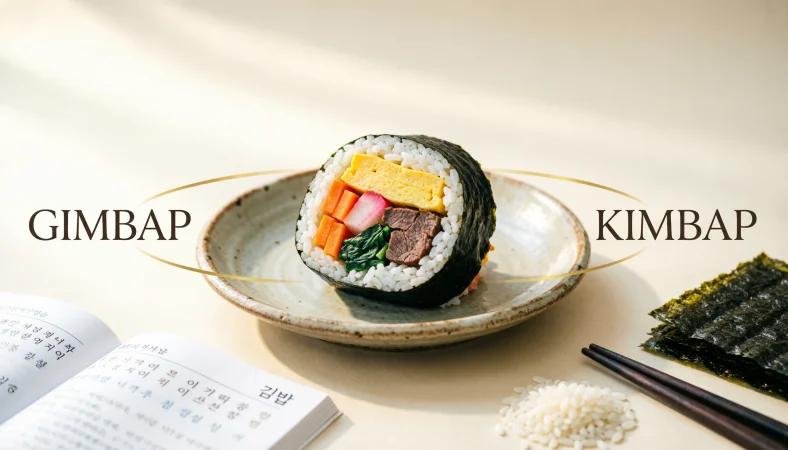
Gimbap or kimbap refers to the same Korean dish, 김밥, made by rolling rice and various fillings in dried laver. The difference is mainly romanization and spelling rather than the food itself. Gimbap is the standard romanized form used by South Korean language authorities, while kimbap remains a widely recognized spelling in English.
If you’ve searched for gimbap or kimbap, you’ve probably noticed that Korean restaurants, food blogs, menus, recipes, and social media posts use both spellings. That naturally raises a simple question: Are gimbap and kimbap different foods, or are they two names for the same Korean dish?
The answer is straightforward. Gimbap and kimbap refer to the same Korean food, 김밥. The difference comes primarily from how the Korean word is represented using the Latin alphabet.
Gimbap is the current standard romanization used by South Korean language authorities. The National Institute of Korean Language identifies Gimbap as the romanized form of 김밥. Korea’s official tourism materials also use Gimbap when presenting the dish to international audiences.
Kimbap, meanwhile, is a long established spelling that remains common in English language usage. It reflects a different way of representing the initial Korean consonant ㄱ. The spelling is familiar to many international readers and appears widely in restaurants, recipes, books, and online discussions.
This distinction matters because people sometimes assume that the spelling difference indicates a difference in ingredients, preparation, or regional style. It doesn’t. You aren’t ordering one dish when you choose gimbap and another when you choose kimbap.
The important distinction is between the Korean word itself and its romanized spelling.
Gimbap vs Kimbap: What’s the Difference?
Gimbap and kimbap are nouns referring to the Korean dish 김밥. The Korean spelling remains the same regardless of which Latin spelling is used.
The word is commonly understood as a combination involving gim, dried laver or seaweed, and bap, rice. The dish typically consists of rice and fillings rolled inside a sheet of dried laver and sliced into individual pieces.
Korea’s official food translation guidance uses Gimbap as the romanized name. The National Institute of Korean Language likewise states that the standard romanization of 김밥 is Gimbap. )
| Feature | Gimbap | Kimbap |
| Korean spelling | 김밥 | 김밥 |
| Meaning | Korean rice roll | Korean rice roll |
| Food itself | Same dish | Same dish |
| Status | Standard romanization | Common alternative spelling |
| Main difference | Romanization | Romanization |
| Korean pronunciation | Same Korean word | Same Korean word |
| Ingredients | No inherent difference | No inherent difference |
| Preparation | No inherent difference | No inherent difference |
| Common in English | Increasingly common | Very common |
| Official Korean romanization | Yes | No |
Quick Recap
Gimbap and kimbap are two spellings for the same Korean dish.
The Korean word is 김밥.
Gimbap is the standard romanized spelling.
Kimbap remains a widely understood English spelling.
The spelling does not indicate a different recipe.
Is Gimbap vs Kimbap a Grammar, Vocabulary, or Usage Issue?
The difference between gimbap and kimbap is primarily a romanization and usage issue, not a grammar issue.
Neither spelling represents a different grammatical form. The Korean word 김밥 stays the same.
What changes is the way Korean sounds and letters are represented in the Latin alphabet.
South Korea’s official Romanization of Korean system is based primarily on standard Korean pronunciation. Under that system, ㄱ can be represented by g or k depending on its position and phonetic environment.
That helps explain why people may encounter different spellings when Korean words are written for international readers.
Are Gimbap and Kimbap Interchangeable?
When referring to the food, they are generally interchangeable in everyday English.
If someone writes, “I ate gimbap,” and another person writes, “I ate kimbap,” they are talking about the same Korean dish.
The main reason to prefer gimbap is standardization. If you’re writing an educational article, preparing a formal menu, creating an official tourism resource, or following South Korean romanization standards, Gimbap is the stronger choice.
Formal vs Informal Usage
Gimbap is generally preferable in formal or authoritative writing because it follows the standard romanization used by Korean language authorities.
Kimbap is perfectly understandable in ordinary English communication.
For example, someone might casually say:
“I ordered kimbap for lunch.”
That sentence is completely understandable.
A Korean language textbook or official tourism publication may instead use:
“I ordered Gimbap for lunch.”
The difference isn’t about grammatical correctness. It’s about spelling conventions and standardization.
Academic vs Casual Usage
Academic writing benefits from consistency.
If you’re writing about Korean linguistics, Korean food culture, Korean history, or Korean language romanization, Gimbap is usually the better choice.
In casual writing, either spelling may be understood.
If your article uses Gimbap in one paragraph and Kimbap in another, however, readers may incorrectly assume that you’re referring to two different dishes. Consistency helps avoid that confusion.
When to Use Gimbap
Use Gimbap when you want the standard romanized form of 김밥.
This is especially appropriate when writing educational material, language resources, food guides, tourism content, or professional material about Korean cuisine.
Workplace Example
Imagine a Korean restaurant is preparing an English menu for international customers.
Using Gimbap creates consistency with official Korean romanization and Korean food translation guidance.
A menu might list:
“Vegetable Gimbap”
“Tuna Gimbap”
“Bulgogi Gimbap”
Korea’s official food translation guidance uses forms such as Tuna Gimbap and Bulgogi and Octopus Gimbap.
Academic Example
A university researcher writing about Korean food culture might introduce the dish as:
“Gimbap, written 김밥 in Korean, is a rice dish rolled in dried laver.”
This approach makes the relationship between the Korean spelling and Romanized spelling clear.
Technology Example
A food delivery application can use Gimbap as its standardized menu spelling while still recognizing searches for Kimbap.
This is particularly useful because users may enter either spelling into a search box.
Usage Recap
Use Gimbap when standardization matters.
It is especially suitable for educational, professional, academic, and official content.
If you’re teaching someone how to romanize Korean, Gimbap is the spelling to prioritize.
When to Use Kimbap
Use kimbap when you’re working within an English language context where that spelling is already familiar to your audience.
Kimbap has become deeply established in international food vocabulary. Many English speakers recognize it immediately, even if they have never studied Korean romanization.
Workplace Example
A food blogger writing for a general English speaking audience may use “kimbap” because readers are familiar with that spelling.
There is nothing inherently misleading about it.
Academic Example
An academic writer may encounter older English language sources that consistently use Kimbap.
If the purpose is to discuss those sources accurately, retaining their original spelling can be appropriate.
The writer can introduce the standard form as well:
“The dish commonly called kimbap is romanized as Gimbap under the current standard.”
Technology Example
Search engines and recipe platforms may contain thousands of pages using Kimbap.
A modern food website can therefore mention both spellings naturally so readers searching either term can find the same recipe or explanation.
Usage Recap
Kimbap is a recognized and widely used English spelling.
It refers to the same dish as Gimbap.
It can be useful when writing for readers who already know the food by that spelling.
What Is Gimbap?
Gimbap is a Korean dish consisting of rice and assorted fillings rolled in dried laver and cut into convenient pieces.
Korea’s official tourism organization describes Gimbap as rice rolled in laver with ingredients that can include pickled radish, egg, fish cake, carrots, spinach, and other fillings. It also notes that modern versions can include ingredients such as kimchi and cheese.
The dish is flexible, which is one reason it has become so popular.
Traditional and contemporary versions can contain different combinations of vegetables, meat, seafood, eggs, tofu, pickled ingredients, or other fillings.
Is Gimbap Sushi?
Gimbap and sushi are different foods, although their rolled appearance can make them look similar.
Gimbap uses Korean culinary traditions and is centered around rice, dried laver, and a wide variety of fillings.
Sushi belongs to Japanese cuisine and has its own history, preparation methods, ingredients, and culinary conventions.
The visual similarity doesn’t mean that one is simply a Korean version of the other.
What Does Kimbap Mean?
Kimbap is simply another commonly used English spelling for the Korean dish 김밥.
The spelling doesn’t describe a separate type of food.
If a restaurant offers Kimbap and another restaurant offers Gimbap, you should not assume one contains different ingredients solely because of the spelling.
Instead, examine the menu description.
One restaurant might serve tuna Gimbap, while another offers vegetable Kimbap. The difference comes from the fillings, not the spelling.
Why Is It Spelled Gimbap Instead of Kimbap?
This is where Korean romanization becomes important.
The Korean word begins with the consonant ㄱ. Under the standard Romanization of Korean system, ㄱ can appear as g or k depending on its position and pronunciation.
The National Institute of Korean Language explains that Korean romanization is based on standard pronunciation and provides specific rules for representing Korean consonants using Latin letters.
For 김밥, the standardized romanization is Gimbap.
This does not mean that people who write Kimbap have invented a different word. It reflects an older or alternative way of representing the Korean sound in English.
The distinction is similar to what happens with many Korean words that have multiple spellings in international English.
When You Should NOT Use Gimbap or Kimbap
There are several mistakes worth avoiding when writing about the dish.
1. Don’t Treat Them as Different Foods
Gimbap and Kimbap are not automatically different recipes.
2. Don’t Claim That Kimbap Is Incorrect English
Kimbap is widely established in English language usage.
3. Don’t Assume Gimbap Refers to One Specific Filling
Gimbap can contain many different fillings.
4. Don’t Treat the Spelling as a Regional Recipe Difference
The spelling alone does not tell you whether the dish is traditional, vegetarian, spicy, or meat based.
5. Don’t Confuse Romanization With Translation
Gimbap is a romanized form of the Korean name, not an English translation such as “rice roll.”
6. Don’t Change Spelling Randomly
Choose one spelling and use it consistently throughout an article or menu.
7. Don’t Tell Readers That Gimbap and Kimbap Have Different Pronunciations
They represent the same Korean word.
8. Don’t Ignore Context
For official Korean language content, Gimbap is the better choice. For casual English content, Kimbap remains widely recognized.
Common Mistakes and Decision Rules
| Correct sentence | Incorrect sentence | Explanation |
| Gimbap is the standard romanized form of 김밥. | Gimbap is a different dish from Kimbap. | Both refer to the same Korean food. |
| Kimbap is a common English spelling. | Kimbap means a different recipe. | The spelling does not determine the recipe. |
| I ordered vegetable Gimbap. | I ordered Gimbap because it is Japanese sushi. | Gimbap is Korean food with its own culinary tradition. |
| Gimbap can contain many different fillings. | Every Gimbap contains the same ingredients. | Recipes vary considerably. |
| Gimbap is the preferred standard spelling in formal Korean language contexts. | Kimbap is never used in English. | Kimbap remains widely used internationally. |
Decision Rule Box
- If you mean the Korean dish 김밥, either Gimbap or Kimbap can identify it in English.
- If you need the standard romanized spelling, use Gimbap.
- If you’re discussing an existing English source that uses Kimbap, preserve that spelling when quoting or describing the source.
- If you’re writing for a general audience, mentioning both spellings can prevent search and terminology confusion.
Gimbap and Kimbap in Modern Technology and AI Tools
Modern technology has made romanization differences more visible.
Search engines, translation software, recipe databases, voice assistants, food delivery services, and AI systems all process Korean words in Latin script.
A person might search for:
“gimbap recipe”
while another searches for:
“kimbap recipe.”
Both searches can refer to the same food.
A well designed search system should understand that relationship.
AI tools also need to distinguish between a romanization variant and a semantic difference. If an AI assistant incorrectly treats Gimbap and Kimbap as two separate dishes, it creates a factual error.
This is why standardized language resources are valuable. The National Institute of Korean Language explicitly identifies Gimbap as the Romanized form of 김밥.
The Etymology of Gimbap
The Korean name 김밥 is commonly analyzed as gim plus bap.
Gim refers to dried edible laver, while bap refers to cooked rice.
Together, the term describes a food centered around rice wrapped in dried laver.
The Korean word itself is written in Hangul as 김밥. Romanization simply provides a way for readers who don’t use Hangul to represent the Korean word using Latin letters.
This is an important distinction.
Gimbap is not an English translation of 김밥. It is a romanized representation of the Korean word.
Official Korean food terminology guidance uses Gimbap rather than translating the name into a generic English phrase.
A Note on Pronunciation
The Korean pronunciation deserves attention because spelling can create misleading expectations for English speakers.
The National Institute of Korean Language records the standard pronunciation of 김밥 as [김ː밥] and [김ː빱], with both pronunciations recognized.
English readers should therefore avoid assuming that the Latin spelling perfectly represents every feature of Korean pronunciation.
Romanization is a practical representation system, not a complete replacement for learning the original Korean pronunciation.
An Expert Style Perspective
A spelling difference does not necessarily indicate a difference in meaning, especially when a Korean word is being represented in Latin letters.
That principle is useful far beyond Gimbap.
Korean has several sounds and writing conventions that don’t map neatly onto English spelling. As a result, historical spellings, standard romanization, personal preferences, and established English usage can coexist.
Two Practical Case Studies
Case Study One: A Korean Restaurant Menu
Imagine a Korean restaurant preparing a menu for international customers.
The restaurant has vegetable rolls, tuna rolls, and beef rolls.
The menu uses:
Vegetable Gimbap
Tuna Gimbap
Bulgogi Gimbap
This follows the standardized spelling used in official Korean food terminology resources.
A customer searching online for “kimbap near me” may still find the restaurant because Kimbap is a widely recognized alternative spelling.
The practical lesson is simple: standardized spelling and search behavior don’t always use exactly the same vocabulary.
Case Study Two: An Educational Food Article
Suppose a writer is publishing an article explaining Korean cuisine to English speaking readers.
Using only Gimbap may be linguistically precise, but some readers may search for Kimbap because that’s the spelling they already know.
The writer can solve this naturally by introducing both forms at the beginning:
“Gimbap, also commonly spelled Kimbap in English, is a Korean rice and filling roll wrapped in dried laver.”
The article can then consistently use Gimbap.
The concrete benefit is greater clarity without treating the two spellings as separate foods.
Author Bio
Author: A professional linguist and SEO content specialist experienced in Korean terminology, English usage, romanization, food vocabulary, and language clarification topics.
Error Prevention Checklist
Always Use Gimbap When
- [ ] You are following standard Korean romanization.
- [ ] You are writing formal educational content.
- [ ] You are preparing academic material about Korean language.
- [ ] You are following official Korean food terminology.
- [ ] You want the spelling used by Korean language authorities.
Never Use Kimbap When
- [ ] You mean a completely different Korean dish.
- [ ] You are claiming that it represents a different recipe.
- [ ] You are presenting it as a separate Korean word from 김밥.
- [ ] You are using it to imply a different ingredient list without evidence.
However, remember that Kimbap is not inherently wrong. It is a widely recognized spelling in English.
Related Korean Language Confusions You Should Master
Understanding Gimbap and Kimbap opens the door to several other useful Korean language distinctions.
1. Kimchi vs Gimchi
Different romanization practices can produce different Latin spellings of Korean words.
2. Bibimbap vs Bibimbab
The final consonant in Korean words can create spelling confusion for English speakers.
3. Bulgogi vs Boolgogi
Established English usage and Korean romanization can produce competing spellings.
4. Tteokbokki vs Topokki
Popular English spellings can differ considerably from standardized forms.
5. Hangul vs Hangeul
Both forms appear in English language discussions of the Korean writing system.
6. Seoul vs Soul
The Korean city name is sometimes humorously or incorrectly represented through English sound associations.
7. Kimchi vs Kimchee
Kimchi is the established modern spelling, while Kimchee appears as an older alternative.
8. Taekwondo vs Tae Kwon Do
English sources have used different spacing and spelling conventions.
9. Korean Romanization vs Translation
Romanization represents Korean words using Latin letters, while translation conveys their meaning in another language.
10. Korean Food Name vs English Description
A Korean dish name can remain in romanized Korean rather than being replaced by a generic English description.
FAQs
Is gimbap the same as kimbap?
Yes. Gimbap and Kimbap refer to the same Korean dish, 김밥. The difference is primarily spelling and romanization rather than ingredients or preparation.
Which is correct, gimbap or kimbap?
Both are recognizable in English, but Gimbap is the standard romanized spelling identified by the National Institute of Korean Language. Kimbap remains a widely used alternative spelling.
Why is it called gimbap instead of kimbap?
The spelling Gimbap follows South Korea’s standard Romanization of Korean system. The initial Korean consonant ㄱ can be represented as g or k depending on its position and pronunciation.
Is kimbap a different type of gimbap?
No. Kimbap is not inherently a different variety of the food. It is a common alternative spelling of 김밥.
What is gimbap made of?
Gimbap commonly contains rice, dried laver, and various fillings such as pickled radish, egg, carrots, spinach, fish cake, meat, or other ingredients. Recipes vary widely.
Is gimbap Korean sushi?
Gimbap is a Korean dish and should not simply be classified as Korean sushi. Although both can involve rice rolled in seaweed, their culinary traditions, preparation, and typical ingredients differ.
How do you spell gimbap in Korean?
Gimbap is written 김밥 in Korean Hangul.
How do you pronounce gimbap?
The Korean word 김밥 has recognized standard pronunciations represented approximately as [김ː밥] and [김ː빱]. English speakers should not assume that the spelling alone perfectly communicates Korean pronunciation.
Final Verdict
The answer to gimbap or kimbap is simple: they refer to the same Korean dish, 김밥.
The main difference is how the Korean word is represented in the Latin alphabet.
Gimbap is the standard romanized spelling used by South Korean language authorities and official Korean food resources. The National Institute of Korean Language explicitly gives Gimbap as the romanized form of 김밥.
Kimbap is a widely recognized alternative spelling in English. It is not the name of a different dish, nor does it automatically indicate different ingredients or preparation.
If you’re writing formal educational, academic, tourism, or language content, Gimbap is generally the best spelling to choose.
If you’re communicating casually or discussing an English source that uses Kimbap, that spelling is still understandable and widely established.
The most useful rule is therefore straightforward: use Gimbap for standardization, recognize Kimbap as a common alternative, and never assume the spelling difference represents two different foods.