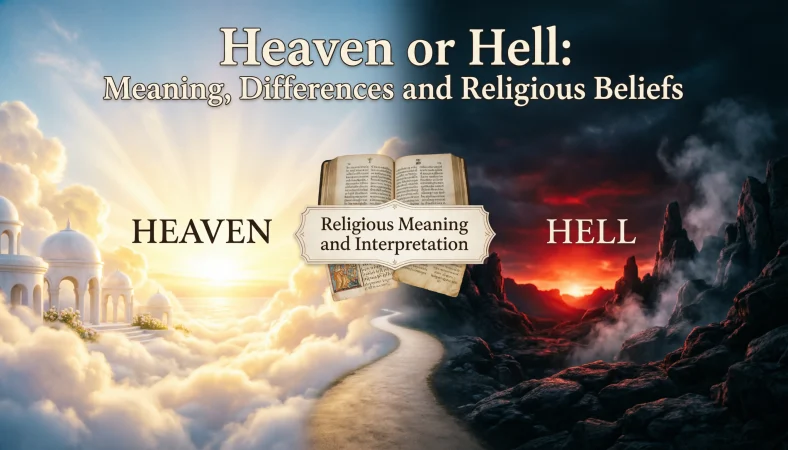
Heaven and hell are terms commonly used to describe contrasting destinations or states associated with the afterlife. In Christian thought, heaven is generally understood as eternal life and communion with God, while hell is associated with judgment and separation from God. Their exact interpretation varies among religious traditions and theological perspectives.
The question of heaven or hell can mean several different things depending on context. Someone may be asking about the religious meaning of the two terms, wondering what different faiths teach about the afterlife, or simply trying to understand how the expressions are used in everyday English.
In the simplest sense, heaven is commonly associated with a divine or blessed realm, the presence of God, eternal life, or the ultimate fulfillment of believers. Hell is commonly associated with divine judgment, punishment, destruction, or separation from God.
These definitions become more complicated when we examine religious texts and traditions. Christianity itself contains several interpretations concerning the nature of heaven, hell, judgment, resurrection, and eternal life. Judaism and Islam also have their own teachings about the afterlife, while other religions understand postmortem existence in very different ways.
The confusion matters because everyday expressions often simplify ideas that are theologically complex. Saying that someone is “going to heaven” can communicate hope, while saying someone is “going to hell” can express judgment, condemnation, anger, or even humor depending on the context.
The terms can also be used metaphorically. A wonderful experience may be described as “heaven,” while an extremely unpleasant experience may be called “hell.”
Understanding the difference therefore requires looking at meaning, religious context, historical development, and everyday usage rather than relying on a single definition.
Heaven vs Hell: What’s the Difference?
Heaven is a noun. In religious contexts, it can refer to the divine realm, God’s dwelling, the state of blessed existence, or the ultimate destiny of the redeemed. In everyday English, it can also describe an ideal or extremely pleasant place.
Hell is also a noun. In religious contexts, it can refer to a realm or condition associated with judgment, punishment, destruction, or separation from God. In ordinary speech, it can describe an extremely difficult or unpleasant experience.
| Feature | Heaven | Hell |
| Part of speech | Noun | Noun |
| Basic religious association | Divine presence and blessedness | Judgment and punishment or separation |
| Common Christian association | Eternal life with God | Final judgment and separation from God |
| Emotional association | Hope, peace, joy | Fear, judgment, suffering |
| Everyday meaning | An ideal or wonderful place | An extremely unpleasant situation |
| Biblical imagery | Kingdom, glory, life, God’s presence | Fire, darkness, judgment, destruction |
| Metaphorical usage | Something exceptionally pleasant | Something exceptionally painful |
| Interpretation | Varies among traditions | Varies among traditions |
Quick Recap
Heaven generally represents blessedness, divine presence, and ultimate hope.
Hell generally represents judgment, punishment, destruction, or separation from God.
Neither term has only one interpretation across every religious tradition.
Both words also have important metaphorical meanings in everyday English.
Is Heaven vs Hell a Grammar, Vocabulary, or Usage Issue?
The difference between heaven and hell is primarily a vocabulary, religious interpretation, and usage issue, not a grammar issue.
Both words are nouns, and their grammatical behavior is relatively straightforward. The difficult part is determining what they mean in a particular context.
Consider these sentences:
“Christians believe in heaven.”
“He described the workplace as hell.”
The first sentence uses heaven in a religious sense. The second uses hell metaphorically.
The words therefore depend heavily on context.
Are Heaven and Hell Interchangeable?
No.
They are traditionally presented as contrasting concepts, particularly in Christian discussions about salvation and judgment.
However, their meanings aren’t always simple opposites. Different theological traditions interpret the nature of both concepts differently.
Some Christians understand heaven primarily as eternal communion with God. Others emphasize resurrection, the renewal of creation, and life with God in a restored creation rather than imagining heaven merely as a place somewhere above the clouds.
Likewise, Christian interpretations of hell include eternal conscious punishment, separation from God, destruction or annihilation, and other understandings.
Formal vs Informal Usage
In formal religious writing, heaven and hell should be used carefully because their theological meanings can be contested.
In informal speech, people frequently use the words figuratively.
For example:
“That vacation was heaven.”
“That traffic was hell.”
Neither sentence necessarily expresses a theological belief.
Academic vs Casual Usage
Academic writing about religion should define terms and identify the tradition being discussed.
Instead of saying, “Everyone believes heaven is a perfect place,” a careful writer might say, “Many Christian traditions understand heaven in terms of eternal communion with God.”
That wording recognizes theological diversity.
Casual conversation usually doesn’t require such precision.
When to Use Heaven
Use heaven when discussing divine reality, eternal blessedness, the afterlife, religious hope, or something metaphorically wonderful.
The word has a long history in English religious vocabulary and appears frequently in Christian writing, worship, literature, and ordinary speech.
Workplace Example
Suppose an employee says:
“This office would be heaven if we had a quiet room.”
Here, heaven is clearly metaphorical. The speaker isn’t making a theological claim. The word emphasizes how pleasant the imagined situation would be.
A manager writing formal workplace material would probably avoid such figurative language if the purpose is precise communication.
Academic Example
A scholar studying Christian theology might write:
“Different Christian traditions have developed different understandings of heaven and resurrection.”
Here, heaven is being used in a formal theological context.
The writer should explain the specific tradition rather than assuming that all Christians hold exactly the same doctrine.
Technology Example
A technology reviewer might write:
“For photographers, this storage system is heaven.”
Again, the word is metaphorical. It communicates enthusiasm rather than a religious proposition.
Usage Recap
Use heaven for religious discussions involving divine presence or blessed existence.
Use it metaphorically for something exceptionally pleasant.
In formal theological writing, define what you mean because interpretations vary.
When to Use Hell
Use hell when discussing religious concepts involving judgment, punishment, destruction, or separation from God, depending on the theological tradition.
The word is also extremely common as an informal metaphor for hardship.
Workplace Example
Someone might say:
“The last week before the deadline was hell.”
The sentence means that the period was extremely stressful or unpleasant.
It does not necessarily indicate a belief about the afterlife.
Academic Example
A religious studies paper might examine how different Christian communities interpret biblical descriptions of hell.
In that context, the writer should distinguish between biblical language, historical theology, and modern interpretation.
Technology Example
A frustrated computer user might say:
“Debugging this program was hell.”
The statement uses hell metaphorically to describe an extremely difficult experience.
It is informal and emotionally strong, so it may not be appropriate in every professional environment.
Usage Recap
Use hell carefully in religious writing because theological interpretations differ.
In everyday English, hell commonly functions as a metaphor for extreme difficulty.
Its emotional intensity makes it more informal than many neutral alternatives.
Heaven and Hell in Christianity
Christianity is the religious context in which the contrast between heaven and hell is especially familiar in English speaking cultures.
The New Testament presents several images and teachings concerning eternal life, judgment, resurrection, the kingdom of God, and final destiny.
One important point is that the popular image of heaven as a place where disembodied souls permanently float in the clouds is a simplification. Christian theology traditionally places substantial emphasis on resurrection and the ultimate renewal of creation.
Likewise, biblical references to hell involve several different terms and images. English Bibles may translate words such as Gehenna, Hades, and Tartarus in different ways depending on the translation and context.
This is why simply searching for one English definition can produce an incomplete picture.
Heaven in Christian Thought
Heaven can refer to God’s realm or dwelling and is closely associated with God’s presence.
Christian teachings about eternal life also emphasize resurrection, restoration, and communion with God.
The Christian hope is therefore broader than merely escaping punishment. It includes reconciliation with God and participation in everlasting life.
Hell in Christian Thought
Hell is associated with divine judgment.
Different Christian traditions disagree about precisely what final punishment involves.
Some teach eternal conscious punishment. Others understand hell as final destruction or annihilation. Others emphasize separation from God.
These differences are significant and should not be ignored when discussing Christian theology.
Heaven and Hell in Other Religious Traditions
Christianity is not the only religion to discuss heavenly or hellish realms.
Islam
Islam contains extensive teachings concerning Paradise and Hell. Paradise, commonly called Jannah, is associated with reward, God’s mercy, and everlasting life. Hell, commonly called Jahannam, is associated with punishment and judgment.
Islamic theology has its own terminology and concepts, so simply equating Islamic teachings with Christian concepts can create inaccuracies.
Judaism
Jewish traditions contain a range of ideas about the afterlife, judgment, resurrection, and the world to come.
The concepts do not map perfectly onto the popular Christian heaven and hell framework.
Different Jewish sources and traditions have developed different understandings of what happens after death.
Other Traditions
Hinduism and Buddhism also contain concepts involving different realms of existence, but these should not automatically be described as identical to Christian heaven and hell.
Religious vocabulary often reflects an entire worldview.
When You Should NOT Use Heaven or Hell
There are several situations where these words should be handled carefully.
1. Don’t Present One Theology as Universal
Not every Christian denomination interprets heaven and hell in exactly the same way.
2. Don’t Treat Metaphorical Language as Theology
When someone says, “This place is heaven,” they may simply mean that it is wonderful.
3. Don’t Treat Every Hell Reference as Literal
People frequently use hell as an emotional expression.
4. Don’t Equate Every Religion’s Afterlife Concepts
Paradise, heaven, reincarnation, judgment, and other concepts have different meanings across traditions.
5. Don’t Use Hell as a Casual Insult in Formal Writing
The word can sound aggressive or disrespectful depending on the audience.
6. Don’t Reduce Heaven to a Physical Location
Religious understandings can involve God’s presence, resurrection, renewed creation, or spiritual reality.
7. Don’t Claim There Is Only One Christian Interpretation of Hell
Historical and contemporary Christian traditions disagree on important details.
8. Don’t Ignore Context
A theological discussion and a casual expression such as “What the hell?” require completely different interpretations.
Common Mistakes and Decision Rules
| Correct sentence | Incorrect sentence | Explanation |
| Many Christians believe in eternal life with God. | All Christians describe heaven in exactly the same way. | Christian traditions differ in theological details. |
| He described the journey as hell. | He literally went to hell because the journey was difficult. | The first sentence is metaphorical. |
| The book discusses Christian teachings about hell. | The book proves exactly what hell looks like. | Religious texts contain imagery that requires interpretation. |
| Heaven can have theological and metaphorical meanings. | Heaven always means the afterlife. | Context determines meaning. |
| The researcher compared different beliefs about the afterlife. | Every religion has the same concept of heaven and hell. | Religious traditions differ substantially. |
Decision Rule Box
- If you mean a religious concept of divine blessedness or eternal life, use heaven.
- If you mean a religious concept associated with judgment or punishment, use hell.
- If you mean an exceptionally pleasant experience, heaven can be metaphorical.
- If you mean an extremely unpleasant experience, hell can be metaphorical.
Heaven and Hell in Modern Technology and AI Tools
Artificial intelligence has made religious information easier to access, but it also creates challenges.
An AI system can quickly summarize teachings about heaven and hell, yet religious terminology often requires historical and denominational context.
For example, an AI generated response may describe hell as eternal conscious punishment without mentioning that other Christian traditions understand final punishment differently.
Likewise, an AI system might describe heaven simply as a place in the sky, overlooking theological concepts involving resurrection, God’s presence, and renewed creation.
Technology can therefore help people explore religious concepts, but it should not replace careful reading of primary religious texts or serious theological scholarship.
When AI tools answer questions about religion, the strongest responses identify the relevant tradition and acknowledge meaningful differences in interpretation.
The Etymology of Heaven and Hell
The word heaven comes from Old English heofon, referring to the sky, heavens, or celestial realm. Over time, it became deeply associated with the divine realm in Christian English.
The word hell comes from Old English hel or helle, referring to an underworld or realm of the dead. Its Germanic linguistic relatives appear in several related languages.
English religious vocabulary developed through interactions among Germanic language traditions, Latin Christianity, Greek biblical texts, and other linguistic influences.
This history helps explain why modern English words can carry several layers of meaning.
A word may have an older physical or mythological sense while also developing a later theological meaning.
An Expert Style Perspective
The safest way to understand religious vocabulary is to separate the word itself from the tradition interpreting it.
This principle is especially useful for heaven and hell.
The words have dictionary meanings, biblical associations, historical meanings, theological interpretations, and everyday metaphorical uses.
Treating all of those meanings as identical can produce an answer that sounds confident while actually being misleading.
Two Practical Case Studies
Case Study One: A Religious Education Article
Imagine a teacher preparing an introductory lesson about Christian beliefs concerning the afterlife.
A weak explanation might say:
“Christians believe good people go to heaven and bad people go to hell.”
That statement is easy to understand but oversimplifies Christian theology.
A stronger lesson would explain salvation, judgment, resurrection, eternal life, and the diversity of Christian interpretations.
The concrete result is better educational accuracy because students learn the basic concepts without being led to believe that every Christian tradition explains them identically.
Case Study Two: Everyday Figurative Language
Imagine a travel writer describing a tropical beach.
The writer says:
“After months of winter, the beach felt like heaven.”
Readers understand this as figurative language.
The writer isn’t necessarily making a theological statement about the afterlife.
Now consider a restaurant review saying:
“Waiting two hours for a table was hell.”
Again, the expression communicates frustration.
The concrete result is that context determines meaning. A literal theological interpretation would completely misunderstand both statements.
Author Bio
Author: A professional language and SEO content specialist experienced in explaining religious vocabulary, linguistic distinctions, cultural terminology, and complex concepts in clear, accessible educational writing.
Error Prevention Checklist
Always Use Heaven When
- [ ] You are discussing a religious concept of divine blessedness.
- [ ] You are describing eternal life or communion with God within an appropriate theological context.
- [ ] You are using the word metaphorically to describe something exceptionally pleasant.
- [ ] You have identified the religious tradition when theological precision matters.
Never Use Hell When
- [ ] You intend to make a neutral statement but the word would sound unnecessarily aggressive.
- [ ] You are presenting one theological interpretation as universally accepted.
- [ ] You are describing another religion’s afterlife without understanding its terminology.
- [ ] You are using the word literally when the original speaker clearly intended a metaphor.
Related Religious and Language Confusions You Should Master
1. Heaven vs Paradise
These terms overlap in some contexts but aren’t universally identical.
2. Hell vs Hades
Hades is a specific term with a complex history and should not automatically be treated as identical to every Christian concept of hell.
3. Gehenna vs Hell
Gehenna has a specific historical and biblical background and is translated differently across contexts.
4. Soul vs Spirit
The two words overlap in ordinary English but have distinct meanings in different theological traditions.
5. Afterlife vs Resurrection
An afterlife generally refers to existence after death, while resurrection involves being raised from death.
6. Sin vs Evil
Sin and evil are related concepts but are not synonyms.
7. Judgment vs Punishment
Judgment refers to evaluation or decision, while punishment refers to a consequence imposed for wrongdoing.
8. Salvation vs Redemption
These concepts are closely connected in Christian theology but aren’t always interchangeable.
9. Faith vs Belief
The words overlap but can carry different theological and philosophical meanings.
10. Eternal Life vs Immortality
Both relate to existence beyond ordinary human life, but theological traditions can distinguish between them.
FAQs
What is the difference between heaven and hell?
Heaven is generally associated with divine presence, blessedness, eternal life, or communion with God, while hell is associated with judgment, punishment, destruction, or separation from God. Exact interpretations vary among religions and Christian traditions.
Do Christians believe everyone goes to heaven or hell?
Christian beliefs differ. Many Christian traditions teach judgment after death and distinguish between salvation and condemnation, but they disagree about the precise nature and timing of judgment, heaven, hell, resurrection, and final destiny.
What does heaven mean in Christianity?
Heaven can refer to God’s realm or presence and is closely connected with Christian hope for eternal life. Christian theology also places significant emphasis on resurrection and the ultimate renewal of creation.
What does hell mean in Christianity?
Hell is broadly associated with divine judgment, but Christian traditions disagree about its nature. Interpretations include eternal conscious punishment, final destruction, separation from God, and other theological understandings.
Is heaven a place or a state?
Different Christian traditions and theological explanations emphasize different aspects. Heaven can be discussed as God’s realm, divine presence, a spiritual reality, or part of the larger Christian hope involving resurrection and renewed creation.
Is hell eternal according to the Bible?
Christian interpretations differ. Some understand biblical passages as teaching eternal conscious punishment, while others interpret final judgment as destruction or annihilation. The answer depends partly on how particular biblical passages and terms are interpreted.
Are heaven and hell mentioned in the Bible?
Related concepts are found throughout the Bible, but English translations use several different terms and images. Words such as heaven, Hades, Gehenna, and descriptions of judgment should be studied in their historical and textual contexts.
Do other religions believe in heaven and hell?
Many religions have concepts involving reward, punishment, heavenly realms, underworlds, or postmortem existence. However, these concepts are not necessarily equivalent to Christian heaven and hell.
Final Verdict
The meaning of heaven or hell depends strongly on context.
In religious discussions, heaven generally represents divine presence, blessedness, eternal life, or communion with God, while hell is associated with judgment, punishment, destruction, or separation from God. The exact meaning varies considerably across religious traditions and theological schools.
In everyday English, the words can take on a completely different role. Heaven can describe something wonderful, while hell can describe something extremely unpleasant.
The most important distinction is therefore not simply between two opposing words. It is between religious meaning, theological interpretation, and everyday usage.
If you’re writing about Christianity, identify the particular theological perspective when the distinction matters. If you’re discussing another religion, use its own terminology rather than assuming that its afterlife concepts perfectly match Christian categories.
And if someone says, “That vacation was heaven,” or “That exam was hell,” remember that the speaker is almost certainly using metaphor rather than making a theological claim.
Understanding these layers makes your writing more accurate, respectful, and useful for readers searching for clear answers about religion and language.