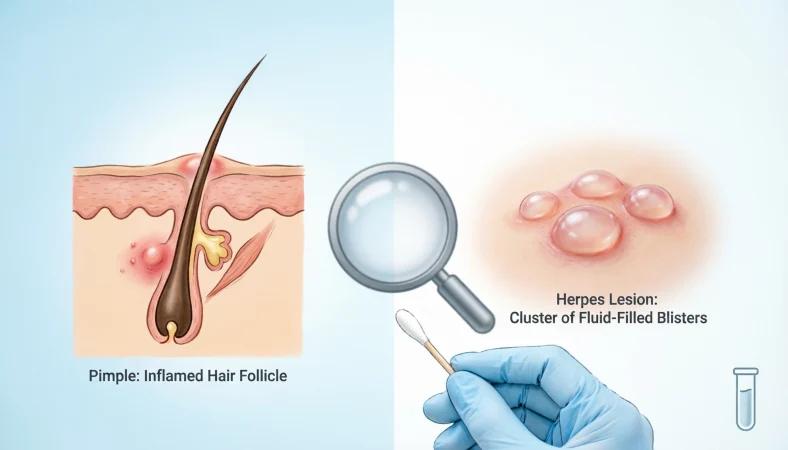
A pimple is usually an inflamed or blocked hair follicle, while herpes is a viral infection that can cause clusters of fluid filled blisters or sores. Unfortunately, appearance alone cannot reliably distinguish them, because herpes can sometimes look like a pimple or ingrown hair. Testing and clinical assessment are the safest ways to know.
Herpes or Pimple: What’s the Difference?
When someone notices a new bump, especially around the genitals, the first question is often whether it is an ordinary spot or something that needs medical attention. The difficulty is that skin conditions can look remarkably similar at first.
A pimple is a common skin lesion associated with blocked pores, excess oil, inflammation, or an infected hair follicle. Pimples can occur almost anywhere that contains hair follicles or oil glands, including the face, chest, back, groin, and buttocks.
Herpes, specifically herpes simplex virus infection, is a viral infection. Genital herpes is usually caused by HSV 1 or HSV 2 and can produce blisters, sores, itching, tingling, burning, or painful urination. However, many people have mild or no symptoms, and herpes lesions can sometimes resemble a pimple or ingrown hair.
| Feature | Pimple | Herpes |
| Cause | Blocked pore, inflammation, or follicle irritation | Herpes simplex virus |
| Typical appearance | Raised spot, sometimes with pus | Small blisters that may break into sores |
| Number | Often one or several unrelated spots | Often appears as a group, although this is not always true |
| Sensation | Tender or sore when touched | May itch, tingle, burn, or hurt |
| Recurrence | Can recur with acne or follicle irritation | Can recur because HSV remains in the body |
| Diagnosis | Usually clinical examination | Clinical assessment and, when appropriate, laboratory testing |
| Contagiousness | Ordinary pimples are not sexually contagious | Herpes can spread through skin contact, including when symptoms aren’t visible |
A single bump does not automatically mean herpes.
Herpes does not always appear as a textbook cluster of blisters.
A pimple can become painful, inflamed, or filled with fluid.
Because appearances overlap, diagnosis should not be based solely on photographs or visual comparison.
Is Herpes or Pimple a Medical Diagnosis or a Visual Comparison?
The phrase “herpes or pimple” describes a symptom identification question, not a formal diagnostic category.
That distinction matters. A person can compare general characteristics, but no article can reliably diagnose an individual lesion without examining it and considering the person’s symptoms and circumstances.
Appearance
A conventional pimple often appears as a raised, inflamed spot. It may contain pus and can be associated with a blocked follicle.
Herpes lesions classically begin as small blisters and can subsequently break open, producing painful sores. Genital herpes may also cause tingling, burning, itching, pain when urinating, or unusual discharge.
Sensation
Pain can occur with either condition, so pain alone isn’t a reliable separator.
Herpes may produce an itching, tingling, burning, or painful sensation before visible lesions develop. Pimples are more commonly tender when pressed or irritated.
Number of Lesions
Several herpes blisters may occur close together, but not every outbreak has a dramatic cluster.
Likewise, several pimples can appear in the same region.
Therefore, the number of bumps can provide a clue, but it cannot establish a diagnosis.
Location
Location can change the possibilities.
A facial lesion around the mouth could represent acne, a cold sore, irritation, or another skin condition. Genital bumps could have numerous causes, including acne, folliculitis, ingrown hairs, cysts, irritation, and sexually transmitted infections.
The NHS specifically advises seeking assessment for symptoms suggestive of genital herpes at a sexual health clinic.
How a Pimple Usually Looks and Feels
Pimples are extremely common and can develop when pores or hair follicles become blocked or inflamed.
A pimple may appear as a red bump, whitehead, blackhead, or pus filled spot. Some are barely noticeable, while deeper inflammatory lesions can be quite painful.
In areas where hair grows, what appears to be a pimple can also be an ingrown hair or folliculitis. This is particularly relevant when evaluating bumps around the pubic region.
The CDC specifically notes that mild genital herpes symptoms may be mistaken for other conditions, including pimples or ingrown hairs.
Workplace Example
Suppose someone notices a small, tender bump after shaving and assumes it is simply a pimple.
If it remains isolated and behaves like an irritated follicle, that may be consistent with a local skin problem. However, the person should avoid assuming the diagnosis if the lesion changes, becomes a blister, develops into an open sore, or is accompanied by other symptoms.
Academic Example
A medical student learning dermatology might compare acne, folliculitis, ingrown hairs, and viral lesions. The important lesson is that morphology provides clues rather than certainty.
Technology Example
A person may upload a photograph to an AI symptom checker and ask whether a lesion is a pimple or herpes. Such tools may provide general information, but an image based prediction cannot replace appropriate clinical assessment or testing.
Usage Recap
A typical pimple is associated with a pore or follicle.
It may be red, raised, tender, or filled with pus.
An isolated bump does not prove that herpes is absent.
How Herpes Usually Looks and Feels
Genital herpes is caused by herpes simplex virus. HSV 1 and HSV 2 can both cause genital infection. Oral herpes commonly causes cold sores around the mouth, although many infections produce no symptoms.
When symptoms occur, genital herpes can produce small blisters around the genitals, anus, thighs, or buttocks. These blisters may break and leave open sores.
The NHS lists tingling, burning, itching, pain when urinating, and unusual discharge among possible symptoms of genital herpes.
The first recognized outbreak can sometimes involve general symptoms such as fever, body aches, or swollen glands. Recurrent outbreaks are generally shorter and less severe than an initial episode.
Importantly, herpes does not always follow the classic textbook pattern.
Some people have no symptoms at all. Others have very mild lesions that resemble ordinary skin problems.
Workplace Example
If an employee notices a potentially infectious lesion, there is no reason to disclose private medical information to colleagues. A person can seek confidential medical advice and follow their clinician’s recommendations.
Academic Example
In a health education context, herpes is best described as a viral infection rather than simply as a type of “rash” or “pimple.”
Technology Example
Digital health services can help people find sexual health clinics and testing resources, but they should not be treated as definitive diagnostic systems based solely on photographs.
Usage Recap
Herpes can cause blisters and sores.
It may cause itching, tingling, burning, or pain.
Some infections produce few or no recognizable symptoms.
A medical assessment is more reliable than visual comparison alone.
When You Should NOT Assume It Is Herpes or a Pimple
There are several situations where guessing based on appearance can be particularly misleading.
- Do not assume every genital bump is herpes.
- Do not assume every genital bump is acne.
- Do not squeeze or pick a lesion simply to determine what is inside it.
- Do not rely on an online photograph to diagnose yourself.
- Do not assume that the absence of obvious blisters rules out herpes.
- Do not assume that a painful lesion must be herpes.
- Do not assume that a lesion is harmless simply because it resembles an ingrown hair.
- Do not delay medical assessment if lesions are recurring, worsening, very painful, or accompanied by other concerning symptoms.
The CDC emphasizes that genital herpes is frequently asymptomatic or mild and may be mistaken for conditions such as pimples or ingrown hairs.
Common Mistakes and Decision Rules
| What you notice | Common assumption | Why that assumption can be wrong |
| One red bump | It must be a pimple | Herpes can sometimes begin with a lesion that resembles a pimple |
| Several bumps | It must be herpes | Acne, folliculitis, and irritation can also produce multiple lesions |
| A painful bump | It must be herpes | Inflamed pimples and ingrown hairs can hurt |
| A blister | It must be herpes | Several other conditions can produce blisters |
| No pain | It cannot be herpes | Herpes can be mild or asymptomatic |
| A genital lesion after shaving | It must be an ingrown hair | Other causes remain possible |
| A recurring lesion | It is just acne | Recurrent lesions deserve appropriate assessment |
Decision Rule Box
If a bump is new, unusual, recurring, blistering, painful, or located around the genitals, do not attempt to make a definitive diagnosis from appearance alone.
If herpes is a realistic possibility, seek medical or sexual health advice and ask whether testing is appropriate.
This is particularly important because herpes testing can involve sampling fluid from a visible blister or sore. The NHS notes that a swab cannot be performed when there is no visible blister or sore.
Herpes or Pimple in Modern Technology and AI Tools
AI image analysis has made online symptom checking increasingly accessible, but accessibility should not be confused with diagnostic certainty.
An image may show useful visual information, but a photograph cannot reliably communicate every relevant clinical detail. A clinician may need information about pain, itching, timing, recurrence, recent sexual contact, shaving, medication, skin conditions, and other symptoms.
The CDC notes that genital herpes can be difficult to diagnose clinically because the classic lesions may be absent when someone is examined. When lesions are present, laboratory confirmation using a sample from the lesion can be appropriate.
This creates an important distinction between information technology and medical diagnosis.
An AI tool can explain what features are commonly associated with herpes.
It cannot guarantee that a particular bump is herpes or a pimple.
Search engines can help someone find a sexual health clinic.
They cannot substitute for an appropriate examination or laboratory test.
Etymology and Medical Background
The word herpes comes from the Greek word herpēs, associated with creeping or spreading lesions. It became part of medical terminology through Latin and later European medical writing.
The word pimple is a much older everyday English term associated with a small skin eruption or swelling.
The two words therefore belong to completely different categories.
Pimple describes a visible type of skin lesion.
Herpes describes an infection caused by herpes simplex viruses.
That distinction is useful because a pimple is a description of what something may look like, whereas herpes identifies an underlying infectious cause.
What Tests Can Tell You Whether It Is Herpes?
When genital herpes is suspected, healthcare professionals may consider the appearance of lesions alongside symptoms and medical history.
If a blister or sore is present, a clinician can take a sample from the lesion for laboratory testing. The CDC identifies nucleic acid amplification testing, including PCR based methods, as highly sensitive for detecting HSV from genital lesions.
Blood tests can also have a role in selected circumstances, although testing decisions depend on symptoms, exposure history, and clinical context. The CDC does not recommend routine herpes screening for the general population without symptoms or other relevant circumstances.
The timing of testing matters as well.
A negative test does not necessarily answer every question about a person’s history, especially if a lesion is old or no longer present. A healthcare professional can explain which test is appropriate.
For people in the UK, the NHS recommends seeking assessment at a sexual health clinic if genital herpes symptoms are present.
Expert Style Guidance
“Appearance can suggest a possibility, but testing and clinical assessment determine the diagnosis.”
That principle is especially important for skin lesions. Many unrelated conditions can produce visually similar bumps, blisters, sores, or areas of inflammation.
A responsible health article should therefore explain recognizable patterns without claiming that a reader can diagnose herpes from appearance alone.
Two Practical Case Studies
Case Study One: A Single Genital Bump
Imagine someone notices one small, tender bump after shaving.
The bump is isolated and initially looks similar to an ordinary pimple or ingrown hair.
The person searches online and becomes concerned about herpes.
The correct response is not to decide based on appearance. Shaving can contribute to follicle irritation, but herpes can also be mistaken for an ingrown hair or pimple. If the lesion changes into a blister or sore, recurs, or is accompanied by other symptoms, professional assessment becomes particularly useful.
The concrete result of avoiding self diagnosis is that the person does not prematurely label themselves with an STI or, conversely, dismiss a potentially important symptom.
Case Study Two: Recurrent Blisters
Consider someone who repeatedly develops painful lesions in a similar genital area. Before the lesions appear, they sometimes notice tingling or burning.
That pattern is more concerning for recurrent herpes than a typical isolated pimple, although a clinician still needs to make the diagnosis.
If a fresh blister or sore is present, obtaining a clinical assessment promptly can improve the opportunity for lesion testing. The NHS notes that treatment for a first episode is most effective when started within five days of symptoms appearing.
The concrete result is better diagnostic information and, when appropriate, earlier treatment.
Author Expertise
This guide is written from the perspective of an experienced health and language content specialist focused on medically responsible educational writing, symptom clarification, search intent, and evidence based communication. It is educational information, not an individual diagnosis.
Error Prevention Checklist
Always remember
- ☑ Herpes can sometimes resemble a pimple or ingrown hair.
- ☑ Pimples can be painful and inflamed.
- ☑ Appearance alone cannot reliably confirm herpes.
- ☑ Genital blisters or sores should be assessed when herpes is a possibility.
- ☑ Testing may be appropriate when symptoms or exposure history warrant it.
Never assume
- ☑ A single bump is automatically herpes.
- ☑ A single bump is automatically a pimple.
- ☑ No visible blister means herpes is impossible.
- ☑ A photograph can provide a definitive diagnosis.
- ☑ A positive or negative internet symptom checker replaces medical testing.
If you have genital blisters or sores, the NHS recommends seeking assessment at a sexual health clinic.
Related Health Questions You Should Understand
The question of herpes versus a pimple often overlaps with several other skin and sexual health topics.
1. Herpes or ingrown hair
Both can produce a tender bump around a hair bearing area, making professional assessment useful when the appearance is uncertain.
2. Herpes or folliculitis
Folliculitis involves inflammation of hair follicles and can produce red or pus filled bumps.
3. Herpes or cyst
Cysts can form lumps beneath the skin and may become painful if inflamed.
4. Cold sore or pimple
Cold sores around the mouth are commonly associated with HSV and can produce small blisters, while pimples are associated with blocked or inflamed pores.
5. Genital herpes symptoms
Possible symptoms include blisters, sores, itching, tingling, burning, and painful urination.
6. STI testing
Many STIs cause no symptoms, which is why testing can be important when there has been a relevant exposure.
7. Herpes testing
Testing may involve a swab from a visible lesion, while blood testing has more limited and situation dependent uses.
8. Genital skin conditions
Not every genital lesion is sexually transmitted. Irritation, folliculitis, cysts, dermatitis, and other conditions can produce bumps or sores.
9. Recurrent skin lesions
A recurring lesion deserves more attention than an isolated, rapidly resolving bump.
10. Sexual health clinic assessment
A sexual health clinic can evaluate genital symptoms and advise whether STI testing is appropriate.
FAQs
What does herpes look like compared with a pimple?
Herpes commonly produces small blisters that can break and form sores, while pimples are usually raised, inflamed spots associated with pores or hair follicles. However, herpes can sometimes resemble a pimple or ingrown hair, so appearance alone cannot establish the diagnosis.
Can herpes look like one pimple?
Yes. Genital herpes can produce mild symptoms that resemble a pimple or ingrown hair. This is one reason visual self diagnosis is unreliable.
How can you tell if a bump is herpes or a pimple?
You cannot reliably tell from appearance alone. Herpes may produce blisters, sores, tingling, burning, itching, or painful urination, while pimples are commonly associated with inflamed pores or follicles. Testing or clinical assessment is the safer way to distinguish causes.
Can a pimple turn into a blister?
An inflamed skin lesion can change appearance, and several skin conditions can produce fluid filled lesions. A blister therefore does not automatically mean herpes. If a genital lesion is unusual or concerning, seek medical advice rather than relying on appearance alone.
Can herpes be painless?
Yes. Many people with genital herpes have no symptoms or only mild symptoms. The absence of significant pain therefore does not rule out infection.
Does herpes always appear in clusters?
No. Although herpes is commonly described as groups of small blisters, real infections can present differently. Some people have very mild or atypical lesions, and others have no recognizable symptoms.
Can an ingrown hair look like herpes?
Yes. An ingrown hair can produce a red or tender bump in a hair bearing area, while genital herpes can sometimes be mistaken for an ingrown hair. The CDC specifically identifies ingrown hairs and pimples among conditions that can be confused with mild genital herpes.
Should I get tested if I have a genital bump?
If the bump is new, unusual, recurring, blistering, painful, or accompanied by other symptoms, medical assessment is sensible. The NHS recommends seeking advice from a sexual health clinic when genital herpes symptoms are present.
Conclusion
When comparing herpes or pimple, the most important point is that appearance alone is not enough to make a reliable diagnosis.
A pimple is generally associated with a blocked or inflamed pore or hair follicle. Herpes is a viral infection that can cause blisters and sores, but it can also produce mild symptoms that resemble pimples or ingrown hairs.
If a bump is around the genitals and you’re uncertain about its cause, particularly if it becomes blistered, painful, recurrent, or accompanied by tingling, burning, unusual discharge, or pain when urinating, seek professional advice.
If a fresh blister or sore is present, testing may be possible using a sample from the lesion.
Most importantly, don’t panic and don’t assume the worst. A genital bump has many possible causes, and herpes is only one of them. At the same time, don’t dismiss a potentially important symptom simply because it resembles a pimple.
The safest answer to “herpes or pimple” is therefore not a visual guess. When the distinction matters, get an appropriate clinical assessment and, when indicated, testing.