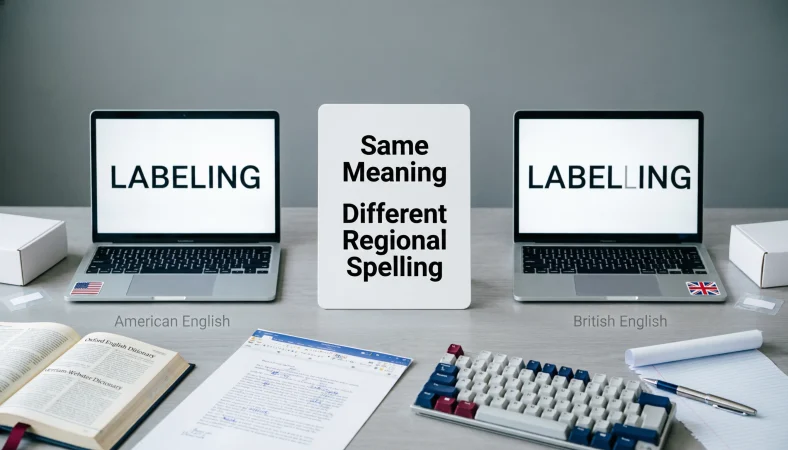
Labeling and labelling are both correct spellings of the same word. The difference is mainly regional: labeling is the standard American English spelling, while labelling is preferred in British English and many other varieties that follow British spelling conventions. The meaning, pronunciation, and grammatical function remain the same.
The question of labeling or labelling is a common spelling problem because both forms appear in reputable dictionaries, books, websites, academic papers, and professional documents. The choice usually depends on which variety of English you are using.
Both spellings come from the verb label, meaning to attach a label to something or to describe or classify something with a particular name, category, or description.
For example:
“Employees are labeling the storage boxes.”
“Employees are labelling the storage boxes.”
The meaning is exactly the same. The only difference is spelling.
American English generally uses labeling, while British English generally uses labelling. The same distinction appears in related words such as labeled and labelled, as well as labeler and labeller.
This small spelling difference matters in practical situations. A student writing for a British university may be expected to follow British spelling. An American business may have a style guide requiring American spelling. A global company might even use different versions depending on the country where content is published.
The confusion becomes especially common because the English spelling system contains several regional differences involving doubled consonants. Understanding the rule behind the difference makes it much easier to choose the appropriate form consistently.
Labeling vs Labelling: What’s the Difference?
Labeling and labelling are both present participles and gerunds of the verb label.
They describe the same action: putting a label on something or identifying something with a particular description.
The principal distinction is regional spelling.
In American English, the preferred form is labeling.
In British English, the preferred form is labelling.
Here is the basic comparison.
Quick Recap
Labeling is generally preferred in American English.
Labelling is generally preferred in British English.
Both forms are grammatically correct.
The difference is spelling rather than meaning or pronunciation.
Is Labeling vs Labelling a Grammar, Vocabulary, or Usage Issue?
This is primarily a spelling and regional usage issue, not a grammar problem.
Both forms represent the same grammatical form of the verb label. Neither spelling changes the action being described.
The important question is which English variety you are following.
Are Labeling and Labelling Interchangeable?
In meaning, yes.
In regional spelling conventions, not always.
An American editor would normally expect:
“The researcher is labeling the samples.”
A British editor would normally expect:
“The researcher is labelling the samples.”
Neither writer is making a grammatical mistake.
The issue is consistency.
If a document uses American English throughout, switching suddenly from labeling to labelling can make the text look inconsistent. The same is true in reverse.
Formal vs Informal Usage
Both forms are acceptable in formal writing when they match the appropriate regional standard.
For example, an American scientific paper may use labeling, while a British scientific paper may use labelling.
Neither version is more formal than the other.
The difference is geographical rather than one of quality.
Academic vs Casual Usage
Academic writers should normally follow the spelling convention required by their institution, publisher, journal, or chosen style guide.
A British university may expect British spelling.
An American university may expect American spelling.
The most important principle is consistency. If you begin an academic paper using one spelling system, don’t switch between regional conventions without a reason.
When to Use Labeling
Use labeling when writing in American English.
This form is standard in the United States and is common in American education, business, technology, government, journalism, and academic writing.
The same spelling pattern appears in other related forms.
For example:
“Researchers are labeling the specimens.”
“The software is labeling each image automatically.”
“The company is labeling its products clearly.”
“She is labeling the folders by department.”
Workplace Example
Imagine an American warehouse manager giving instructions:
“Employees are labeling all packages before shipment.”
Here, labeling follows standard American spelling.
A marketing department might similarly write:
“We are labeling the new product line according to federal requirements.”
The spelling is appropriate for American business communication.
Academic Example
A researcher in the United States might write:
“The participants were responsible for labeling each sample.”
The word describes the process of assigning or attaching identifying information to the samples.
Technology Example
Artificial intelligence systems often perform automated labeling of images, documents, audio files, and other data.
For example:
“The software is labeling images according to their contents.”
In American technical documentation, labeling is the expected spelling.
Usage Recap
Use labeling for American English.
It is appropriate in business, education, science, technology, and everyday writing.
If your audience follows American spelling, this is normally the form to choose.
When to Use Labelling
Use labelling when writing in British English.
This spelling is common in the United Kingdom and in many English varieties influenced by British spelling conventions.
For example:
“The researchers are labelling the samples.”
“The company is labelling its products clearly.”
“The teacher asked students to begin labelling the diagram.”
The additional l reflects the British spelling pattern.
Workplace Example
A British company might write:
“All staff members are responsible for correctly labelling customer files.”
That spelling is entirely standard in British English.
Academic Example
A British academic paper might state:
“Participants were instructed to begin labelling the diagrams.”
Again, labelling follows the regional spelling convention.
Technology Example
A British software manual might say:
“The system automatically labels incoming files.”
If the manual uses British spelling consistently, the corresponding gerund form would normally be labelling.
Usage Recap
Use labelling for British English.
It is also common in other English varieties that follow British spelling conventions.
The extra l does not change the meaning or pronunciation.
Why Does Labeling Have One L in American English?
The spelling difference comes from broader differences in how American and British English handle certain suffixes.
When words ending in a consonant plus l take certain endings, British English often doubles the final l, while American English frequently does not.
This can be seen in several related forms.
British English commonly uses:
“labelled”
“labelling”
American English commonly uses:
“labeled”
“labeling”
The pattern is not unique to the word label.
Compare:
British: travelling
American: traveling
British: cancelled
American: canceled
British: modelling
American: modeling
British: signalling
American: signaling
However, spelling rules can be more complicated than simply saying that British English always doubles the consonant and American English never does. There are exceptions and differences depending on the word and suffix.
That is why it is better to learn labeling and labelling as established regional forms rather than trying to apply one oversimplified rule to every English word.
When You Should NOT Use Labeling or Labelling
There are several situations where choosing between these forms incorrectly can create problems.
1. Don’t Mix Regional Spellings Randomly
If your document uses American English, avoid switching to British spellings without a reason.
2. Don’t Assume Labelling Is Incorrect
The additional l is not a spelling mistake when British English is being used.
3. Don’t Assume Labeling Is Incorrect
The single l is not an error when American English is being used.
4. Don’t Change the Spelling Based on Meaning
The meaning does not determine the spelling.
Regional convention determines it.
5. Don’t Mix Labeled and Labelled Carelessly
If you use labeling, the corresponding past form is normally labeled in American English.
If you use labelling, the corresponding past form is normally labelled in British English.
6. Don’t Ignore a Publisher’s Style Guide
Academic journals and professional publishers may specify a particular variety of English.
7. Don’t Change a Quotation
If you are quoting a source, preserve the original spelling unless your editorial guidelines explicitly require otherwise.
8. Don’t Treat Regional English as Wrong English
American and British spelling conventions are both legitimate forms of standard English.
Common Mistakes and Decision Rules
Decision Rule Box
- If you are writing American English, use labeling.
- If you are writing British English, use labelling.
- If your publisher, employer, university, or client provides a style guide, follow that guide first.
- If you are writing for an international audience, choose one spelling system and use it consistently.
Labeling and Labelling in Modern Technology and AI Tools
The distinction has become particularly relevant in technology because labeling is an important term in data science and artificial intelligence.
In machine learning, data labeling refers to assigning meaningful categories or annotations to data.
For example, an image dataset might contain thousands of photographs that need to be identified as containing cats, dogs, cars, people, or other objects.
The process of assigning those categories is called data labeling in American English and data labelling in British English.
The underlying technical concept does not change.
A British AI research paper might discuss “data labelling for computer vision.”
An American technology company might describe the same process as “data labeling for computer vision.”
AI systems themselves can also assist with automated data annotation and classification.
This makes regional spelling particularly important in technical documentation, software interfaces, research papers, and international product content.
Labeling or Labelling in Academic and Scientific Writing
Researchers frequently encounter this distinction because scientific literature is international.
A journal based in the United States may prefer American spelling.
A journal based in the United Kingdom may follow British spelling.
Authors should never assume that one spelling is universally required.
Instead, check the publication’s instructions for authors.
For example, an American journal might use:
“Automated labeling improved the organization of the dataset.”
A British journal could write:
“Automated labelling improved the organisation of the dataset.”
Notice that the difference may extend beyond one word.
The British sentence also uses organisation, while American English generally uses organization.
This illustrates an important principle: regional spelling is usually a system, not a collection of isolated choices.
Labeling or Labelling in Professional Communication
Businesses should establish a consistent style for internal and external communication.
Imagine a multinational company with offices in New York and London.
The American office may use:
“Product labeling requirements”
The British office may use:
“Product labelling requirements”
Both can be correct within their respective regional contexts.
Problems arise when the same document mixes conventions randomly.
A professional document might contain labeling, labelling, color, and colour in different sections without any editorial reason.
That inconsistency can make the writing appear poorly edited.
For global organizations, a clear style guide can solve this problem.
The Etymology of Labeling and Labelling
The word label entered English through French and ultimately traces back through older European linguistic forms.
Its history is connected with words referring to strips, slips, lists, tags, or written identifying marks.
Over time, the meaning expanded.
A label could be a physical tag attached to an object.
It could identify the contents of a container.
It could identify a person, category, or concept.
The verb label developed from this noun and came to mean attaching a label or assigning a descriptive classification.
The modern forms labeling and labelling are therefore grammatical forms of the same English verb.
Their difference is not a difference in origin or meaning. It reflects later regional spelling conventions.
An Expert Style Perspective
When two spellings represent the same word, the best choice is usually determined by the English variety your readers expect, not by which spelling looks more familiar to you.
This principle is useful far beyond labeling and labelling.
English is a global language with multiple established standards.
American English, British English, Canadian English, Australian English, and other varieties have their own spelling preferences.
A professional writer’s goal is not to eliminate those differences. It is to use them accurately and consistently.
Two Practical Case Studies
Case Study One: American Academic Writing
Imagine an American researcher preparing a paper about artificial intelligence.
The paper repeatedly discusses data labeling.
The author writes:
“Data labeling was performed manually before the model was trained.”
That spelling fits American English.
If the same paper suddenly contains “data labelling” in several sections, readers may interpret the inconsistency as an editing mistake.
The concrete lesson is that consistency matters as much as correctness.
Case Study Two: British Professional Writing
Now consider a British company preparing packaging documentation.
The document states:
“Correct labelling is required before products are shipped.”
That spelling fits British English.
If another section suddenly states “product labeling requirements,” the meaning remains clear, but the style becomes inconsistent.
The practical result is that choosing one regional spelling convention improves editorial quality and makes professional documents look more carefully prepared.
Author Bio
Author: A professional linguist and SEO content specialist focused on English spelling, grammar, regional language differences, commonly confused words, and practical language education.
Error Prevention Checklist
Always Use Labeling When
- You are writing standard American English.
- Your American publisher requires American spelling.
- Your company style guide uses American English.
- Your audience is primarily based in the United States.
- You are using related American forms such as labeled.
Always Use Labelling When
- You are writing standard British English.
- Your British publisher requires British spelling.
- Your organization follows British spelling conventions.
- Your audience expects British English.
- You are consistently using related forms such as labelled.
Related Grammar and Spelling Confusions You Should Master
1. Labeled vs Labelled
These are the past tense and past participle forms corresponding to the same regional distinction.
2. Traveling vs Travelling
American English generally uses traveling, while British English generally uses travelling.
3. Canceled vs Cancelled
American English commonly uses canceled, while British English commonly uses cancelled.
4. Modeling vs Modelling
American English generally uses modeling, while British English generally uses modelling.
5. Signaling vs Signalling
The same regional spelling pattern appears here.
6. Color vs Colour
American English generally uses color, while British English generally uses colour.
7. Center vs Centre
American English generally uses center, while British English generally uses centre.
8. Organization vs Organisation
Both are established spellings, with organization especially common in American English and organisation especially common in British English.
9. License vs Licence
British English commonly distinguishes between the noun licence and the verb license, while American English generally uses license for both.
10. Practice vs Practise
British English commonly uses practice as a noun and practise as a verb, while American English generally uses practice for both.
FAQs
What is the difference between labeling and labelling?
There is no difference in meaning. Labeling is generally the American English spelling, while labelling is generally the British English spelling.
Is labeling or labelling correct?
Both are correct. The appropriate choice depends on the variety of English being used.
Is labeling American or British English?
Labeling is the standard spelling in American English.
Is labelling American or British English?
Labelling is the standard spelling in British English and is also common in other varieties that follow British spelling conventions.
Why does British English use labelling?
British spelling conventions commonly double the final consonant in certain words when suffixes are added. Labelling follows this established spelling pattern.
Why does American English use labeling?
American English generally avoids doubling the final l in this particular formation, producing labeling.
Is labeling a correct spelling?
Yes. Labeling is the standard American English spelling and is widely used in American professional, academic, scientific, and technical writing.
Is labelling a correct spelling?
Yes. Labelling is the standard British English spelling and is widely used in British professional, academic, scientific, and technical writing.
Which is correct for academic writing, labeling or labelling?
Either can be correct. Use the spelling required by your university, journal, publisher, or selected English style guide. Consistency is essential.
Should I use labeling or labelling for SEO?
SEO does not make one spelling universally superior. Choose the spelling that matches your target audience and search intent. If your audience is primarily American, labeling may be more appropriate. If your audience is primarily British, labelling may be preferable.
Final Verdict
The choice between labeling or labelling is straightforward once you identify the English variety you are using.
Labeling is the standard American English spelling.
Labelling is the standard British English spelling.
Both words have the same meaning, grammatical function, and pronunciation. Neither is inherently more correct than the other.
The real issue is consistency.
If you’re writing for an American audience, use labeling, labeled, and other corresponding American forms.
If you’re writing for a British audience, use labelling, labelled, and the corresponding British forms.
For academic, business, scientific, and professional writing, always check the relevant style guide before making your final choice.
The easiest rule to remember is simple: American English generally uses one l, while British English generally uses two l’s in labeling and related forms.
Once you understand that regional distinction, this commonly confused spelling pair becomes much easier to handle accurately.