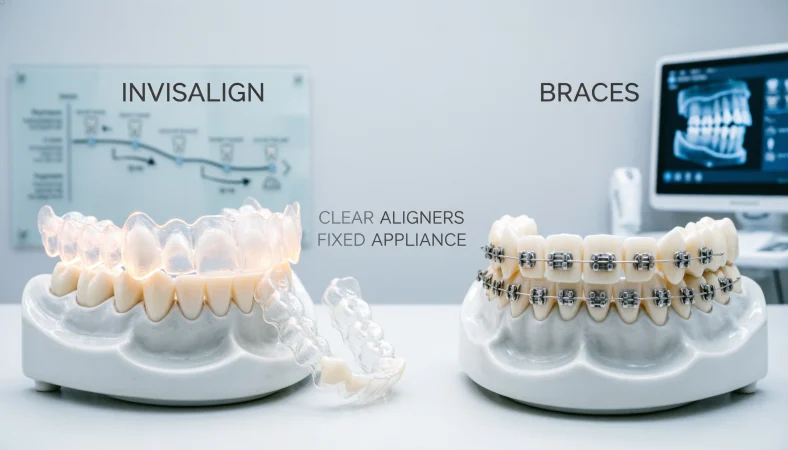
Invisalign and braces are both orthodontic treatments designed to move teeth into healthier and more attractive positions, but they work in different ways. Invisalign uses removable, custom made clear aligners, while braces use fixed brackets and wires. The better option depends on the complexity of the tooth movement, appearance, lifestyle, oral hygiene, and orthodontist’s assessment.
Choosing between invisalign or braces is one of the most common questions people ask when considering orthodontic treatment. Both options can straighten teeth, improve crowding, and correct certain bite problems, but they are not identical treatments.
Invisalign uses a series of transparent aligners that fit over the teeth. Each aligner applies controlled pressure to gradually move teeth. The American Association of Orthodontists explains that clear aligners are custom formed and typically worn for about 22 hours a day, with patients progressing through a sequence of trays.
Traditional braces use brackets attached to the teeth and an orthodontic wire that applies controlled forces. Because braces remain attached throughout treatment, they do not depend on the patient remembering to put them back in.
This difference can have a major practical effect.
Someone who values discretion and can consistently follow an aligner schedule may prefer Invisalign. Someone with more complicated orthodontic needs, or someone who would rather have a fixed appliance managed by an orthodontist, may be better suited to braces.
Research also shows why there isn’t a universal winner. Studies have found that clear aligners can be effective for many mild and moderate cases, while other evidence suggests fixed appliances may produce more predictable results for certain complex movements.
The right choice therefore isn’t simply about which treatment looks better. It is about matching the appliance to the patient’s teeth, bite, treatment goals, and ability to follow the treatment plan.
Invisalign vs Braces: What’s the Difference?
Invisalign is a brand of clear orthodontic aligners. It uses a series of removable, transparent trays designed to move teeth gradually.
Braces are fixed orthodontic appliances that use brackets, wires, and other components to apply controlled forces to teeth.
Both are forms of orthodontic treatment, but their mechanics and practical demands differ.
| Feature | Invisalign | Braces |
| Appliance type | Removable clear aligners | Fixed orthodontic appliance |
| Appearance | Relatively discreet | More visible |
| Removable | Yes | No |
| Eating | Aligners are removed for eating | Food restrictions may apply |
| Cleaning | Trays are removed for brushing | Cleaning around brackets requires extra care |
| Patient responsibility | High | Lower for appliance wear |
| Complex tooth movement | Effective in selected cases | Often highly versatile |
| Adjustments | New aligners are provided | Wires and brackets are adjusted |
| Comfort | Generally smooth plastic surfaces | Brackets and wires can irritate cheeks |
| Best suited to | Selected mild to moderate cases and suitable patients | Broad range of orthodontic problems |
| Appearance during treatment | Clear | Visible, although less visible alternatives exist |
| Main challenge | Consistent wear | Cleaning and appliance maintenance |
Quick Recap
Invisalign is removable and relatively discreet.
Braces are fixed and highly versatile.
Clear aligners depend heavily on patient compliance.
Braces can be particularly useful when complex tooth movement requires precise fixed control.
Neither option is automatically best for every patient.
Is Invisalign vs Braces a Treatment, Technology, or Usage Issue?
Unlike a typical vocabulary comparison, this is a medical and treatment decision rather than a language question.
The terms refer to two different approaches to orthodontic tooth movement.
Invisalign belongs to the clear aligner category. Braces belong to the fixed appliance category.
They are not interchangeable in a technical sense, even though both can be used for the same broad goal of improving tooth alignment.
Are Invisalign and Braces Interchangeable?
Not exactly.
An orthodontist may sometimes treat a particular patient successfully with either approach, but that does not mean the treatments work identically.
Clear aligners are particularly dependent on wearing the trays for the recommended amount of time. The American Association of Orthodontists notes that aligners are typically worn at least 22 hours per day.
Braces remain attached to the teeth, so the patient cannot simply decide not to wear them.
This distinction makes compliance one of the most important practical differences.
Formal vs Informal Usage
In professional dental writing, terms such as clear aligner therapy, fixed orthodontic appliances, malocclusion, and orthodontic treatment are more precise.
Patients commonly use simpler phrases such as “clear braces,” “invisible braces,” or “Invisalign.”
These expressions aren’t always technically equivalent.
For example, Invisalign is not technically a type of traditional brace. It is a branded clear aligner system.
Academic vs Casual Usage
Academic research usually distinguishes between clear aligners and fixed appliances.
A casual conversation may simply ask:
“Which is better, Invisalign or braces?”
That question is perfectly understandable, but an orthodontist needs more information before answering it.
The severity of crowding, type of bite problem, tooth position, periodontal health, treatment objectives, and patient compliance can all influence the decision.
When to Choose Invisalign
Invisalign can be attractive to people who want a discreet treatment option and are comfortable following a structured wearing routine.
The aligners are transparent and removable. This means patients can generally remove them for meals and oral hygiene.
A 2018 systematic review found that Invisalign was a viable alternative to conventional orthodontic treatment for selected non growing patients with mild to moderate malocclusions that did not require extraction. The same review found limitations for some more demanding movements.
Workplace Example
An adult professional who frequently attends meetings may prefer clear aligners because they are less noticeable than traditional metal braces.
This can be especially appealing for people who regularly give presentations, work with clients, or simply feel self conscious about visible orthodontic appliances.
Academic Example
A university student might prefer removable aligners because they can be taken out briefly for important occasions while still following the prescribed treatment schedule.
However, removing aligners too frequently can reduce the effectiveness of treatment.
Technology Example
Digital scanning and computer based treatment planning are important parts of modern clear aligner treatment.
Digital records can help orthodontists visualize tooth positions and plan sequences of movement. However, computer generated treatment simulations should not be interpreted as guarantees of exactly how teeth will move.
Invisalign Usage Recap
Invisalign may be appealing when appearance, removability, and convenience are major priorities.
It requires discipline because the patient must wear the aligners as instructed.
It may not be appropriate for every orthodontic problem.
When to Choose Braces
Braces remain one of the most established approaches to orthodontic treatment.
Traditional braces attach brackets directly to the teeth and use wires to apply controlled forces. Because the appliance remains in place, treatment doesn’t depend on the patient remembering to insert an aligner.
This can be a significant advantage for children, teenagers, or adults who may struggle with consistent aligner wear.
Workplace Example
A professional with a complicated bite problem may choose braces because the orthodontist believes a fixed appliance provides better control for the planned tooth movements.
Appearance remains a consideration, but treatment effectiveness comes first.
Academic Example
A student undergoing orthodontic treatment may benefit from braces when the treatment plan involves complex movements that the orthodontist believes are better handled with fixed appliances.
The exact choice should be based on examination rather than simply age or lifestyle.
Technology Example
Modern braces are not limited to traditional metal designs. Orthodontic technology includes ceramic brackets and other approaches intended to make fixed treatment less noticeable.
Even so, fixed appliances remain different from removable clear aligners because their components stay attached during treatment.
Braces Usage Recap
Braces provide continuous fixed control.
They can be used for a broad range of orthodontic problems.
They require careful brushing and cleaning around brackets and wires.
Invisalign or Braces: Which Works Faster?
Treatment duration varies substantially from one patient to another.
It depends on the amount and type of tooth movement required, the patient’s biology, treatment objectives, compliance, and the orthodontic system being used.
It is therefore misleading to promise that one method will always be faster.
A 2024 systematic review comparing Invisalign with fixed orthodontic appliances found a statistically significant reduction in treatment time favoring Invisalign in its pooled analysis, while also concluding that more research was needed regarding long term stability.
At the same time, other systematic evidence has found no significant difference in treatment duration, demonstrating why treatment speed should not be treated as a universal advantage of one method.
Your individual treatment plan matters much more than an advertised average.
Invisalign or Braces: Which Is More Effective?
Effectiveness depends on what movement needs to be achieved.
Clear aligners can successfully treat many orthodontic problems. However, research does not support the idea that they are equally effective for every possible tooth movement.
A systematic review published in 2020 found low to moderate certainty regarding specific clear aligner movements and reported that clear aligners could produce clinically acceptable results comparable to fixed appliances for certain mild to moderate malocclusions.
More recent evidence continues to show a nuanced picture. A 2024 systematic review found that clear aligners may be an effective alternative to traditional braces, while also noting that further research is needed.
The practical conclusion is important:
The best appliance is the one that can predictably achieve the movements your orthodontist needs to make.
When You Should NOT Use Invisalign or Braces
Neither treatment should be selected solely because it is popular.
1. Don’t Choose Invisalign Only Because It Looks Better
A discreet appliance is valuable, but appearance should not override clinical suitability.
2. Don’t Choose Braces Simply Because They Are Traditional
Being established does not mean they are automatically the best option for every patient.
3. Don’t Assume Severe Problems Can Always Be Treated With Aligners
Clear aligners have limitations for certain complex movements. Reviews have identified reduced effectiveness for some extraction space closure, major anteroposterior discrepancies, vertical problems, and other demanding movements.
4. Don’t Choose Invisalign If You Know You Won’t Wear It
Removable treatment requires consistent patient participation.
5. Don’t Choose Braces Without Considering Oral Hygiene
Fixed brackets create additional areas where plaque and food can accumulate.
6. Don’t Base the Decision on a Social Media Before and After Photo
Individual orthodontic cases differ dramatically.
7. Don’t Assume the Cheapest Treatment Is the Best
Treatment quality, diagnosis, supervision, and long term stability matter more than the initial advertised price.
8. Don’t Treat an Online Simulation as a Diagnosis
Digital visualization can support treatment planning, but it does not replace a clinical examination.
Common Mistakes and Decision Rules
| Correct statement | Incorrect assumption | Explanation |
| Clear aligners can treat many orthodontic cases. | Clear aligners can treat every case. | Some complex movements may be better suited to fixed appliances. |
| Braces remain attached during treatment. | Braces can be removed whenever you want. | Fixed appliances are professionally removed. |
| Aligners require consistent wear. | Wearing aligners occasionally is enough. | Insufficient wear can interfere with treatment. |
| Orthodontists assess suitability before treatment. | Anyone can choose the ideal appliance online. | Diagnosis determines appropriate treatment. |
| Both options can straighten teeth. | Both options work identically. | Their mechanics and capabilities differ. |
| Treatment time varies by patient. | Invisalign is always faster. | Research findings vary and individual cases differ. |
Decision Rule Box
- If appearance and removability are major priorities, ask whether clear aligners are clinically suitable.
- If complex tooth movement or continuous fixed control is important, ask whether braces are more appropriate.
- If you struggle with consistent appliance wear, discuss fixed options with your orthodontist.
- If oral hygiene is a concern, ask how each option will affect your cleaning routine.
Invisalign or Braces: Comfort and Appearance
Comfort is subjective.
Clear aligners generally have smooth surfaces, although patients may experience pressure or temporary discomfort when changing trays.
Braces can cause pressure as teeth move and may sometimes irritate the cheeks or lips, particularly after placement or adjustments.
Neither treatment is completely sensation free.
Appearance is a different matter.
Clear aligners are designed to be relatively discreet. Traditional metal braces are visibly noticeable, although ceramic options can provide a less noticeable fixed alternative.
For many adults, appearance is one of the biggest reasons they investigate clear aligners.
However, the most attractive appliance is not necessarily the most appropriate appliance.
Invisalign or Braces: Oral Hygiene
Oral hygiene is important with either option.
With aligners, patients remove the trays before eating and can brush their teeth without brackets and wires in the way.
With braces, cleaning requires more attention because brackets and wires create additional surfaces around which plaque can accumulate.
A systematic review and meta analysis found potentially better short term oral health measures with aligners compared with fixed appliances in some circumstances, although the certainty of that evidence was low to very low.
This is an important distinction.
Clear aligners may make cleaning easier, but they do not eliminate the need for excellent oral hygiene.
Invisalign or Braces: Cost Considerations
The price of orthodontic treatment varies by country, clinic, case complexity, treatment duration, and the specific appliance used.
There is no reliable universal price that applies to everyone.
Clear aligner treatment can sometimes cost more than basic metal braces, but the relationship varies considerably by provider and case.
Instead of asking only for the appliance price, ask what the total treatment fee includes.
Important questions include whether the price covers diagnostic records, follow up visits, refinements, replacement aligners, retainers, and post treatment monitoring.
A lower initial quote may not represent a lower overall cost if important services are excluded.
Modern Technology and AI Tools in Orthodontics
Digital orthodontics has transformed treatment planning.
Modern clinics can use digital scans, imaging, computer based planning, and software to model possible tooth movement.
Clear aligner treatment relies heavily on digital planning, but fixed orthodontics has also benefited from digital scanning and treatment planning technologies.
Artificial intelligence is increasingly being explored in dentistry for image analysis, diagnosis support, treatment planning, and prediction.
However, technology should be viewed as a clinical aid rather than an independent decision maker.
An AI system can analyze an image, but orthodontic treatment involves biological responses, bone, gums, jaw relationships, tooth roots, and patient behavior.
These factors require professional assessment.
The Etymology and History of Invisalign and Braces
The word orthodontics comes from Greek roots associated with straight or proper and tooth.
The concept of correcting irregular tooth positions is much older than modern orthodontic appliances.
Fixed braces developed through several stages of orthodontic innovation. Modern brackets and wires eventually made controlled tooth movement much more systematic.
Clear aligner therapy emerged later as digital planning, polymer materials, scanning, and manufacturing technologies advanced.
Invisalign became one of the most recognized branded clear aligner systems and helped make removable transparent orthodontic treatment familiar to the general public.
Today, “Invisalign” is often used casually to mean clear aligners in general, although Invisalign is specifically a brand.
An Expert Style Perspective
The strongest orthodontic treatment decision is not the one with the most attractive marketing. It is the one that provides predictable tooth movement for the patient’s specific diagnosis while fitting the patient’s ability to follow treatment instructions.
This principle explains why orthodontists do not recommend the same appliance to every patient.
Aesthetic preference matters.
Convenience matters.
Cost matters.
But clinical suitability comes first.
Two Evidence Based Case Studies
Case Study One: Mild to Moderate Crowding
Consider a non growing adult with mild to moderate crowding who does not require extraction and has an otherwise suitable orthodontic profile.
A systematic review found substantial consistency that Invisalign can be a viable alternative to conventional orthodontic treatment in selected mild to moderate non extraction cases.
The concrete result from the evidence is not that Invisalign is universally superior. Rather, it demonstrates that clear aligners can be a clinically reasonable treatment option for appropriately selected patients.
Case Study Two: Comparing Treatment Outcomes
A 2024 systematic review included 10 studies comparing Invisalign with fixed orthodontic appliances. Its pooled analysis found a statistically significant reduction in treatment time favoring Invisalign, while the overall analysis suggested similar efficacy for tooth movement. The authors also emphasized the need for additional research into long term stability.
This provides a useful real world lesson.
A study result can support clear aligners as a legitimate treatment option without proving that every patient will finish faster or receive the same outcome.
Clinical evidence should inform the decision, not replace individualized diagnosis.
Author Bio
Author: A professional health and SEO content specialist focused on translating complex dental and orthodontic information into accurate, accessible educational content while prioritizing evidence based explanations and responsible health communication.
Error Prevention Checklist
Always Consider Invisalign When
[ ] You strongly value a discreet orthodontic appearance.
[ ] You can reliably wear removable aligners as instructed.
[ ] Your orthodontist confirms that your case is suitable.
[ ] You prefer removable appliances for eating and oral hygiene.
[ ] You understand that refinements may sometimes be required.
Never Choose Braces or Invisalign Without Considering
- [ ] The complexity of your bite.
- [ ] The amount and type of tooth movement required.
- [ ] Your ability to follow treatment instructions.
- [ ] Your oral hygiene routine.
- [ ] Your periodontal health.
- [ ] The treatment plan and expected retention requirements.
Related Orthodontic Topics You Should Understand
1. Clear Aligners vs Braces
Understanding the broader category helps explain why Invisalign is a clear aligner rather than a conventional fixed brace.
2. Ceramic Braces vs Metal Braces
Ceramic brackets provide another fixed option for people concerned about appearance.
3. Invisalign Treatment Time
Treatment duration depends on the patient’s specific orthodontic needs and compliance.
4. Orthodontic Retainers
Retainers help maintain tooth position after active orthodontic treatment.
5. Invisalign Attachments
Small tooth colored attachments may be used to help aligners produce specific movements.
6. Overbite Treatment
Different types of overbite can require different orthodontic strategies.
7. Crowded Teeth Treatment
Mild crowding may be suitable for aligners, while more complicated crowding requires individualized planning.
8. Orthodontic Malocclusion
Malocclusion refers to an abnormal relationship between the teeth or jaws.
9. Clear Aligner Compliance
Consistent wear is one of the most important patient responsibilities during aligner treatment.
10. Orthodontic Treatment Planning
Diagnosis and treatment planning determine whether aligners, braces, or another approach is most appropriate.
FAQs
Is Invisalign better than braces?
Not universally. Invisalign can be an excellent option for selected patients, particularly when discretion and removability are important. Braces may provide advantages for certain complex movements. The appropriate choice depends on diagnosis and treatment goals.
Is Invisalign faster than braces?
Sometimes, but not always. Research findings vary. A recent systematic review found a statistically significant reduction in treatment time favoring Invisalign, while other evidence has found no significant difference in treatment duration.
Is Invisalign more comfortable than braces?
Many patients find clear aligners comfortable because they have smooth surfaces, but both treatments can cause temporary pressure or soreness as teeth move. Individual experiences vary.
Which is better for severe orthodontic problems?
Fixed braces may be preferred for some complex orthodontic problems because they provide continuous control over tooth movement. Clear aligners can treat many conditions, but systematic reviews have identified limitations for certain complex movements.
Is Invisalign good for crowded teeth?
It can be effective for appropriately selected cases of crowding. The severity and type of crowding matter, so an orthodontic examination is necessary before deciding whether aligners are appropriate.
Are braces more effective than Invisalign?
Neither is universally more effective. Evidence suggests that clear aligners can produce acceptable results in many selected cases, while fixed appliances may offer advantages for particular movements and complex cases.
Which is easier to clean, Invisalign or braces?
Clear aligners are removable, which can make brushing and flossing more straightforward. Braces require careful cleaning around brackets and wires. Good oral hygiene remains essential with either treatment.
Can Invisalign fix an overbite?
Clear aligners can be used for some overbite cases, but the answer depends on the cause and severity of the bite problem. Some cases may require braces or additional orthodontic techniques.
Final Verdict
The choice between invisalign or braces should not be reduced to a simple question of which treatment is better.
Invisalign offers a discreet, removable approach that can be highly effective for appropriately selected cases. Braces provide fixed control and remain an important treatment option for a broad range of orthodontic problems.
Research supports clear aligners as a legitimate alternative in many situations, particularly selected mild and moderate cases, but evidence also shows limitations for certain complex movements.
The most important factors are therefore your diagnosis, treatment goals, tooth movement requirements, oral health, lifestyle, and ability to follow the treatment plan.
If appearance and removability are priorities, ask whether Invisalign is suitable for your case.
If your orthodontic needs are complex or consistent appliance wear would be difficult, ask whether braces would provide a more predictable option.
Ultimately, the best treatment is not the one with the most appealing advertisement. It is the one your orthodontist determines can safely and predictably achieve the result you need.
Meta Title
Invisalign or Braces: Which Is Better for You?
Meta Description
Compare Invisalign and braces for effectiveness, comfort, appearance, treatment time, cleaning, and cost to understand which orthodontic option may suit you.
Image Generation Prompt
SEO Friendly URL Slug
invisalign-or-braces