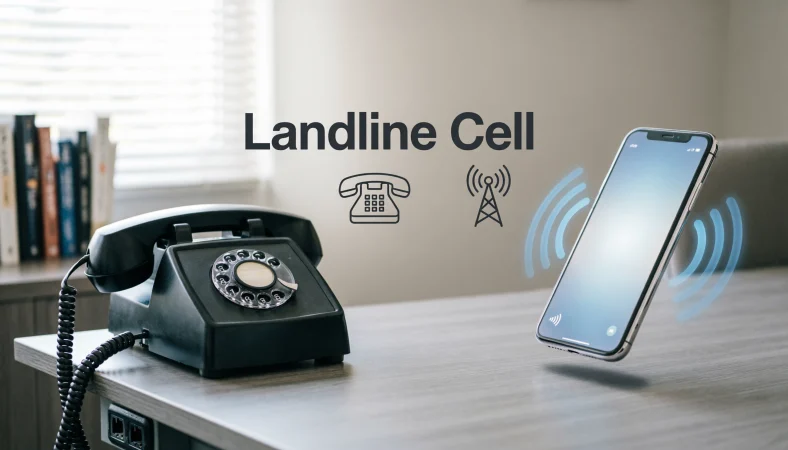
A landline is a telephone connected to a fixed physical location, while a cell is a mobile phone that uses a cellular network to make and receive calls. The choice between landline or cell usually depends on location, portability, reliability, cost, and personal needs. Knowing the difference helps avoid confusion when forms, businesses, or people ask for a phone number.
A landline is a traditional phone connected through a physical line, while a cell phone uses a wireless mobile network. For most everyday communication, a cell phone is more convenient and portable, while landlines can offer reliable service at a fixed location.
Hook + E-E-A-T Intro: Wondering whether “landline” or “cell” is the right term? Although both refer to phones, they describe different types of telephone connections. In this guide, we’ll quickly explain the difference, when to use each term, and how they are commonly used in everyday English.
Landline or Cell: What’s the Difference?
The terms landline and cell both refer to telephone services, but they describe different ways of connecting calls.
A landline is a noun that refers to a telephone connection associated with a fixed physical location. Traditional landlines use physical cables, although modern fixed telephone services can use other technologies while still serving a stationary phone connection.
A cell is a noun and a shortened form of cell phone. It refers to a portable telephone that communicates through cellular networks. Depending on the country and context, people may also say mobile, mobile phone, or cell phone.
| Feature | Landline | Cell |
| Meaning | A fixed telephone connection | A portable cellular telephone |
| Part of speech | Noun | Noun |
| Portability | Usually stays in one location | Designed to be carried |
| Network | Usually connected to a fixed service | Uses a cellular network |
| Common setting | Homes, offices, institutions | Homes, workplaces, vehicles, public spaces |
| Main advantage | Reliable fixed communication | Mobility and convenience |
| Common US term | Landline | Cell or cell phone |
| Common UK term | Landline | Mobile or mobile phone |
Quick Recap
A landline is associated with a fixed location.
A cell is a portable phone using cellular service.
A landline is useful when a stable fixed connection matters.
A cell is useful when communication needs to travel with you.
The words aren’t interchangeable when a form or conversation specifically asks which type of phone number you have.
Is Landline or Cell a Grammar, Vocabulary, or Usage Issue?
The difference between landline and cell is primarily a vocabulary and usage issue.
It isn’t a grammatical disagreement in the same way that choosing between two verb forms might be. The words identify different types of telephone connections.
For example:
“Please call me on my landline.”
This tells the reader that the number belongs to a fixed telephone service.
“Please call me on my cell.”
This tells the reader that the number belongs to a mobile phone.
Are Landline and Cell Interchangeable?
Not exactly.
They can both refer to a telephone through which someone can be contacted, but they aren’t precise substitutes for one another.
If a company asks, “Do you have a landline?” answering “Yes” means you have a fixed telephone connection.
If a person asks, “Can I have your cell number?” they are asking for a mobile phone number.
Using the wrong term can therefore result in giving someone the wrong contact information.
Formal Versus Informal Usage
Landline is perfectly acceptable in formal writing.
Cell is common in everyday American English, but cell phone is clearer in formal documents when there is any possibility of confusion.
For example:
“Please provide your landline number.”
This is concise and appropriate for a form.
“Please provide your cell phone number.”
This is also clear and appropriate.
In casual conversation, someone might simply say:
“What’s your cell?”
The meaning is normally obvious from context.
Academic Versus Casual Usage
Academic writing usually benefits from precise terminology.
A paper discussing telecommunications might use terms such as fixed line telephone, mobile phone, and cellular network rather than relying on conversational expressions.
Casual conversations are less demanding. A person might say, “Call my cell,” without needing to explain that they mean a cellular telephone.
When to Use a Landline
Use landline when you’re referring to a telephone associated with a fixed physical location.
The term is particularly useful in situations involving offices, homes, businesses, customer service, institutions, and emergency communication systems.
Workplace Example
“Please call the office landline during business hours.”
This sentence tells employees or customers that the number is connected to the office’s fixed telephone service.
Another example is:
“The receptionist answered the landline.”
The word immediately establishes that the telephone is a fixed office communication point.
Academic Example
“Participants were contacted using either a landline or a mobile telephone.”
This wording is useful in research because it distinguishes between fixed and mobile communication methods.
A researcher might need to identify the communication method because telephone access can affect the results of a study.
Technology Example
“The security system sends alerts to a designated landline.”
Here, the term identifies a fixed telephone destination.
Although modern communication technology has reduced dependence on traditional landlines, fixed telephone services remain relevant in some homes, offices, institutions, and specialized systems.
Landline Usage Recap
Use landline when the phone connection is fixed to a particular location.
It is especially useful when distinguishing a fixed telephone number from a mobile number.
When to Use a Cell
Use cell when you mean a portable cellular telephone.
In American English, cell is a common shortened form of cell phone.
For international audiences, however, cell phone or mobile phone may be clearer because terminology varies between English speaking regions.
Workplace Example
“Call me on my cell if you need an immediate response.”
This indicates that the person can be reached through a portable mobile telephone.
Academic Example
“Students were asked to provide a cell phone number for appointment reminders.”
This clearly identifies the requested contact number as a mobile number.
Technology Example
“The application sends a verification code to the user’s cell.”
In this context, cell means the user’s mobile phone.
Modern applications commonly rely on mobile numbers for authentication, alerts, account recovery, and notifications.
Cell Usage Recap
Use cell when referring to a mobile telephone in American English.
Use cell phone when greater clarity is needed.
For audiences outside the United States, mobile phone may be the more familiar term.
When You Should NOT Use Landline or Cell
There are several situations where choosing one word over the other can create unnecessary confusion.
1. Don’t Call a Mobile Number a Landline Number
A mobile number belongs to cellular service rather than a conventional fixed telephone connection.
2. Don’t Assume Every Phone Number Is a Cell Number
Businesses, offices, institutions, and households may still maintain fixed telephone services.
3. Don’t Use Cell Without Considering Your Audience
Although cell is extremely common in American English, international readers may be more familiar with mobile.
4. Don’t Treat Landline as a Synonym for Any Telephone
The word specifically identifies a fixed telephone connection.
5. Don’t Give a Cell Number When a Form Requests a Landline
Some organizations ask for a landline specifically because they need a fixed contact number.
6. Don’t Assume a Landline Is Always an Old Fashioned Phone
The concept of a fixed telephone connection is broader than the image of an old telephone sitting beside a wall.
7. Don’t Use Mobile and Cell as Different Technologies
In ordinary usage, mobile phone and cell phone generally refer to the same broad category of portable cellular devices.
8. Don’t Ignore Regional Vocabulary
American English commonly uses cell phone, while British English commonly uses mobile phone.
Common Mistakes and Decision Rules
| Correct sentence | Incorrect sentence | Explanation |
| Please provide your landline number. | Please provide your cell number when a fixed number is required. | A landline refers to a fixed telephone connection. |
| Call my cell after five. | Call my landline when you mean the mobile number. | A cell is a mobile telephone. |
| The office has a landline. | The office has a cell when referring to its fixed desk phone. | A desk telephone can be a landline. |
| Text my cell for confirmation. | Text my landline for a normal mobile messaging request. | Cellular phones commonly support text messaging. |
| The researcher recorded whether participants had a landline. | The researcher recorded whether participants had a cell when the study specifically concerned fixed lines. | Precise terminology matters in research. |
Decision Rule Box
- If the telephone is connected to a fixed location, use landline.
- If the telephone is portable and uses cellular service, use cell or cell phone.
- If you’re writing for British readers, mobile phone is often more natural than cell phone.
- If a form specifically asks for a landline or cell number, provide the number that matches the requested category.
Landline or Cell in Modern Technology and AI Tools
The distinction between landlines and cells remains relevant even though communication technology has changed dramatically.
Modern smartphones can handle calls, messages, video conferences, authentication codes, internet access, and applications. As a result, the mobile phone has become a central communication device rather than simply a portable telephone.
Landlines still have practical applications. Businesses may use fixed numbers for reception desks, customer service, departments, and public contact information. Some organizations also maintain fixed numbers because customers expect to contact a stable office rather than an individual employee.
AI systems and digital assistants can also interact with telephone infrastructure. Automated systems may route calls, identify numbers, transcribe conversations, send notifications, or connect callers to departments.
When a software system asks whether a number is a landline or mobile number, the distinction can affect how the system handles verification messages, voice calls, or text messages.
For example, a verification service may send a text message to a mobile number but use an automated voice call for a fixed telephone.
Why Are They Called Landline and Cell?
The word landline combines the idea of a fixed telephone connection with a physical line. The term became useful for distinguishing fixed telephone services from newer mobile communication systems.
The word cell comes from the cellular structure used by mobile communication networks. A geographic area is divided into smaller coverage regions commonly called cells. Each cell is served by cellular network equipment, allowing mobile devices to communicate while users move between coverage areas.
This explains why cell phone became a common American term.
The British term mobile phone emphasizes portability rather than the cellular network structure.
An Expert Style Explanation
The simplest distinction is physical location versus mobility: a landline identifies a fixed telephone connection, while a cell identifies a portable telephone using cellular communication.
That distinction works well in forms, customer service conversations, technology documentation, and everyday communication.
Two Practical Case Studies
Case Study 1: A Business Contact Form
Imagine a company creates an online registration form with separate fields for Landline Number and Cell Phone Number.
A customer enters the number for their office telephone in the landline field and their personal mobile number in the cell field.
The terminology helps the company understand how each number can be used.
If the company needs to contact the customer during business hours, it may call the fixed number. If it needs to send a verification code, the mobile number may be more suitable.
The result is better contact routing and fewer communication errors.
Case Study 2: A University Research Project
Suppose a university research team studies how households communicate by telephone.
The researchers ask participants whether they have a landline, a mobile phone, or both.
This distinction allows researchers to categorize telephone access more accurately.
If the survey simply asks whether participants “have a phone,” it could combine very different communication situations into one category.
By distinguishing fixed and mobile services, the researchers can produce more precise data and clearer conclusions.
Error Prevention Checklist
Always Use Landline When
The telephone is fixed to a location.
A form specifically requests a fixed telephone number.
- You’re describing an office desk telephone.
- You’re distinguishing fixed service from mobile service.
- You’re discussing traditional or fixed telephone infrastructure.
Always Use Cell When
You mean a portable cellular telephone.
You’re writing in American English.
You’re referring to a personal mobile number.
A form specifically requests a cell phone number.
You’re discussing mobile authentication or text messaging.
Never Use Cell When
You specifically mean a fixed telephone number.
A document requires a landline number.
You’re describing a fixed office telephone.
You are discussing a fixed telephone service and need technical precision.
Related Grammar Confusions You Should Master
Understanding landline and cell is part of a broader vocabulary skill: knowing when two familiar words represent related but different concepts.
Other useful distinctions include:
- Mobile and portable
- Telephone and smartphone
- Number and contact
- Call and text
- Wireless and cellular
- Internet and WiFi
- Phone and device
- Voice call and video call
- Landline and fixed line
- Cell phone and mobile phone
These distinctions become particularly important in technical writing because everyday language often simplifies concepts that have different meanings in telecommunications.
Frequently Asked Questions
What is the difference between a landline and a cell phone?
A landline is associated with a fixed telephone connection at a particular location, while a cell phone is portable and communicates through a cellular network.
Is a cell phone the same as a mobile phone?
Yes. Cell phone and mobile phone generally describe the same type of portable cellular telephone. The main difference is regional vocabulary. Cell phone is especially common in American English, while mobile phone is common in British English.
What does landline mean on a form?
On a form, landline normally means a telephone number connected to a fixed telephone service rather than a mobile phone number.
What does cell mean when someone asks for a phone number?
When someone asks for your cell, they usually mean your cell phone number, which is the number associated with your mobile telephone.
Is a landline a mobile phone?
No. A landline is normally associated with a fixed location, while a mobile phone is designed to be carried and used through a cellular network.
Should I give my landline or cell number?
Give the number requested. If someone asks for your landline, provide your fixed telephone number. If they ask for your cell, provide your mobile telephone number.
Is cell phone American or British English?
Cell phone is strongly associated with American English. British English generally uses mobile phone instead.
Can a landline number be used on a cell phone?
In some circumstances, a number can be transferred between services through number portability. Therefore, the number itself does not always reveal the current type of telephone service. The relevant distinction is the service currently associated with the number.
Conclusion
The choice between landline or cell becomes straightforward once you identify what type of telephone you’re describing.
A landline refers to a telephone connection associated with a fixed location. A cell refers to a portable cellular telephone and is a common shortened form of cell phone in American English.
Neither term is inherently better. The correct choice depends on the communication service, the context, and sometimes the regional variety of English.
If a form asks for a landline number, provide a fixed telephone number. If it asks for a cell number, provide your mobile number. For international audiences, remember that mobile phone is often more widely understood than cell phone.
The key is precision. Once you understand whether the phone is fixed or mobile, choosing the right term is easy.