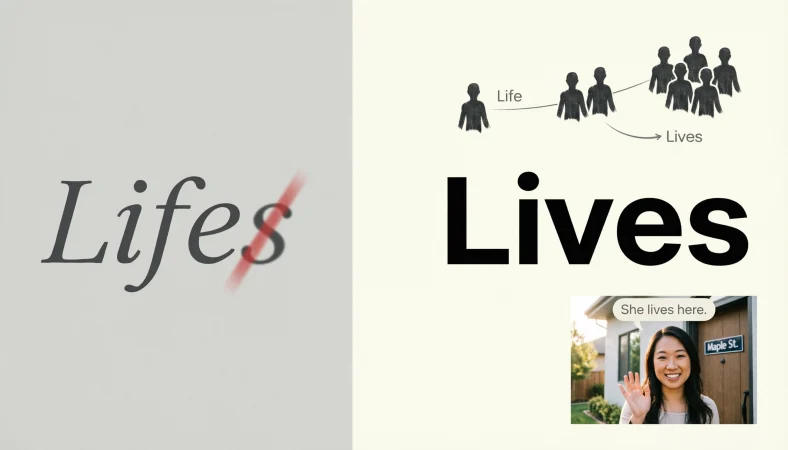
Lives is the correct plural form of “life.” Lifes is generally incorrect when you mean more than one life. However, “lives” can also be the third person singular form of the verb “live.” Understanding these two meanings helps prevent common spelling and grammar mistakes in writing.
If you have ever wondered whether to write lifes or lives, the correct choice is almost always lives when referring to more than one person’s existence. The word “life” is an irregular plural noun, so it does not become “lifes.” Instead, it changes to “lives.” For example, “Many lives were saved” is correct. The confusion causes real mistakes because “life” looks like an ordinary noun that might take an s in the plural. There is an additional complication: “lives” is also a verb form of “live,” as in “She lives in London.”
Lifes vs Lives: What’s the Difference?
The main difference is simple: lives is the standard plural form of the noun life, while lifes is not normally accepted as the plural of life in standard English.
The word life is a singular noun. It refers to the existence of a person, animal, organism, or sometimes a particular way of living.
For example:
“Every life matters.”
When you are talking about more than one life, the plural becomes lives.
“Several lives were saved.”
The spelling changes from life to lives because English has several nouns ending in “f” or “fe” that form their plurals by changing the ending to “ves.”
There is another important point. Lives can also be a verb.
“She lives with her parents.”
In that sentence, “lives” comes from the verb live, not the noun life.
So the meaning of lives depends on its role in the sentence.
Mini Recap
Life is singular.
Lives is the normal plural of life.
Lives can also be a verb meaning resides or exists.
Lifes is generally not the correct plural spelling.
Is Lifes vs Lives a Grammar, Vocabulary, or Usage Issue?
The difference between lifes and lives is primarily a grammar and spelling issue.
It isn’t really a vocabulary difference because “lifes” does not normally represent a separate standard English word with a different meaning. The problem usually occurs when someone applies a regular plural rule to an irregular noun.
Most English nouns form plurals by adding “s.”
For example:
book becomes books
car becomes cars
phone becomes phones
But English contains many irregular plurals that don’t follow this straightforward pattern.
Life becomes lives.
Knife becomes knives.
Wife becomes wives.
Wolf becomes wolves.
This is why simply adding “s” to life produces the incorrect form “lifes.”
Are Lifes and Lives Interchangeable?
No.
In standard English, lives should be used when you mean multiple lives.
For example:
“Thousands of lives were changed by the discovery.”
Writing “Thousands of lifes were changed” would be considered a spelling error.
Formal and Informal Usage
The correct form remains lives in both formal and informal English.
You should not use “lifes” simply because you’re writing casually.
In a text message, social media post, academic paper, newspaper article, business report, or formal document, lives remains the normal spelling.
Academic and Casual Usage
Students should use lives in essays, assignments, examinations, research papers, and presentations.
Casual writers should also use lives when referring to multiple lives.
The distinction does not depend on the level of formality. It depends on the grammatical meaning.
When to Use Lives as a Plural Noun
Use lives when you are talking about two or more lives.
This is the most common reason people search for the correct spelling.
Workplace Example
“The new safety procedures could save lives.”
Here, “lives” is a plural noun because the sentence refers to the lives of multiple people.
Another example is:
“The company puts customer lives and safety first.”
The word refers to multiple human lives.
Academic Example
“War can have devastating effects on civilian lives.”
Here, lives refers to the existence and experiences of many civilians.
Technology Example
“Modern medical technology has helped save millions of lives.”
Again, lives is a plural noun referring to many individual lives.
Usage Recap
Use lives when the word means more than one life.
A useful test is to replace it with “multiple lives.” If that meaning works, lives is the correct form.
When to Use Lives as a Verb
The word lives has another important function. It can be the third person singular present form of the verb live.
For example:
“He lives in New York.”
“She lives with her family.”
“The animal lives in the forest.”
In each case, lives does not mean multiple lives. It describes where someone or something resides or continues to exist.
Workplace Example
“Our manager lives near the office.”
Here, “lives” is a verb describing where the manager resides.
Academic Example
“The species lives in tropical environments.”
The word describes the habitat in which the species exists.
Technology Example
“The database lives on a secure server.”
In technology writing, “lives” can be used informally to describe where digital information or software is located.
Usage Recap
When lives follows a singular subject such as “he,” “she,” or “it,” it can be a verb.
When lives refers to multiple people or organisms, it is usually a plural noun.
Why Is the Plural of Life Lives?
The plural form of life is irregular because English spelling and pronunciation have developed over centuries.
The word “life” ends with “fe,” but its plural does not simply add “s.” Instead, the ending changes.
Life becomes lives.
This pattern is found in several other English words.
Knife becomes knives.
Wife becomes wives.
Wolf becomes wolves.
Half becomes halves.
However, not every word ending in “f” or “fe” follows this pattern. That is one reason English pluralization can be difficult for learners.
For example, roof normally becomes roofs, not rooves.
Chief becomes chiefs.
Belief becomes beliefs.
The best approach is to learn common irregular plural forms individually rather than assuming every word ending in “f” follows one universal rule.
When You Should NOT Use Lifes or Lives
Understanding when not to use each form can prevent several common errors.
1. Do Not Write Lifes as the Normal Plural of Life
If you mean multiple lives, use lives.
Incorrect:
“Many lifes were saved.”
Correct:
“Many lives were saved.”
2. Do Not Assume Every Noun Takes S
The plural of life is irregular.
Don’t apply the regular plural rule mechanically.
3. Do Not Use Lives as a Plural When You Mean One Life
If you are talking about a single person’s existence, use life.
Incorrect:
“He risked his lives.”
Correct:
“He risked his life.”
4. Do Not Confuse the Noun With the Verb
“She lives in Canada” does not mean she has multiple lives.
In that sentence, “lives” is a verb.
5. Do Not Change Lives to Lifes in Casual Writing
Informal writing does not make “lifes” an acceptable plural.
The spelling remains lives.
6. Do Not Use Life When Multiple Lives Are Intended
If you are referring to several people, animals, or organisms, the plural form is needed.
“Thousands of life were affected” is incorrect.
“Thousands of lives were affected” is correct.
7. Do Not Assume Lifes Is Always Meaningless
In specialized contexts, unusual forms may appear as names, trademarks, usernames, titles, or deliberate creative language. Those cases do not change the standard English plural of life.
Common Mistakes and Decision Rules
Decision Rule Box
If you mean more than one existence or individual life, use lives.
If you mean one existence, use life.
If you mean resides or exists and the subject is he, she, or it, use lives.
Do not normally use lifes as the plural of life.
Lifes and Lives in Modern Technology and AI Tools
The distinction between these words also appears in digital communication, software, search engines, and AI generated text.
Modern technology frequently discusses human lives in contexts such as healthcare, autonomous systems, cybersecurity, emergency response, and artificial intelligence.
For example:
“AI assisted systems may help save lives.”
Here, lives is a plural noun.
Technology writers may also use lives as a verb.
“The data lives on a remote server.”
In this sentence, “lives” describes the location of the data.
AI writing systems generally recognize lives as the standard plural form of life. However, automated systems can sometimes reproduce spelling errors found in user supplied text or poorly edited online material.
For high quality publishing, writers should still proofread generated content rather than assuming every automatically produced sentence is correct.
The Etymology of Life and Lives
The English word life has very old Germanic roots. It is related to words found in several Germanic languages and has developed through historical forms of English.
The irregular plural lives reflects a broader historical pattern in English in which vowel changes and consonant changes helped distinguish singular and plural forms.
English has retained several examples of these older patterns.
Life and lives are therefore not simply the result of a modern spelling preference. The relationship between the two forms is rooted in the historical development of the language.
An Expert Style Explanation
The safest way to distinguish life and lives is to identify the grammatical meaning first, then choose the spelling. Lives can represent either a plural noun or a singular verb form.
This approach works because it focuses on function rather than memorization alone.
Two Practical Case Studies
Case Study 1: Health and Safety Communication
Imagine a workplace safety campaign that states:
“New procedures can save lives.”
The organization is talking about the potential effect on multiple workers. Therefore, lives is required.
A careless editor might write “save lifes” by treating life as a regular noun.
Correcting the spelling ensures that the message appears professional and grammatically reliable.
The practical result is clearer communication in an environment where precision matters.
Case Study 2: Technology Documentation
Consider a technical guide that says:
“The application lives on a private server.”
Here, lives is not a plural noun. It is a verb meaning that the application exists or is located on that server.
Replacing it with “lifes” would be grammatically incorrect.
This example demonstrates why context matters. The same spelling, lives, can have two different grammatical roles.
Error Prevention Checklist
Always Use Lives When
You mean more than one life.
You are discussing multiple people or organisms.
You are describing the lives affected by an event.
You are using the third person singular form of live.
You mean that someone or something resides or exists somewhere.
Never Use Lifes When
You simply mean the plural of life.
You are writing standard academic English.
You are preparing professional documents.
You are writing formal reports.
You are describing multiple human lives.
You are answering a grammar or spelling question about the plural of life.
Related Grammar Confusions You Should Master
Learning life versus lives can help you understand several other irregular English forms.
Related spelling and grammar topics include:
- Wife versus wives
- Knife versus knives
- Wolf versus wolves
- Leaf versus leaves
- Half versus halves
- Shelf versus shelves
- Child versus children
- Person versus people
- Man versus men
- Woman versus women
These examples show that English contains many plural forms that cannot be created simply by adding “s.”
FAQ,s
Is lifes or lives correct?
Lives is correct when you mean more than one life. Lifes is not normally the standard plural form of life.
What is the plural of life?
The plural of life is lives.
For example:
“One life was changed.”
“Many lives were changed.”
Why is the plural of life lives instead of lifes?
Life has an irregular plural form. The spelling changes from “life” to “lives” rather than simply adding “s.”
Is lives a noun or a verb?
Lives can be either a plural noun or a verb. As a noun, it means more than one life. As a verb, it is the third person singular form of “live.”
Is lifes ever correct?
In standard English, lifes is generally not correct as the plural of life. It may appear as a name, title, brand, username, or deliberate creative spelling, but those special uses do not make it the standard plural.
How do you use lives in a sentence?
You can use lives as a plural noun or a verb.
As a noun:
“The accident changed many lives.”
As a verb:
“She lives in London.”
What is the difference between life and lives?
Life is singular. Lives is its plural form. Lives can also be the third person singular present form of the verb “live.”
Is lives an irregular plural?
Yes. Lives is an irregular plural because it does not follow the simple pattern of adding “s” to the singular noun.
Should I write lifes in an essay?
No. If you mean multiple lives, write lives. This is the standard form in academic and professional English.
How can I remember that life becomes lives?
Think of similar forms such as knife and knives or wife and wives. The ending changes rather than simply adding “s.”
Conclusion:
The correct spelling is lives when you mean more than one life. The form lifes is generally incorrect as the standard plural.
There is one additional detail worth remembering. Lives can also function as a verb. In “She lives in London,” it comes from the verb “live.” In “Many lives were saved,” it is the plural noun form of “life.”
So, when deciding between lifes or lives, look at what the sentence means. If you’re talking about multiple lives, choose lives. If you’re describing where one person or thing resides or exists, lives can also be the correct verb.
The easiest rule is simple: life becomes lives in the plural, not lifes.