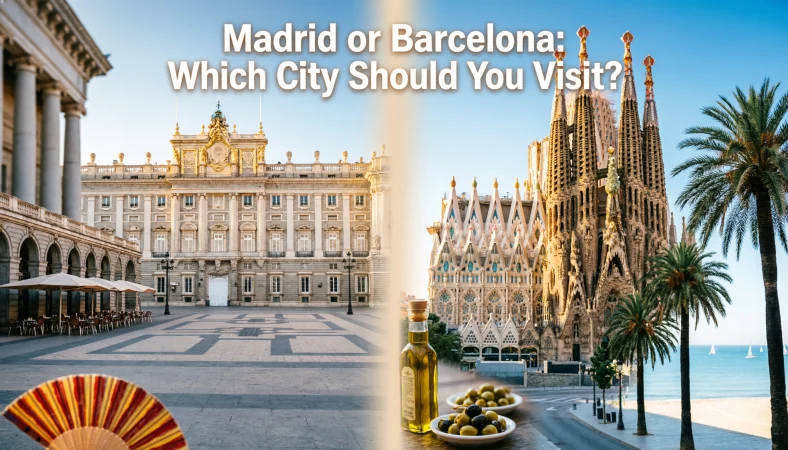
Madrid and Barcelona are both outstanding Spanish cities, but they offer distinctly different travel experiences. Madrid is Spain’s inland capital, known for major museums, historic neighborhoods, royal heritage, food, and nightlife. Barcelona combines Mediterranean beaches, Catalan culture, distinctive architecture, art, and coastal scenery, making the choice depend largely on your interests.
The question of Madrid or Barcelona is one of the most common choices travelers face when planning a trip to Spain. Both cities have world famous attractions, excellent food, rich history, vibrant neighborhoods, and strong cultural identities. Yet choosing between them can significantly change the character of your holiday.
Madrid is Spain’s capital and political center. It has a distinctly urban atmosphere, impressive royal heritage, major art institutions, traditional neighborhoods, extensive nightlife, and a food culture built around everything from historic taverns to modern restaurants. The city is also known for its dry climate, hot summers, and cold winters.
Barcelona has a different personality. It sits on the Mediterranean coast and combines historic neighborhoods with beaches, modernist architecture, Catalan cultural traditions, art, shopping, and outdoor activities. Barcelona Tourism describes the city as Mediterranean and coastal, with relatively mild winters and warm summers.
This distinction matters because travelers sometimes assume that the two cities provide essentially the same experience. They don’t. A traveler interested primarily in museums and Spanish royal history may prefer Madrid, while someone dreaming of beaches, Gaudí architecture, and Mediterranean scenery may find Barcelona more appealing.
There is no universal winner. The better destination depends on what you want to see, how long you have, when you are traveling, and what kind of atmosphere you enjoy.
Madrid vs Barcelona: What’s the Difference?
Madrid is the capital of Spain and is located inland in the center of the country. It is strongly associated with national political life, royal history, major museums, traditional Spanish food, urban neighborhoods, and nightlife.
Barcelona is the capital of Catalonia and is located on Spain’s Mediterranean coast. It is particularly associated with Catalan culture, modernist architecture, beaches, art, design, and its relationship with the sea.
| Feature | Madrid | Barcelona |
| Country | Spain | Spain |
| Regional identity | Capital of Spain | Capital of Catalonia |
| Location | Inland | Mediterranean coast |
| Atmosphere | Grand, urban, energetic | Coastal, artistic, Mediterranean |
| Major strength | Museums, history, food, nightlife | Architecture, beaches, art, coastal atmosphere |
| Famous landmark types | Royal Palace, Prado, Retiro | Sagrada Família, Park Güell, Gothic Quarter |
| Climate | Dry, hot summers, cold winters | Mild Mediterranean climate |
| Beach access | No city beach | Several urban beaches |
| Nightlife | Extensive and varied | Extensive and strongly connected with coastal districts |
| Best for | Art, history, food, nightlife | Architecture, beaches, design, seaside experiences |
Madrid’s official tourism information highlights the Royal Palace, Prado Museum, Retiro, Paseo del Arte, neighborhoods, food, and nightlife as major parts of the city’s visitor experience.
Barcelona’s tourism authority highlights museums, modernist heritage, beaches, shopping, science attractions, and FC Barcelona among its major attractions.
Mini Recap
Madrid is generally stronger for major museums, royal history, traditional urban culture, and nightlife.
Barcelona stands out for architecture, beaches, Catalan culture, and Mediterranean scenery.
Madrid has an inland climate with greater seasonal extremes.
Barcelona has a milder coastal climate.
Neither city is objectively better for every traveler.
Is Madrid vs Barcelona a Grammar, Vocabulary, or Usage Issue?
This comparison is not a grammar issue. It is a travel choice and usage question involving two proper nouns that identify different cities.
The words Madrid and Barcelona cannot be used interchangeably because they refer to different locations. Saying that you are visiting Madrid does not communicate the same information as saying that you are visiting Barcelona.
The comparison also changes depending on context.
In casual conversation, someone might ask:
Madrid or Barcelona for a first trip?
That question is short and conversational.
In academic or professional writing, a more complete version would be:
Which city offers a better cultural experience for a first time visitor to Spain, Madrid or Barcelona?
In travel planning, the distinction becomes practical. Your answer may depend on attractions, weather, budget, transportation, food preferences, nightlife, and the amount of time available.
What Makes Madrid Special?
Madrid is particularly appealing to travelers who want a large cultural capital rather than a beach destination.
One of its biggest advantages is the concentration of major cultural institutions. The Paseo del Arte brings together the Prado Museum, Thyssen Bornemisza National Museum, and Reina Sofía Museum within a relatively compact area. Madrid Tourism also identifies the Paseo del Prado and Retiro area as part of the UNESCO World Heritage Landscape of Light.
The Royal Palace adds another dimension. The palace is closely connected with Spanish royal history and remains the official residence of the Spanish royal family, although it is not their normal home.
Workplace Example
For a business traveler, Madrid can be particularly convenient because it functions as Spain’s national capital and a major business center. Meetings can be combined with museums, restaurants, shopping, and evening entertainment without needing to leave the city.
Academic Example
Students and researchers interested in European art, Spanish history, architecture, literature, or politics can find a particularly rich environment in Madrid. The city contains major museums, historic districts, libraries, cultural institutions, and sites connected with Spanish history.
Technology Example
Madrid also has a strong modern business and technology environment. Its official tourism information promotes business areas, events, digital services, transport resources, and technology related attractions alongside traditional tourism.
Usage Recap
Choose Madrid if your priority is art, museums, Spanish history, food, nightlife, and a major capital city atmosphere.
It is especially attractive for travelers who enjoy spending days exploring cultural institutions and evenings discovering restaurants, theaters, bars, and neighborhoods.
What Makes Barcelona Special?
Barcelona’s greatest distinction is its combination of urban culture and the Mediterranean Sea.
A traveler can spend the morning visiting architectural landmarks, the afternoon walking through historic neighborhoods, and the evening near the waterfront. Barcelona Tourism specifically highlights its beaches and maritime atmosphere among the city’s major attractions.
Architecture is another major reason to visit. Barcelona’s modernist heritage gives the city a visual identity that is difficult to reproduce elsewhere. Gaudí’s work, including the Sagrada Família and Park Güell, is central to the city’s international image.
The city also offers a broad range of museums, shopping districts, parks, gardens, cultural institutions, and neighborhoods. Barcelona Tourism lists more than 50 landmarks in its searchable attraction database and highlights museums, modernist buildings, parks, science facilities, and coastal sites.
Workplace Example
Barcelona can be attractive for business travelers who want to combine meetings with a coastal environment. The city has major conference facilities, technology organizations, creative industries, and international events.
Academic Example
Students of architecture, art, design, urban planning, and Catalan culture may find Barcelona especially rewarding. The city’s built environment provides an unusually visible connection between architectural history and everyday urban life.
Technology Example
Barcelona has developed a strong technology and innovation identity. The Barcelona Supercomputing Center and other technology institutions are part of the city’s modern landscape, while contemporary landmarks such as Torre Glòries reflect its modern architectural identity.
Usage Recap
Choose Barcelona if you want architecture, beaches, art, design, Catalan culture, and a Mediterranean atmosphere.
It is particularly appealing when outdoor experiences and coastal scenery are important parts of your ideal trip.
When You Should NOT Choose Madrid or Barcelona
Neither city is the right choice for every traveler or every trip.
- Do not choose Madrid if a beach vacation is your main objective. Madrid is inland and does not offer Barcelona’s urban beach experience.
- Do not choose Barcelona if your primary goal is Spanish royal history. Madrid offers stronger access to royal sites and national institutions.
- Do not choose Madrid simply because it is the capital. Capital status does not automatically make it the better tourist destination.
- Do not choose Barcelona only because of photographs. Popular architectural landmarks can become extremely busy, and the city’s appeal extends far beyond its most photographed sites.
- Do not choose either city without considering the season. Madrid’s summers can become very hot, while Barcelona’s coastal summers can also feel hot and humid.
- Do not assume one city represents all of Spain. Spain contains many distinct regional cultures and landscapes.
- Do not choose based only on football. Both cities have famous football traditions, but a trip should ideally include more than a stadium visit.
- Do not assume you must choose only one. With enough time, visiting both is practical and can create a much richer Spanish itinerary.
Madrid or Barcelona for Attractions
If attractions are your main concern, the answer depends on the type of attractions you prefer.
Madrid excels in traditional museums and historical institutions. The Prado, Reina Sofía, Thyssen Bornemisza, Royal Palace, Retiro, and historic central neighborhoods can easily fill several days.
Barcelona excels in architectural experiences. The Sagrada Família, Park Güell, Gothic Quarter, Casa Batlló, Casa Milà, Montjuïc, and waterfront areas create a sightseeing experience that feels visually different from Madrid.
The difference can be summarized simply.
Madrid is stronger for museum based sightseeing.
Barcelona is stronger for architecture and outdoor sightseeing.
That doesn’t mean Barcelona lacks museums or Madrid lacks architecture. It means each city has a particularly strong identity in these areas.
Madrid or Barcelona for Food?
Both cities are excellent food destinations, but the culinary experiences have different regional personalities.
Madrid is particularly associated with tapas, traditional taverns, markets, cocido, bocadillo de calamares, churros, and a strong late dining culture. Madrid Tourism specifically promotes historic taverns, tapas, gourmet markets, Michelin starred restaurants, and rooftop dining.
Barcelona offers Catalan cuisine alongside a broad international food scene. Seafood, Mediterranean ingredients, traditional Catalan dishes, markets, bakeries, and contemporary restaurants are important parts of the city’s culinary identity.
If you want classic central Spanish urban food culture, Madrid has an advantage.
If you want Mediterranean and Catalan influences, Barcelona may be the better choice.
Madrid or Barcelona for Nightlife?
Madrid has one of the strongest nightlife reputations in Spain. Its official tourism site highlights areas such as Malasaña, Chueca, La Latina, Huertas, Salamanca, Lavapiés, Sol, and Gran Vía.
The city is particularly well suited to travelers who enjoy long evenings that move from dinner to drinks, live music, theater, or clubs.
Barcelona also has excellent nightlife, especially around areas such as El Raval, the Gothic Quarter, El Born, Gràcia, and the waterfront.
If your idea of nightlife includes a broad urban scene extending deep into the night, Madrid has a slight advantage.
If you prefer nightlife combined with coastal scenery and Mediterranean atmosphere, Barcelona may feel more appealing.
Madrid or Barcelona for Beaches?
This is one of the easiest categories to decide.
Barcelona wins.
Madrid is an inland city, so it cannot provide the experience of walking from a central neighborhood to a Mediterranean beach.
Barcelona’s beaches are part of the city’s identity. Barcelona Tourism specifically presents the city’s beaches, Barceloneta, Olympic Marina, and maritime environment as major attractions.
If swimming, seaside walks, beach restaurants, or coastal sunsets are central to your trip, Barcelona should be near the top of your list.
Madrid or Barcelona for Weather?
The cities have noticeably different climates.
Madrid has a dry climate with hot summers and cold winters. Official tourism information notes that summer temperatures can exceed 35 degrees Celsius, while winter temperatures can fall substantially lower.
Barcelona has a Mediterranean coastal climate. Its official tourism authority describes average annual temperatures above 16 degrees Celsius, relatively mild winters, and warm summers.
For travelers who dislike cold winters, Barcelona may be more comfortable.
For travelers who dislike humid coastal conditions and prefer dry heat, Madrid may appeal more.
Spring and autumn are excellent periods for both cities because temperatures are generally more suitable for extensive sightseeing.
Madrid or Barcelona for a First Trip to Spain?
For a first trip, there is no universal answer.
Choose Madrid if you want:
- Major art museums
- Royal history
- Traditional Spanish urban culture
- Extensive nightlife
- Historic neighborhoods
- Food and tapas
- A capital city experience
Choose Barcelona if you want:
- Famous architecture
- Mediterranean beaches
- Catalan culture
- Art and design
- Coastal scenery
- Outdoor sightseeing
- A visually distinctive city
If you have seven or more days, combining the two is worth serious consideration.
Madrid or Barcelona for a Short Trip?
With only two or three days, your choice becomes more important.
Madrid works particularly well for a compact cultural trip because several major attractions are concentrated around the central area and Paseo del Arte.
Barcelona also works well for a short visit because several iconic neighborhoods and architectural attractions can be combined with the waterfront.
For a three day trip, avoid trying to see everything. Choose a few major attractions and leave time for simply walking around.
Madrid or Barcelona: Can You Visit Both?
Yes.
The two cities are connected by high speed rail, making a combined itinerary practical. Renfe has operated direct Madrid and Barcelona services with journey times around two and a half hours on some services.
That means travelers can spend several days in one city and then continue to the other without losing an entire day to transportation.
A simple itinerary could look like this:
Days 1 to 3: Madrid
Days 4 to 6: Barcelona
For a longer trip, you can add destinations such as Seville, Valencia, Granada, Toledo, or Girona depending on your interests and available time.
Madrid and Barcelona in Modern Technology and AI Tools
Travel planning has changed significantly because of digital maps, mobile applications, online ticketing, translation tools, and AI travel assistants.
An AI system can help compare Madrid and Barcelona based on weather, attractions, food, transportation, and travel style. Digital maps can also help travelers estimate walking times and organize attractions by neighborhood.
However, technology should support rather than replace judgment. Attraction opening hours, ticket requirements, transportation schedules, local regulations, and event dates can change.
Official tourism websites remain useful for current information. Madrid provides official maps, guides, event information, and city resources, while Barcelona Tourism maintains attraction and visitor information.
Etymology and Cultural Identity
Madrid’s name has a long and complex history involving earlier forms associated with the city’s pre modern development. The city’s official tourism material notes the historical Arabic name Magerit in connection with the fortress that preceded later development of the Royal Palace area.
Barcelona also has ancient roots. Its history stretches through Iberian, Roman, medieval, and modern periods, while its contemporary identity is strongly connected with Catalonia and Catalan culture.
The linguistic difference is also worth remembering. Spanish is spoken throughout both cities, while Catalan has an especially important cultural and linguistic presence in Barcelona and Catalonia.
A visitor doesn’t need to master Catalan to enjoy Barcelona, but understanding that the city has a distinct regional identity makes the experience more meaningful.
Two Practical Case Studies
Case Study 1: The Art and History Traveler
Imagine a traveler with five days who cares most about European art, museums, royal history, architecture, and traditional food.
Madrid is likely the stronger choice.
The traveler can build a route around the Prado, Reina Sofía, Thyssen Bornemisza, Royal Palace, Retiro, Plaza Mayor, historic neighborhoods, and traditional food districts.
The concrete advantage is concentration. Madrid’s official tourism information places several major cultural institutions around the Paseo del Arte and Retiro area.
Case Study 2: The Architecture and Beach Traveler
Now consider a traveler with five days who wants iconic architecture, outdoor experiences, design, food, and time beside the sea.
Barcelona is likely the stronger choice.
The traveler can combine Sagrada Família, Park Güell, the Gothic Quarter, modernist architecture, Montjuïc, local neighborhoods, and the beaches.
The concrete advantage is variety within a single destination. Barcelona Tourism highlights architecture, museums, shopping, parks, and beaches as interconnected parts of the visitor experience.
Expert Style Explanation
“Madrid rewards travelers who want to understand Spain through its capital, institutions, art, food, and urban life, while Barcelona rewards travelers who want architecture, regional culture, and the Mediterranean in the same trip.”
The important point is that the comparison is about travel personality rather than quality. Both cities are major destinations, but they satisfy different preferences.
Author Expertise
Written by a travel and SEO content specialist focused on destination research, search intent, cultural context, and practical travel comparisons.
Error Prevention Checklist
Always choose Madrid when
- Major art museums are your priority.
- You want royal and national history.
- You enjoy traditional tapas and urban food culture.
- Nightlife is a major part of your trip.
- You prefer a large inland capital atmosphere.
Always choose Barcelona when
- Beaches are important to your trip.
- Architecture is a major interest.
- You want a Mediterranean environment.
- Catalan culture interests you.
- You enjoy combining city sightseeing with outdoor activities.
Never choose based only on
- Which city appears more famous online.
- One photograph or social media video.
- Football alone.
- The assumption that one city is universally better.
Related Travel Comparisons You Should Know
Once you understand the difference between Madrid and Barcelona, several related comparisons can help you plan a broader Spanish itinerary.
- Madrid vs Seville
- Barcelona vs Valencia
- Madrid vs Valencia
- Barcelona vs Malaga
- Madrid vs Granada
- Barcelona vs Seville
- Madrid vs Lisbon
- Barcelona vs Lisbon
- Madrid vs Rome
- Barcelona vs Rome
These comparisons are useful because the best destination depends on the same core factors: attractions, climate, food, transportation, culture, budget, and travel style.
Frequently Asked Questions
Is Madrid or Barcelona better for a first visit to Spain?
Madrid is better for travelers focused on museums, royal history, food, and capital city culture. Barcelona is better for travelers who prioritize architecture, beaches, Mediterranean scenery, and Catalan culture. For a longer first trip, visiting both is an excellent option.
Is Madrid or Barcelona cheaper?
Costs vary according to accommodation, season, neighborhood, dining choices, and attractions. Neither city should automatically be considered cheap. Comparing specific hotels and travel dates is more useful than assuming one city always costs less.
Is Madrid or Barcelona better for nightlife?
Madrid has a particularly broad and varied nightlife scene, with numerous neighborhoods offering bars, clubs, live music, theaters, and late night dining. Barcelona also has excellent nightlife, especially for travelers who enjoy a coastal atmosphere.
Is Madrid or Barcelona better for beaches?
Barcelona is the clear choice because it has urban Mediterranean beaches. Madrid is inland and does not offer a comparable city beach experience.
Is Madrid or Barcelona better for art?
Madrid has an exceptional advantage for major European art museums, particularly the Prado, Reina Sofía, and Thyssen Bornemisza. Barcelona is especially strong for modernist architecture, design, contemporary art, and Catalan artistic heritage.
Is Madrid or Barcelona better for food?
Both are excellent. Madrid is particularly appealing for traditional taverns, tapas, markets, and classic Spanish food culture, while Barcelona offers Catalan cuisine, Mediterranean ingredients, seafood, markets, and a broad contemporary restaurant scene.
Is Madrid or Barcelona better in winter?
Barcelona generally has milder winter conditions because of its Mediterranean coastal location. Madrid has colder winters, although the city often experiences sunny winter days.
Conclusion
The choice between Madrid or Barcelona isn’t really about deciding which city is universally better. It’s about deciding which experience fits your trip.
Madrid is the stronger choice for travelers who love major art museums, royal history, traditional Spanish food, historic neighborhoods, and energetic nightlife. The city offers a classic capital experience with an unusually strong concentration of cultural attractions.
Barcelona is the stronger choice for travelers who want iconic architecture, Mediterranean beaches, Catalan culture, outdoor experiences, and a distinctive coastal atmosphere. Its combination of urban sightseeing and seaside life is difficult to match.
If you’re still undecided, use one simple rule.
Choose Madrid for museums, history, food, and nightlife.
Choose Barcelona for architecture, beaches, design, and the Mediterranean.