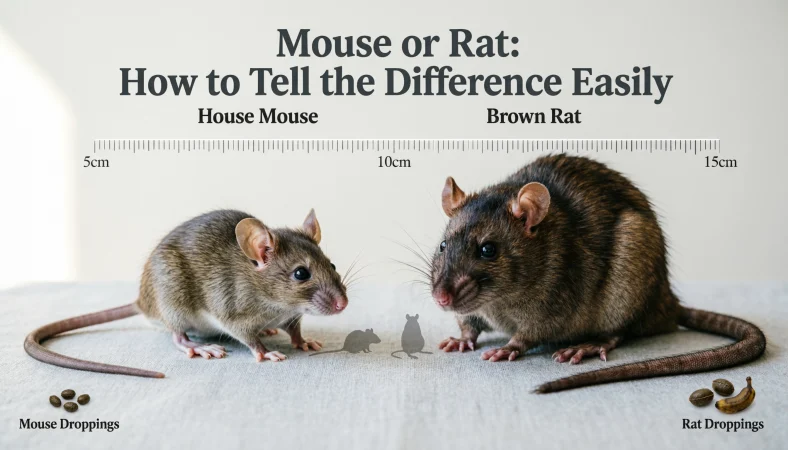
A mouse is a small rodent with a relatively slender body, pointed face, and large ears, while a rat is generally larger, heavier, and more robust, with a thicker body and proportionally smaller ears. Although both belong to the rodent family, they are different animals with distinct physical features, behavior, habitats, and common associations.
The question of mouse or rat often comes up when someone notices a small rodent indoors, finds droppings in a kitchen, hears scratching behind a wall, or sees an animal moving quickly across a floor. At first glance, the two can look surprisingly similar. Both have four legs, fur, whiskers, long tails, sharp incisors, and a strong ability to adapt to human environments.
However, calling one a rat when it is actually a mouse can lead to practical mistakes. Their body size, droppings, nesting behavior, food preferences, and movement patterns can differ. Accurate identification matters when you’re trying to understand where a rodent came from or determine what kind of animal you’re dealing with.
A mouse generally refers to a smaller rodent, particularly species belonging to the genus Mus, although the word is also used more broadly for various small rodents. A rat generally refers to larger rodents, especially species such as the Norway rat and roof rat.
Size is one useful clue, but it isn’t enough by itself. Young rats can be mistaken for mice because their bodies are still small. That’s why experienced identification considers several characteristics together rather than relying on a single feature.
Mouse vs Rat: What’s the Difference?
A mouse and a rat are both rodents, but they differ considerably in average size, body proportions, behavior, and habitat preferences.
The word mouse is a noun referring to a small rodent. In everyday language, it most often describes a house mouse or a similar small species.
The word rat is also a noun referring to a rodent, generally one that is larger and heavier than a typical mouse.
| Feature | Mouse | Rat |
| Typical body size | Small and slender | Larger and heavier |
| Face | Pointed and delicate | Blunter and broader |
| Ears | Relatively large | Relatively smaller |
| Eyes | Relatively prominent | Smaller in proportion |
| Tail | Thin and delicate | Thicker and more substantial |
| Droppings | Small and often pointed | Larger and more capsule shaped |
| Movement | Quick and agile | More deliberate and powerful |
| Food needs | Smaller quantities | Greater quantities |
| Climbing | Excellent | Good, depending on species |
| Burrowing | Limited compared with many rats | Common in several rat species |
| Common indoor species | House mouse | Norway rat and roof rat |
Mini Recap
A mouse is generally smaller, lighter, and more delicate.
A rat is generally larger, heavier, and more robust.
Large ears and a pointed face often suggest a mouse.
A thicker body and heavier tail often suggest a rat.
Size alone isn’t always enough because young rats can resemble mice.
Is Mouse vs Rat a Grammar, Vocabulary, or Usage Issue?
The comparison between “mouse” and “rat” is primarily a vocabulary and identification issue, rather than a grammar problem.
The two words are not interchangeable when you’re referring to a particular animal. Calling a rat a mouse changes the meaning because the terms normally identify different types of rodents.
They can, however, appear in similar grammatical structures.
For example:
I saw a mouse in the garage.
I saw a rat in the garage.
Both sentences are grammatically correct. The difference is the animal being described.
Formal Versus Informal Usage
In everyday conversation, people sometimes use “mouse” and “rat” loosely when they aren’t sure what they saw.
In scientific, pest management, veterinary, or academic contexts, precise identification is more important. A professional may distinguish species, physical characteristics, habitat, and evidence such as droppings or tracks.
Academic Versus Casual Usage
A casual speaker might say:
There’s some kind of mouse in the basement.
A biology student might instead write:
The specimen was identified as a house mouse based on its physical characteristics.
The second sentence demonstrates more precise terminology.
The same distinction applies to rats. In professional contexts, simply saying “rat” may be less informative than identifying the particular species when that information is available.
What Is a Mouse?
A mouse is a relatively small rodent characterized by a slender body, pointed snout, large ears, and a thin tail.
The house mouse is one of the most familiar examples. House mice are highly adaptable and can live around buildings, food storage areas, farms, warehouses, and homes.
Their small size allows them to enter surprisingly narrow openings. A gap that appears insignificant to a person can provide access to a mouse.
Mice are also highly agile. They can move rapidly along floors, climb various surfaces, and explore spaces that larger rodents may not easily enter.
Workplace Example
Imagine an office employee discovers small droppings inside a storage cabinet.
A workplace report might say:
Small rodent droppings were discovered near the food storage area.
If the animal is later identified as a house mouse, a more precise report could state:
Evidence of house mouse activity was found near the food storage area.
This distinction is useful because workplace pest management often requires accurate documentation.
Academic Example
A biology student might compare the body proportions of a mouse and rat during a laboratory exercise.
A suitable sentence would be:
The mouse has proportionally larger ears and a more slender body than the rat.
Here, “mouse” is being used as a specific biological term rather than a general word for any small rodent.
Technology Example
The word “mouse” has another extremely common meaning in technology. A computer mouse is an input device used to control a pointer or cursor.
This creates an interesting vocabulary distinction. Context determines whether “mouse” refers to an animal or a computer device.
For example:
The mouse ran underneath the desk.
clearly describes an animal.
Meanwhile:
My computer mouse stopped working.
refers to technology.
Usage Recap
Use “mouse” when referring to a small rodent that fits the characteristics of a mouse.
In technology, “mouse” can also refer to a computer pointing device.
The surrounding context usually makes the intended meaning clear.
What Is a Rat?
A rat is a rodent generally larger and more robust than a typical mouse.
Common rats associated with human environments include the Norway rat and roof rat. They differ in physical characteristics and behavior, so even the word “rat” can describe more than one type of animal.
A mature rat typically has a heavier body, thicker tail, broader head, and more substantial overall appearance than a house mouse.
Rats can also be strong climbers or swimmers depending on the species and environment. Some are excellent burrowers, making them capable of establishing nests below ground or around structures.
Workplace Example
Consider a restaurant manager who discovers large droppings near a storage room.
Instead of immediately assuming the animal is a mouse, the manager may document:
Large rodent droppings were found near the storage area and require professional identification.
This is better than making an unsupported identification from one clue.
Academic Example
A biology paper might say:
Rats generally have a more robust body structure than mice of comparable age.
The comparison focuses on anatomy rather than the negative social meanings sometimes associated with the word “rat.”
Technology Example
Unlike “mouse,” the word “rat” does not normally have a common consumer technology meaning. However, technology professionals may encounter the abbreviation RAT, which can refer to a remote access tool or remote access trojan depending on context.
This is a completely separate meaning from the animal.
Usage Recap
Use “rat” when describing a larger rodent that fits rat characteristics.
A rat usually has a heavier body and thicker tail than a mouse.
In technical contexts, uppercase “RAT” can have meanings unrelated to animals.
When You Should NOT Use Mouse or Rat
There are several situations where choosing one word without sufficient evidence can cause confusion.
- Don’t identify an animal based only on its size. A young rat may be surprisingly small.
- Don’t assume every small rodent is a mouse. Physical proportions can provide better clues than size alone.
- Don’t call every large rodent a rat. Other rodents can be mistaken for rats.
- Don’t rely exclusively on droppings. Droppings can vary with age, diet, and other factors.
- Don’t use “mouse” as a synonym for every small rodent in scientific writing. Common names can be less precise than species identification.
- Don’t assume “rat” automatically means a dangerous or aggressive animal. Behavior varies by species and circumstance.
- Don’t confuse the animal meaning of “mouse” with the computer device. Context matters.
- Don’t make pest control decisions solely from an uncertain identification. When identification affects treatment, professional assessment can be appropriate.
Common Mistakes and Decision Rules
| Correct Sentence | Incorrect Sentence | Explanation |
| I saw a mouse near the pantry. | I saw a rat near the pantry. | Use “mouse” when the animal has been identified as a mouse. |
| The rat entered the building through a damaged opening. | The mouse entered the building through a damaged opening. | The larger rodent should be called a rat when identification supports it. |
| The mouse has large ears relative to its head. | The rat has mouse like proportions. | Body proportions help distinguish the animals. |
| The rat has a thick tail. | The mouse has a thick rat like tail. | Tail structure is a useful identification clue. |
| My computer mouse needs new batteries. | My computer rat needs new batteries. | “Mouse” is the standard term for the computer input device. |
Decision Rule Box
- If you mean the smaller rodent, use “mouse.”
- If you mean the larger, more robust rodent, use “rat.”
- If identification is uncertain, use “rodent” until you have enough evidence to be more specific.
How to Tell a Mouse and Rat Apart
When you’re looking at an animal briefly, several features can help.
1. Body Size
A mature rat is usually considerably larger than a typical house mouse. However, size should be treated as a starting point rather than a final answer.
2. Face Shape
Mice tend to have a more pointed, delicate snout. Rats generally have a broader and somewhat blunter face.
3. Ears
Mouse ears are often large in relation to the head. Rat ears tend to look smaller relative to the animal’s overall body.
4. Tail
A mouse usually has a relatively thin tail. Rats typically have a thicker and more substantial tail.
5. Droppings
Mouse droppings are generally much smaller than rat droppings. Mouse droppings are often narrow and pointed, whereas rat droppings tend to be larger and more capsule shaped.
Droppings can help with identification, but they shouldn’t be the only evidence.
6. Behavior
Mice are highly agile and can exploit very small spaces. Rats tend to have greater physical strength and may create or use larger access points, burrows, or pathways.
Mouse and Rat in Modern Technology and AI Tools
Modern technology has created an unusual overlap in the word “mouse.”
The computer mouse is one of the most familiar human computer interface devices. It allows users to move a pointer, select items, click buttons, and interact with graphical interfaces.
AI systems also encounter both meanings of the word. When a user says, “My mouse isn’t working,” context may determine whether they mean an animal or a computer device.
Modern language systems therefore need to interpret words based on surrounding information rather than relying on dictionary definitions alone.
For example:
The mouse clicked the button.
The context strongly suggests a computer device.
The mouse ate the grain.
The context clearly indicates an animal.
This is an example of contextual disambiguation, an important concept in natural language processing and human communication.
Etymology of Mouse and Rat
The words “mouse” and “rat” are both ancient terms with long histories in English and related languages.
“Mouse” can be traced back through Old English mūs, with connections to related words in other Indo European languages. The word’s history is remarkably old, reflecting how familiar small rodents have been to human societies.
“Rat” entered English much later than “mouse,” with its history associated with European forms referring to the animal.
The long history of these words explains why they are deeply established in everyday language. They aren’t modern scientific inventions. People have been distinguishing these types of rodents linguistically for centuries.
Why Are Mice and Rats So Often Confused?
The simplest reason is visual similarity.
Both animals have:
- Fur
- Whiskers
- Four legs
- Long tails
- Rounded bodies
- Prominent incisors
- Similar general movement patterns
A person who sees a rodent for only a second may not have enough information to identify it confidently.
Young rats create an additional problem. Their smaller bodies can make them resemble adult mice.
That is why identification should consider several characteristics together.
Two Practical Case Studies
Case Study 1: A Small Rodent in a Kitchen
Imagine someone sees a small gray rodent near a kitchen cabinet.
The animal appears tiny and moves quickly. The person immediately assumes it is a mouse.
However, the animal’s body proportions, tail thickness, head shape, and droppings should be examined before making a definite identification.
The practical lesson is simple: small does not automatically mean mouse.
Case Study 2: Large Droppings Near a Building
Now imagine a building manager discovers noticeably large rodent droppings near an exterior wall.
The manager suspects rats because the droppings are larger and the surrounding area shows signs of substantial rodent activity.
This is a reasonable working hypothesis, but professional identification may still be appropriate before choosing a control strategy.
The concrete result is better decision making. Correct identification can help determine where to inspect, what entry points to examine, and what type of professional response may be appropriate.
Expert Style Explanation
“The most reliable distinction between a mouse and a rat comes from combining several physical clues rather than relying on size alone. Body proportions, ears, face shape, tail thickness, and evidence of activity provide a much stronger identification.”
That principle is useful because common animal names aren’t always perfectly precise. Observation should come before certainty.
Author Expertise
Written by a language and SEO content specialist with expertise in terminology, comparative definitions, search intent, and clear educational explanations.
Error Prevention Checklist
Always use mouse when
- The animal has been reliably identified as a mouse.
- You are describing a typical small rodent with mouse characteristics.
- You are referring to a computer pointing device.
- The context clearly establishes the smaller rodent.
Always use rat when
- The animal has been reliably identified as a rat.
- The rodent has characteristic rat proportions.
- You are discussing a known rat species.
- The context clearly establishes the larger rodent.
Use rodent when
- You cannot confidently identify the animal.
- You are discussing rodents generally.
- A precise species identification isn’t necessary.
Related Animal Confusions You Should Master
Understanding this comparison can also help with other commonly confused animal terms.
- Mouse vs vole
- Rat vs hamster
- Rat vs guinea pig
- Mouse vs hamster
- Hare vs rabbit
- Possum vs opossum
- Alligator vs crocodile
- Frog vs toad
- Moth vs butterfly
- Lizard vs gecko
These comparisons demonstrate an important principle: animals that look superficially similar may differ substantially in anatomy, behavior, habitat, and classification.
Frequently Asked Questions
What is the difference between a mouse and a rat?
A mouse is generally smaller and more slender, with relatively large ears, a pointed face, and a thin tail. A rat is generally larger and more robust, with a broader head and thicker tail.
How can you tell if it is a mouse or rat?
Look at several characteristics together. Consider body size, face shape, ear size, tail thickness, droppings, and behavior. A single characteristic may not provide enough evidence for reliable identification.
Is a baby rat bigger than a mouse?
A young rat can be similar in size to an adult mouse, which makes identification difficult. Body proportions and other characteristics can be more useful than size alone.
Are mice and rats the same animal?
No. Mice and rats are different rodents. They belong to related groups but have different physical characteristics, species, behaviors, and typical body sizes.
Do mice have bigger ears than rats?
Mice generally have ears that appear larger in proportion to their heads. Rats usually have smaller looking ears relative to their larger bodies.
Do rats have thicker tails than mice?
Generally, yes. A rat’s tail tends to be thicker and more substantial, while a mouse usually has a thinner, more delicate tail.
Is a mouse a type of rat?
No. A mouse is not simply a small rat. Although both are rodents and belong to related groups, they are distinct animals.
Which is more dangerous, a mouse or a rat?
Neither should automatically be labeled dangerous based solely on the animal’s name. Both can contaminate food and surfaces and may carry or spread pathogens. The risks depend on the species, environment, and circumstances.
Conclusion
The choice between mouse or rat becomes much easier once you understand that these are different animals rather than interchangeable names.
A mouse is generally smaller and more slender, with relatively large ears, a pointed face, and a thin tail. A rat is generally larger and more robust, with a broader body, thicker tail, and different proportions.
The most important lesson is not to rely on size alone. Young rats can resemble mice, and brief sightings rarely provide enough information for absolute certainty.
If you are identifying an animal, consider its body proportions, ears, face, tail, droppings, movement, and surrounding evidence. If you still aren’t sure, “rodent” is a useful general term until identification becomes more certain.
The distinction also matters in language. “Mouse” can describe an animal or a computer input device, while “rat” has separate meanings in cultural and technical contexts.
In short, use mouse for the smaller rodent and rat for the larger, more robust rodent when the evidence supports that identification. When accuracy matters, observe first and label second.