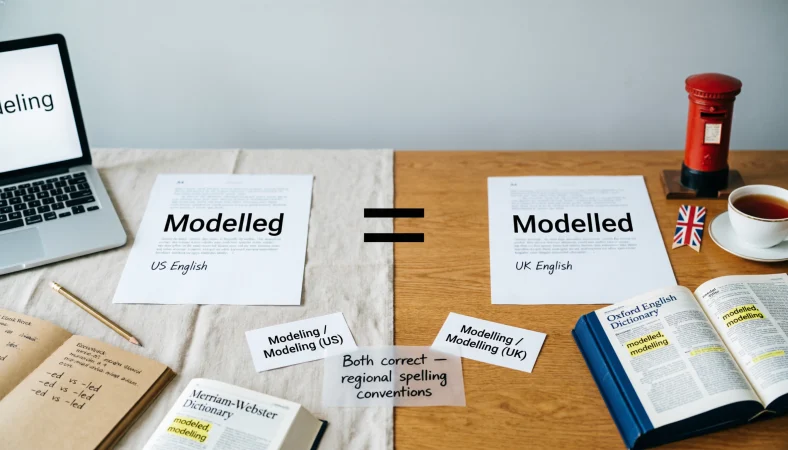
Modeled and modelled are both correct spellings of the past tense and past participle of the verb “model.” Modeled is the standard spelling in American English, while modelled is preferred in British English and many other varieties that follow British spelling conventions. The difference is mainly regional spelling, not meaning or pronunciation.
If you have ever wondered whether modeled or modelled is the correct spelling, the answer depends largely on which variety of English you are writing in. Both forms describe the same action: creating a representation, serving as an example, or displaying something as a model.
In American English, modeled is the usual spelling. In British English, modelled is generally preferred. The distinction comes from different conventions for forming past tense and participle forms of verbs ending in a single consonant preceded by a vowel.
This small spelling difference can cause real mistakes in school assignments, professional documents, academic papers, websites, and international communication. A writer may use American spelling throughout an article and then accidentally switch to the British form. Conversely, someone writing for a British audience may use the American form and unintentionally create an inconsistent style.
The good news is that there is no need to memorize two different meanings. The words mean the same thing. You simply need to choose the spelling that matches your audience, publication style, or preferred variety of English.
Modeled vs Modelled: What’s the Difference?
Modeled and modelled are both verb forms of model. They are the simple past tense and past participle forms of the verb.
The difference is spelling convention rather than meaning.
In American English, writers commonly use modeled with one final l before the ending.
In British English, writers commonly use modelled with two final l letters before the ending.
The distinction also appears in related forms. American English generally uses modeling, while British English generally uses modelling.
Quick Recap
Modeled is the standard American spelling.
Modelled is the standard British spelling.
Both forms have the same meaning.
The difference is primarily regional and stylistic.
Choose one spelling system and use it consistently.
Is Modeled vs Modelled a Grammar, Vocabulary, or Usage Issue?
This is mainly a spelling and usage issue, rather than a difference in grammar or vocabulary.
Both words come from the same verb, model, and both can function as the past tense or past participle.
Consider these sentences:
The architect modeled the building in three dimensions.
The architect modelled the building in three dimensions.
The meaning is identical. The spelling changes because the writer is following a different English convention.
Are They Interchangeable?
In terms of meaning, yes.
In terms of spelling preference, not always.
If you’re writing for an American publication, modeled will normally look more natural. If you’re writing for a British publication, modelled will generally be expected.
The same principle applies to related words such as:
modeling and modelling
labeled and labelled
canceled and cancelled
traveled and travelled
These differences are especially important in professional editing because consistency often matters as much as individual spelling choices.
Formal vs Informal Usage
There is no meaningful difference in formality between the two spellings.
Neither word is more professional or more academic simply because it has one l or two.
The appropriate choice depends on the English variety being used.
For example, an American scientific journal may use modeled, while a British academic publication may use modelled.
Academic vs Casual Usage
Academic writers should follow the spelling conventions required by their institution, publisher, journal, or style guide.
Casual writers have more flexibility, but consistency is still useful.
If the rest of your article uses American spelling, suddenly writing modelled can make the text look edited from multiple sources.
How to Use Modeled Correctly
Modeled is the preferred form in American English.
It can describe several different actions depending on context.
Workplace Example
The marketing team modeled customer behavior using historical sales data.
Here, modeled means created a representation or simulation of something.
Another example is:
The manager modeled effective communication during the meeting.
In this sentence, modeled means demonstrated behavior that others could imitate.
Academic Example
The researchers modeled the spread of the disease using statistical data.
Here, the researchers created a mathematical or statistical representation of a real world process.
Another example is:
The experiment modeled the effects of increased temperature on plant growth.
Again, the word describes representation rather than imitation.
Technology Example
Engineers modeled the new bridge using computer software.
In technology and engineering, modeling often involves creating a digital representation of an object, environment, system, or process.
Usage Recap
Use modeled when following American English spelling conventions.
It works naturally in professional, academic, scientific, creative, and technical writing.
Its meaning does not change depending on the context.
How to Use Modelled Correctly
Modelled is the preferred form in British English and is also common in other English varieties influenced by British spelling.
It has exactly the same meanings as modeled.
Workplace Example
The consultant modelled the company’s expected revenue growth.
The consultant created a representation of potential financial performance.
Another example:
The supervisor modelled the behavior expected from new employees.
Here, modelled means demonstrated behavior.
Academic Example
The researchers modelled the relationship between income and educational attainment.
This is standard British academic usage.
A British university student would generally be expected to write modelled rather than modeled when following British spelling conventions.
Technology Example
The engineers modelled the aircraft using advanced computer software.
The sentence describes digital or mathematical representation.
Usage Recap
Use modelled when following British English conventions.
The word has the same pronunciation and meaning as modeled.
The extra l reflects a spelling convention, not a change in definition.
When You Should NOT Use Modeled or Modelled
The main mistake isn’t choosing one spelling over the other. The bigger mistake is using the wrong form for your chosen variety of English.
Here are common situations where you should be careful.
1. Do Not Mix Spelling Systems Randomly
If your document consistently uses American spelling, switching from modeled to modelled can create unnecessary inconsistency.
2. Do Not Assume Modelled Is More Correct
The additional l does not make the British form more grammatically correct.
3. Do Not Assume Modeled Is Always Correct
The American form isn’t universally preferred. British publications normally use modelled.
4. Do Not Change the Meaning
Neither spelling means something different.
5. Do Not Apply One Rule to Every English Variety
Spelling conventions vary between American and British English.
6. Do Not Mix Modeling and Modelling Without a Reason
The same regional convention generally applies to the present participle.
7. Do Not Ignore a Required Style Guide
Academic publishers and professional organizations may specify which spelling system you should follow.
8. Do Not Correct British Writing Into American English Automatically
If a British writer uses modelled, that is not a spelling error.
Common Mistakes and Decision Rules
| Correct Sentence | Incorrect Sentence | SEO-Friendly Explanation |
|---|---|---|
| The American team modeled the system. | The American team modelled the system. | Modeled is the standard American English spelling. |
| The British team modelled the system. | The British team modeled the system. | Modelled is the standard British English spelling. |
| The researchers modeled the results. | The researchers modelled the results. | American English typically uses one l in modeled. |
| The researchers modelled the results. | The researchers modeled the results. | British English typically uses two l’s in modelled. |
| She modeled the behavior. | She modelled the behavior. | Modeled follows the usual American English spelling convention. |
| She modelled the behaviour. | She modeled the behavior. | Modelled and behaviour follow common British English spelling conventions. |
Decision Rule Box
- If you are writing in American English, use modeled.
- If you are writing in British English, use modelled.
- If you are unsure, identify the spelling convention used by your audience or publication and follow it consistently.
Modeled and Modelled in Modern Technology and AI Tools
The word model has become especially important in technology because modern computing relies heavily on models.
In artificial intelligence, machine learning systems are often described as models because they represent patterns learned from data.
For example:
The researchers modeled customer demand using historical information.
In British English, the same sentence would normally use:
The researchers modelled customer demand using historical information.
The distinction remains purely orthographic.
The technology does not change the spelling rule.
This is particularly useful to remember because AI and technology writing frequently uses the word model in several different senses.
A mathematical model represents relationships.
A computer model represents a system.
A statistical model represents patterns in data.
An AI model processes information according to learned patterns.
A physical model represents a real object.
In each case, the past tense follows the spelling convention of the English variety being used.
Why Does American English Use Modeled?
The spelling difference is connected to broader conventions governing words that end in a consonant preceded by a vowel.
American English often uses a single final consonant in forms such as modeled, labeled, and traveled.
British English commonly doubles the final consonant in these forms, producing modelled, labelled, and travelled.
This does not mean every word follows an identical rule without exceptions. English spelling has developed through several historical influences, and individual words can have their own established conventions.
That is why it is better to learn the regional spelling pattern rather than trying to create a universal rule from a single example.
A Short Etymology of Model
The English word model ultimately traces back through French and Italian to Latin roots associated with a measure, standard, or pattern.
The word developed into the modern sense of something that represents another thing or serves as an example.
Over time, model became both a noun and a verb.
As a noun, it can describe a representation, example, design, or person who displays clothing.
As a verb, it can mean to represent something, create a simulation, demonstrate behavior, or serve as an example.
The spelling difference between modeled and modelled developed as English spelling conventions diverged across regions.
An Expert Style Insight
“When two spellings carry the same meaning, consistency with your chosen variety of English is more important than treating one regional form as universally correct.”
This is best understood as a practical editorial principle rather than a quotation attributed to a particular linguist.
Two Practical Case Studies
Case Study 1: An American Research Paper
Imagine an American university student writing a paper about climate simulations.
The student writes:
The researchers modeled future temperature patterns using historical climate data.
The spelling modeled fits American English.
If the rest of the paper also uses forms such as analyze, behavior, and center, the spelling system is internally consistent.
Changing the word to modelled would not make the sentence grammatically wrong, but it could introduce an unnecessary British spelling into an otherwise American document.
Case Study 2: A British Technical Report
Now imagine a British engineering firm preparing a report.
The writer produces:
The engineers modelled the structural response of the building under heavy loads.
The spelling modelled fits British English.
If the document also uses modelling, behaviour, and optimisation, the spelling system is consistent.
Changing modelled to modeled would introduce American spelling into the document.
The concrete lesson from both cases is the same: consistency creates a polished professional style.
Error Prevention Checklist
Always Use Modeled When
- You are writing in American English.
- Your publication follows American spelling.
- Your audience expects American English.
- Your document already uses forms such as labeled, traveled, and canceled.
- Your organization has an American English style guide.
Always Use Modelled When
- You are writing in British English.
- Your publication follows British spelling.
- Your audience primarily uses British English.
- Your document already uses forms such as labelled, travelled, and cancelled.
- Your organization has a British English style guide.
Never Use Modelled When
You are required to follow a strict American English style guide and consistency matters.
Never Use Modeled When
You are required to follow a strict British English style guide and consistency matters.
Related Grammar Confusions You Should Master
Once you understand modeled or modelled, several similar spelling questions become easier.
Labeled or Labelled
American English generally uses labeled, while British English generally uses labelled.
Modeling or Modelling
American English generally uses modeling, while British English generally uses modelling.
Traveled or Travelled
American English generally uses traveled, while British English generally uses travelled.
Canceled or Cancelled
American English generally favors canceled, while British English commonly uses cancelled.
Signaled or Signalled
American English commonly uses signaled, while British English commonly uses signalled.
Fueled or Fuelled
American English commonly uses fueled, while British English generally uses fuelled.
Leveled or Levelled
American English commonly uses leveled, while British English generally uses levelled.
Marveled or Marvelled
American English commonly uses marveled, while British English generally uses marvelled.
Dialed or Dialled
American English commonly uses dialed, while British English generally uses dialled.
Equaled or Equalled
American English commonly uses equaled, while British English commonly uses equalled.
Frequently Asked Questions
Is modeled or modelled correct?
Both are correct. Modeled is generally preferred in American English, while modelled is generally preferred in British English and other varieties that follow British spelling conventions.
Is modeled American or British English?
Modeled is the standard spelling in American English. British English generally uses modelled.
Is modelled British spelling?
Yes. Modelled is the common British spelling of the past tense and past participle of model.
What is the difference between modeled and modelled?
There is no difference in meaning. The difference is spelling. American English generally uses modeled, while British English generally uses modelled.
Is modeling or modelling correct?
Both are correct. American English generally uses modeling, while British English generally uses modelling.
Why does British English double the l in modelled?
British spelling conventions commonly double the final consonant in certain forms of words such as modelled and travelled. American English often uses a single final consonant in these forms.
Should I use modeled or modelled in academic writing?
Use the form required by your academic institution, journal, publisher, or style guide. If no specific rule exists, choose the English variety appropriate for your audience and remain consistent.
Is modeled a real word?
Yes. Modeled is a standard English word and is the normal American spelling of the past tense and past participle of model.
Is modelled a real word?
Yes. Modelled is a standard English word and is the normal British spelling of the past tense and past participle of model.
Can I use modeled in British English?
You may encounter modeled in British writing, especially in international or American influenced contexts, but modelled is the conventional British spelling.
Conclusion
The choice between modeled or modelled is straightforward once you identify your English variety.
Use modeled for American English.
Use modelled for British English and other varieties that generally follow British spelling conventions.
Neither spelling is inherently more correct. Neither changes the meaning of the verb. The real issue is consistency.
If you’re writing an American article, report, essay, or website, modeled is usually the safest choice. If you’re writing for a British audience, modelled is normally the better option.
The same principle extends to related forms such as modeling and modelling, as well as many other words whose spellings differ between American and British English.
When in doubt, check your audience, check the relevant style guide, and then stick with one spelling system from beginning to end. That simple habit will prevent most spelling inconsistencies and make your writing look considerably more polished.