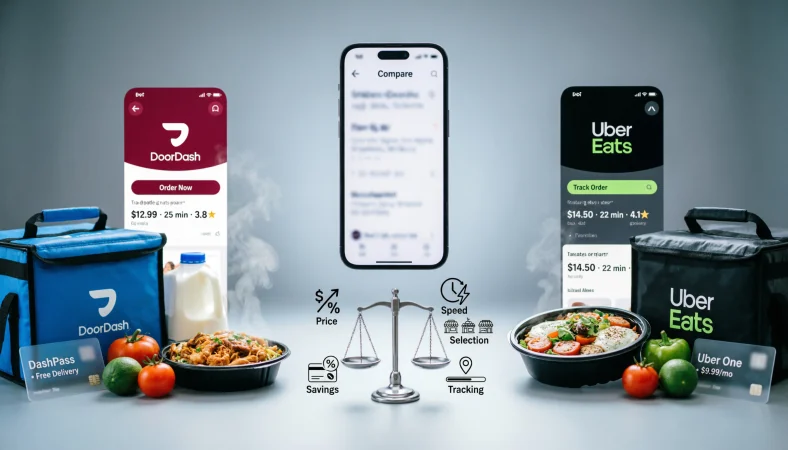
DoorDash and Uber Eats are two major food delivery platforms, but neither is universally better. The right choice depends on restaurant selection, delivery fees, membership benefits, promotions, delivery speed, and what is available in your area. Comparing the final checkout price for the same order is usually the most reliable way to choose.
When people search for DoorDash or Uber Eats, they are usually asking a practical question: which service gives better value, more restaurants, faster delivery, or a better overall ordering experience?
DoorDash and Uber Eats operate in the same broad food delivery market, but their strengths can differ significantly depending on location and order type.
DoorDash connects customers with restaurants, grocery stores, convenience stores, and other merchants through its marketplace. Uber Eats provides restaurant and grocery delivery while also connecting its food delivery service with the broader Uber ecosystem.
That distinction matters because the cheapest option isn’t always the one with the lowest advertised delivery fee. Your actual cost can depend on the restaurant, order size, distance, service fees, taxes, promotions, membership status, and even the particular time you place the order.
As of 2026, DoorDash remains the larger US food delivery platform by transaction share. Consumer Edge reported that DoorDash held 60.7 percent of the US food delivery market at the end of 2024, compared with 26.1 percent for Uber Eats. However, the national numbers don’t tell the whole story. In New York City, the two services were almost tied, while Los Angeles was similarly competitive. (Consumer Edge)
So, instead of asking which app is always better, a smarter question is: Which service gives me the better restaurant, price, delivery time, and membership value for this particular order?
DoorDash vs Uber Eats: What’s the Difference?
At the most basic level, both platforms perform a similar function. They allow customers to browse participating businesses, place orders digitally, pay through the platform, track delivery, and receive food or other products.
The major differences appear in selection, pricing, memberships, promotions, geographic strength, and the wider ecosystem surrounding each service.
| Feature | DoorDash | Uber Eats |
| Primary service | Food and local commerce delivery | Food and local commerce delivery |
| Delivery network | Dashers | Uber delivery couriers |
| Membership | DashPass | Uber One |
| Broader ecosystem | Food, groceries, convenience and local commerce | Food, groceries, delivery and Uber rides |
| Delivery fee | Varies by merchant and order | Varies by merchant and order |
| Service fee | Varies by order | Varies by order |
| Membership advantage | $0 delivery fees and reduced service fees on eligible orders | $0 delivery fees and membership savings on eligible orders |
| US market position | Larger national share | Second major national platform |
| Best comparison method | Compare final checkout price | Compare final checkout price |
DoorDash says its updated US fee structure considers factors such as distance and order size. The company announced in July 2026 that more than 70 percent of recent orders in its analyzed sample would have had the same or lower fees under its new model, with a median potential saving of $0.78 per order. (DoorDash)
Uber One similarly provides benefits on qualifying orders, including $0 delivery fees and service fee savings, although eligibility, minimum order requirements, and other conditions apply. (Uber Eats)
Quick Recap
DoorDash has the larger US market share.
Uber Eats can be highly competitive in individual cities.
Membership benefits can substantially change the final price.
The same restaurant may cost different amounts on each platform.
Your local availability matters more than national rankings.
Is DoorDash vs Uber Eats a Price, Service, or Usage Issue?
Choosing between these platforms isn’t simply a matter of asking which company has lower prices.
It is better understood as a local service and value comparison.
The final amount you pay can vary according to several factors.
Restaurant Availability
A restaurant may appear on one platform but not the other.
Even when both apps carry the same restaurant, menus, prices, promotions, estimated delivery times, or available ordering options can differ.
This makes restaurant availability one of the first things worth checking.
Delivery Fees
Delivery fees are not fixed across all orders.
DoorDash says delivery fees can vary by merchant, while its service fee can vary according to factors including distance and order size. (DoorDash)
Uber Eats also applies different fees and eligibility conditions depending on the order and merchant.
Membership
Frequent customers should compare memberships rather than individual delivery fees alone.
DoorDash currently lists DashPass at $9.99 per month or $96 per year in the United States, with $0 delivery fees and reduced service fees on eligible orders. (DoorDash)
Uber One currently lists its US membership at $9.99 per month or $96 per year, with benefits including $0 delivery fees on eligible orders, discounts on eligible deliveries and pickup orders, and benefits connected with eligible Uber rides. (Uber Eats)
The actual value depends on how frequently you order and whether your preferred merchants participate.
DoorDash: When Is It the Better Choice?
DoorDash can be particularly attractive for customers who regularly order from a wide range of local businesses or who want food delivery combined with grocery and convenience shopping.
The company describes its marketplace as covering restaurants, groceries, convenience products, and other local goods. (DoorDash)
Workplace Example
Imagine an employee ordering lunch for six coworkers.
The important factors aren’t simply the advertised delivery fee. The customer should check the group order total, restaurant availability, estimated arrival time, service charges, and available promotions.
If DoorDash offers the preferred restaurant at a lower final price, it becomes the more practical choice.
Academic Example
Students often care about affordability.
A student ordering a small meal may find that membership savings do not justify a subscription. Someone ordering several times every week may reach a different conclusion.
The important lesson is that membership value depends on usage frequency.
Technology Example
DoorDash provides real time order tracking through its platform, allowing customers to follow the progress of their orders. (DoorDash)
Its technology also extends beyond restaurant delivery. DoorDash promotes grocery, convenience, and other local commerce categories.
Usage Recap
DoorDash can be especially appealing when it has better local restaurant coverage, better promotions, or a lower final checkout total.
It is also worth considering for customers who use food, grocery, and convenience delivery regularly.
Uber Eats: When Is It the Better Choice?
Uber Eats has a major advantage for people who already use the wider Uber ecosystem.
It combines food delivery benefits with eligible ride benefits, making the membership structure particularly relevant for customers who use both services. (Uber Eats)
Workplace Example
Consider someone who frequently travels for work.
If that person uses Uber for transportation and Uber Eats for meals, a single membership can provide benefits across both activities.
That broader ecosystem may make Uber One more attractive than a food delivery membership considered in isolation.
Academic Example
A student who primarily orders food may compare individual delivery prices.
However, a student who also uses Uber rides could place more value on a membership that connects delivery and transportation benefits.
The best option therefore depends on the complete pattern of use.
Technology Example
Uber Eats benefits from its connection to Uber’s larger technology platform.
Customers can manage food delivery and transportation services within the broader Uber environment.
This integration is one of the most important differences between the two companies.
Usage Recap
Uber Eats can be particularly attractive to existing Uber customers.
Its membership can make more sense when you use both food delivery and eligible transportation services.
Still, restaurant availability and order pricing should be checked before every major purchase.
When You Should NOT Choose DoorDash or Uber Eats Automatically
There are several situations where blindly choosing one platform can cost you more.
1. When You Haven’t Compared the Final Total
The delivery fee alone doesn’t tell you what the order will cost.
Always check the amount immediately before payment.
2. When a Restaurant Is Available on Both Platforms
If the same restaurant appears on both services, comparing them can take less than a minute and may reveal a meaningful price difference.
3. When You Order Infrequently
A membership may not save enough money if you only order once every few weeks.
4. When You Already Have a Membership
If you already subscribe to one service, the other platform may not provide enough additional value to justify switching.
5. When Delivery Time Matters Most
The cheapest order isn’t useful if it arrives significantly later than another available option.
6. When a Promotion Looks Better Than It Actually Is
A discount may apply only to the food subtotal and not to taxes or other charges.
7. When the Restaurant Sets Different Prices
Menu prices can vary between platforms. A lower delivery fee doesn’t necessarily mean a lower total.
8. When Your Favorite Restaurant Has a Preferred Platform
Availability and fulfillment quality can outweigh a small price difference.
Common Mistakes and Decision Rules
| Correct Approach | Incorrect Approach | Explanation |
| Compare the final checkout total | Compare only delivery fees | Other charges can change the total |
| Compare the same restaurant on both apps | Assume one platform is always cheaper | Prices and promotions change |
| Check membership eligibility | Assume membership applies everywhere | Benefits depend on qualifying merchants and orders |
| Check estimated delivery time | Choose solely by price | Faster delivery can matter more |
| Compare restaurant selection locally | Rely only on national rankings | Local markets can differ significantly |
Decision Rule Box
- If price is your priority, compare the final checkout total.
- If speed is your priority, compare the current delivery estimates.
- If you order frequently, compare membership savings.
- If selection is your priority, compare the restaurants available in your area.
- If you already use Uber for rides, consider the combined value of Uber One.
DoorDash and Uber Eats in Modern Technology and AI Tools
Food delivery platforms increasingly depend on sophisticated technology.
Both services use digital marketplaces, location technology, payment systems, order management, routing, customer communication, and delivery tracking.
Artificial intelligence can also play a role in modern delivery systems. Large delivery marketplaces can use data to improve matching, estimate arrival times, organize logistics, personalize recommendations, and help manage demand.
For customers, the most visible technological benefit is usually convenience.
You can browse a restaurant, customize an order, pay electronically, receive status updates, and monitor delivery without calling the restaurant.
The underlying systems are considerably more complicated than the simple interface suggests.
Membership Comparison: DashPass vs Uber One
Membership can completely change the economics of food delivery.
DoorDash says DashPass provides $0 delivery fees and reduced service fees on eligible restaurant, grocery, convenience, and other orders. Its current listed US price is $9.99 monthly or $96 annually. (DoorDash)
Uber One currently lists a US price of $9.99 monthly or $96 annually. Its listed benefits include $0 delivery fees on eligible orders, up to 10 percent off eligible deliveries and pickup orders, and 6 percent Uber Cash back on eligible rides. (Uber Eats)
These benefits come with conditions.
For example, Uber says benefits are available only at eligible participating merchants, and minimum order requirements can apply. (Uber Eats)
That means a subscription should never be judged by its headline benefit alone.
Which Membership Is Better?
- If you primarily order restaurant and grocery deliveries, compare DashPass and Uber One based on your actual merchants.
- If you also use Uber rides regularly, Uber One can offer broader value.
- If your favorite restaurants provide stronger DashPass benefits, DashPass may be the better choice.
The winner is therefore dependent on your personal ordering pattern.
Authority and Trust: What the Numbers Tell Us
National market share provides useful context.
Consumer Edge reported that DoorDash held 60.7 percent of US food delivery share at the end of 2024, while Uber Eats held 26.1 percent. (Consumer Edge)
However, the same research demonstrates why national statistics should not be treated as a universal answer.
In New York City, DoorDash had 38.4 percent and Uber Eats had 38.2 percent at the end of 2024. In the Los Angeles market, DoorDash had 41.8 percent and Uber Eats had 41.9 percent. (Consumer Edge)
That is a useful reminder: the strongest national platform may not be the strongest option in your city.
Two Practical Case Studies
Case Study 1: The Frequent Restaurant Customer
Imagine a customer who orders dinner four times a week.
Suppose that customer regularly uses eligible merchants and would otherwise pay delivery charges on many orders.
A membership could potentially provide substantial savings over time.
DoorDash reported in 2024 that DashPass members had collectively saved more than $10 billion globally since the service launched in 2018. (DoorDash)
This doesn’t mean every customer will save money. Individual savings depend on qualifying orders and actual usage.
The practical result is that frequent users have a much stronger reason to calculate membership value.
Case Study 2: The Customer Who Compares Both Apps
Consider someone ordering the same meal from a restaurant available on both services.
The customer checks the restaurant menu, food subtotal, delivery fee, service charges, promotion, estimated delivery time, and final total on each platform.
This approach is more reliable than assuming one company always wins.
The comparison becomes particularly important because DoorDash announced in July 2026 that its updated fee structure was designed around delivery effort and that more than 70 percent of sampled recent orders would have had the same or lower fees under the new model. (DoorDash)
The concrete lesson is simple: delivery economics change, so compare the actual order rather than relying on old assumptions.
Which Is Cheaper: DoorDash or Uber Eats?
There is no permanent winner.
One restaurant may be cheaper on DoorDash today and cheaper on Uber Eats tomorrow.
Promotional campaigns can change the result. Membership status can change it again. Distance, order size, restaurant pricing, taxes, and service fees can also affect the final amount.
The most reliable method is to build the same cart on both platforms and compare the final checkout totals.
This is especially useful for larger orders because even a modest percentage difference can become noticeable when the food subtotal is high.
Which Has More Restaurants?
Nationally, DoorDash has the larger US market share, suggesting a broad marketplace footprint. (Consumer Edge)
But restaurant availability is local.
A customer in one city might find a favorite independent restaurant only on DoorDash. Another customer may discover that a preferred restaurant offers a better experience through Uber Eats.
Therefore, asking which platform has more restaurants is less useful than asking:
Which platform has more of the restaurants I actually want to order from?
That is the more practical measure.
Which Is Better for Groceries and Convenience Items?
DoorDash has expanded beyond traditional restaurant delivery and explicitly offers groceries and convenience products through its marketplace. (DoorDash)
Uber Eats also offers food and grocery delivery in eligible markets.
For customers who frequently order household products, snacks, groceries, or other local goods, compare availability and membership benefits rather than focusing exclusively on restaurant delivery.
Related Food Delivery Comparisons You Should Understand
If you’re comparing delivery platforms, these related questions are also useful:
- DoorDash vs Grubhub
- Uber Eats vs Grubhub
- DoorDash vs restaurant direct delivery
- Uber Eats vs restaurant direct ordering
- DashPass vs Uber One
- Delivery fee vs service fee
- Pickup vs delivery
- Restaurant menu price vs app menu price
- Food delivery membership value
- Best food delivery app for local restaurants
Understanding these factors gives you a more complete picture than simply choosing whichever app you recognize first.
Frequently Asked Questions
Is DoorDash or Uber Eats cheaper?
Neither is consistently cheaper for every order. The final price depends on restaurant pricing, delivery fees, service fees, promotions, order size, distance, and membership benefits. Comparing the final checkout totals for the same order is the most reliable method.
Is DoorDash better than Uber Eats?
DoorDash may be better for some customers because of local restaurant selection, promotions, grocery availability, or membership benefits. However, Uber Eats can be better for customers who already use Uber or find stronger local prices and availability there.
Does DoorDash have more restaurants than Uber Eats?
DoorDash has a larger US food delivery market share, but national market share does not necessarily mean it has more restaurants in every city. Local restaurant availability can differ substantially.
Which has lower delivery fees, DoorDash or Uber Eats?
There is no universal winner. Delivery fees can vary according to merchant, distance, order size, membership status, and other factors. Check the final price for your specific order.
Is DashPass better than Uber One?
It depends on how you use the services. DashPass may be more valuable for frequent DoorDash customers, while Uber One can be particularly attractive to people who use both Uber Eats and eligible Uber rides.
Which is better for restaurants, DoorDash or Uber Eats?
Restaurants may choose different platforms depending on their local customer base, fees, tools, and business strategy. For customers, the most important question is which service offers the restaurant with the best price, availability, and delivery experience.
Does Uber One include Uber Eats?
Yes. Uber One provides benefits for eligible Uber Eats orders as well as certain eligible Uber rides. The exact benefits and eligibility requirements can vary by market and merchant. (Uber Eats)
Conclusion
The answer to DoorDash or Uber Eats isn’t a permanent winner.
DoorDash currently has the stronger national US market position, while Uber Eats remains a major competitor and can be extremely strong in particular cities. Consumer Edge’s 2024 data illustrates this clearly: DoorDash led nationally, yet the two platforms were almost tied in New York City and Los Angeles. (Consumer Edge)
For frequent DoorDash customers, DashPass can provide meaningful value through eligible delivery and service fee benefits. For people who use both food delivery and Uber rides, Uber One may offer a broader membership proposition. (DoorDash)
But memberships shouldn’t be the only deciding factor.
Restaurant selection, food prices, delivery time, promotions, distance, fees, and local availability all matter.
The smartest strategy is simple: compare the same order on both platforms and choose the option with the best combination of final price, delivery time, restaurant availability, and membership value.
In other words, don’t ask which app is always better.
Ask which app is better for this order, at this restaurant, in your location, right now.