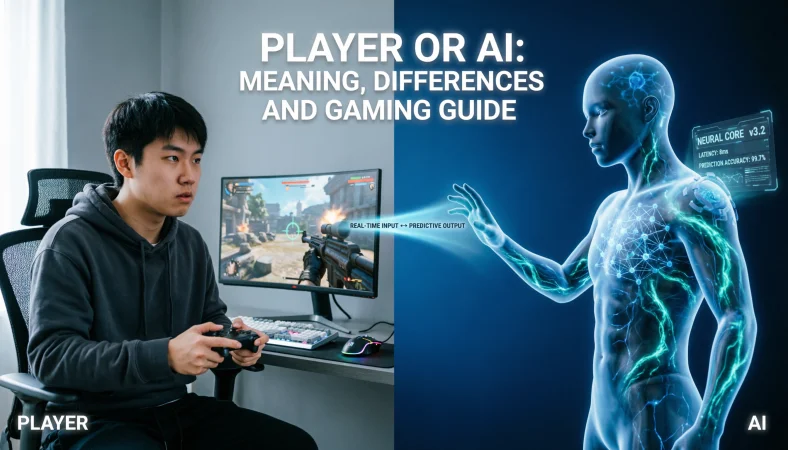
Player or AI usually refers to whether a person is controlling a character or whether a computer system is controlling it. A player is a human participant who makes decisions and controls actions, while AI refers to computer controlled behavior generated by programmed systems or artificial intelligence. The distinction matters in gaming, sports simulations, apps, and interactive technology.
The search query “player or ai” is common among people trying to understand whether a character, opponent, teammate, or account in a game is controlled by a real person or a computer. Although the terms seem straightforward, modern games increasingly blur the line between human controlled players, computer controlled characters, bots, and AI powered systems.
A player is generally a person who participates in a game or interactive activity. The word is a noun and can describe someone controlling a character, competing against others, or taking part in a game.
AI, short for artificial intelligence, is also commonly used as a noun. In gaming, it usually refers to computer controlled behavior that allows characters, opponents, teammates, or systems to respond to situations without direct human control.
The confusion creates real mistakes because people sometimes use player, bot, NPC, and AI as if they mean exactly the same thing. They don’t always do so.
A computer controlled character can be called an AI opponent, but not every computer controlled character necessarily uses sophisticated artificial intelligence. Likewise, a player may interact with AI without the character itself being the opponent.
Understanding the distinction becomes especially important in multiplayer games, sports games, strategy titles, role playing games, simulations, and modern applications that use generative AI.
Player Vs AI: What’s The Difference?
A player is a noun referring to a human participant in a game or activity. In gaming, the player usually controls a character, vehicle, team, or other interactive element.
AI is a noun referring to artificial intelligence. In a gaming context, it generally describes computer controlled behavior designed to make decisions, respond to circumstances, or imitate aspects of human behavior.
| Feature | Player | AI |
| Basic meaning | Human participant | Computer based intelligence or automated behavior |
| Part of speech | Noun | Noun |
| Controller | Human | Computer system |
| Decision making | Human decisions | Programmed or learned system decisions |
| Common gaming role | Controls a character or team | Controls opponents, teammates, or NPCs |
| Internet connection | May be required in multiplayer | May operate locally or online |
| Examples | Human opponent, user, gamer | Bot, AI opponent, computer controlled teammate |
| Behavior | Based on human choices | Based on programmed or learned behavior |
The distinction is simple at its core.
A player is a human participant.
AI is a computer based system or behavior.
A game can contain both at the same time.
A human player might compete against an AI opponent.
Quick Recap
A player is normally a person participating in the game.
AI refers to artificial intelligence or computer generated decision making.
A human player can interact with AI controlled characters.
Not every computer controlled character necessarily uses advanced AI.
Is Player Vs AI A Grammar, Vocabulary, Or Usage Issue?
The difference between player and AI is primarily a vocabulary and usage issue, not a grammar problem.
Both words have established meanings, but their meanings overlap in certain gaming conversations. People sometimes say “AI player” to describe a computer controlled opponent, even though the underlying distinction remains between human participation and automated control.
Are Player And AI Interchangeable?
No.
A player generally refers to the human participant, while AI refers to an artificial intelligence system.
Consider this sentence:
The player defeated the AI.
Here, player identifies the human participant and AI identifies the computer controlled opponent.
If you replace player with AI, the meaning changes:
The AI defeated the player.
Now the computer controlled system won against the human participant.
Formal Vs Informal Usage
In casual gaming conversations, people may use several overlapping terms.
Someone might say:
Is that player real?
Another person might answer:
No, it’s AI.
This is perfectly understandable informal language.
In technical writing, however, it is better to be more precise. You might write:
The opponent is controlled by an AI based decision making system.
That wording distinguishes the human participant from the underlying technology.
Academic Vs Casual Usage
Academic writing about games, human computer interaction, or artificial intelligence should distinguish carefully between players, bots, NPCs, and AI systems.
Casual gaming discussions don’t always require such precision.
For example:
I think that player is a bot.
This is normal conversational language, even though “bot” and “AI” aren’t necessarily identical concepts.
How To Use Player Correctly
The word player has a broad meaning. It can refer to someone participating in a sport, game, board game, video game, gambling activity, or other competitive environment.
In video games, player usually identifies the human controlling a character or making decisions.
For example:
The player controls the character using a keyboard and mouse.
The word can also refer to a participant in multiplayer gaming:
The other player joined the match five minutes ago.
Workplace Example
In a game development company, a designer might say:
We need to make the tutorial easier for new players.
Here, players are the people who use the game.
A product manager might also say:
Player feedback shows that the new interface is confusing.
Again, player refers to human users.
Academic Example
A researcher studying video games might write:
The study examined how players respond to different difficulty levels.
Here, players are human research participants.
Technology Example
A game interface might display:
Player 1 has joined the match.
This indicates that a participant has entered the game.
The term can also be used in sports technology. A football simulation, for example, may distinguish between a human controlled player and computer controlled teammates.
Player Usage Recap
Use player when referring to a person participating in a game.
It can describe a human gamer, competitor, or participant.
In multiplayer games, a player generally refers to a human controlled participant unless the context specifies otherwise.
How To Use AI Correctly
AI stands for artificial intelligence. In everyday technology discussions, the abbreviation is commonly used as a noun.
In gaming, AI can refer to systems that control characters, generate responses, adapt behavior, analyze situations, or provide automated assistance.
For example:
The AI controls the opposing team.
Here, AI identifies the computer based system responsible for controlling those characters.
AI can also exist outside gaming. Recommendation systems, voice assistants, image generators, chatbots, fraud detection systems, and autonomous software can all involve artificial intelligence.
Workplace Example
A game studio might say:
The AI team is improving enemy behavior.
In this case, AI may refer either to the technology itself or, depending on context, to the development team responsible for it.
Academic Example
A researcher might investigate:
How AI controlled opponents influence player engagement.
Here, AI controlled opponents are computer controlled entities, while players are human participants.
Technology Example
A modern game may use AI for navigation, opponent tactics, dialogue, animation decisions, or procedural content.
However, the word AI shouldn’t automatically be interpreted as meaning a highly advanced learning system. Many games rely on carefully designed rules, behavior trees, state machines, pathfinding systems, or other traditional techniques.
AI Usage Recap
Use AI when discussing artificial intelligence or computer generated decision making.
AI can control characters, analyze situations, or generate content.
A computer controlled character may be described as AI, although not every automated system uses sophisticated machine learning.
When You Should NOT Use Player Or AI
Several common situations can lead to inaccurate descriptions.
1. Don’t Call Every NPC A Player
An NPC, or non player character, is generally controlled by the game rather than by a human participant.
2. Don’t Assume Every Bot Uses Advanced AI
A bot can be controlled by relatively simple programmed rules. The term AI is often used broadly in gaming.
3. Don’t Call A Human Player AI
A human may behave predictably or use automated tools, but that doesn’t make the person an AI system.
4. Don’t Assume Every AI Character Is A Bot
AI can perform many functions besides controlling an opponent.
5. Don’t Use Player To Mean Any Character
A character can be part of the game world without being controlled by the player.
6. Don’t Treat NPC And AI As Perfect Synonyms
An NPC describes a character’s relationship to the player. AI describes a technological mechanism or behavior system. One describes a role, while the other describes how behavior may be produced.
7. Don’t Assume An Online Opponent Is Human
Some multiplayer games include bots alongside real users.
8. Don’t Assume A Human Like Response Proves Human Control
Modern AI systems can produce remarkably convincing dialogue and behavior. Appearance alone isn’t proof of human participation.
Common Mistakes And Decision Rules
| Correct sentence | Incorrect sentence | Explanation |
| The player defeated the AI. | The AI defeated the AI. | The first sentence clearly identifies a human against a computer controlled opponent. |
| The AI controls the enemy team. | The player controls the enemy team. | If the computer controls the team, AI is the more accurate term. |
| Three players joined the match. | Three AIs joined the match. | Use players when referring to human participants. |
| The player interacts with an AI character. | The player is the AI character. | The human participant and computer controlled character are separate entities. |
| The game uses AI to control opponents. | The game uses players to control opponents. | AI describes the automated decision making system. |
Decision Rule Box
- If you mean the human participant, use player.
- If you mean the artificial intelligence system controlling behavior, use AI.
- If you mean a computer controlled character, use NPC, bot, computer controlled character, or AI character according to the specific context.
- If you mean the person using the game, use player rather than AI.
Player And AI In Modern Technology And AI Tools
The distinction between players and AI has become more important as games and interactive applications have become more sophisticated.
Older games often used predictable computer controlled behavior. Modern systems can combine conventional game programming with machine learning, neural networks, natural language processing, procedural generation, and other techniques.
AI can now help create dialogue, generate environments, analyze player behavior, adjust difficulty, personalize experiences, and support developers.
Yet the presence of AI doesn’t eliminate the role of the player.
In fact, many modern systems are designed around the interaction between the two.
A player provides goals, choices, and actions. An AI system responds to those actions.
This creates a feedback loop in which the human influences the computer system and the computer system changes the environment presented to the human.
Authority And Trust: Understanding The Terms
The word player has a long history in English and comes from the verb “play.” The noun developed naturally to describe someone who plays a game, sport, musical instrument, theatrical role, or other activity.
The abbreviation AI is much newer. It comes from “artificial intelligence,” a term associated with the development of computer systems designed to perform tasks associated with aspects of human intelligence.
The phrase artificial intelligence became established in computing during the twentieth century, particularly following the Dartmouth workshop of 1956, which is widely associated with the formal emergence of AI as an academic field.
A useful expert principle is:
“A player describes who participates; AI describes the technology that performs or supports automated behavior.”
That distinction prevents many common misunderstandings.
Two Practical Case Studies
Case Study One: Human Player Versus Computer Opponent
Imagine a football video game in which one person controls Manchester United while the computer controls Liverpool.
The human is the player.
The computer controlled team is the AI controlled opponent.
If the human scores, you can accurately say:
The player scored against the AI.
The important result is conceptual clarity. The sentence immediately tells the reader who made the decision and who was controlled by the computer.
Case Study Two: AI Teammates In A Multiplayer Game
Now consider a cooperative game designed for four participants. Two people join the match, while the remaining two positions are filled by computer controlled characters.
The two humans are players.
The two automated teammates may be described as AI teammates or bots, depending on how the game implements them.
This distinction matters because a player count could otherwise become ambiguous. Saying “four players” may imply four human participants even though only two people are actually present.
The concrete result of using precise terminology is a clearer description of the game’s actual multiplayer structure.
Player Or AI Error Prevention Checklist
Always Use Player When
- You mean a human participant.
- You are discussing someone controlling a game.
- You are describing a human competitor.
- You are referring to user behavior in a game.
Never Use AI When
- You simply mean a human gamer.
- You are describing a real person participating in a match.
- You are referring to a user providing manual input.
- You are discussing human player feedback.
Always Use AI When
- You mean artificial intelligence.
- A computer system makes automated decisions.
- You are discussing an AI controlled opponent.
- You are describing technology that generates or adapts behavior.
Related Grammar Confusions You Should Master
If you’re learning terminology used in gaming and technology, several related distinctions are worth understanding:
- Player vs NPC
- Bot vs AI
- Human vs computer
- NPC vs playable character
- AI vs machine learning
- Bot vs player
- User vs player
- Character vs avatar
- Online player vs offline player
- Computer controlled vs human controlled
These terms overlap in everyday conversation, but their technical meanings can differ.
FAQs
What does player or AI mean in gaming?
Player or AI usually describes whether a game character or opponent is controlled by a human participant or by a computer based system. A player is human, while AI refers to artificial intelligence or automated decision making.
Is an AI considered a player?
Usually, no. In gaming terminology, a player generally refers to a human participant. A computer controlled character may occupy a similar role in a match but is normally described as AI, a bot, or an NPC.
What is the difference between a player and AI?
A player is a human participant who makes decisions and provides input. AI is a computer based system that can make automated decisions or generate behavior without direct human control.
Is a bot the same as AI?
Not necessarily. A bot is an automated program that performs tasks or controls behavior. Some bots use AI, while others rely on straightforward programmed rules.
Is an NPC the same as AI?
No. NPC means non player character and describes a character that isn’t directly controlled by the player. An NPC may use AI or conventional programmed behavior.
Can AI play a video game?
Yes. AI systems can be designed to control game characters, make strategic decisions, navigate environments, or interact with players.
How can you tell if a player is AI?
The answer depends on the game. Some games identify bots directly, while others reveal them through labels, behavior patterns, match information, or game settings. Human like behavior alone isn’t reliable proof that an opponent is a real person.
Does AI mean computer controlled?
Not always. AI is a broader technological concept. In gaming, AI frequently controls characters or systems, but it can also be used for recommendations, content generation, analytics, or other functions.
Conclusion
The difference between player and AI becomes clear once you focus on who is participating and what technology is controlling the behavior.
A player is normally a human participant. The person makes choices, provides input, and interacts directly with the game.
AI refers to artificial intelligence. In gaming, it can control opponents, teammates, characters, or systems that respond automatically to the player’s actions.
The terms aren’t interchangeable. A human player can compete against AI, cooperate with AI, or use AI powered tools. A computer controlled character can perform a role similar to a player without actually being a human player.
When writing or speaking about games, use player for the human participant and AI for the artificial intelligence system. When greater precision is needed, distinguish among AI, bots, NPCs, and computer controlled characters.
Once you understand these distinctions, conversations about multiplayer games, bots, NPCs, artificial intelligence, and modern gaming technology become much easier to follow.