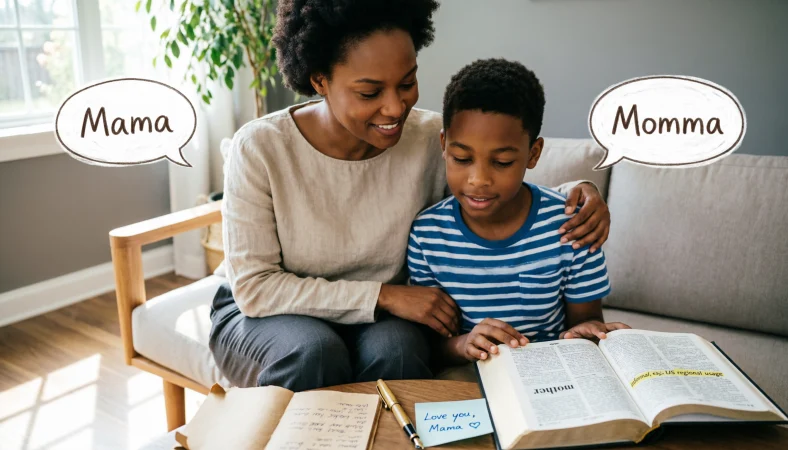
Mama and momma are both informal terms for a mother, but they differ mainly in spelling, pronunciation preference, regional use, and personal style. Mama is more widely recognized and commonly used across English varieties, while momma often has a more colloquial, affectionate, or dialectal feel, particularly in American English. Neither spelling is inherently wrong.
The search query “mama or momma” often comes from people wondering which spelling is correct when referring affectionately to their mother. Both mama and momma are informal nouns used as familiar names or terms of address for a mother. The confusion arises because the words look almost identical, sound similar in many varieties of English, and can appear in songs, family conversations, social media posts, children’s books, and regional speech.
Unlike many spelling questions, this one does not have a simple right versus wrong answer. Mama is an established and widely used form, while momma is also an established informal spelling, especially in American English.
The distinction matters because spelling can communicate voice, dialect, family tradition, age, cultural background, or emotional tone. A writer choosing a word for a personal letter might make a different choice from a journalist writing a formal article.
Understanding the difference helps you choose the form that sounds natural for your intended audience and context.
Mama Vs Momma: What’s The Difference?
Both mama and momma are nouns. They are informal terms for a mother and can also function as terms of address.
Mama is a familiar form of mother found across several English varieties. It is particularly common in family speech and children’s language. It can sound affectionate, warm, traditional, or culturally specific depending on context.
Momma is another informal form of mother. The extra m reflects a spelling that more explicitly represents certain pronunciations of the word. It is particularly associated with American informal speech and can carry a distinctly colloquial or regional tone.
| Feature | Mama | Momma |
| Part of speech | Noun | Noun |
| Basic meaning | Mother | Mother |
| Formality | Informal | Informal |
| Common use | Family speech, affectionate writing, names, songs | Family speech, colloquial writing, American regional usage |
| Spelling | Shorter form | Longer form with an extra m |
| Pronunciation | Usually similar to momma | Usually similar to mama |
| Emotional tone | Warm, affectionate, familiar | Warm, affectionate, colloquial |
| Capitalization | Capitalized when used as a name or direct address | Capitalized when used as a name or direct address |
The two terms share the same fundamental meaning.
Mama is generally the more broadly recognizable spelling.
Momma can sound more conversational or regionally marked.
The best choice often depends on personal preference and the voice you want to convey.
Quick Recap
Mama and momma both mean mother in informal English.
Mama is generally more widespread and versatile.
Momma often has a distinctly colloquial or American flavor.
Neither spelling is automatically incorrect.
Is Mama Vs Momma A Grammar, Vocabulary, Or Usage Issue?
The difference between mama and momma is primarily a vocabulary, spelling, and usage issue, rather than a grammar issue.
Both terms can perform the same grammatical function. The main difference lies in how people spell and use them in different contexts.
Are Mama And Momma Interchangeable?
In many everyday contexts, yes.
For example:
I love my mama.
and
I love my momma.
Both sentences communicate the same basic idea.
However, they aren’t always interchangeable from a stylistic perspective. A particular family may consistently use one spelling. A songwriter may choose one form because it fits the rhythm of a lyric. An author may use momma to create a particular regional voice.
The meaning remains essentially the same, but the social and stylistic impression can change.
Formal Vs Informal Usage
Both mama and momma are informal.
In a formal document, writers would generally use mother rather than either term.
For example:
My mother attended the ceremony.
is appropriate in formal writing.
By contrast:
My mama attended the ceremony.
sounds personal and conversational.
Academic Vs Casual Usage
Academic writing normally uses mother unless the writer is discussing a quotation, cultural expression, linguistic form, literary character, or specific name.
For example:
The poem repeatedly uses the word “mama” to create an intimate voice.
Here, mama is being discussed as a linguistic and literary choice.
In casual conversation, either mama or momma can be natural depending on the speaker’s background.
How To Use Mama Correctly
Mama is an affectionate and familiar word for mother. It can be used when talking about a mother or directly addressing her.
For example:
Mama made dinner for everyone.
Here, mama functions as a noun referring to the speaker’s mother.
It can also appear as direct address:
Mama, can you help me?
When used as a direct name, it is commonly capitalized.
Workplace Example
A workplace conversation might include mama when an employee is talking informally about family:
My mama is visiting this weekend.
This would be natural in a personal conversation but would be less appropriate in formal business writing.
Academic Example
A linguistics researcher could write:
The participant consistently used mama when referring to her mother.
In this case, the word is being analyzed rather than used as the writer’s preferred family term.
Technology Example
Mama can appear in social media usernames, family apps, digital contact names, messaging conversations, and personalized devices.
Someone might save a parent’s contact as:
Mama
This is not a grammatical requirement. It is a personal naming choice.
Mama Usage Recap
Use mama when you want a familiar and affectionate term for mother.
It works naturally in family conversations and personal writing.
It is also suitable when discussing a particular cultural, literary, or linguistic expression.
How To Use Momma Correctly
Momma carries essentially the same core meaning as mama. Its additional letter can give the spelling a more colloquial appearance.
For example:
My momma always told me to be honest.
The sentence is informal and personal.
Momma is especially recognizable in American cultural and regional contexts. It frequently appears in dialogue, storytelling, country music, folk expressions, and representations of Southern or rural speech.
That does not mean every person who uses momma is from a particular region. People may choose the spelling simply because it is familiar to them.
Workplace Example
In casual workplace conversation, someone might say:
My momma taught me never to give up.
The word creates a personal and conversational tone.
In a formal report, however, mother would usually be more appropriate.
Academic Example
A researcher studying American dialects might write:
The speaker’s use of momma contributes to the informal character of the dialogue.
This demonstrates why spelling can matter in linguistic analysis. The word isn’t merely communicating the concept of mother. It can also help represent voice.
Technology Example
Momma may appear in text messages, social media posts, contact names, family group chats, and personalized digital content.
For example:
Good morning, Momma!
The spelling communicates affection and familiarity rather than formal language.
Momma Usage Recap
Use momma when the informal, affectionate, or colloquial style fits your context.
It is especially common in American informal usage.
It can help preserve a speaker’s personal or regional voice.
Mama Or Momma: Regional And Cultural Usage
One of the most interesting aspects of this spelling difference is that language choices can reflect identity and culture.
Mama has broad international recognition. Variants of mama occur in many languages and cultures, often because early childhood speech naturally produces simple sounds such as “ma” and “mama.”
Momma is more closely associated with English, particularly American informal usage.
In American English, speakers may also use mother, mom, mommy, mama, momma, ma, or other family specific terms.
These choices can depend on age, family tradition, geography, culture, and personal preference.
That is why it would be misleading to say that one form is universally more correct.
When You Should NOT Use Mama Or Momma
There are several contexts where neither term is the best choice.
1. Formal Legal Documents
Use mother rather than mama or momma unless the informal wording is part of a quotation or official name.
2. Academic Reports
Formal academic writing generally benefits from precise standard vocabulary.
3. Professional Correspondence
A business email usually calls for mother rather than a highly personal family term.
4. Medical Documentation
Clinical or administrative documents generally use mother for clarity and professionalism.
5. Formal Biographical Writing
Unless you’re intentionally reproducing someone’s voice, mother is usually preferable.
6. Technical Documentation
Technical writing should use precise terminology. Mama and momma are rarely appropriate unless they are part of a product name or example.
7. Formal News Reporting
Journalistic style generally favors mother in neutral reporting, although a direct quotation may preserve mama or momma.
8. When You Need To Preserve A Specific Dialect
If you’re not intentionally representing a speaker’s voice, don’t add momma simply to make dialogue sound regional.
Common Mistakes And Decision Rules
| Correct sentence | Incorrect sentence | Explanation |
| I called my mama last night. | I called my momma last night. | Both can be correct, but the choice depends on personal and stylistic preference. |
| Mama, are you ready? | mama, are you ready? | Capitalization is appropriate when mama functions as a direct name. |
| My mother attended the meeting. | My momma attended the meeting. | Mother is normally better for formal professional contexts. |
| My momma taught me that lesson. | My momma taught me that lesson. | This sentence is already correct; the key issue is whether the informal style fits the context. |
| The novel uses “mama” repeatedly. | The novel uses mama repeatedly. | Quotation marks can distinguish the word being discussed from ordinary usage, depending on editorial style. |
Decision Rule Box
- If you mean the formal relationship, use mother.
- If you mean an affectionate family term, mama or momma can work.
- If you want the more broadly recognizable spelling, choose mama.
- If you want a strongly conversational or colloquial American flavor, momma may be appropriate.
Mama And Momma In Modern Technology And AI Tools
Modern technology has made personal language choices more visible.
People use mama and momma in text messages, social media posts, digital contact names, family group chats, voice assistants, and personalized applications.
AI writing tools can also generate either spelling depending on the requested style. A prompt asking for American Southern dialogue, for example, may produce momma more frequently than a neutral English prompt.
However, writers should not rely on AI alone to determine whether a spelling is culturally appropriate. Context matters.
If you’re writing dialogue for a specific character, the character’s background should influence vocabulary. If you’re writing a neutral article, mama is generally easier for a broad audience to recognize.
Authority And Trust: Why Both Forms Exist
The history of mama is closely connected with the simple syllables used by young children when developing speech. Similar forms appear across many languages, making mama one of the most recognizable family words internationally.
Momma developed as an English spelling that represents an informal pronunciation and provides a fuller visual representation of the repeated consonant sound.
Neither word represents a grammatical error.
Instead, they belong to the large group of informal kinship terms whose usage is shaped by family habits, regional speech, culture, and personal identity.
An Expert Style Principle
“When two informal forms share the same meaning, context and voice often matter more than choosing a single universally correct spelling.”
That principle is especially useful for personal writing and dialogue.
Two Practical Case Studies
Case Study One: Personal Writing
Imagine someone writing a birthday message to their mother.
They write:
Happy birthday, Mama. I hope you know how much I love you.
The use of mama creates warmth and intimacy. Replacing it with mother would make the sentence more formal and emotionally distant.
The concrete result is a change in tone rather than meaning.
Case Study Two: Character Dialogue
Consider a novel featuring a character from a family where momma is the normal household term.
The character says:
Momma always told me to keep my promises.
Changing momma to mother would preserve the literal meaning but could make the character’s speech sound less natural.
The concrete result is that preserving momma helps maintain the character’s voice.
Mama Or Momma Error Prevention Checklist
Always Use Mama When
- You want a familiar and affectionate term for mother.
- You are writing broadly accessible informal English.
- You want a spelling that is widely recognized.
- You are using the word in personal writing or dialogue.
Never Use Momma When
- You are writing a formal legal document.
- You are preparing a technical report.
- Your style guide requires formal standard terminology.
- You are not intentionally representing an informal voice.
Always Use Momma When
- It reflects the speaker’s established family usage.
- You want a distinctly colloquial voice.
- You are preserving a quotation.
- The spelling contributes to characterization.
Related Grammar Confusions You Should Master
If you often encounter questions about informal family vocabulary, these related distinctions are worth learning:
- Mom vs mum
- Mom vs mommy
- Mama vs mother
- Mum vs mummy
- Grandma vs grandmother
- Granny vs grandma
- Auntie vs aunty
- Dad vs daddy
- Papa vs father
- Ma vs mama
These terms often differ more in tone, region, age, and family tradition than in basic meaning.
FAQs
Is mama or momma correct?
Both are correct informal terms for mother. Mama is more broadly recognized, while momma is especially associated with colloquial American usage and personal or regional speech.
Is mama more correct than momma?
No. Mama is more widely used and may be preferable for general audiences, but momma is also an established informal form. Context determines which sounds more appropriate.
What is the difference between mama and momma?
The basic meaning is the same. The main difference is spelling and stylistic association. Mama is broadly used, while momma often has a more colloquial or American regional feel.
Is momma a Southern word?
Momma is strongly associated with some forms of Southern and regional American speech, but it isn’t exclusively Southern. Families and individuals in many places use the spelling.
Is mama formal or informal?
Mama is generally informal and affectionate. In formal writing, mother is normally preferred.
Is momma a real word?
Yes. Momma is an established informal English word meaning mother. It appears in dictionaries and in widespread everyday usage.
Should I write mama or momma in a formal essay?
Usually, neither is preferable unless you are discussing the word itself or reproducing a quotation. In most formal essays, mother is the appropriate term.
Why do people spell mama as momma?
The spelling momma can reflect pronunciation, family tradition, regional speech, or a desire to emphasize the informal character of the word. It is not necessarily a correction of mama.
Is mama American or British?
Mama is used in both American and British English as well as other English varieties. Its exact frequency and cultural associations vary by region and community.
Should mama be capitalized?
Capitalize Mama when it is used as a name or direct form of address, such as “Thank you, Mama.” Use lowercase when it functions as an ordinary noun, such as “Her mama lives nearby,” depending on the style and context.
Conclusion
The choice between mama and momma isn’t really about finding one spelling that defeats the other. Both are established informal terms for mother, and both can be completely natural.
Mama is the safer choice when you want a widely recognized, affectionate, and versatile term. Momma can be especially effective when you want to preserve personal family language, conversational speech, or a distinctly colloquial American voice.
For formal writing, neither is normally necessary. Choose mother when you need neutral and professional language.
The most important rule is to consider your audience and purpose. A birthday message, novel, song, text message, or family conversation allows much more freedom than a legal document or academic report.
In other words, the best answer to the mama or momma question depends on what you want your writing to sound like. If you’re aiming for broad informal usage, mama is a strong choice. If you’re preserving a particular family or regional voice, momma may be exactly right.