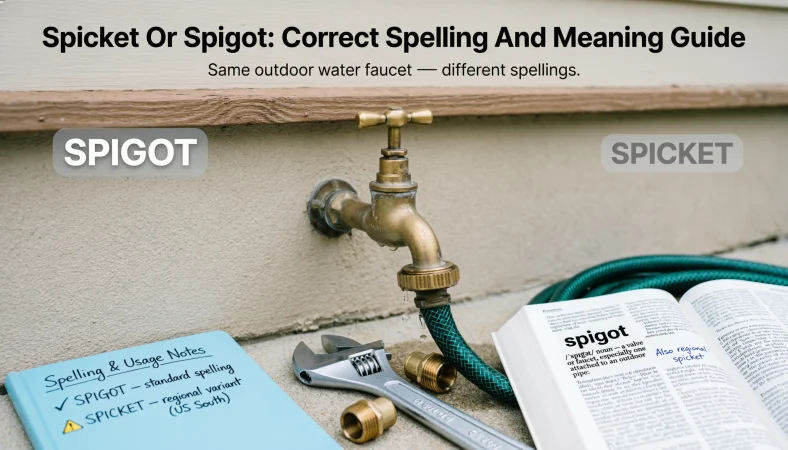
Spicket or spigot refers to the same type of water outlet, but spigot is the standard dictionary spelling, while spicket is a regional and informal variant found in some parts of the United States. If you’re writing formally or want the broadly accepted form, choose spigot. Spicket is understandable but is less standard in edited English.
The question “spicket or spigot” comes up frequently when people are talking about the outdoor faucet attached to a house, garden hose connection, or water supply pipe. You may have heard someone say, “Turn on the spicket,” while seeing the word spigot in dictionaries, hardware guides, plumbing manuals, and product descriptions.
The confusion is understandable because both words are used to describe essentially the same thing in everyday American English.
A spigot is a noun meaning a tap, faucet, or valve that controls the flow of liquid from a pipe or container. An outdoor water faucet is one of the most familiar examples.
Spicket is generally considered a nonstandard or regional variant of spigot. It occurs in informal speech, particularly in some American regional varieties. Because people hear the word before they encounter its written form, they may reasonably assume that spicket is the standard spelling.
That distinction matters when writing instructions, shopping for plumbing equipment, preparing technical documentation, or communicating with a professional.
If you want the safest standard spelling, spigot is the clear choice.
Spicket Vs Spigot: What’s The Difference?
The basic distinction is straightforward.
Spigot is a standard English noun referring to a device that controls the flow of liquid, especially a faucet or valve connected to a pipe.
Spicket is an informal or regional variant of spigot. It has the same practical meaning in the contexts where it is used.
| Feature | Spigot | Spicket |
| Part of speech | Noun | Noun |
| Basic meaning | Faucet, tap, or valve controlling liquid flow | Regional or informal form of spigot |
| Standard status | Standard English | Regional or nonstandard in many contexts |
| Common usage | Plumbing, household, technical, and general writing | Informal regional speech |
| Meaning | Water outlet or valve | Usually the same water outlet or valve |
| Best for formal writing | Yes | Usually no |
| Common context | Outdoor faucet, pipe fitting, water valve | Casual conversation |
| Pronunciation | Commonly pronounced with a hard g sound | Often pronounced like spigot or with regional variation |
The most important takeaway is that spigot is the standard spelling.
Spicket is not usually a completely different object.
In everyday regional speech, spicket can refer to an outdoor faucet or water valve.
Quick Recap
Spigot is the standard spelling.
Spicket is a regional or informal variant.
Both can refer to an outdoor faucet or water valve.
Use spigot in formal, technical, and professional writing.
Is Spicket Vs Spigot A Grammar, Vocabulary, Or Usage Issue?
The distinction between spicket and spigot is primarily a vocabulary, spelling, and regional usage issue.
It isn’t a grammar problem because both forms function as nouns. The main question is which spelling is appropriate in a particular context.
Are Spicket And Spigot Interchangeable?
In everyday regional speech, they can be interchangeable.
If someone says:
Turn off the spicket.
Most listeners who know the regional usage will understand that the person means a water faucet or spigot.
However, in standard edited English, spigot is preferred.
That means the words can be functionally interchangeable in conversation without being equally appropriate in formal writing.
Formal Vs Informal Usage
Spigot works in virtually any context.
For example:
Turn off the outdoor spigot before winter.
That sentence is appropriate for casual conversation, a home maintenance guide, or a professional plumbing article.
Spicket is much more closely associated with informal and regional speech.
A person might naturally say:
The spicket is leaking again.
But a technical manual would generally use:
The spigot is leaking.
Academic Vs Casual Usage
Academic writing should normally use spigot.
For example:
The outdoor spigot was connected to the building’s main water supply.
A regional oral history, literary quotation, or sociolinguistic study might preserve spicket because the purpose is to represent actual speech.
In other words, spicket can be useful when discussing language even though it is less appropriate as the default spelling in formal prose.
How To Use Spigot Correctly
Spigot is the standard term for a faucet or valve that controls liquid flow.
In everyday household language, the most familiar example is an outdoor faucet where a garden hose can be attached.
For example:
I need to replace the leaking spigot outside the garage.
The word can also describe valves used in other contexts involving liquids.
A spigot may be attached to a pipe, tank, barrel, or other container.
Workplace Example
A property manager might write:
Please check the exterior spigot before the landscaping crew arrives.
This is clear and professional.
A maintenance worker could also document:
The rear spigot has a damaged washer and needs repair.
Academic Example
An engineering or plumbing text might discuss how a spigot regulates water flow:
The spigot controls the passage of water through the connected pipe.
Here, the standard vocabulary is appropriate for technical writing.
Technology Example
Smart home systems can interact with water management equipment, including electronically controlled valves and outdoor faucets.
A modern irrigation system might include a valve assembly connected to a water spigot. In a product description, the manufacturer would normally use precise terms such as faucet, valve, hose bib, or spigot according to the actual component.
Spigot Usage Recap
Use spigot when you need the standard term.
It is appropriate in professional, academic, technical, and everyday writing.
It commonly refers to an outdoor water faucet or liquid control valve.
How To Use Spicket Correctly
Spicket is most commonly encountered in informal regional American speech.
For example:
Don’t forget to turn off the spicket.
The meaning is generally clear to speakers familiar with the regional form.
However, if you’re writing instructions for a national audience, spigot is usually the better choice.
That doesn’t mean someone who says spicket is unable to communicate clearly. Language naturally develops regional variations, and many speakers acquire words primarily through conversation rather than dictionaries.
The important distinction is between spoken regional usage and standard written usage.
Workplace Example
A worker might casually tell a colleague:
The spicket behind the building is leaking.
The colleague will probably understand the meaning immediately.
In a written maintenance report, however, the more standard version would be:
The spigot behind the building is leaking.
Academic Example
A linguistics researcher might use spicket deliberately:
The interview participant consistently used the regional form spicket instead of the standard form spigot.
Here, spicket is not an error. It is the subject of linguistic analysis.
Technology Example
A smart irrigation product might be marketed in casual conversation using the word spicket, but formal product documentation would typically use standard terminology such as spigot, faucet, or valve.
Spicket Usage Recap
Spicket is understandable and established in regional informal usage.
It usually refers to the same kind of fixture as a spigot.
Use spigot instead when writing formal, technical, academic, or nationally targeted content.
What Is A Spigot?
A spigot is essentially a device that controls the flow of liquid.
In household plumbing, people most often use the word for an outdoor faucet.
You might find one attached to the exterior wall of a home. It typically has a threaded outlet where a garden hose can be connected.
Depending on the design, an outdoor spigot may include a handle, valve mechanism, threaded hose connection, and protective features.
The term can also be used more broadly for outlets on containers and systems that dispense liquid.
This is why spigot is not necessarily synonymous with outdoor faucet in every technical context.
Is A Spigot The Same As A Hose Bib?
In many everyday situations, people use spigot, hose bib, outdoor faucet, and outside tap to describe the same general fixture.
There can be technical differences depending on the plumbing design.
A hose bib is specifically designed with a threaded connection for attaching a hose.
A spigot can be a broader term for a liquid outlet or valve.
In ordinary household conversation, however, the terms often overlap.
This is another reason why context matters when choosing plumbing terminology.
When You Should NOT Use Spicket Or Spigot
There are several situations where using either word without checking the context can create confusion.
1. Don’t Use Spicket In Formal Technical Documentation
Choose spigot or the more precise technical term instead.
2. Don’t Assume Spicket Is The Standard Spelling
It is common enough to be recognizable, but standard edited English generally favors spigot.
3. Don’t Use Spigot If You Actually Mean A Different Plumbing Component
A valve, hose bib, faucet, tap, and spigot can have overlapping meanings without being technically identical in every context.
4. Don’t Use Regional Speech In National Instructions Without A Reason
A nationally distributed home maintenance guide should favor widely recognized terminology.
5. Don’t Assume Every Water Valve Is A Spigot
The exact component should be identified when technical accuracy matters.
6. Don’t Correct Someone’s Speech Without Considering Regional Usage
A person saying spicket may be using a legitimate regional form rather than making a communication error.
7. Don’t Change A Quotation
If someone said spicket in a recorded interview, preserve the original wording when quoting them unless your editorial rules require otherwise.
8. Don’t Confuse Pronunciation With Standard Spelling
Hearing a word pronounced in conversation does not necessarily tell you its conventional written form.
Common Mistakes And Decision Rules
| Correct sentence | Incorrect sentence | Explanation |
| Turn off the outdoor spigot. | Turn off the outdoor spicket. | Spigot is the standard spelling in edited English. |
| The spigot is leaking. | The spicket is leaking. | The first sentence uses the standard form. |
| We replaced the garden spigot. | We replaced the garden spicket. | Standard technical and household writing favors spigot. |
| The speaker called it a spicket. | The speaker called it a spigot. | When reporting an exact regional usage, preserve the original term. |
| The maintenance guide refers to the spigot. | The maintenance guide refers to the spicket. | Formal instructional writing normally uses spigot. |
Decision Rule Box
- If you mean the standard English term for a liquid outlet or faucet, use spigot.
- If you are reproducing regional or informal speech, spicket may be appropriate.
- If you are writing technical instructions, use the most precise standard plumbing term for the component.
- If you mean an outdoor faucet designed for a garden hose, spigot or hose bib may be appropriate depending on the technical context.
Spicket And Spigot In Modern Technology And AI Tools
The distinction remains relevant in modern technology because smart home systems increasingly interact with household water systems.
Smart irrigation controllers, leak detection devices, automated valves, and water monitoring systems may connect to plumbing fixtures traditionally described as outdoor spigots.
AI based home systems can also analyze water consumption, detect unusual usage patterns, or help homeowners troubleshoot common problems.
However, technology doesn’t eliminate the importance of precise terminology.
An AI assistant may understand that a user asking about a leaking spicket probably means an outdoor spigot. But when generating a professional repair guide, the system should use standard terminology and explain any regional alternatives.
That distinction is particularly important in search optimized content because users may search for either spelling even though the standard answer is spigot.
Authority And Trust: The History Of Spigot
The word spigot has a long history in English and is associated with a faucet or valve used to control liquid flow. Historical sources connect it with forms found in Middle English and Old French, with the word developing over time into its modern plumbing sense.
The regional form spicket is generally understood as a variant that developed through spoken usage. Regional pronunciation and spelling differences are common in English, especially with household vocabulary learned through conversation.
This is an important reminder that a word can be widespread in speech without being the preferred form in edited writing.
An Expert Style Principle
“A regional spelling can be linguistically meaningful without being the preferred spelling for standard written English.”
That distinction allows us to recognize spicket without incorrectly treating it as the standard form.
Two Practical Case Studies
Case Study One: Home Maintenance Instructions
Imagine a homeowner searching for instructions about a leaking outdoor faucet.
They search for “how to fix a leaking spicket” and find a professional guide titled “How to Repair a Leaking Spigot.”
The homeowner has encountered the same fixture under two different spellings.
The concrete result is that understanding the variant allows the homeowner to find the correct information even though their preferred spoken form differs from the standard written term.
Case Study Two: Regional Conversation
Imagine a family in a region where spicket is commonly used.
One family member says:
Turn off the spicket before the temperature drops.
Everyone understands the instruction.
Later, that person searches for replacement parts online and discovers that retailers primarily use the word spigot.
The practical result is that knowing both forms improves search behavior. The regional term remains understandable, while the standard spelling helps locate professional products and documentation.
Spicket Or Spigot Error Prevention Checklist
Always Use Spigot When
- You are writing a professional or SEO-friendly article.
- You are preparing plumbing instructions or how-to guides.
- You are writing academic, technical, or educational content.
- You want to use the standard dictionary spelling.
- You are addressing a broad national or international audience.
- You need the more widely recognized term for an outdoor faucet or water tap.
Avoid Spicket When
- Your style guide requires standard English terminology.
- You are writing technical instructions for plumbing customers.
- You are describing plumbing equipment in formal documentation.
- You are writing content for a broad audience unfamiliar with regional vocabulary.
- You want to avoid confusion between spigot vs. spicket in professional writing.
Use Spicket When
- You are explaining the difference between spigot and spicket in a language or vocabulary article.
- You are intentionally reproducing regional or informal speech.
- You are quoting someone who uses the term spicket.
- You are discussing regional English vocabulary or pronunciation.
- You want dialogue to reflect a particular informal or regional voice.
Related Grammar Confusions You Should Master
Understanding spicket and spigot also opens the door to several related vocabulary and usage distinctions:
- Faucet vs tap
- Spigot vs hose bib
- Faucet vs valve
- Water tap vs outdoor faucet
- Pipe vs hose
- Valve vs spigot
- Sink vs basin
- Drain vs outlet
- Plumbing fixture vs plumbing fitting
- Standard English vs regional English
These distinctions are useful because household vocabulary often varies by country and region.
FAQs
Is spicket or spigot correct?
Spigot is the standard spelling. Spicket is a regional and informal variant that is used in some parts of the United States.
Is spicket a real word?
Yes. Spicket is an established regional form used by some English speakers to refer to a spigot or outdoor faucet. It is less standard than spigot in formal written English.
What is the difference between spicket and spigot?
They generally refer to the same type of water outlet in everyday usage. Spigot is the standard form, while spicket is a regional or informal variant.
Why do people say spicket instead of spigot?
People may say spicket because they learned the word through regional speech or family usage. Regional vocabulary often develops through spoken language and can persist across generations.
Is spigot the correct spelling for an outdoor faucet?
Yes. Spigot is a standard term for an outdoor faucet or other liquid outlet. Depending on the exact plumbing fixture, hose bib or outdoor faucet may also be more precise.
Is spicket an American word?
Spicket is primarily encountered as a regional American variant of spigot. Its frequency varies significantly by region and speaker.
Should I write spicket or spigot in a formal document?
Use spigot in formal writing unless you are specifically quoting someone, documenting regional speech, or discussing the word spicket itself.
Is a spigot the same as a hose bib?
They can refer to the same outdoor plumbing fixture in everyday conversation, although hose bib is a more specific plumbing term for a faucet designed to connect with a hose.
Conclusion
The answer to the spicket or spigot question is straightforward: spigot is the standard spelling, while spicket is a regional and informal variant.
Both terms can refer to an outdoor faucet or liquid outlet, and people who use spicket are generally communicating clearly within communities where that form is familiar.
For formal writing, plumbing instructions, academic work, product descriptions, and professional communication, choose spigot. If you’re quoting regional speech, studying dialect, or writing realistic dialogue, spicket may be exactly the right choice.
The distinction is therefore less about right versus wrong and more about standard versus regional usage.
When searching for plumbing information online, knowing both forms can be useful. You may hear “spicket” in conversation while finding “spigot” in dictionaries, hardware stores, manuals, and technical documentation.
Once you recognize that relationship, the confusion disappears: spigot is the standard form, and spicket is the regional variant.