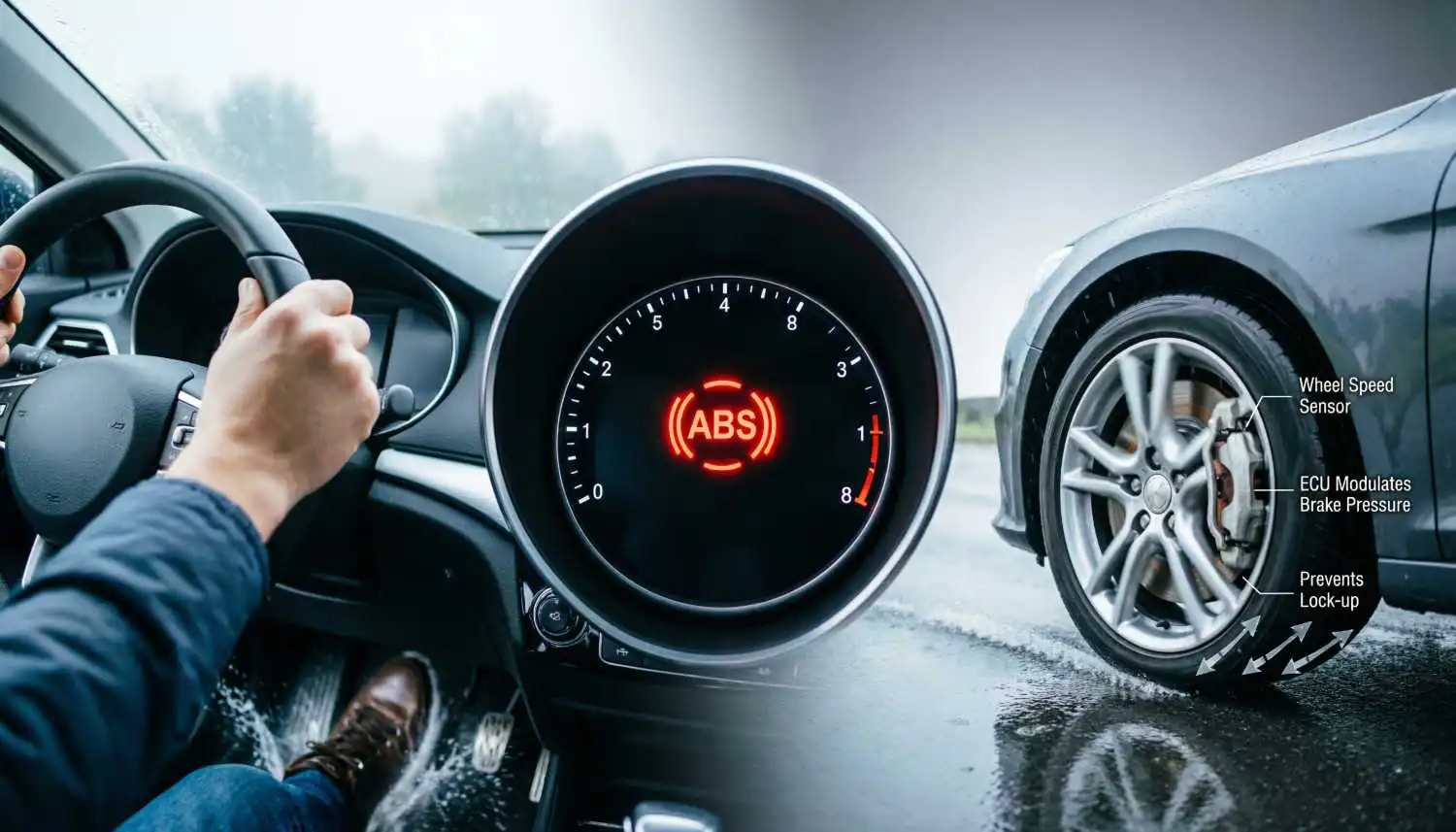
Definition: ABS stands for Anti-lock Braking System, a safety feature in vehicles that prevents the wheels from locking up during hard braking. It helps you maintain steering control and reduces the risk of skidding, especially on slippery roads.
Ever noticed the ABS light flick on your dashboard or heard a rapid pulsing sound when you slam the brakes? That’s not your car malfunctioning. That’s your ABS doing its job.
Understanding what ABS means in a car isn’t just for mechanics or car enthusiasts. It’s essential knowledge for everyday drivers. Whether you’re navigating rainy streets, icy roads, or sudden stops in traffic, ABS plays a major role in keeping you safe.
Modern vehicles rely heavily on safety systems, and ABS is one of the most important. It doesn’t just stop your car. It helps you stay in control while stopping. In this guide, we’ll break down everything you need to know about ABS in a clear, friendly way so you can drive with more confidence and awareness.
Origin
The Anti-lock Braking System wasn’t always standard in cars. Its roots actually go back to aviation.
- 1920s: Early versions of anti-lock braking were used in aircraft to prevent wheels from locking during landing.
- 1970s: The technology began appearing in luxury cars.
- 1980s–1990s: ABS became more widely adopted in passenger vehicles.
- Today: ABS is standard in most modern cars worldwide due to safety regulations.
The evolution of ABS reflects the growing focus on driver safety and accident prevention.
Popularity
ABS has become one of the most recognized safety features in cars.
Why ABS is Popular:
- Improves braking control
- Reduces skidding on wet or icy roads
- Works automatically without driver input
- Required by law in many countries
Today, most drivers expect ABS as a standard feature, just like airbags and seatbelts.
How It Is Used
How ABS Works (Simple Explanation)
When you brake suddenly, your car’s wheels can lock up. This means they stop rotating while the car is still moving, causing a skid.
ABS prevents this by:
- Monitoring wheel speed using sensors
- Detecting when a wheel is about to lock
- Rapidly pulsing the brakes (you may feel this vibration)
- Allowing the wheels to keep rotating slightly
Real-World Example:
- You slam the brakes on a wet road 🚗💦
- Without ABS: Wheels lock → car skids
- With ABS: Brakes pulse → you maintain control and steer safely
Key Features:
- Automatic system
- Works in emergencies
- Enhances steering during braking
Examples
Friendly Examples
- “I felt the pedal vibrate, that must be the ABS kicking in.”
- “Good thing my car has ABS, that stop could’ve been messy.”
Professional Examples
- “The vehicle is equipped with an Anti-lock Braking System for enhanced safety.”
- “ABS ensures optimal braking performance under emergency conditions.”
Funny Examples
- “ABS said nope, we’re not sliding today.” 😄
- “My car really said ‘I got you’ when I hit the brakes.”
Comparison with Similar Terms
| Feature | ABS | Traction Control (TCS) | Electronic Stability Control (ESC) |
| Purpose | Prevents wheel lock during braking | Prevents wheel spin during acceleration | Helps maintain vehicle stability |
| When it works | Braking | Acceleration | Turning or skidding |
| Driver control | Automatic | Automatic | Automatic |
| Main benefit | Better stopping control | Better grip | Prevents loss of control |
Key Takeaway:
- ABS = braking safety
- TCS = acceleration grip
- ESC = overall stability
Alternate Meanings
While ABS in cars means Anti-lock Braking System, the abbreviation can have other meanings depending on context:
- Fitness: Abdominal muscles 💪
- Plastic industry: Acrylonitrile Butadiene Styrene
- Text slang: “Absolutely”
Always consider context. In automotive discussions, ABS almost always refers to the braking system.
Professional or Polite Alternatives
In formal or technical communication, you might see:
- Anti-lock Braking System
- Vehicle braking control system
- Advanced braking safety system
Example:
Instead of saying “ABS kicked in,” a professional might say:
“The Anti-lock Braking System was activated during emergency braking.”
Common Mistakes
1. Thinking ABS Shortens Stopping Distance
Not always true. On loose surfaces like gravel, stopping distance may increase slightly.
2. Pumping the Brakes
With ABS, you should press firmly and hold the brake pedal. The system does the pumping for you.
3. Ignoring the ABS Warning Light
If the ABS light stays on, the system may not work properly.
4. Assuming It Prevents All Skids
ABS helps control, but it doesn’t defy physics. Speed and road conditions still matter.
Quick Tips
- Press and hold the brake firmly during emergencies
- Don’t panic if you feel vibration, it’s normal
- Keep tyres in good condition for ABS to work effectively
- Check the ABS warning light regularly
- Practice emergency braking in a safe area
FAQ
1. What does ABS mean in a car dashboard?
It indicates the Anti-lock Braking System. If the light is on, the system may need checking.
2. Is it safe to drive with the ABS light on?
Yes, but without ABS functionality. Your regular brakes will still work, but safety is reduced.
3. Does ABS work on all surfaces?
It works best on wet or slippery roads but may be less effective on gravel or snow.
4. Why does the brake pedal vibrate?
That’s ABS rapidly applying and releasing brakes to prevent wheel lock.
5. Do all cars have ABS?
Most modern cars do, and it’s mandatory in many countries.
6. Can ABS fail?
Yes, usually due to sensor issues or electrical faults.
7. Does ABS reduce accidents?
Yes, it helps drivers maintain control during sudden braking.
8. Is ABS the same as automatic braking?
No. ABS prevents wheel lock, while automatic braking systems actively apply brakes to avoid collisions.
Conclusion
ABS, or Anti-lock Braking System, is one of the most important safety features in modern cars. It works quietly in the background but can make a huge difference in critical moments. By preventing wheel lock and helping you maintain steering control, ABS gives you a better chance of avoiding accidents, especially in slippery conditions.
Understanding how ABS works, what it does, and how to use it properly can make you a more confident and safer driver. Remember, it’s not just about stopping your car. It’s about staying in control while doing it.
Next time you feel that brake pedal pulse, don’t panic. Your car is literally helping you stay safe.