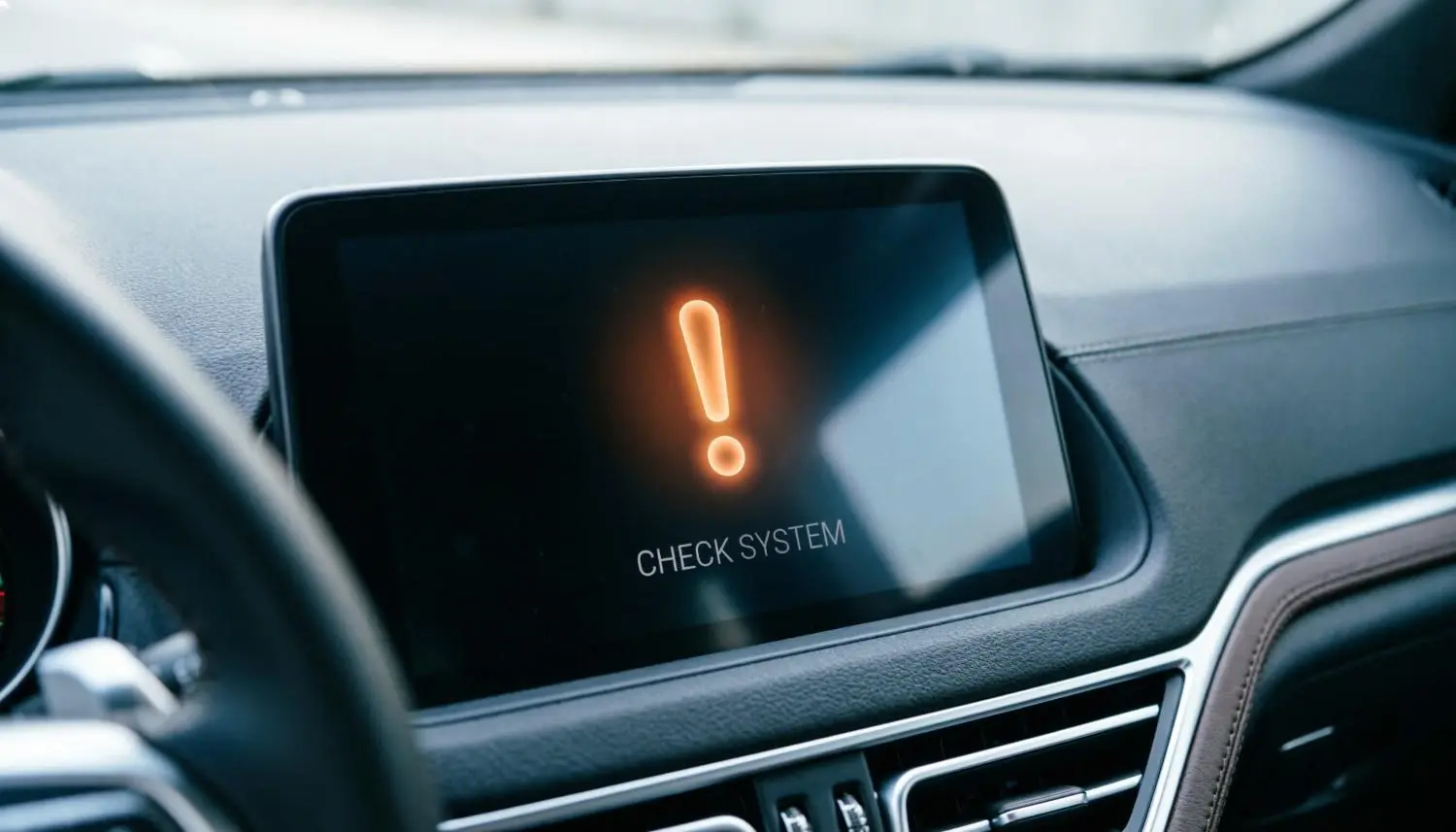
Definition: The exclamation point in a car is a warning indicator on your dashboard that signals a problem or alert related to your vehicle’s system, most commonly the tire pressure monitoring system (TPMS), brake system, or a general warning light depending on its shape and context.
When you see an exclamation mark (!) on your car dashboard, it’s your vehicle’s way of saying:
👉 “Something needs your attention.”
However, the exact meaning depends on the symbol around the exclamation point. It is not a single universal warning but a category of alerts.
Common Variations:
- ⚠️ Exclamation point inside a triangle → General warning
- 🚗 Exclamation point inside a horseshoe shape → Low tire pressure (TPMS)
- 🛑 Exclamation point inside a circle (often with brackets) → Brake system issue
In Simple Terms:
Think of it like a notification alert on your phone it doesn’t always mean danger, but it does mean you should check what’s going on.
You’re driving peacefully, maybe listening to music or heading to work and suddenly, a small exclamation mark lights up on your dashboard.
Your first thought?
👉 “Is something wrong with my car?”
You’re not alone. This tiny symbol causes confusion for thousands of drivers every day.
The truth is, the exclamation point warning light is one of the most misunderstood car indicators, mainly because it doesn’t represent just one issue. Instead, it acts as a universal warning symbol used across different vehicle systems.
In this guide, we’ll break it down in a simple, friendly, and practical way so you’ll know:
- What the symbol actually means
- When it’s serious (and when it’s not)
- What actions you should take immediately
Let’s decode it step by step 👇
Origin
The use of the exclamation mark (!) as a warning symbol didn’t start with cars it comes from general safety and hazard communication systems.
Where it came from:
- ⚠️ Used in industrial safety signs to signal caution
- 📘 Adopted into automotive design to simplify warnings
- 🚗 Integrated into dashboards as vehicles became more digital and sensor-driven
As cars evolved with electronic control units (ECUs) and sensors, manufacturers needed a simple, universal symbol that drivers could recognize instantly.
👉 The exclamation mark became that symbol because it already means alert, attention, or caution worldwide.
Popularity
Today, nearly every modern car brand uses some form of the exclamation mark warning light.
Why it’s so common:
- ✔️ Easy to recognize
- ✔️ Universally understood
- ✔️ Works across multiple systems
- ✔️ Requires no language translation
From economy cars to luxury vehicles, the exclamation mark has become a standard dashboard icon.
However, the downside is:
👉 Because it’s used in multiple contexts, many drivers misinterpret it or ignore it, which can lead to bigger problems later.
How It Is Used
The meaning of the exclamation point depends heavily on its shape, color, and location on the dashboard.
1. Tire Pressure Warning (Most Common)
Symbol: Exclamation mark inside a U-shaped tire (🛞)
Meaning:
- One or more tires have low pressure
What to do:
- Check tire pressure
- Inflate to recommended PSI
- Inspect for punctures
2. Brake Warning Light
Symbol: Exclamation mark inside a circle with brackets
Meaning:
- Low brake fluid
- Parking brake engaged
- Possible brake system issue
What to do:
- Release parking brake
- Check brake fluid
- Visit a mechanic if it stays on
3. General Warning Light
Symbol: Exclamation mark inside a triangle (⚠️)
Meaning:
- A non-specific issue detected by the system
- Could relate to traction control, sensors, or electronics
What to do:
- Check dashboard messages
- Refer to owner’s manual
4. Master Warning Indicator
Some cars use this symbol as a “master alert”, meaning:
👉 Another issue exists, and you need to check the information display for details.
Examples
Friendly Examples
- “Oh, that little exclamation mark just means my tire pressure is low.”
- “No stress it’s just reminding me to check my tires.”
Professional Examples
- “The dashboard indicates a tire pressure warning via the exclamation symbol.”
- “Please inspect the braking system as indicated by the warning light.”
Funny Examples
- “My car just hit me with a ‘!’ like it’s texting me urgently 😂”
- “That exclamation mark be like: ‘Hey! PAY ATTENTION!’”
Comparison with Similar Terms
| Symbol | Meaning | Urgency Level | Action Needed |
| ⚠️ ! in triangle | General warning | Medium | Check system message |
| 🛞 ! in tire shape | Low tire pressure | Medium | Inflate tires |
| 🛑 ! in circle | Brake issue | High | Inspect immediately |
| 🔧 Wrench icon | Maintenance needed | Low | Schedule service |
| 🛢️ Oil light | Low oil pressure | Critical | Stop driving immediately |
Key Insight:
👉 Not all warning lights are equal. The context of the exclamation mark matters more than the symbol itself.
Alternate Meanings
While the exclamation point in cars mostly relates to warnings, it can also mean:
- 🚗 Transmission alert (in some vehicles)
- ⚙️ Electronic system fault
- ❄️ Low washer fluid or traction warning (rare cases)
👉 Always check your car’s manual, because meanings can vary by manufacturer.
Professional or Polite Alternatives
If you’re explaining the issue in a professional context:
Instead of saying:
❌ “That weird exclamation thing is on”
Say:
✔️ “The dashboard warning indicator is active”
✔️ “A system alert has been triggered”
✔️ “The vehicle is displaying a warning signal related to tire pressure or braking”
Common Mistakes
1. Ignoring the Warning
Many drivers assume it’s not serious.
👉 This can lead to:
- Tire blowouts
- Brake failure
- Costly repairs
2. Assuming It’s Always Tire Pressure
While common, it’s not always the case.
3. Not Checking the Manual
Each car has slightly different meanings.
4. Delaying Action
Waiting too long can turn a small issue into a big one.
Quick Tips
- ✅ Always check the symbol shape
- ✅ Look for additional messages on screen
- ✅ Keep a tire pressure gauge handy
- ✅ Don’t ignore brake-related warnings
- ✅ When in doubt, get it inspected
👉 Rule of thumb:
If it stays on, don’t ignore it.
FAQ
1. What does the exclamation point mean in a car dashboard?
It usually indicates a warning related to tire pressure, brakes, or a general system alert.
2. Is it safe to drive with the exclamation light on?
It depends.
- Tire pressure: Usually safe short-term
- Brake warning: Potentially dangerous
3. Why is my tire pressure light on but tires look fine?
Temperature changes or small pressure drops can trigger the sensor.
4. Can I reset the exclamation warning light?
Yes, after fixing the issue (e.g., inflating tires), the system may reset automatically or require manual reset.
5. Does the exclamation mark always mean low tire pressure?
No, it depends on the symbol shape and context.
6. What color is the warning light?
- Yellow/Orange: Caution
- Red: Serious issue
7. How do I know which system is affected?
Check:
- Dashboard message
- Owner’s manual
8. Should I go to a mechanic immediately?
If it’s related to brakes or remains on after fixing the issue yes.
Conclusion
The exclamation point in a car might look small, but it carries an important message:
👉 “Pay attention something needs checking.”
The key takeaway is that context matters. Whether it’s low tire pressure, a brake warning, or a general alert, the symbol is designed to help you prevent bigger problems before they happen.
Instead of ignoring it, take a moment to:
- Identify the symbol shape
- Check your car’s system
- Take appropriate action
A few minutes of attention can save you from expensive repairs or even dangerous situations.