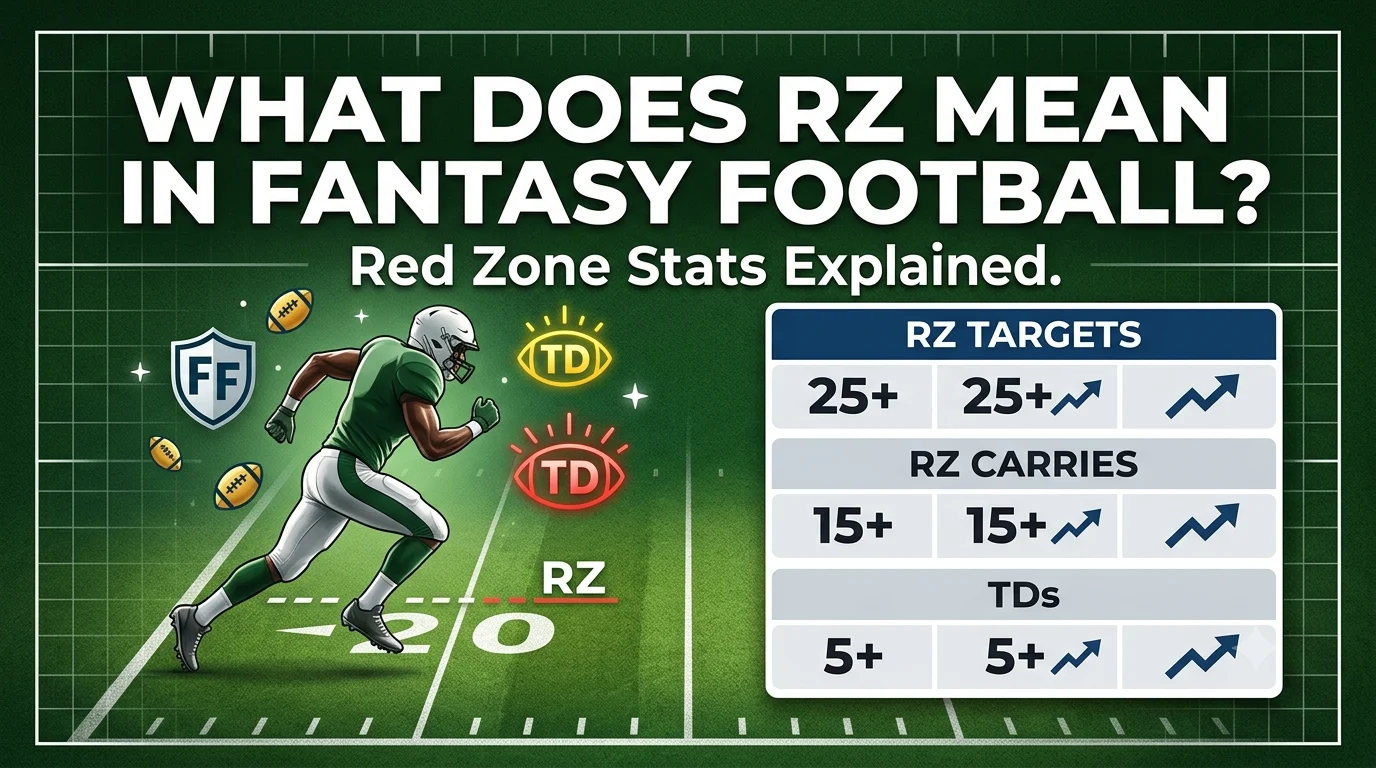
Quick Definition: In fantasy football, RZ stands for Red Zone. It refers to the area of the football field between the opponent’s 20-yard line and the goal line. Fantasy football managers use RZ stats to evaluate which players receive opportunities near the end zone, making the abbreviation an important indicator of potential touchdown production.
RZ in fantasy football means Red Zone, the area inside the opponent’s 20-yard line where offenses have the highest chance of scoring a touchdown. Fantasy football platforms use RZ to display statistics such as red zone carries, red zone targets, and red zone touchdowns, helping managers identify players with valuable scoring opportunities.
Simple Definition
Whenever you see RZ on a fantasy football app or player statistics page, it usually refers to Red Zone performance.
Examples include:
- RZ Targets
- RZ Carries
- RZ Receptions
- RZ Attempts
- RZ Touchdowns
Players with strong RZ usage are often more likely to score fantasy points through touchdowns.
Origin
The term Red Zone has existed in American football for decades.
Although there are different stories about its origin, the phrase became widely used by football broadcasters and coaches to describe the portion of the field where offenses are most likely to score.
The “Red Zone” refers to:
- The opponent’s 20-yard line
- Through the goal line
This area is considered critical because offensive play-calling changes dramatically once teams move close to the end zone.
As fantasy football became more analytical in the late 1990s and early 2000s, fantasy platforms began tracking RZ statistics to help managers evaluate touchdown potential rather than relying only on total yards.
Today, red zone metrics are among the most important advanced statistics used by fantasy managers.
Introduction
Fantasy football is filled with abbreviations and advanced statistics that can seem overwhelming to new managers. Among the most important is RZ, a simple two-letter abbreviation that can reveal which players are most likely to score touchdowns.
If you’ve ever checked player rankings on ESPN, Yahoo Fantasy, Sleeper, NFL Fantasy, or another fantasy football platform, you’ve probably noticed statistics labeled RZ. While many beginners assume it refers to a special scoring system, it actually stands for Red Zone one of the most valuable areas on the football field.
Understanding red zone opportunities can help you make smarter lineup decisions, identify breakout players before they become popular, and gain an edge over your league opponents. In this guide, you’ll learn what RZ means in fantasy football, why it matters, how it’s used, examples, comparisons with similar football statistics, common mistakes, and practical tips for using red zone data effectively.
Popularity
RZ statistics have become increasingly popular because fantasy football scoring heavily rewards touchdowns.
You’ll frequently see RZ used on:
- ESPN Fantasy Football
- Yahoo Fantasy Sports
- Sleeper
- NFL Fantasy
- CBS Sports Fantasy
- FantasyPros
- DraftKings
- FanDuel
Fantasy analysts discuss red zone opportunities every week because they often predict future touchdown production better than yardage alone.
Why Fantasy Managers Care About RZ
Red zone usage helps answer questions like:
- Which running back gets goal-line carries?
- Which receiver is targeted near the end zone?
- Which tight end is the quarterback’s favorite scoring option?
- Which players have the highest touchdown upside?
For many managers, these insights are the difference between winning and losing close matchups.
How It Is Used
Fantasy football managers use RZ statistics to evaluate player value and weekly lineup decisions.
Red Zone Targets
For wide receivers and tight ends, RZ Targets show how often they are targeted inside the opponent’s 20-yard line.
Example:
A receiver with 15 RZ targets has many opportunities to score touchdowns.
Red Zone Carries
Running backs often receive RZ carries.
Example:
A running back with 25 red zone carries is likely the team’s primary goal-line runner.
Red Zone Touchdowns
This statistic tracks touchdowns scored from red zone plays.
Players with consistent red zone production are usually valuable fantasy starters.
Red Zone Efficiency
Some analysts also evaluate how effectively teams convert red zone possessions into touchdowns.
This can influence:
- Quarterback rankings
- Running back projections
- Receiver touchdown potential
Why RZ Matters
Touchdowns are worth significant fantasy points.
A player with:
- 60 rushing yards
- 1 touchdown
often scores more fantasy points than someone with:
- 110 rushing yards
- No touchdown
Because of this, red zone opportunities are often more valuable than yardage alone.
Examples
Friendly Examples
- This running back gets most of the team’s RZ carries.
- That receiver leads the team in RZ targets.
- Start him this week his RZ usage has increased.
- He’s becoming the quarterback’s favorite RZ option.
- Her fantasy advice always includes checking RZ stats.
Professional Examples
Fantasy analysts commonly write statements like:
- The tight end ranks fifth in the league in RZ targets.
- Increased RZ opportunities raise the player’s touchdown projection.
- Coaches trust him in critical red zone situations.
- His RZ efficiency supports continued fantasy value.
Funny Examples
- My player reached the RZ three times…and still forgot how to score. 😂
- My fantasy team loves RZ trips but hates touchdowns. 😅
- Every fantasy manager dreams of unlimited RZ carries. 🏈
- My quarterback visits the red zone like it’s a tourist attraction but never stays long enough to score!
Comparison with Similar Terms
Fantasy football includes many abbreviations that are related to player performance.
| Term | Meaning | Why It Matters |
| RZ | Red Zone | Touchdown opportunities |
| TD | Touchdown | Fantasy scoring |
| ATT | Attempts | Passing or rushing volume |
| TGT | Targets | Passing opportunities |
| REC | Receptions | Catch totals |
| YDS | Yards | Offensive production |
| ADP | Average Draft Position | Draft strategy |
| PPR | Point Per Reception | League scoring format |
| FPTS | Fantasy Points | Overall scoring |
RZ vs TD
| RZ | TD |
| Opportunity to score | Actual score |
| Predictive statistic | Result statistic |
| Indicates usage | Indicates production |
A player can have many RZ opportunities without scoring multiple touchdowns, but over time, high red zone usage often leads to increased scoring.
Alternate Meanings
Although RZ almost always means Red Zone in fantasy football, it can have different meanings in other contexts.
| Meaning | Industry |
| Red Zone | Football |
| Restricted Zone | Security |
| Reaction Zone | Science |
| Rendezvous | Military/Aviation (abbreviated) |
| Risk Zone | Business |
| Regional Zone | Logistics |
When discussing fantasy football, however, RZ almost always refers to the Red Zone.
Professional or Polite Alternatives
In formal football analysis or sports journalism, writers often spell out the abbreviation on first reference.
Examples:
- Red Zone opportunities
- Red Zone carries
- Red Zone targets
- Goal-line opportunities
- Inside-the-20 opportunities
- Scoring-area usage
Example:
Instead of writing:
He dominates RZ.
You could write:
He dominates red zone opportunities, making him a strong fantasy football option.
Common Mistakes
Many fantasy football beginners misunderstand RZ statistics.
Mistake 1: Thinking RZ Means Touchdowns
Incorrect.
RZ represents opportunities near the goal line, not touchdowns themselves.
Mistake 2: Ignoring Red Zone Usage
Some managers focus only on total yards.
However, consistent red zone opportunities often predict future fantasy success.
Mistake 3: Assuming Every RZ Opportunity Becomes a Score
Not every trip into the red zone results in a touchdown.
Teams may:
- Kick field goals
- Turn the ball over
- Fail on fourth down
- Run out of time
Mistake 4: Comparing Players Only by Touchdowns
Touchdowns can vary from week to week.
Red zone usage often provides a more stable measure of future scoring potential.
Mistake 5: Ignoring Team Offensive Strength
A player on a high-scoring offense generally receives more red zone opportunities than a similarly talented player on a struggling team.
Quick Tips
- RZ stands for Red Zone.
- The Red Zone begins at the opponent’s 20-yard line.
- More RZ opportunities usually mean greater touchdown potential.
- Running backs with many RZ carries are valuable fantasy assets.
- Receivers with frequent RZ targets often score more touchdowns.
- Use RZ stats alongside yards, targets, and snap counts for better decisions.
- Don’t judge players by touchdowns alone look at their opportunities.
- Review weekly RZ trends before setting your fantasy lineup.
FAQ
What does RZ mean in fantasy football?
RZ stands for Red Zone, the area between the opponent’s 20-yard line and the goal line where teams have the best chance to score touchdowns.
Why are RZ stats important?
Red zone statistics help fantasy managers identify players who receive valuable scoring opportunities, which often lead to touchdowns and higher fantasy point totals.
What are RZ targets?
RZ targets are passes thrown to a receiver or tight end while the offense is inside the opponent’s 20-yard line.
What are RZ carries?
RZ carries are rushing attempts by a running back or quarterback inside the opponent’s 20-yard line.
Does more RZ usage guarantee touchdowns?
No. While increased red zone opportunities improve the likelihood of scoring, they do not guarantee touchdowns in every game.
Which fantasy positions benefit most from RZ opportunities?
Running backs, wide receivers, tight ends, and mobile quarterbacks all benefit from consistent red zone usage, though goal-line running backs often see the biggest impact.
Where can I find RZ statistics?
Most major fantasy football platforms and sports analytics websites provide red zone statistics, including red zone targets, carries, and touchdowns.
Should I draft players with strong RZ usage?
Red zone opportunities are an important factor during drafts and weekly lineup decisions, but they should be considered alongside overall workload, offensive efficiency, health, and matchup.
Conclusion
Understanding what RZ means in fantasy football can give you a significant advantage over managers who focus only on basic statistics. RZ, or Red Zone, represents the most valuable area of the football field for scoring touchdowns, making it one of the most important metrics when evaluating fantasy players.
Whether you’re analyzing red zone targets, red zone carries, or overall RZ opportunities, these statistics provide valuable insight into which players are most likely to produce fantasy points. While touchdowns can be unpredictable from week to week, consistent red zone involvement often signals future scoring success.
By combining RZ data with other metrics like targets, snap counts, yards, and team offensive performance, you’ll make more informed draft choices, waiver-wire pickups, and weekly lineup decisions throughout the fantasy football season.