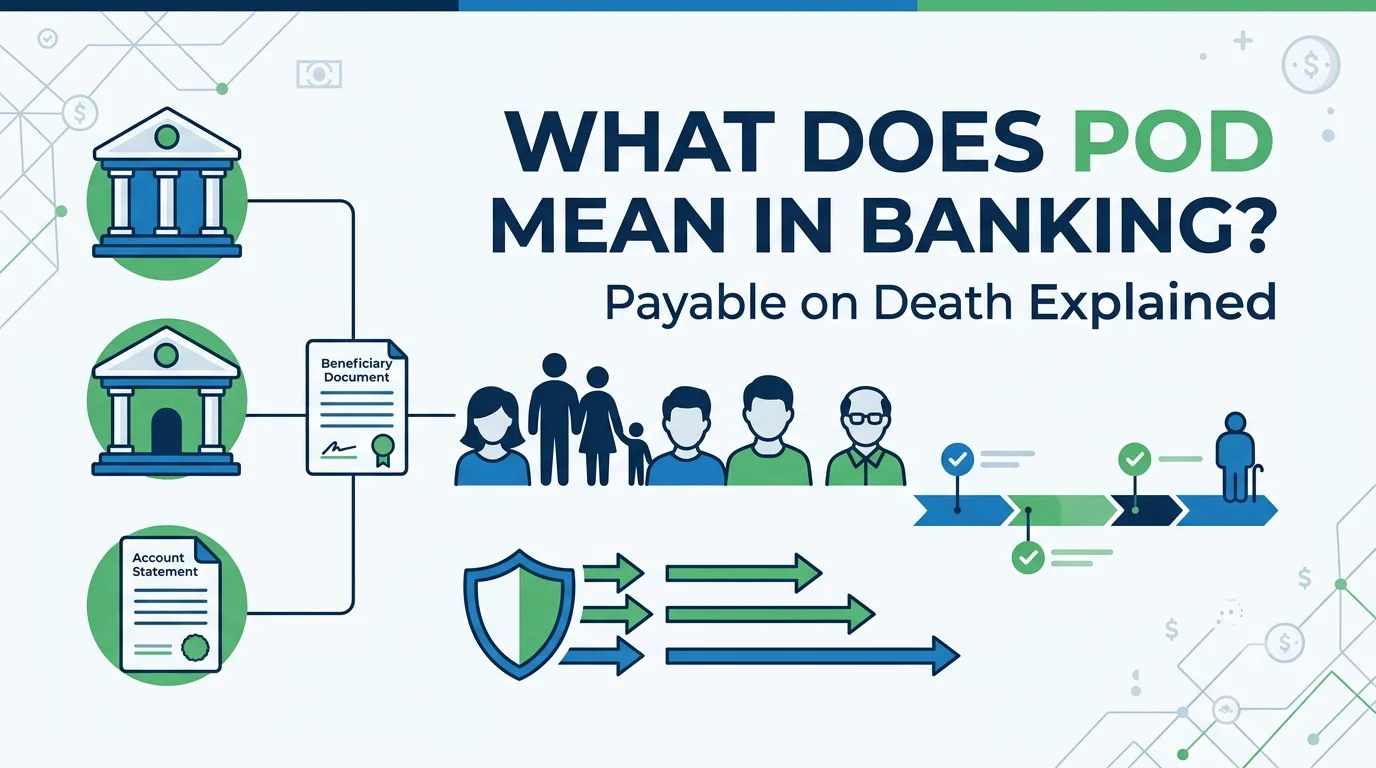
Quick Definition: In banking, POD stands for Payable on Death. It is a legal designation added to a bank account that allows the account owner to name one or more beneficiaries who will automatically receive the funds after the owner’s death, without the money going through probate. The owner retains full control of the account during their lifetime, and the beneficiary has no access until the owner passes away.
POD (Payable on Death) is a banking designation that lets an account owner transfer money directly to a named beneficiary after their death. The beneficiary does not have access to the account while the owner is alive, and the funds typically bypass the probate process, making the transfer faster and simpler.
A POD account is commonly used for:
- Checking accounts
- Savings accounts
- Certificates of Deposit (CDs)
- Money market accounts
Simple Definition
Think of a POD account as a regular bank account with a built-in beneficiary.
- While you’re alive: You have complete ownership and control.
- After your death: The named beneficiary can claim the remaining balance by following the bank’s procedures and providing the required documents.
Origin
The concept of Payable on Death (POD) accounts developed as part of estate planning and banking law.
Historically, transferring money after death often required probate a court-supervised legal process used to distribute a deceased person’s assets. Probate can take months or even years, depending on the estate and local laws.
To simplify the transfer of bank deposits, many jurisdictions introduced laws recognizing Payable on Death designations. Financial institutions gradually adopted POD accounts to allow customers to name beneficiaries without creating a trust or changing ownership during their lifetime.
Today, POD accounts are widely offered by banks and credit unions in many countries, particularly in the United States, as an efficient estate planning tool.
Introduction
Planning what happens to your money after you pass away is an important part of financial planning. One of the simplest ways to make sure your bank account goes to the right person is by adding a Payable on Death (POD) designation.
Many people wonder, “What does POD mean in banking?” because they see it on account paperwork or hear it mentioned during estate planning. Although the abbreviation is short, it has significant legal and financial implications.
Unlike a joint bank account, a POD account does not give another person access while you’re alive. Instead, it names someone who can receive the money only after your death. This arrangement can help families avoid lengthy probate proceedings, reduce legal costs, and make it easier for beneficiaries to access funds when they need them most.
In this guide, you’ll learn exactly what POD means in banking, how it works, its legal background, advantages and disadvantages, examples, comparisons with similar account types, common mistakes, and answers to frequently asked questions.
Popularity
POD accounts have become increasingly popular because they provide a simple and affordable way to transfer bank assets after death.
Several factors have contributed to their widespread use:
- Growing awareness of estate planning
- Desire to avoid probate
- Easy beneficiary designation
- No need to create a living trust for simple accounts
- Low or no additional cost at most banks
- Simple account management
People of all ages may choose a POD designation, especially those who want to ensure that family members can access funds quickly after their passing.
Common users include:
- Parents naming children as beneficiaries
- Married couples naming each other
- Individuals without a will
- Retirees organizing their estate
- People with multiple bank accounts
How It Is Used
A POD designation is added directly to an eligible bank account.
Opening a POD Account
The process generally involves:
- Opening or using an existing eligible bank account.
- Completing a beneficiary designation form.
- Naming one or more beneficiaries.
- Keeping beneficiary information updated.
The account remains fully controlled by the owner during their lifetime.
During the Owner’s Lifetime
The beneficiary:
- Cannot withdraw money.
- Cannot make deposits unless authorized separately.
- Has no ownership rights.
- Cannot close the account.
The owner can:
- Spend the money.
- Change beneficiaries.
- Remove the POD designation.
- Close the account at any time.
After the Owner’s Death
Once the owner dies, the beneficiary usually needs to provide:
- A certified death certificate
- Government-issued identification
- Any bank-required claim forms
After verification, the bank typically releases the funds according to its procedures and applicable laws.
Example Timeline
| Event | What Happens |
| Account opened | Owner controls everything |
| Beneficiary added | POD designation becomes active |
| Owner is alive | Beneficiary has no access |
| Owner passes away | Beneficiary submits required documents |
| Bank verifies claim | Funds are transferred to beneficiary |
Examples
Friendly Examples
Here are some simple examples to understand how POD works.
Example 1
Sarah opens a savings account and names her daughter Emma as the POD beneficiary.
- Sarah manages the account for years.
- Emma cannot use the money.
- After Sarah’s death, Emma claims the remaining balance.
Example 2
John names his wife as the POD beneficiary on his checking account.
If John dies first, his wife can receive the account balance after completing the bank’s claim process.
Example 3
Michael adds two children as equal POD beneficiaries.
When he dies, the remaining balance is divided according to the account designation and the bank’s policies.
Professional Examples
Financial advisors often recommend POD accounts in situations such as:
- Covering funeral expenses
- Passing emergency savings to family
- Simplifying estate administration
- Reducing probate delays
- Organizing small estates
Example:
A financial planner recommends adding a POD beneficiary to a client’s savings account to streamline the transfer of funds after death.
Funny Examples (Educational)
Although banking is a serious topic, these lighthearted examples help explain the concept.
- “My savings account has a POD beneficiary but thankfully they’re waiting a very long time! 😊”
- “A POD account isn’t a secret treasure chest. It’s just smart planning!”
- “Naming a beneficiary today can save your family paperwork tomorrow.”
Comparison with Similar Terms
POD is often confused with other banking and estate planning terms.
| Term | Meaning | Ownership During Lifetime | Avoids Probate? |
| POD | Payable on Death | Owner only | Yes (in many jurisdictions) |
| Joint Account | Two or more owners | Shared ownership | Often, depending on ownership structure |
| TOD | Transfer on Death | Owner only | Yes (commonly for investment accounts) |
| Living Trust | Legal trust arrangement | Trustee manages assets | Yes |
| Will | Estate planning document | Owner retains ownership | Usually requires probate |
POD vs TOD
Although they are similar, they typically apply to different assets.
| POD | TOD |
| Bank accounts | Investment accounts and securities |
| Checking accounts | Stocks |
| Savings accounts | Mutual funds |
| CDs | Brokerage accounts |
Alternate Meanings
While POD most commonly means Payable on Death in banking, it has several meanings in other industries.
| POD Meaning | Industry |
| Payable on Death | Banking |
| Proof of Delivery | Shipping and logistics |
| Print on Demand | Publishing |
| Point of Distribution | Emergency management |
| Plain Old Documentation | Software development (informal) |
| Podcast | Digital media (abbreviated in some contexts) |
Always use the surrounding context to determine the intended meaning.
Professional or Polite Alternatives
In formal financial discussions, professionals may use the full term instead of the abbreviation.
Examples include:
- Payable on Death designation
- Beneficiary designation
- Beneficiary account
- Estate transfer designation
- Account beneficiary arrangement
Example:
Instead of saying:
“It’s a POD account.”
A banker might say:
“This account includes a Payable on Death beneficiary designation.”
Common Mistakes
Many people misunderstand how POD accounts work.
Mistake 1: Thinking the Beneficiary Owns the Account Immediately
Incorrect.
The beneficiary has no ownership rights while the account owner is alive.
Mistake 2: Confusing POD with a Joint Account
A joint owner can generally access the account immediately.
A POD beneficiary cannot.
Mistake 3: Forgetting to Update Beneficiaries
Life events such as marriage, divorce, births, or deaths may require updating your beneficiary designation.
Mistake 4: Assuming POD Covers All Assets
POD only applies to eligible bank accounts.
Other assets may require:
- A will
- TOD designation
- Trust
- Other estate planning tools
Mistake 5: Naming an Ineligible or Outdated Beneficiary
Always review your beneficiary information periodically to ensure it reflects your current wishes and complies with your bank’s requirements.
Quick Tips
- POD stands for Payable on Death.
- It allows money to pass directly to a named beneficiary after the owner’s death.
- The owner keeps full control during their lifetime.
- Beneficiaries cannot access the account while the owner is alive.
- POD accounts can help avoid probate in many jurisdictions.
- Review your beneficiaries after major life events.
- Keep beneficiary contact information current.
- Ask your bank about its specific POD rules and documentation requirements.
FAQ
What does POD mean in banking?
POD stands for Payable on Death, a designation that allows a bank account’s funds to be transferred to a named beneficiary after the account owner’s death.
Is a POD account the same as a joint account?
No. A joint account has multiple owners with access during the owner’s lifetime, while a POD beneficiary has no access until the owner dies.
Does a POD account avoid probate?
In many jurisdictions, yes. A properly designated POD account typically passes directly to the beneficiary without becoming part of the probate estate. However, local laws may vary.
Can I change my POD beneficiary?
Yes. As long as you are alive and legally competent, you can usually change or remove your beneficiary by completing the bank’s required forms.
Can I name multiple POD beneficiaries?
Yes. Many financial institutions allow you to designate multiple beneficiaries and specify how the funds should be divided.
Does the beneficiary pay taxes on a POD account?
Tax consequences depend on your country’s laws and the size of the estate. Beneficiaries should consult a qualified tax professional or estate planning attorney for guidance.
Can a POD beneficiary access the account before I die?
No. A POD beneficiary generally has no authority to withdraw or manage funds while the account owner is alive.
Is a POD account a good estate planning tool?
For many people, yes. A POD designation is a simple and cost-effective way to transfer eligible bank account funds directly to beneficiaries while simplifying estate administration.
Conclusion
Understanding what POD means in banking is essential for anyone planning their finances or estate. A Payable on Death (POD) designation allows an account owner to name one or more beneficiaries who will receive the account balance after the owner’s death, while the owner maintains complete control during their lifetime.
POD accounts offer several advantages, including simplified asset transfers, reduced probate involvement in many jurisdictions, and an easy way to ensure loved ones receive funds quickly. However, it’s important to keep beneficiary information up to date and understand how POD accounts fit into your overall estate plan.
If you’re considering adding a POD designation, speak with your bank and, when appropriate, consult an estate planning professional to ensure your beneficiary choices align with your financial goals and local laws.