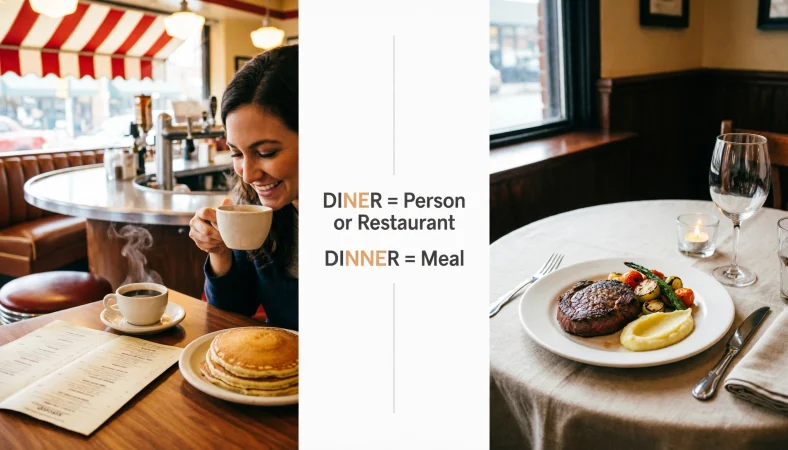
Diner or dinner have completely different meanings even though they sound nearly identical. A diner is usually a person who eats a meal or a casual restaurant, while dinner is a meal, typically the main meal of the day. Knowing the difference helps prevent spelling mistakes, awkward sentences, and confusing messages.
The difference between diner or dinner is a classic English vocabulary confusion. The words look similar and are pronounced differently by only a small sound, so it’s easy to type one when you mean the other.
The important distinction is simple: diner is a noun referring either to a person who eats or, especially in American English, a type of casual restaurant. Dinner is a noun referring to a meal, usually the main meal eaten during the day or evening.
Consider these two sentences:
“The diner ordered a burger.”
“The family ate dinner at seven.”
In the first sentence, diner means a person eating at a restaurant. In the second, dinner means the meal itself.
The spelling difference is only one letter, but the meaning changes completely. This can create embarrassing mistakes in text messages, restaurant reviews, invitations, emails, school assignments, and professional writing.
For example, writing “What time is the diner?” when you mean “What time is the dinner?” can make the reader wonder whether you’re asking about a restaurant rather than a meal.
Understanding pronunciation, meaning, part of speech, and context makes this distinction much easier to remember.
Diner vs Dinner: What’s the Difference?
Both diner and dinner are nouns, but they refer to different things.
A diner can mean a person who is eating, particularly someone eating at a restaurant. In American English, diner can also mean a casual restaurant, often associated with traditional American food, booths, counter seating, and an extensive menu.
A dinner is a meal. Depending on regional and personal usage, it can mean the main meal of the day and is often associated with the evening meal.
| Feature | Diner | Dinner |
| Part of speech | Noun | Noun |
| Main meaning | A person who eats | A meal |
| Another meaning | A casual restaurant | No equivalent restaurant meaning |
| Example | The diner ordered coffee. | Dinner starts at seven. |
| Related word | Dine | Dine |
| Common context | Restaurants and people eating | Meals and eating occasions |
| Pronunciation | Usually sounds like “DYE ner” | Usually sounds like “DIN er” |
| Common mistake | Using it when referring to a meal | Using it when referring to a restaurant or person |
Quick Recap
A diner can be a person eating or a casual restaurant.
A dinner is a meal.
The two words are not interchangeable.
Remembering the extra n in dinner can help you connect the word with the meal itself.
Is Diner vs Dinner a Grammar, Vocabulary, or Usage Issue?
The difference between diner and dinner is primarily a vocabulary and spelling issue.
Both words are grammatically correct nouns. The problem occurs when a writer chooses the wrong noun for the intended meaning.
They aren’t interchangeable.
- If you’re talking about a meal, use dinner.
- If you’re talking about a person eating, use diner.
- If you’re talking about a casual restaurant, particularly in American English, use diner.
Are Diner and Dinner Interchangeable?
No.
You cannot normally replace one with the other without changing the meaning of the sentence.
Compare:
“The diner was crowded.”
This could mean that a casual restaurant was crowded.
“The dinner was crowded.”
This doesn’t make sense if you’re referring to the number of people in a restaurant. A dinner can be large, formal, or well attended, but it isn’t normally described as “crowded.”
Now compare:
“The diner enjoyed the meal.”
Here, diner refers to a person.
“The dinner enjoyed the meal.”
This is incorrect because a meal cannot enjoy something.
Formal vs Informal Usage
Both words are standard English and appear in formal and informal writing.
Dinner is appropriate in everything from casual messages to academic writing.
Diner is equally standard, but its meaning depends on context.
The restaurant meaning of diner is especially associated with American English. In other varieties of English, a person eating at a restaurant may be described as a customer or guest instead.
Academic vs Casual Usage
Academic writing might use dinner when discussing eating habits, social customs, nutrition, history, or cultural traditions.
For example:
“Participants were asked to record what they consumed at dinner.”
A researcher could use diner when referring to restaurant customers:
“The study examined how diners responded to menu descriptions.”
The words are therefore perfectly suitable for formal writing when used correctly.
When to Use Diner
Use diner when you mean a person who is eating or a casual restaurant.
The context usually makes the intended meaning clear.
Diner as a Person
A diner is someone who eats, especially someone eating in a restaurant.
For example:
“The diner asked for the check.”
Here, the diner is the person.
Another example:
“Each diner received a menu.”
Again, the word refers to people.
Diner as a Restaurant
In American English, a diner can also be a casual restaurant.
For example:
“We stopped at a diner for breakfast.”
This meaning is particularly common in discussions of American food culture.
Traditional diners may serve breakfast, burgers, sandwiches, coffee, pies, and other familiar foods.
Workplace Example
A restaurant manager might write:
“The diner requested a table near the window.”
Here, diner clearly refers to a customer.
A restaurant industry report might say:
“Diners increasingly use mobile applications to compare menus.”
The word refers to restaurant customers.
Academic Example
A researcher studying restaurant behavior might write:
“Diners were asked to rate the presentation of each meal.”
Again, diners means people eating.
Technology Example
A restaurant application might track diner preferences.
For example:
“The platform recommends restaurants based on each diner’s previous orders.”
Here, diner refers to the user or customer.
Usage Recap
Use diner for a person who eats.
Use diner for a casual restaurant, especially in American English.
Think of the word as being connected to dine, the verb meaning to eat a meal.
When to Use Dinner
Use dinner when you mean a meal.
Dinner is traditionally described as the main meal of the day, although the exact timing and importance of dinner vary between cultures, households, and individuals.
Everyday Example
“We’re having dinner at eight.”
Here, dinner refers to the meal.
Another example:
“Dinner was delicious.”
The food or meal is being described.
Workplace Example
A business invitation might say:
“You are invited to a dinner celebrating the company’s anniversary.”
Here, dinner is an organized meal or social event.
Academic Example
A study might examine:
“The researchers recorded participants’ dinner habits.”
This refers to what people eat during their dinner meal.
Technology Example
A meal planning application might send a notification:
“Your dinner recipe is ready.”
The application is recommending a meal.
Usage Recap
Use dinner for a meal.
Use it when discussing eating schedules, recipes, meal planning, invitations, or food.
If you can replace the word with meal, dinner is probably the correct choice.
Why Do Diner and Dinner Sound So Similar?
The similarity comes from their shared relationship with the verb dine.
To dine means to eat a meal, especially in a somewhat formal or restaurant related context.
From the same general word family, English developed:
dine as a verb
diner as a noun for someone who dines
dinner as a noun for a meal
The words therefore look related because they are related.
Their spelling, however, reflects different historical developments.
Pronunciation also provides a useful clue.
In most standard pronunciations, diner has a long vowel sound similar to the word mine, while dinner has a short vowel sound similar to winner.
A simple comparison is:
diner: DYE ner
dinner: DIN er
The pronunciation difference is small but useful.
When You Should NOT Use Diner or Dinner
There are several common situations where choosing the wrong word can change the meaning.
1. Don’t Use Diner for a Meal
Incorrect:
“We had a great diner last night.”
Correct:
“We had a great dinner last night.”
2. Don’t Use Dinner for a Restaurant
Incorrect:
“We ate at a small dinner.”
Correct:
“We ate at a small diner.”
3. Don’t Use Dinner for a Person
Incorrect:
“The dinner asked for another glass of water.”
Correct:
“The diner asked for another glass of water.”
4. Don’t Assume Every Restaurant Is a Diner
A diner is a particular type of casual restaurant, especially in American usage.
5. Don’t Confuse a Dinner Party With a Diner
A dinner party is a social gathering centered around a meal.
A diner can refer to one of the people attending it, but the words don’t mean the same thing.
6. Don’t Use Diner in Formal Meal Invitations
If you’re inviting someone to a meal, write:
“Join us for dinner.”
Not:
“Join us for diner.”
7. Don’t Assume Dinner Always Means an Evening Meal
In some cultures and historical contexts, dinner may refer to the main meal of the day even when it occurs earlier.
8. Don’t Rely Only on Spelling
Context is the most reliable way to understand which word is intended.
Common Mistakes and Decision Rules
| Correct sentence | Incorrect sentence | Explanation |
| We had dinner at eight. | We had diner at eight. | Dinner means the meal. |
| The diner ordered steak. | The dinner ordered steak. | Diner means the person eating. |
| We stopped at a diner. | We stopped at a dinner. | Diner can mean a casual restaurant. |
| Dinner was excellent. | Diner was excellent. | The meal was excellent. |
| The diners were waiting for their food. | The dinners were waiting for their food. | Diners are people. |
| She invited us to dinner. | She invited us to diner. | Dinner is the meal or meal event. |
Decision Rule Box
- If you mean the meal, use dinner.
- If you mean the person eating, use diner.
- If you mean a casual restaurant, especially in American English, use diner.
A useful memory trick is this:
Dinner has two n’s because it refers to the meal.
Diner has one n and is connected directly to dine, describing someone who dines.
Diner and Dinner in Modern Technology and AI Tools
Digital technology has made these spelling distinctions even more important.
Search engines, grammar checkers, word processors, voice assistants, and AI writing tools routinely process sentences where context determines the correct word.
For example:
“I need a diner near me.”
This likely means the person wants to find a restaurant.
“I need dinner near me.”
This could mean the person wants food or a place to eat dinner.
An AI assistant that relies only on spelling may misunderstand the request. A strong language system instead considers surrounding words.
Technology also creates new situations where the distinction matters. Food delivery platforms, restaurant search applications, digital calendars, and meal planning tools all use vocabulary related to both diners and dinner.
The same principle applies to human writing: meaning should determine the word, not visual similarity.
The Etymology of Diner and Dinner
The history of these words explains why they are so closely related.
Dine comes from Old French disner, meaning to eat or take a meal. The word eventually developed into modern English dine.
Dinner also developed from the same historical family and originally referred to the principal meal of the day.
Diner, in the sense of a person who eats, developed naturally from the verb dine.
The restaurant meaning of diner is much more recent. It developed in American English and became associated with a type of casual restaurant.
This means the two words aren’t random spelling twins. They share a historical connection but evolved into different grammatical and semantic roles.
An Expert Style Perspective
When two English words look similar, don’t decide between them by spelling alone. Identify what the word represents in the sentence first.
That principle works particularly well with diner and dinner.
Ask yourself whether you’re describing a person, a restaurant, or a meal.
If it is a meal, choose dinner.
If it is a person eating or a casual restaurant, choose diner.
Two Practical Case Studies
Case Study One: A Restaurant Invitation
Imagine you’re sending a message to several coworkers:
“Would you like to join us for dinner on Friday?”
The meaning is immediately clear. You’re inviting them to a meal.
Now imagine writing:
“Would you like to join us for diner on Friday?”
The reader will probably recognize the spelling mistake, but the sentence still looks unprofessional.
The concrete lesson is that one missing letter can make a simple invitation look careless.
Case Study Two: A Restaurant Review
Consider this sentence:
“The diner was friendly and recommended the house burger.”
Here, diner means the customer.
Now compare:
“The dinner was friendly and recommended the house burger.”
The second sentence is nonsensical because a meal cannot recommend food.
The practical result is clear: identifying whether you’re describing a person or a meal prevents major semantic errors.
Author Bio
Author: A professional linguist and SEO content specialist focused on English vocabulary, commonly confused words, grammar, pronunciation, and practical language education.
Error Prevention Checklist
Always Use Dinner When
- You mean a meal.
- You are discussing an evening meal.
- You are referring to a formal meal or dinner event.
- You are discussing recipes or meal planning.
- You could substitute the word “meal” without changing the meaning.
Never Use Diner When
- You mean the meal itself.
- You are inviting someone to a meal.
- You are describing what someone ate.
- You are referring to the food served at a meal.
However, use diner when you mean a person eating or a casual restaurant.
Related Grammar Confusions You Should Master
English contains many pairs that differ by only one letter or sound but have completely different meanings.
1. Desert vs Dessert
A desert is a dry region, while dessert is sweet food eaten after a meal.
2. Principal vs Principle
A principal can be a person or something most important, while a principle is a rule or belief.
3. Advice vs Advise
Advice is a noun, while advise is a verb.
4. Affect vs Effect
Affect is commonly used as a verb, while effect is commonly used as a noun, although both words have additional uses.
5. Stationary vs Stationery
Stationary means not moving, while stationery refers to writing materials.
6. Compliment vs Complement
A compliment expresses praise, while a complement completes or enhances something.
7. Than vs Then
Than is commonly used for comparisons, while then refers to time, sequence, or consequence.
8. Lose vs Loose
Lose means to misplace or fail to win, while loose means not firmly attached or tight.
9. Their vs There
Their indicates possession, while there refers to a place or introduces something.
10. Your vs You’re
Your indicates possession, while you’re is the contraction of “you are.”
FAQs
What is the difference between diner and dinner?
Diner can mean a person who eats or a casual restaurant, particularly in American English. Dinner means a meal, generally the main meal of the day and often the evening meal.
Is diner a person or a restaurant?
It can be either. A diner can mean a person eating a meal, especially at a restaurant, or a casual restaurant associated with American food culture.
Is dinner a person?
No. Dinner refers to a meal or, in some contexts, a meal event. A person eating the meal can be called a diner.
How do you remember the difference between diner and dinner?
Remember that dinner means the meal and contains two n’s. Diner can describe the person eating or a casual restaurant.
Is diner and dinner pronounced differently?
Yes. Diner usually has a long vowel sound, approximately “DYE ner,” while dinner has a short vowel sound, approximately “DIN er.”
Is diner a restaurant or a person?
Both meanings are possible. Context determines whether diner refers to a person who is eating or a casual restaurant.
Should I say dinner or diner?
Use dinner when you mean a meal. Use diner when you mean a person eating or a casual restaurant.
Why do people confuse diner and dinner?
They are closely related in spelling and etymology, and their pronunciation differs by only a small vowel sound. Fast typing also makes the one letter difference easy to miss.
Is dinner always at night?
No. Dinner is often associated with the evening in modern American English, but historically and regionally it can refer to the main meal of the day regardless of when it occurs.
What is a diner in American English?
In American English, a diner is commonly a casual restaurant serving familiar foods such as breakfast dishes, burgers, sandwiches, coffee, and desserts. The word can also refer to a person eating at a restaurant.
Final Verdict: Diner or Dinner
The difference between diner or dinner becomes easy once you focus on meaning rather than spelling.
Dinner is a meal. You eat dinner, prepare dinner, order dinner, and invite someone to dinner.
Diner refers to a person who eats or, in American English, a casual restaurant. A diner can order dinner, but dinner cannot order a meal.
The easiest rule to remember is:
Dinner equals the meal.
Diner equals the person or restaurant.
If you’re writing a message, article, restaurant review, invitation, academic paper, or professional email, identifying the intended meaning before choosing the word will prevent this common spelling mistake.
Once you connect diner with the verb dine and dinner with the word meal, the distinction becomes much easier to remember.