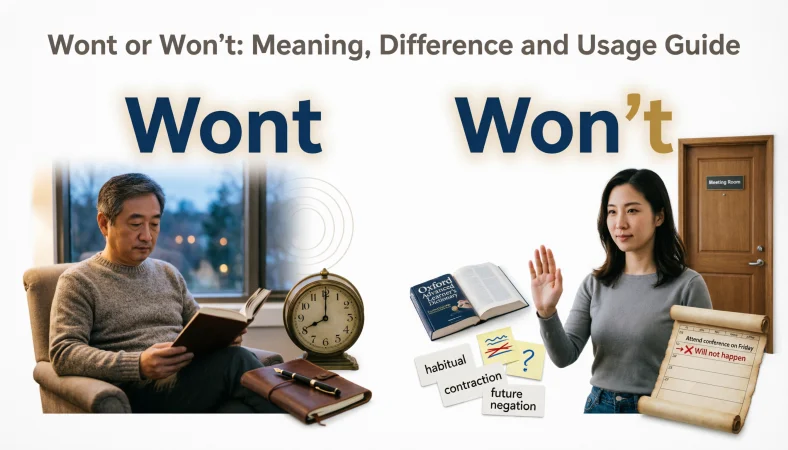
Wont and won’t are two different English forms that should not be treated as interchangeable. Wont is a noun meaning a customary habit or usual behavior, while won’t is a contraction of “will not,” and it can express refusal, unwillingness, or a future negative action. The apostrophe therefore changes both meaning and grammatical function.
The difference between wont or won’t is a small spelling distinction with a surprisingly large effect on meaning. The apostrophe in won’t is not decorative. It signals that the word is a contraction of will not.
Without the apostrophe, wont is a separate word with a much older meaning. It refers to a person’s customary behavior, habit, or usual practice. It is relatively formal and uncommon in everyday conversation.
With the apostrophe, won’t is a contraction. It normally means will not and is used to talk about something that will not happen, someone who refuses to do something, or a person who is unwilling to cooperate.
Consider these two sentences:
She won’t attend the meeting.
As is her wont, she arrived early.
The first sentence concerns a future action that will not happen. The second describes someone’s customary behavior.
Because the words look almost identical, writers sometimes omit or add the apostrophe incorrectly. This can create grammatical errors, alter the intended meaning, or make formal writing appear careless.
Understanding the difference is particularly important in academic writing, professional communication, proofreading, and online publishing.
Wont vs Won’t: What’s the Difference?
The simplest way to distinguish these words is to identify their grammatical roles.
Wont is primarily a noun. It means a customary habit, usual practice, or characteristic way of behaving. It can also appear in the phrase be wont to, where it functions in a related way to describe something someone habitually does.
Won’t is a contraction of will not. It is formed with an apostrophe and functions as part of a verb phrase.
| Feature | Wont | Won’t |
| Word type | Noun, and part of the expression be wont to | Contraction |
| Full form | No expanded form | Will not |
| Main meaning | Habit or customary behavior | Will not, refusal, or unwillingness |
| Apostrophe | No | Yes |
| Typical tone | Formal or literary | Everyday and conversational |
| Example | It was his wont to read before bed. | He won’t read tonight. |
| Frequency | Relatively uncommon | Very common |
| Main idea | Habit | Negation or refusal |
Mini Recap
Wont refers to a habit or customary behavior.
Won’t means “will not.”
The apostrophe is essential in the contraction.
They are different words with different grammatical functions.
Is Wont vs Won’t a Grammar, Vocabulary, or Usage Issue?
The distinction involves grammar, vocabulary, spelling, and punctuation, but grammar is especially important because the two forms behave differently in sentences.
When you write won’t, you are using a contraction of two words.
I won’t go.
This means:
I will not go.
When you write wont, you are using a separate vocabulary item.
It was his wont to walk before breakfast.
Here, “wont” refers to a habitual practice.
Are Wont and Won’t Interchangeable?
No.
Replacing one with the other changes the meaning of the sentence.
For example:
She won’t complain.
means that she will not complain or is unwilling to complain.
But:
She is accustomed to complaining.
describes a habit.
The word “wont” can express that habitual idea in formal English:
Complaining was her wont.
The two forms therefore cannot simply be substituted for each other.
Formal Versus Informal Usage
Won’t is completely normal in everyday English. Native speakers use it constantly in conversation, emails, messages, interviews, and informal writing.
Wont is considerably more formal and literary.
You might encounter:
As was his wont, the professor arrived before everyone else.
But in ordinary conversation, a speaker would probably say:
As usual, the professor arrived before everyone else.
This difference in frequency is important. A word can be grammatically correct but still sound unusual in casual conversation.
Academic Versus Casual Usage
Academic writing can use both forms, but their roles differ.
Won’t may occur when quoting speech, discussing future behavior, or writing in a relatively accessible style.
Wont can appear in literary analysis, historical writing, or formal descriptions of habitual behavior.
For example:
The author was wont to describe nature in highly symbolic terms.
This sentence means that the author habitually or characteristically described nature in that way.
What Does Wont Mean?
Wont is a noun meaning a person’s usual habit, customary behavior, or established practice.
It is pronounced like want, which can make it confusing for learners who encounter it in writing.
One of its most recognizable constructions is:
It was his wont to…
This means:
It was his usual habit to…
For example:
It was her wont to rise before dawn.
In modern English, you could express the same idea more naturally as:
She usually rose before dawn.
The word is not incorrect or obsolete, but it has a formal and somewhat literary character.
Wont as a Noun
As a noun, wont can refer to a habitual action.
Reading before bed was his wont.
Here, the word names a regular practice.
Another example is:
Silence was her wont during difficult discussions.
This means that remaining silent was her usual behavior.
The Expression Be Wont To
A particularly important construction is:
be wont to
This means be accustomed to, usually do, or be in the habit of doing.
For example:
He was wont to take long walks in the evening.
The sentence means that he habitually took long evening walks.
Another example:
Writers are often wont to revise their work several times.
The meaning is that writers often have a tendency or habit of doing so.
Workplace Example
A formal workplace report might say:
The director was wont to review every proposal personally.
This means the director usually reviewed proposals personally.
In modern workplace writing, however, the clearer version would probably be:
The director usually reviewed every proposal personally.
Academic Example
In literary criticism, “wont” can be useful:
The novelist was wont to use recurring images of water.
The word provides a formal way of describing a characteristic pattern in the author’s work.
Technology Example
In technical writing, “wont” is unusual but possible in historical or analytical prose.
For example:
Early programmers were wont to optimize code manually.
A modern technical article would probably say:
Early programmers often optimized code manually.
Usage Recap
Use wont when you mean a habit or customary behavior.
The phrase be wont to means to be accustomed to doing something.
It is grammatically correct but often sounds formal, literary, or old fashioned.
What Does Won’t Mean?
Won’t is a contraction of will not.
It is used to express a negative future action, refusal, unwillingness, or something that is not expected to happen.
For example:
I won’t attend the meeting.
means:
I will not attend the meeting.
Another example is:
The machine won’t start.
Here, “won’t” can mean that the machine refuses or fails to start.
Won’t for Future Actions
The most straightforward use is negative future meaning.
We won’t finish the project today.
This means:
We will not finish the project today.
The sentence predicts or states that the action will not happen.
Won’t for Refusal
Won’t can also express refusal.
He won’t listen to the advice.
Depending on context, this may mean that he refuses to listen.
This use is especially common in conversation.
Won’t for Things That Refuse to Work
English also uses “won’t” with objects and machines.
The door won’t open.
My computer won’t connect to the network.
The printer won’t respond.
The object isn’t literally making a conscious decision. The expression means that the expected action is not occurring despite an attempt to make it happen.
Workplace Example
I won’t be available for the afternoon meeting.
This is a natural professional statement.
A more formal alternative would be:
I will not be available for the afternoon meeting.
Both are grammatically correct.
Academic Example
The results won’t support the original hypothesis if the sample is too small.
This is understandable and grammatically correct, although a highly formal academic document may prefer the full form:
The results will not support the original hypothesis if the sample is too small.
Technology Example
The application won’t load on my phone.
This is extremely common in technical support conversations.
The sentence means that the application refuses or fails to load.
Usage Recap
Use won’t when you mean will not.
It can express future negation, refusal, unwillingness, or failure of something to perform an expected action.
The apostrophe must remain in standard writing.
Wont or Won’t in Formal Writing
One of the most useful distinctions is that won’t is not necessarily informal, while wont is not necessarily more sophisticated.
The contraction “won’t” is standard English.
However, some academic and professional styles prefer avoiding contractions in particularly formal documents. In such cases, writers may use will not instead.
For example:
The system won’t process the request.
can become:
The system will not process the request.
This is a stylistic choice.
By contrast:
The system will not process the request.
and:
The system wont process the request.
are not stylistic alternatives. The second sentence is incorrect because it is missing the apostrophe.
When You Should NOT Use Wont or Won’t
There are several situations where choosing the wrong form can create confusion.
- Do not use wont when you mean will not.
Write won’t.
- Do not use won’t when you mean a customary habit.
Use wont if the formal vocabulary fits the sentence.
- Do not remove the apostrophe from won’t in standard writing.
The apostrophe identifies the contraction.
- Do not assume wont means want.
Although “wont” is pronounced like “want,” its meaning is completely different.
- Do not use wont casually when a simpler word is clearer.
“Habit,” “usually,” or “custom” may be more natural.
- Do not expand wont into “will not.”
Wont is not a contraction.
- Do not assume spellcheck will catch every error.
Both “wont” and “won’t” are legitimate forms, so context matters.
- Do not treat the apostrophe as optional.
Removing it can transform one word into another with a different meaning.
Common Mistakes and Decision Rules
| Correct Sentence | Incorrect Sentence | Explanation |
| I won’t attend the event. | I wont attend the event. | The intended meaning is “I will not,” so the apostrophe is required. |
| It was his wont to arrive early. | It was his won’t to arrive early. | The sentence describes a habit, so the noun “wont” is correct. |
| The computer won’t start. | The computer wont start. | “Won’t” means the computer will not start or is failing to start. |
| It was her wont to read at night. | It was her won’t to read at night. | The sentence describes customary behavior. |
| He won’t change his decision. | He wont change his decision. | The intended meaning is “He will not change.” |
Decision Rule Box
- If you mean “will not,” use won’t.
- If you mean a habit, custom, or customary behavior, use wont.
- If you mean “usually,” “habitually,” or “accustomed to,” wont may be appropriate in formal writing.
Wont or Won’t in Modern Technology and AI Tools
Modern technology provides many examples of won’t.
Technical support pages and users regularly write:
My phone won’t charge.
The website won’t load.
The application won’t open.
The device won’t connect.
In each case, “won’t” expresses failure or refusal to perform an expected action.
The word wont is much less common in technology writing. It may appear in literary or historical commentary, but technical documentation usually favors clearer words such as “usually,” “typically,” or “often.”
AI writing systems can also encounter this distinction. Since both forms are valid English words, automated systems need contextual information to select the correct one.
A grammar system should interpret:
The printer won’t work.
as a negative statement about the printer.
But:
It was his wont to repair printers himself.
contains the noun “wont” and describes a habitual action.
This illustrates why contextual language understanding is more important than simple spelling matching.
The Etymology of Wont and Won’t
The history of these words helps explain why they look so similar today.
Wont is an old English word associated with habit and customary behavior. It developed from earlier forms connected with being accustomed to something.
Won’t, however, has a different history. It developed as a contraction of will not. Its unusual spelling is the result of historical changes in the contraction rather than a simple combination of the first letters of “will” and “not.”
This explains why won’t does not look exactly like a straightforward contraction such as “can’t” or “don’t.”
The apostrophe represents missing letters.
Why Does Won’t Have an Apostrophe?
The apostrophe in won’t signals that letters have been omitted in the contraction.
In modern usage:
will not → won’t
The resulting spelling became established through historical usage.
This is important because apostrophes in contractions are meaningful. They distinguish contractions from independent words.
Compare:
I won’t go.
with:
I wont go.
The first is standard.
The second would normally be interpreted as an incorrect spelling if the intended meaning is “I will not.”
Two Practical Case Studies
Case Study 1: Professional Email
Imagine an employee writing:
I wont be able to attend the meeting tomorrow.
The intended meaning is clearly “I will not be able to attend.”
The corrected version is:
I won’t be able to attend the meeting tomorrow.
The concrete improvement is grammatical and professional accuracy. The apostrophe makes the contraction immediately recognizable.
For a more formal style, the writer could use:
I will not be able to attend the meeting tomorrow.
Case Study 2: Literary Analysis
Consider a university student writing about a nineteenth century novel.
The student writes:
The narrator wont to describe the landscape in great detail.
The intended meaning is that the narrator habitually described the landscape.
A grammatically appropriate construction would be:
The narrator was wont to describe the landscape in great detail.
The correction is important because “wont” normally requires the appropriate grammatical construction when it is used in the sense of habitual behavior.
The sentence could also be simplified:
The narrator often described the landscape in great detail.
The second version is usually clearer for modern readers.
Expert Style Explanation
“The apostrophe in won’t is a meaning marker, not merely a punctuation detail. Without it, the reader encounters a different English word with a completely different function.”
This is the most useful principle to remember when proofreading.
Author Expertise
Written by a language and SEO content specialist specializing in English grammar, commonly confused words, punctuation, regional usage, and search focused educational content.
Error Prevention Checklist
Always use won’t when
- You mean “will not.”
- You are describing a negative future action.
- You are expressing refusal.
- You are describing something that fails to perform an expected action.
Always use wont when
- You mean a habit or customary behavior.
- You are using the formal expression “be wont to.”
- You are writing literary, historical, or formal prose where the word fits naturally.
Never use wont when
- You mean “will not.”
- You are writing a normal negative future statement.
- You are expressing refusal.
Never use won’t when
- You mean habit or custom.
- You mean “usually” in a formal construction involving customary behavior.
Related Grammar Confusions You Should Master
Understanding this pair can help you recognize several other commonly confused English forms.
- Its or It’s
“Its” shows possession, while “it’s” means “it is” or “it has.”
- Your or You’re
“Your” indicates possession, while “you’re” means “you are.”
- Their or They’re
“Their” indicates possession, while “they’re” means “they are.”
- Whose or Who’s
“Whose” indicates possession or asks about possession, while “who’s” means “who is” or “who has.”
- Were or We’re
“Were” is a form of the verb “be,” while “we’re” means “we are.”
- Then or Than
“Then” commonly relates to time or sequence, while “than” is generally used for comparison.
- Affect or Effect
“Affect” is commonly a verb, while “effect” is commonly a noun, although both have additional uses.
- Advice or Advise
“Advice” is a noun, while “advise” is a verb.
- Passed or Past
“Passed” is usually a verb form, while “past” can function as a noun, adjective, adverb, or preposition.
- Its or Its’
“Its’” is not the standard possessive form. The correct possessive form is “its.”
Frequently Asked Questions
What is the difference between wont and won’t?
“Wont” is a noun referring to a habit or customary behavior, while “won’t” is a contraction of “will not.” They have different meanings and grammatical functions.
Is wont a real word?
Yes. Wont is a legitimate English word meaning habit, custom, or customary behavior. It is relatively formal and is often found in literary or historical writing.
Is won’t short for will not?
Yes. “Won’t” is the standard contraction of “will not.”
Should I write wont or won’t for will not?
Always write won’t when you mean will not. The apostrophe is necessary in standard English.
What does wont mean in a sentence?
Wont means a customary habit or usual behavior. For example, “It was his wont to walk before breakfast” means that he habitually walked before breakfast.
What does won’t mean in texting?
In texting and everyday digital communication, “won’t” means “will not.” It can express a future negative action, refusal, or unwillingness.
Is wont formal English?
Yes. Wont is grammatically correct but relatively formal, literary, or old fashioned in many modern contexts. Words such as “habit,” “usually,” and “custom” are often more natural.
Conclusion
The difference between wont or won’t becomes clear when you focus on meaning rather than appearance.
Wont is a noun associated with habit, custom, or customary behavior. It is most often encountered in formal, literary, historical, or traditional expressions such as “it was his wont to…”
Won’t is a contraction of will not. It is extremely common in everyday English and can express a negative future action, refusal, unwillingness, or the failure of something to work as expected.
The apostrophe is therefore important.
If you mean:
will not
write:
won’t
If you mean:
habit or customary behavior
write:
wont
For most modern writing, won’t will be far more common. Wont is a specialized vocabulary word that should be used when its formal meaning is genuinely appropriate.
The easiest memory trick is simple: won’t has the apostrophe because it represents “will not,” while wont is the separate word connected with habit.