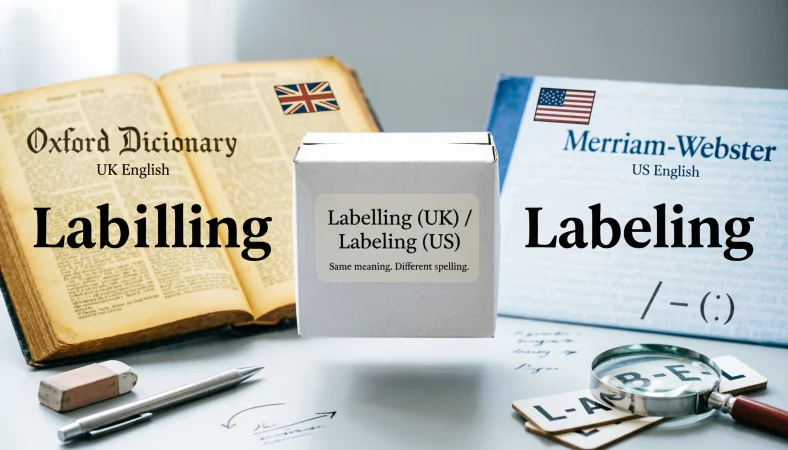
Labelling and labeling are both correct spellings of the same word. The difference is regional: labelling is the standard British English spelling, while labeling is the standard American English spelling. Both forms mean attaching a label or identifying something with words, symbols, or information. The choice depends mainly on the variety of English you are using.
The question of labelling or labeling often creates confusion because both spellings appear in dictionaries, books, websites, workplaces, and academic writing. Unlike many spelling mistakes, neither form is inherently wrong. The important issue is knowing which spelling matches your intended variety of English.
Both words come from the verb label, meaning to attach a label to something, identify something, or describe something using a particular term. When the verb becomes a present participle or gerund, English spelling conventions determine whether the final consonant is doubled before adding the ending.
British English normally writes labelling, with two consecutive letters before the ending. American English normally writes labeling, with only one.
This difference can create real problems in professional and academic writing. A writer may use American spelling throughout a document but suddenly switch to British spelling, making the text appear inconsistent. The reverse can happen as well.
The good news is that the rule is straightforward once you understand the regional spelling systems behind it.
Labelling vs Labeling: What’s the Difference?
Both forms are present participles and gerunds of the verb label.
Labelling is the standard British English spelling.
Labeling is the standard American English spelling.
They have exactly the same basic meaning. The distinction is primarily orthographic, meaning it concerns how the word is spelled rather than what the word means.
| Feature | Labelling | Labeling |
| Word type | Present participle or gerund | Present participle or gerund |
| Base verb | Label | Label |
| Main spelling system | British English | American English |
| Meaning | Attaching or assigning a label | Attaching or assigning a label |
| Common usage | UK, Ireland, Australia and other varieties influenced by British English | United States and American English contexts |
| Example | The labelling of the products was completed. | The labeling of the products was completed. |
| Meaning difference | None | None |
Mini Recap
Labelling and labeling have the same meaning.
British English generally prefers labelling.
American English generally prefers labeling.
Neither spelling is universally more correct.
Consistency with your chosen English variety is the key.
Is Labelling vs Labeling a Grammar, Vocabulary, or Usage Issue?
This is primarily a spelling and regional usage issue, not a grammar problem.
The two forms are grammatically equivalent. You can use either one as a gerund or present participle without changing the grammatical structure of a sentence.
For example:
The company is labeling the new products.
The same sentence in British English would normally be:
The company is labelling the new products.
The grammar remains exactly the same. Only the spelling changes.
Are They Interchangeable?
In meaning, yes. In regional style, not always.
A British publication would generally use labelling, while an American publication would generally use labeling.
A writer producing content for an international audience can technically use either form, but maintaining one spelling system throughout the article is usually better.
Formal Versus Informal Usage
The distinction has nothing to do with formality.
Both forms can appear in formal reports, academic papers, government documents, websites, technical manuals, and everyday conversation.
The important factor is the English variety being followed.
Academic Versus Casual Usage
Academic writing should normally follow the spelling conventions required by the institution, journal, publisher, or style guide.
For example, an American university publication may prefer labeling, while a British university publication may prefer labelling.
Casual writing is more flexible, but consistency still improves readability and professionalism.
What Does Labelling Mean?
Labelling means attaching a label to something or identifying something with written information, symbols, or a descriptive term.
It can describe a physical action:
The staff are labelling the boxes before shipment.
It can also describe an abstract process:
The labelling of people can sometimes create unfair assumptions.
In British English, the spelling with the doubled consonant is standard.
The word can appear in several contexts, including manufacturing, retail, education, psychology, science, food regulation, and everyday communication.
Workplace Example
Imagine a warehouse preparing hundreds of packages.
A British English report might state:
The team is responsible for labelling every package before delivery.
The word describes the physical process of attaching identifying information to each package.
Academic Example
In academic writing, the term can refer to categorization.
For example:
Researchers examined the effects of labelling social groups according to simplified categories.
Here, labelling does not necessarily involve a physical sticker. It refers to assigning a descriptive category.
Technology Example
In software and data management, labelling can refer to assigning names or categories to information.
For example:
The system is responsible for labelling images according to their content.
This terminology is common in discussions of datasets, machine learning, image recognition, and information organization.
Usage Recap
Use labelling when following British English spelling conventions.
It can describe physical labeling, classification, categorization, or data organization.
The meaning remains unchanged when the spelling changes to the American form.
What Does Labeling Mean?
Labeling has exactly the same basic meaning as labelling. The difference is that it follows American English spelling conventions.
For example:
The manufacturer is labeling each package with a tracking number.
The sentence describes the process of adding identifying information to products.
American English generally avoids doubling the final consonant in this particular word before the ending.
Workplace Example
Consider an American company preparing products for retail.
A company manual might say:
Employees are responsible for labeling all containers correctly.
The spelling is consistent with American English.
Academic Example
An American academic paper might state:
The study examines the consequences of labeling behavior as abnormal.
Again, the word refers to assigning a description or category.
Technology Example
In artificial intelligence and machine learning, labeling is especially important.
A dataset may contain thousands of photographs that need to be assigned categories before a machine learning system can learn from them.
For example:
The researchers spent several weeks labeling images for the training dataset.
The term can describe human annotation of data, automated categorization, or a combination of both.
Usage Recap
Use labeling when writing in American English.
It has the same pronunciation and meaning as labelling.
It is especially common in American business, technology, education, and scientific writing.
Why Does English Have Labelling and Labeling?
The difference comes from broader spelling conventions in British and American English.
British English often retains doubled consonants in words formed from verbs ending in a consonant under particular spelling patterns.
American English has developed conventions that frequently simplify certain doubled consonants.
The same regional distinction appears in other words.
For example:
| British English | American English |
| Labelling | Labeling |
| Travelled | Traveled |
| Travelling | Traveling |
| Cancelled | Canceled |
| Cancelling | Canceling |
There are exceptions and style specific variations, so it is important not to assume that every British and American spelling difference follows exactly the same rule.
The Spelling Rule Behind Labelling and Labeling
The simplest practical rule is to remember the regional preference.
British English commonly uses:
label → labelling
American English commonly uses:
label → labeling
The difference becomes especially noticeable when the word appears in longer forms.
British English:
labelled
labelling
American English:
labeled
labeling
Notice that the difference is not limited to the present participle. The past tense and past participle also show the regional spelling distinction.
When You Should NOT Use Labelling or Labeling
There are several situations where choosing the wrong form can make your writing inconsistent or unsuitable for its audience.
- Do not mix British and American spelling randomly.
A document using “colour,” “centre,” and “organise” should normally not suddenly switch to “labeling” unless there is a specific reason.
- Do not assume labeling is incorrect because you learned British English.
It is the standard American form.
- Do not assume labelling is a spelling mistake because your software flags it.
An American English spell checker may flag British spelling even when the word is perfectly correct.
- Do not change spelling merely because one form looks more familiar.
Choose according to the intended English variety.
- Do not use both forms interchangeably in the same formal document.
Consistency matters more than choosing one form as universally superior.
- Do not treat the spelling difference as a difference in meaning.
Both words describe the same underlying action or process.
- Do not ignore a publisher’s style guide.
Academic journals, businesses, and professional organizations may have specific language requirements.
- Do not confuse spelling preference with pronunciation.
The two forms are generally pronounced the same way.
Common Mistakes and Decision Rules
| Correct Sentence | Incorrect Sentence | Explanation |
| The company is labelling the boxes. | The company is labeling the boxes. | The second form is not incorrect in American English, but it may conflict with British English style. |
| The company is labeling the boxes. | The company is labelling the boxes. | The second form may conflict with an American English style guide. |
| The products were labelled correctly. | The products were labeled correctly. | “Labeled” is standard American English, while “labelled” is standard British English. |
| The researchers are labeling the images. | The researchers are labelling the images. | American academic writing normally uses “labeling.” |
| The researchers are labelling the images. | The researchers are labeling the images. | British academic writing normally uses “labelling.” |
Decision Rule Box
- If you are writing in British English, use labelling.
- If you are writing in American English, use labeling.
- If your publisher, school, employer, or style guide specifies a variety of English, follow that requirement consistently.
Labelling or Labeling in Different Countries
The choice isn’t simply about two countries.
British spelling conventions influence many varieties of English around the world. Countries and regions with strong British English traditions may commonly use labelling.
American English is dominant in the United States and strongly influences international technology, business, entertainment, and digital communication.
This means you may encounter both forms online.
For example, an international website may use labeling because its software documentation follows American English, while a British newspaper may use labelling.
Neither occurrence should automatically be treated as an error.
Labelling or Labeling in Modern Technology and AI Tools
The distinction is particularly interesting in artificial intelligence because labeling and labelling are frequently used when discussing training data.
Machine learning systems often require labeled datasets. Human workers or specialized systems may assign categories to images, audio recordings, text, video, or other information.
An American technology company might write:
Data labeling is an essential stage of machine learning development.
A British organization might write:
Data labelling is an essential stage of machine learning development.
The underlying technical process is identical.
The same regional spelling distinction appears in related terms such as:
labeled data
labelled data
data labeling
data labelling
For AI related content, consistency is especially important because technical documentation may be read internationally.
Labelling or Labeling in Academic Writing
Academic writers should pay close attention to institutional requirements.
If an American journal follows American English, labeling will generally be expected.
If a British journal follows British English, labelling will generally be preferred.
The important thing is not to choose the spelling randomly.
Consider these examples.
American style:
This study investigates the effects of labeling individuals according to social categories.
British style:
This study investigates the effects of labelling individuals according to social categories.
Both sentences communicate exactly the same idea.
Labelling or Labeling in Professional Writing
Businesses should establish a consistent house style.
Imagine a company website that uses British spelling throughout its pages:
organisation
colour
behaviour
centre
It would normally be more appropriate to write:
labelling
A company using American spelling would typically use:
organization
color
behavior
center
and:
labeling
The issue is therefore larger than one word. Your choice should fit the broader spelling system used throughout the document.
Etymology of Label
The English word label has a long history and entered English through forms associated with Old French and medieval usage.
Over time, its meaning developed around identifying, marking, attaching a tag, and eventually describing or categorizing people and things.
Today, the word can refer to a physical object:
Put a label on the package.
It can also refer to a conceptual category:
Avoid labeling someone based on one mistake.
This expansion explains why labelling and labeling appear in so many fields.
Why Consistency Matters More Than Preference
A common misconception is that one spelling must be “more correct.”
That’s not how regional English works.
British English and American English have developed different conventions. Both are established varieties of English with their own spelling standards.
The real mistake is often inconsistency.
Consider a report containing:
The organisation is labeling products by colour.
This sentence mixes British spelling in “organisation” and “colour” with American spelling in “labeling.”
A reader can understand it perfectly, but a professional editor may flag the inconsistency.
A British version would be:
The organisation is labelling products by colour.
An American version would be:
The organization is labeling products by color.
The second versions are not better because they are American. They are better because each sentence consistently follows one spelling system.
Two Practical Case Studies
Case Study 1: A British University Essay
Imagine a student at a British university writing about social psychology.
The student’s essay repeatedly uses British spellings such as “behaviour,” “organisation,” and “categorisation.”
The student writes:
The labeling of individuals can influence social perception.
The sentence is understandable, but the spelling conflicts with the surrounding British style.
Changing it to:
The labelling of individuals can influence social perception.
creates consistency.
The concrete improvement is editorial consistency rather than a change in meaning.
Case Study 2: An American Software Company
Now imagine an American software company creating documentation for an AI data platform.
Its documentation consistently uses American spelling:
organization
behavior
color
The technical documentation says:
The system supports automatic data labelling.
Changing the word to:
The system supports automatic data labeling.
aligns the term with the company’s established American spelling style.
Again, the meaning doesn’t change. The improvement is consistency with the intended audience.
Expert Style Explanation
“Neither labelling nor labeling is inherently more correct. The professional choice is determined by the English variety being followed and by the requirement to maintain consistency throughout the text.”
This principle is useful for writers, editors, students, marketers, developers, and anyone producing published content for a defined audience.
Author Expertise
Written by a language and SEO content specialist focused on English usage, regional spelling conventions, semantic search intent, and clear educational communication.
Error Prevention Checklist
Always use labelling when
- You are following British English conventions.
- Your publisher specifies British spelling.
- Your academic institution requires British English.
- Your document consistently uses British forms such as “organisation” and “colour.”
Always use labeling when
- You are following American English conventions.
- Your publisher specifies American spelling.
- Your organization uses an American English style guide.
- Your document consistently uses American forms such as “organization” and “color.”
Never choose based solely on
- Which spelling looks more familiar.
- Which spelling appears first in a search result.
- Which form your browser happens to recognize.
- The assumption that American spelling is always simpler or British spelling is always more formal.
Related Grammar Confusions You Should Master
Once you understand this regional spelling difference, several related comparisons become easier to recognize.
Travelled or Traveled
British English normally uses “travelled,” while American English generally uses “traveled.”
Cancelled or Canceled
British English commonly uses “cancelled,” while American English generally uses “canceled.”
Colour or Color
“Colour” is associated with British English, while “color” is standard American English.
Organise or Organize
British English commonly uses “organise,” while American English generally uses “organize,” although “organize” also occurs in British usage.
Centre or Center
“Centre” is standard British spelling, while “center” is standard American spelling.
Behaviour or Behavior
British English normally uses “behaviour,” while American English uses “behavior.”
Realise or Realize
British English commonly permits “realise,” while American English generally uses “realize.”
Ageing or Aging
British English commonly uses “ageing,” while American English generally uses “aging.”
Modelling or Modeling
British English generally uses “modelling,” while American English generally uses “modeling.”
Programme or Program
British English often uses “programme” for general contexts, while “program” is standard American usage. Technology has its own conventions, particularly with computer programs.
Frequently Asked Questions
Is labelling or labeling correct?
Both are correct. “Labelling” is the standard British English spelling, while “labeling” is the standard American English spelling. They have the same meaning and grammatical function.
Is labeling American or British English?
“Labeling” is the standard American English spelling. British English generally uses “labelling.”
Is labelling British or American English?
“Labelling” is the standard British English spelling. American English generally uses “labeling.”
Why does British English spell labelling with two l’s?
British English commonly doubles the final consonant in this form of the word. The spelling reflects British conventions for forming certain words from verbs ending in a consonant.
Why does American English use labeling?
American English generally uses “labeling” with one l before the ending. This reflects established American spelling conventions.
Is labeling or labelling used in academic writing?
Both can be correct in academic writing. The appropriate choice depends on the English variety required by the university, journal, publisher, or style guide.
Is labeling a spelling mistake?
No. “Labeling” is a standard American English spelling and is not inherently incorrect.
Is labelling a spelling mistake?
No. “Labelling” is a standard British English spelling and is not inherently incorrect.
Should I use labeling or labelling in an SEO article?
Choose the spelling that matches your target audience and maintain it consistently. If your content primarily targets American readers, “labeling” is generally appropriate. If your audience primarily uses British English, “labelling” is generally appropriate.
Do labelling and labeling have different meanings?
No. They have the same basic meaning. The difference is regional spelling rather than meaning.
Conclusion
The choice between labelling or labeling is much simpler once you understand the regional spelling rule.
Labelling is the standard British English form, while labeling is the standard American English form. Both are grammatically correct, and neither has a different meaning.
The most important consideration is consistency.
If your article, essay, website, report, or academic paper follows British English, choose labelling. If it follows American English, choose labeling.
The distinction also applies to related forms such as “labelled” and “labeled.” Your decision should fit the wider spelling system used throughout your writing.
The best rule to remember is this:
British English: labelling
American English: labeling
Neither spelling is universally superior. The correct choice depends on your audience, your publication requirements, and the variety of English you have chosen.
Once you apply that rule consistently, this commonly confusing spelling choice becomes easy to handle.