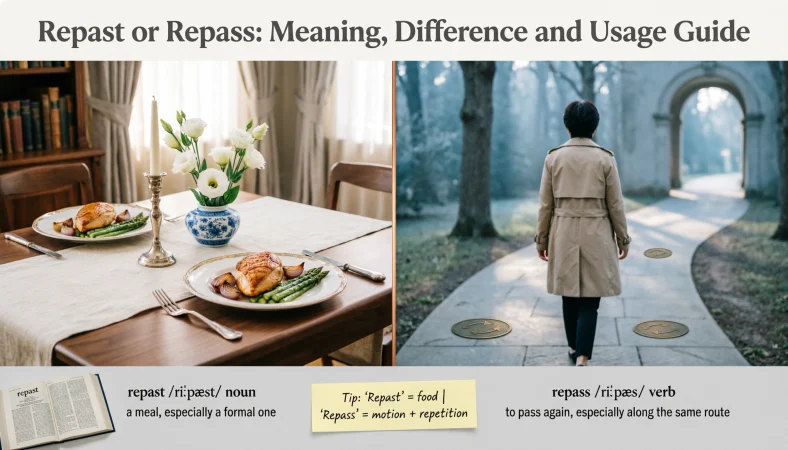
Repast and repass are different English words with different meanings and grammatical roles. A repast is a meal, especially a formal meal or one held after a funeral, while repass means to pass again, return, or go through something another time. Confusing them can change the meaning of a sentence completely.
The difference between repast or repass is easy to miss because the words look and sound remarkably similar. Both contain the same letters in a slightly different arrangement, and both have connections to older French and Latin vocabulary. Yet they describe completely different ideas.
Repast is primarily a noun meaning a meal or the food served at a meal. It is a relatively formal or literary word and is sometimes used when discussing a meal following a funeral or memorial service.
Repass, on the other hand, can function as a verb meaning to pass again, go back through something, or return. In some contexts, it can also function as a noun referring to a second passage or return.
The confusion can create genuine mistakes. Someone writing about food might accidentally use “repass,” while someone describing a person returning to a location might incorrectly write “repast.” Because the two words are pronounced similarly in many contexts, spellcheck alone may not catch the problem.
The key is to remember that repast concerns a meal, whereas repass concerns passing again or returning.
Repast vs Repass: What’s the Difference?
The simplest distinction is semantic. The words belong to different meaning groups.
Repast is a noun. It refers to a meal, particularly when the word is used in formal, literary, historical, or ceremonial contexts.
Repass is primarily a verb. It means to pass again, return through a place, or go through something another time. Its use is considerably less common in everyday English.
| Feature | Repast | Repass |
| Primary word class | Noun | Verb |
| Basic meaning | A meal | To pass again or return |
| Common context | Formal meals, literary writing, funeral gatherings | Returning, passing through again |
| Everyday frequency | Uncommon but recognizable | Relatively uncommon |
| Example | The family shared a repast after the service. | We may repass through the village tomorrow. |
| Related idea | Food and dining | Movement and repetition |
| Pronunciation | Usually pronounced like ree past | Usually pronounced like ree pass |
| Common confusion | Mistaken for repass | Mistaken for repast |
Mini Recap
Repast means a meal.
Repass means to pass again or return.
Repast is normally a noun.
Repass is primarily a verb.
The words are not interchangeable.
Is Repast vs Repass a Grammar, Vocabulary, or Usage Issue?
This is primarily a vocabulary and usage issue, although grammar also matters because the words normally occupy different grammatical positions.
Consider these examples:
The family gathered for a repast.
Here, “repast” functions as a noun because it names a meal.
Now consider:
We had to repass the same street.
Here, “repass” functions as a verb because it describes an action.
Replacing one word with the other would change the sentence’s meaning.
Are Repast and Repass Interchangeable?
No.
A repast is connected with eating. A repass is connected with passing again or returning.
You cannot write:
We enjoyed a repass after the ceremony.
if you mean a meal.
The appropriate word is:
We enjoyed a repast after the ceremony.
Likewise, if you mean that someone passed through an area again, “repass” may be appropriate:
The travelers repassed through the town on their way home.
Formal Versus Informal Usage
Repast has a distinctly formal, literary, or somewhat old fashioned tone. In ordinary conversation, most speakers would simply say meal.
For example:
We had a meal after the service.
sounds natural and conversational.
We shared a repast after the service.
sounds more formal, ceremonial, or literary.
Repass is also relatively uncommon in everyday conversation. People often use expressions such as “go back,” “pass through again,” or “return” instead.
Academic Versus Casual Usage
In academic writing, “repast” may appear in historical, literary, cultural, or religious discussions.
For example:
The communal repast played an important role in the ceremony.
In ordinary conversation, a speaker would probably say:
The group had a meal together.
“Repass” may occur in historical or literary descriptions of movement:
The travelers repassed the mountain route several days later.
What Does Repast Mean?
Repast is a noun meaning a meal or the food eaten during a meal.
The word is more formal than “meal.” It can describe an ordinary meal in literary writing, but it frequently appears in descriptions of ceremonial, communal, historical, or funeral meals.
For example:
The guests gathered for a repast following the ceremony.
The sentence indicates that the guests gathered to eat.
The word can also describe a meal without any connection to death or mourning.
The travelers stopped at the inn for a warm repast.
However, modern speakers are much more likely to say “meal.”
Repast in Funeral and Memorial Contexts
One important use of “repast” occurs after funeral or memorial services.
A family may arrange a meal where relatives, friends, and members of the community gather after the service. Such a meal may be described as a funeral repast or memorial repast.
For example:
The family invited friends to a repast following the memorial service.
This does not mean that “repast” itself means funeral. It means meal. The surrounding context tells readers that the meal is connected with a funeral or memorial gathering.
That distinction is important.
Workplace Example
A formal workplace announcement might say:
Employees are invited to attend a repast following the retirement ceremony.
The word gives the announcement a formal and ceremonial tone.
A more natural modern version would be:
Employees are invited to attend a meal following the retirement ceremony.
Academic Example
A historian might write:
The communal repast was an important part of the village celebration.
Here, “repast” gives the sentence a formal historical tone.
Technology Example
“Repast” is not normally a technology term in everyday English. However, it can appear in digital archives, historical databases, culinary websites, and content management systems describing meals or historical gatherings.
For example, a digital archive might categorize an event as a ceremonial repast.
Usage Recap
Use repast when you mean a meal.
It works especially well in formal, literary, historical, and ceremonial contexts.
In everyday writing, meal is usually the more natural choice.
What Does Repass Mean?
Repass primarily means to pass again or to go through a place or route another time.
It is formed from re, meaning again, and pass, meaning to move through or go beyond something.
For example:
The travelers repassed through the village the following morning.
The meaning is that they passed through the village again.
The word can also be used more abstractly when something is gone through or considered again, although other expressions are often more natural in contemporary English.
Workplace Example
A manager might write:
Before the meeting ends, I would like to repass the main points with the team.
This use is understandable, although “review the main points again” would usually sound more natural in modern professional English.
Academic Example
A historical account might state:
The army repassed the river after regrouping.
Here, the meaning is straightforward: the army crossed or passed through the area again.
Technology Example
In technology related writing, “repass” may appear when describing a process that goes through data, a file, or a system again.
However, modern technical writers generally prefer clearer expressions such as:
process again
run again
pass through again
review again
For that reason, “repass” is less common in contemporary technical communication.
Usage Recap
Use repass when you specifically mean passing again or returning through something.
Because the word is relatively uncommon, consider “return,” “pass through again,” or “go through again” when those alternatives make the meaning clearer.
When You Should NOT Use Repast or Repass
Several situations commonly lead writers toward the wrong word.
- Do not use repast when you mean returning somewhere.
If someone goes back through a location, “repass” may be appropriate.
- Do not use repass when you mean a meal.
A meal is a repast, not a repass.
- Do not assume repast means funeral.
A repast can occur after a funeral, but the word itself simply means a meal.
- Do not use repast in casual conversation when “meal” is clearer.
The formal word may sound unnecessarily old fashioned.
- Do not use repass when “review” is clearer.
In professional writing, “review again” may communicate your intended meaning more naturally.
- Do not treat the words as spelling variants.
They have separate meanings.
- Do not rely on pronunciation alone.
The words can sound similar enough to cause confusion.
- Do not assume a spellchecker will identify the problem.
Both words are legitimate English words, so automated spelling tools may accept either one.
Common Mistakes and Decision Rules
| Correct Sentence | Incorrect Sentence | Explanation |
| The family gathered for a repast after the service. | The family gathered for a repass after the service. | A meal is a repast. |
| The travelers repassed through the town. | The travelers repasted through the town. | Passing through again is repassing. |
| The guests enjoyed a formal repast. | The guests enjoyed a formal repass. | Repass does not mean meal. |
| The soldiers repassed the river. | The soldiers repasted the river. | Repass describes passing again. |
| The historical account describes a communal repast. | The historical account describes a communal repass. | The context concerns eating. |
Decision Rule Box
- If you mean a meal, use repast.
- If you mean passing again, returning, or going through something another time, use repass.
- If you mean an ordinary meal in modern conversation, meal is usually the clearest choice.
Repast or Repass in Modern Technology and AI Tools
Modern technology creates an interesting challenge for uncommon vocabulary.
AI writing tools, search engines, grammar checkers, and spellcheck systems recognize both repast and repass as legitimate words. That means automated software may not automatically identify an incorrect choice.
For example:
The group gathered for a repass.
A grammar checker may not flag this sentence because “repass” is a real word. Yet if the writer intended to describe a meal, the sentence is semantically incorrect.
AI systems therefore need context to distinguish between the two.
A prompt discussing funeral meals is likely to require repast.
A prompt discussing someone passing through a location again may require repass.
This is an example of why semantic context matters more than simple spellchecking.
Repast and Repass in Formal Writing
Both words have legitimate places in formal writing, but their usefulness differs.
Repast can be effective when writing about history, ceremonies, literature, cultural practices, or memorial traditions.
For example:
The guests gathered around the table for a ceremonial repast.
The word adds a formal tone.
Repass is useful when the idea of passing again is important.
For example:
The travelers repassed the same route several weeks later.
However, modern writers should consider whether a simpler phrase communicates the meaning more effectively.
Instead of:
The travelers repassed the route.
you could write:
The travelers passed through the route again.
Or more naturally:
The travelers returned along the same route.
Repast and Funeral Traditions
The association between “repast” and funerals deserves special attention because it is one of the most common reasons people encounter the word today.
A funeral repast is a meal or gathering held after a funeral or memorial service.
The meal can provide an opportunity for people to eat, talk, share memories, support one another, and spend time together after a formal ceremony.
The word itself, however, is broader than this context.
A repast can be any meal.
For example:
The travelers enjoyed a simple repast at sunset.
There is no funeral context in this sentence.
Understanding this distinction prevents an important vocabulary error.
Etymology of Repast and Repass
The two words have different histories despite their similar appearance.
Repast comes into English through French and ultimately relates to Latin roots associated with food and eating. Its historical development explains why it refers to a meal.
Repass is constructed from the prefix re, meaning again, and the verb pass, meaning to move through or go beyond.
The difference in their origins reflects the difference in their meanings.
Repast is connected with eating.
Repass is connected with repeated movement.
Remembering these underlying ideas can make the distinction easier to retain.
Why Are Repast and Repass So Often Confused?
The confusion comes from several factors.
First, they look extremely similar.
Second, they can sound similar when spoken quickly.
Third, both are relatively uncommon words, so many people don’t encounter them frequently enough to develop a strong instinct for their meanings.
Fourth, both can appear in formal writing, which may make them seem like alternative spellings.
They aren’t.
Compare:
We gathered for a repast.
with:
We repassed through the village.
The first concerns food.
The second concerns movement.
That contrast provides the easiest memory aid.
Two Practical Case Studies
Case Study 1: Funeral Program
Imagine a family preparing a printed funeral program.
The program states:
Family and friends are invited to a repass following the service.
If the intended meaning is a meal, this is the wrong word.
The appropriate wording is:
Family and friends are invited to a repast following the service.
The concrete improvement is semantic accuracy. The correction tells readers that food and communal dining will follow the service.
Case Study 2: Historical Travel Account
Now consider a historian describing an expedition.
The original sentence reads:
The explorers repasted through the valley after returning from the mountains.
The intended meaning is that the explorers passed through the valley again.
A clearer correction would be:
The explorers repassed through the valley after returning from the mountains.
The result is a precise description of repeated movement.
These examples demonstrate why context should determine the word rather than visual similarity.
Expert Style Explanation
“The safest way to distinguish these words is to connect each one with its core idea: repast belongs to eating, while repass belongs to passing again.”
This simple semantic association is more reliable than trying to remember the spelling alone.
Author Expertise
Written by a language and SEO content specialist specializing in English vocabulary, word distinctions, semantic search intent, and practical grammar education.
Error Prevention Checklist
Always use repast when
- You mean a meal.
- You are describing a formal or ceremonial meal.
- You are referring to a meal following a funeral or memorial service.
- You are writing in a literary or historical style where the formal word fits naturally.
Always use repass when
- You mean to pass again.
- You mean to return through a location.
- You are describing repeated movement.
- The context specifically involves passing through something another time.
Never use repast when
- You mean return.
- You mean pass through again.
- You mean repeat a journey.
Never use repass when
- You mean meal.
- You mean food.
- You mean a funeral meal.
Related Grammar Confusions You Should Master
If you’re interested in commonly confused English words, these comparisons are worth learning next:
- Passed or Past
- Accept or Except
- Affect or Effect
- Compliment or Complement
- Advice or Advise
- Principal or Principle
- Stationary or Stationery
- Dessert or Desert
- Further or Farther
- Allusion or Illusion
These pairs demonstrate the same basic lesson. Similar spelling or pronunciation doesn’t necessarily mean similar meaning.
Frequently Asked Questions
What is the difference between repast and repass?
A repast is a meal, while repass means to pass again or return through something. They are different words with different meanings and should not be used interchangeably.
Is a repast the same as a funeral?
No. A repast means a meal. The word is frequently used for a meal held after a funeral or memorial service, but it does not itself mean funeral.
What does repast mean after a funeral?
After a funeral, a repast refers to a meal or gathering where family members, friends, and other attendees may eat and spend time together following the service.
What does repass mean?
Repass means to pass again, return through a location, or go through something another time. It is relatively uncommon in everyday modern English.
Is repast a formal word for meal?
Yes. “Repast” is a formal, literary, or somewhat old fashioned word for a meal. In ordinary conversation, “meal” is usually more natural.
Is repass a real word?
Yes. Repass is a legitimate English word. It is primarily used as a verb meaning to pass again or return through something.
Should I say repast or repass after a funeral?
If you mean a meal following a funeral, use repast. A funeral repast is a meal or gathering held after the service.
Is repast or repass used more often?
Neither is especially common in everyday modern English. “Repast” appears in formal, literary, historical, and ceremonial contexts, while “repass” is generally limited to contexts involving repeated movement or passage.
Conclusion
The difference between repast or repass comes down to one essential distinction.
Repast means a meal.
Repass means to pass again or return through something.
Although the words look and sound similar, they are not alternative spellings and cannot normally replace each other.
Repast is particularly useful in formal, literary, historical, and ceremonial contexts. It is also commonly encountered when discussing a meal held after a funeral or memorial service. In everyday conversation, however, “meal” will usually sound more natural.
Repass is much less common, but it has a clear meaning when you need to describe passing through something again or returning along a route. In many modern contexts, phrases such as “return,” “pass through again,” or “go through again” may be clearer.
The simplest rule is easy to remember:
Meal means repast.
Passing again means repass.
Once you connect each word with its core meaning, this easily confused pair becomes much simpler to use correctly.