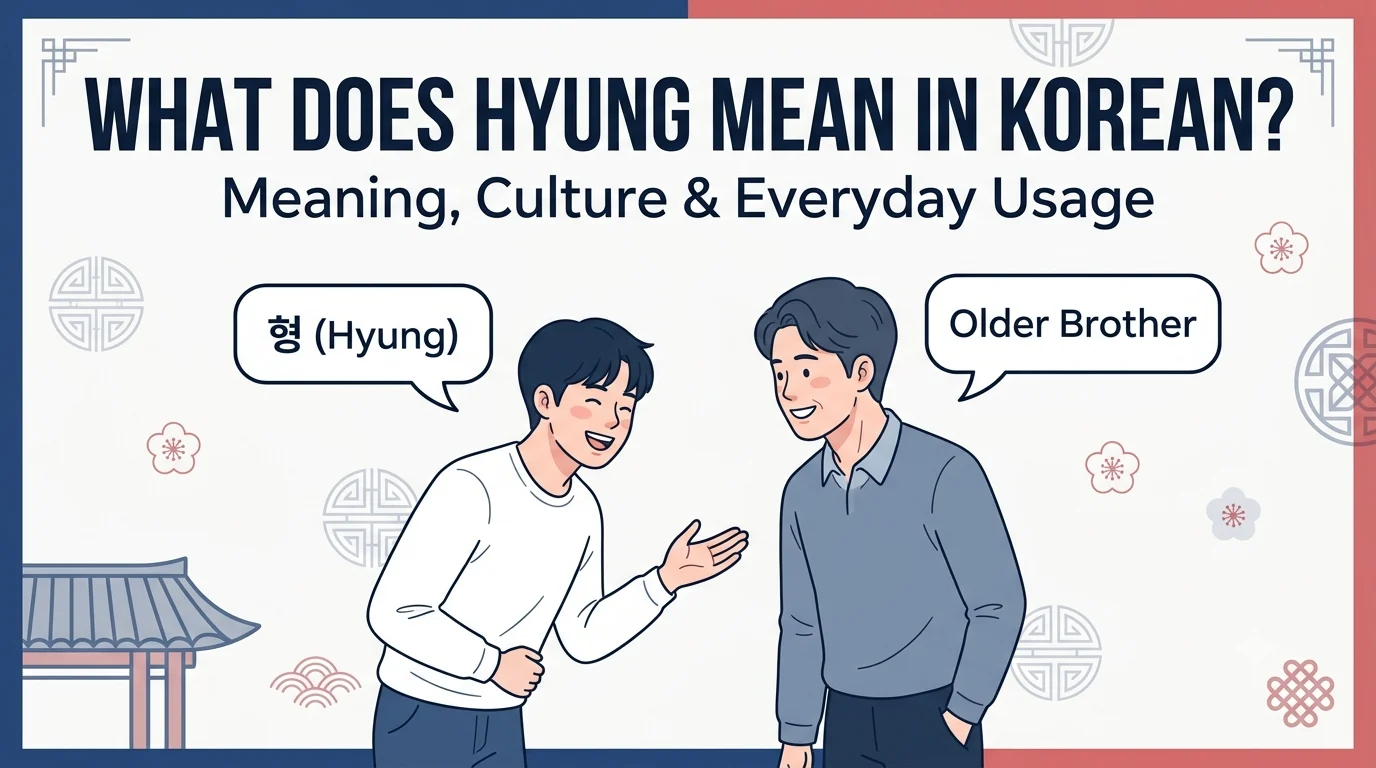
Quick Definition: Hyung (형) is a Korean word that means “older brother” when spoken by a male to an older male. Beyond family, it is also used to address older male friends, mentors, teammates, or close acquaintances as a sign of respect, affection, and closeness. It is one of the most important kinship terms in Korean culture and reflects age-based hierarchy and social relationships.
Hyung (형) is a Korean honorific term meaning “older brother,” used only by males when addressing or referring to an older male. While it literally refers to an older biological brother, it is commonly used for older male friends, colleagues, teammates, or mentors to show respect and familiarity.
Unlike English, Korean uses specific family terms even outside the family to reflect social relationships and age differences.
Simple Meaning
If a younger man says:
“Hyung!”
He’s essentially saying:
- Older brother
- Big brother
- Respected older male friend
- Senior male
The exact meaning depends on the relationship.
Origin
The word 형 (hyung) has been part of the Korean language for centuries.
Historically, Korean society has emphasized:
- Respect for elders
- Family hierarchy
- Confucian values
- Social etiquette
Within families, younger brothers naturally referred to their older brothers as hyung.
Over time, Korean society expanded this family title beyond blood relatives.
Today, younger males commonly use hyung when speaking to:
- Older male friends
- Athletic teammates
- Workplace mentors
- Close acquaintances
This reflects one of the defining characteristics of Korean culture: treating close social relationships like family.
Introduction
If you’ve watched Korean dramas, listened to K-pop, or followed Korean celebrities, you’ve probably heard someone shout “Hyung!” countless times. Whether it’s in emotional family scenes, sports competitions, military settings, or friendly conversations between idols, this single word carries much more meaning than simply “older brother.”
In Korean culture, age and social hierarchy play a significant role in everyday communication. Words like hyung, oppa, noona, and unnie aren’t just family titles they’re an essential part of showing respect and building relationships.
For international fans, understanding what hyung means helps make Korean conversations, TV shows, and social interactions much easier to understand. In this guide, you’ll learn the exact definition of hyung, its cultural importance, origin, pronunciation, examples, common mistakes, and how it compares with similar Korean relationship terms.
Popularity
Although hyung has always been common in Korea, it has become internationally recognized thanks to the global popularity of Korean entertainment.
Millions of people now hear the word through:
- K-dramas
- K-pop groups
- Korean reality shows
- Korean variety programs
- YouTube creators
- Esports teams
- Korean movies
- Language-learning apps
Fans of groups like BTS, SEVENTEEN, EXO, Stray Kids, NCT, and other K-pop artists frequently hear younger members calling older members hyung.
Because of this exposure, even many non-Korean fans recognize the word immediately.
Why Is Hyung So Popular?
Its popularity comes from several factors:
- Korean Wave (Hallyu)
- K-pop fandom culture
- Streaming services
- Social media clips
- Language-learning communities
- Gaming and esports
Today, “hyung” is one of the first Korean words many international fans learn.
How It Is Used
The meaning of hyung depends on who is speaking and the relationship involved.
Biological Older Brother
The most literal meaning is an older brother.
Example:
Minho calls his older brother hyung every day.
Older Male Friend
A younger male may call an older close friend hyung.
Example:
Hyung, let’s grab dinner later!
This expresses both friendship and respect.
Sports Teams
Athletes frequently call older teammates hyung.
Example:
Thanks, hyung! Great pass!
Military
Military service in South Korea reinforces hierarchical relationships, making terms like hyung common among close peers when appropriate.
Tone
Depending on context, hyung can sound:
| Situation | Tone |
| Family | Loving ❤️ |
| Friends | Casual 😊 |
| Sports | Respectful 💪 |
| Mentorship | Appreciative 🙏 |
| Emotional scene | Affectionate 🥹 |
Examples
Friendly Examples
- Hyung, are you coming tonight?
- Thanks, hyung!
- Hyung, let’s play soccer later.
- Happy birthday, hyung! 🎉
- You’re the best, hyung!
Professional Examples
While hyung is generally informal, younger men in Korean workplaces may use it with older male coworkers if they have developed a close relationship outside strict business settings.
Examples:
- Hyung, could you explain this report?
- Thanks for helping me today, hyung.
However, in formal offices, titles such as job position or honorifics are usually preferred.
Funny Examples
- Hyung, save me from this homework! 😂
- Buy me lunch, hyung! 🍜
- Hyung, my wallet is crying again. 💸
- You’re basically everyone’s favorite hyung.
- Hyung, teach me your secret!
Comparison with Similar Terms
Korean has several relationship terms depending on gender and age.
| Korean Word | Used By | Refers To | Meaning |
| Hyung (형) | Male | Older male | Older brother |
| Oppa (오빠) | Female | Older male | Older brother/older male |
| Noona (누나) | Male | Older female | Older sister |
| Unnie (언니) | Female | Older female | Older sister |
| Sunbae (선배) | Anyone | Senior | Senior at school or work |
| Dongsaeng (동생) | Anyone | Younger person | Younger sibling/friend |
Hyung vs Oppa
These two words are often confused.
| Hyung | Oppa |
| Used by males | Used by females |
| Refers to older male | Refers to older male |
| Means older brother | Means older brother |
The speaker’s gender determines which word is correct.
Alternate Meanings
Unlike many internet abbreviations, hyung has very few alternate meanings.
Possible interpretations include:
| Meaning | Context |
| Older brother | Family |
| Older male friend | Friendship |
| Mentor | Sports or work |
| Senior male | Social relationships |
Outside Korean language and culture, hyung generally does not have another widely recognized meaning.
Professional or Polite Alternatives
In formal Korean settings, people often avoid hyung unless they have a close relationship.
More formal alternatives include:
| Situation | Better Alternative |
| Workplace | Job title |
| Business | Position + honorific |
| Teacher | Seonsaengnim (teacher) |
| Professor | Gyosunim |
| Customer | Appropriate honorific |
| Stranger | Sir/Mister (context dependent) |
If speaking English, you might instead say:
- Mr.
- Sir
- Mentor
- Senior colleague
- Team leader
Common Mistakes
Many Korean learners misunderstand how hyung works.
Mistake 1: Women Saying Hyung
Incorrect:
A woman calling an older male hyung.
Correct:
Women use oppa instead.
Mistake 2: Calling Every Older Man Hyung
Hyung implies some degree of familiarity.
Strangers usually receive formal titles instead.
Mistake 3: Ignoring Age
Age matters greatly in Korean culture.
Using hyung with someone younger would sound incorrect.
Mistake 4: Assuming It Only Means Brother
While it literally means older brother, it’s also commonly used among close friends and teammates.
Mistake 5: Using It in Formal Business Meetings
Formal Korean communication often relies on professional titles rather than family terms.
Quick Tips
- Hyung (형) means older brother.
- Only males use hyung.
- It refers to an older male.
- It can describe family, friends, teammates, or mentors.
- It reflects respect and closeness.
- Women use oppa, not hyung.
- Don’t use it for strangers in formal situations.
- Understanding hyung helps you better enjoy K-dramas, K-pop, and Korean culture.
FAQ
What does hyung mean in Korean?
Hyung means older brother and is used by males when addressing an older male family member, friend, or mentor.
Who can say hyung?
Only males use hyung, and they use it when speaking to an older male.
What is the difference between hyung and oppa?
Hyung is used by males for older males, while oppa is used by females for older males.
Can hyung refer to a friend?
Yes. Younger males often call older close friends hyung as a sign of respect and affection.
Is hyung only for family?
No. It is commonly used for older friends, teammates, coworkers, and mentors, depending on the relationship.
Why do K-pop idols call each other hyung?
Many K-pop groups have members of different ages. Younger male members call older male members hyung to acknowledge age hierarchy and show closeness.
Is hyung a formal word?
Not usually. It is respectful but generally used in informal or familiar relationships rather than formal business settings.
How do you pronounce hyung?
Hyung is pronounced approximately as “hyuhng,” with a soft “yu” sound. The Korean spelling is 형.
Conclusion
The Korean word hyung (형) is much more than a simple translation of “older brother.” It reflects the values of respect, age hierarchy, and close relationships that are deeply rooted in Korean culture.
Whether you’re watching K-dramas, listening to K-pop, learning Korean, or simply curious about Korean expressions, understanding what does hyung mean in Korean provides valuable insight into how Koreans build and express meaningful relationships. Remember that hyung is used only by males toward older males, while similar terms like oppa, noona, and unnie are used in different gender-based contexts.
By using hyung appropriately and understanding its cultural significance, you’ll not only improve your Korean vocabulary but also gain a deeper appreciation for Korean etiquette and everyday communication.