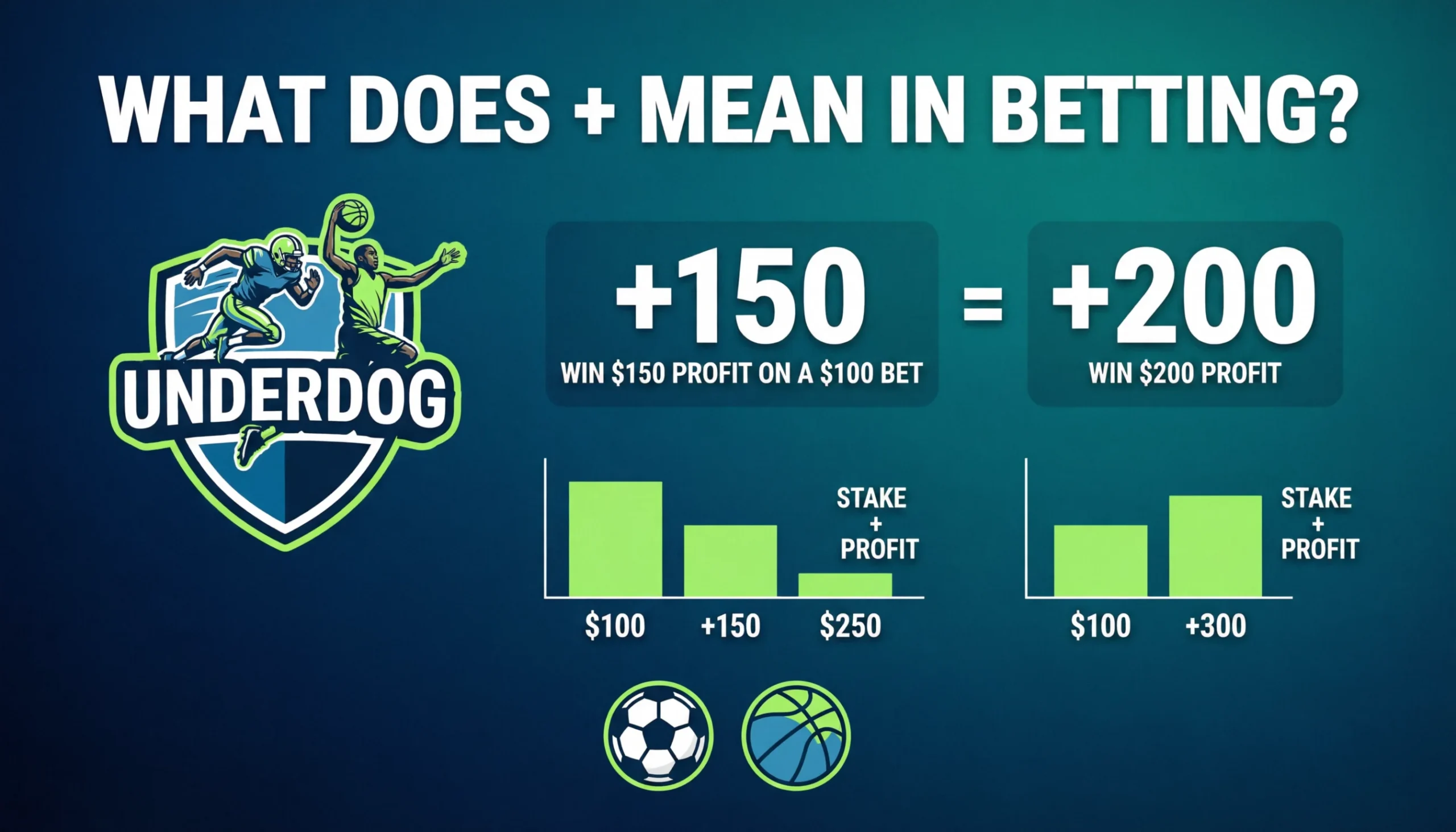
Quick Definition: In sports betting, the plus sign (+) indicates positive American odds. It usually identifies the underdog and shows how much profit you would earn on a $100 bet. For example, +150 means you would win $150 in profit if you bet $100 and your wager is successful.
If you’re new to sports betting, you’ve probably noticed odds written with either a plus (+) or minus (-) sign. These symbols aren’t random they tell you important information about a team’s chances of winning and how much your bet could pay.
The plus sign (+) represents positive American odds, meaning the team or player is generally considered the underdog. Because underdogs are viewed as less likely to win, sportsbooks offer larger potential payouts to attract bets.
The plus sign (+) in betting means positive American odds. It usually identifies the underdog and indicates how much profit you’ll earn from a $100 wager if your bet wins. For example, +200 means a successful $100 bet earns $200 in profit, plus your original $100 stake is returned.
How Positive Odds Work
Here’s a simple breakdown:
| Odds | Profit on $100 Bet | Total Return |
| +100 | $100 | $200 |
| +150 | $150 | $250 |
| +200 | $200 | $300 |
| +300 | $300 | $400 |
| +500 | $500 | $600 |
Profit is what you win, while total return includes both your winnings and your original stake.
Origin
The plus and minus system comes from the American odds format, which became popular with sportsbooks in the United States.
Unlike decimal odds (common in Europe) or fractional odds (common in the United Kingdom), American odds use positive and negative numbers to represent both payouts and implied probability.
Historically:
- Sportsbooks needed a standardized way to display betting prices.
- Favorites were assigned negative (-) odds because bettors needed to risk more money for smaller profits.
- Underdogs received positive (+) odds because sportsbooks paid larger profits to offset their lower probability of winning.
Today, American odds remain the standard format across many U.S.-based sportsbooks and are widely recognized around the world.
Introduction
Sports betting can seem confusing at first, especially when sportsbooks display odds like +120, -180, or +350. Many beginners assume the numbers represent rankings or scores, but they actually explain probability and potential payouts.
Understanding what the plus sign (+) means is one of the first steps toward reading betting lines with confidence. Whether you’re betting on football, basketball, baseball, soccer, hockey, tennis, or MMA, you’ll regularly encounter positive odds.
Generally speaking:
- Positive (+) odds indicate the underdog.
- Negative (-) odds indicate the favorite.
However, the plus sign isn’t just about identifying the underdog it also tells you exactly how much profit you can make from a winning $100 wager.
This guide explains how positive odds work, where you’ll see them, how to calculate payouts, common mistakes to avoid, and how they compare with other betting formats.
Popularity
Positive odds appear across nearly every major sport and betting market.
You’ll commonly see them in:
- NFL betting
- NBA betting
- MLB betting
- NHL betting
- College sports
- Soccer
- Tennis
- Golf
- UFC and MMA
- Boxing
- Esports
Examples include:
- Team A +140
- Fighter +180
- Golfer +2500
- Soccer club +110
The larger the positive number, the less likely the sportsbook believes the outcome is but the greater the potential payout.
How It Is Used
The plus sign appears in several betting markets.
Moneyline Betting
Moneyline betting is the most common place you’ll see positive odds.
Example:
| Team | Odds |
| Chiefs | -170 |
| Raiders | +150 |
In this example:
- The Chiefs are favorites.
- The Raiders are underdogs.
- A successful $100 bet on the Raiders returns $150 in profit.
Futures Betting
Future bets often have large positive odds.
Example:
| Team | Odds |
| Team A | +800 |
| Team B | +1800 |
| Team C | +4000 |
These bets pay more because predicting a future champion is more difficult.
Player Awards
Positive odds are common in MVP, Rookie of the Year, and scoring title markets.
Example:
- Player A +500
- Player B +900
- Player C +2500
Live Betting
During games, odds constantly change.
A favorite may become:
- +120
- +180
- +300
if they fall behind.
Examples
Friendly Examples
Here are some beginner-friendly examples.
| Bet | Result |
| +100 | Win $100 profit on a $100 bet |
| +150 | Win $150 profit |
| +250 | Win $250 profit |
| +400 | Win $400 profit |
Example:
You bet $100 on Team A at +180.
If Team A wins:
- Profit = $180
- Total Return = $280
Professional Examples
Sportsbooks display positive odds in a consistent format.
| Market | Odds |
| Moneyline | +135 |
| MVP | +700 |
| Championship Winner | +900 |
| First Goal Scorer | +650 |
| Tournament Winner | +2500 |
Professional bettors compare these prices across sportsbooks to find the best value.
Funny Examples
Positive odds can lead to some entertaining conversations.
- “My fantasy team has +5000 odds… so you’re saying there’s a chance? 😄”
- “I picked the biggest underdog because I like surprises.”
- “The odds were +1000. My optimism was even higher!”
- “Underdogs make great stories and sometimes great payouts.”
Comparison with Similar Terms
The plus sign is only one part of understanding betting odds.
| Betting Term | Meaning |
| + Odds | Underdog with positive payout |
| – Odds | Favorite requiring larger risk |
| Moneyline | Bet on who wins |
| Point Spread | Bet based on winning margin |
| Decimal Odds | Odds shown as multipliers |
| Fractional Odds | Traditional UK format |
Plus (+) vs. Minus (-)
| Plus (+) | Minus (-) |
| Usually the underdog | Usually the favorite |
| Higher potential payout | Lower potential payout |
| Less likely outcome | More likely outcome |
| Profit shown for a $100 bet | Amount needed to risk to win $100 |
American vs. Decimal Odds
| American Odds | Decimal Odds (Approx.) |
| +100 | 2.00 |
| +150 | 2.50 |
| +200 | 3.00 |
| +300 | 4.00 |
Knowing both formats can help when comparing sportsbooks that use different systems.
Alternate Meanings
Outside sports betting, the plus (+) symbol has many unrelated meanings.
| Context | Meaning |
| Mathematics | Addition |
| Medicine | Positive test result |
| Grades | Slightly above a standard grade |
| Technology | Premium subscription |
| Phones | International dialing prefix |
| Programming | Addition or string concatenation |
In betting, however, + almost always refers to positive American odds.
Professional or Polite Alternatives
In articles, betting guides, or educational materials, writers often use more descriptive language instead of simply saying “plus.”
Examples include:
- Positive American odds
- Positive moneyline odds
- Underdog odds
- Plus money
- Positive betting line
- American odds with a plus sign
Example:
Instead of writing:
“The team is +150.”
You could write:
“The team is listed at +150 positive American odds, making it the underdog.”
Common Mistakes
Many beginners misunderstand positive odds.
1. Thinking + Means the Favorite
The plus sign almost always indicates the underdog.
2. Confusing Profit With Total Return
At +200, a winning $100 bet earns $200 in profit, not a $200 total return. The total returned is $300 because your original stake is included.
3. Assuming Bigger Numbers Mean Better Bets
Higher positive odds mean larger payouts but lower implied probability.
4. Ignoring Implied Probability
Odds don’t guarantee outcomes they reflect the sportsbook’s assessment and pricing.
5. Comparing Odds Without Shopping
Different sportsbooks may offer different prices for the same event. Comparing odds can improve potential returns.
Quick Tips
Use these tips when reading positive betting odds:
- A plus sign usually means the underdog.
- Positive odds show profit based on a $100 wager.
- Always separate profit from total return.
- Larger positive numbers mean bigger potential payouts but lower implied probability.
- Compare odds across sportsbooks when possible.
- Learn both American and decimal odds formats.
- Manage your bankroll responsibly.
- Never assume an underdog can’t win upsets happen.
FAQ
1. What does + mean in betting?
The + symbol means positive American odds, typically identifying the underdog and showing how much profit a successful $100 bet would earn.
2. Does a plus sign always mean the underdog?
In most moneyline markets, yes. Positive odds generally indicate the underdog, while negative odds identify the favorite.
3. What does +150 mean in betting?
A $100 winning bet at +150 earns $150 in profit, giving a total return of $250.
4. What does +200 mean?
A successful $100 wager at +200 earns $200 in profit and returns $300 in total.
5. Can favorites ever have positive odds?
In standard head-to-head betting, favorites almost always have negative odds. However, odds can shift due to market movement or special betting markets, so it’s possible in uncommon situations.
6. Are positive odds better than negative odds?
Not necessarily. Positive odds offer higher payouts but generally represent less likely outcomes. Whether they’re “better” depends on whether the odds accurately reflect the true probability of the event.
7. What is “plus money”?
“Plus money” is another term for positive American odds, such as +120 or +300.
8. How do sportsbooks calculate positive odds?
Sportsbooks set odds based on statistical models, market activity, expert analysis, injuries, and other factors. The displayed odds also reflect the bookmaker’s margin.
Conclusion
So, what does + mean in betting? The plus sign represents positive American odds, which usually identify the underdog and indicate how much profit you’ll earn from a successful $100 wager. For example, +150 means a winning $100 bet earns $150 in profit, while +300 earns $300 in profit.
Learning how to read positive odds is a fundamental skill for anyone interested in sports betting. By understanding the relationship between payouts, implied probability, and underdogs, you’ll be better equipped to interpret betting lines and make informed decisions. Remember that bigger payouts also come with greater risk, so always evaluate the odds carefully and practice responsible bankroll management.