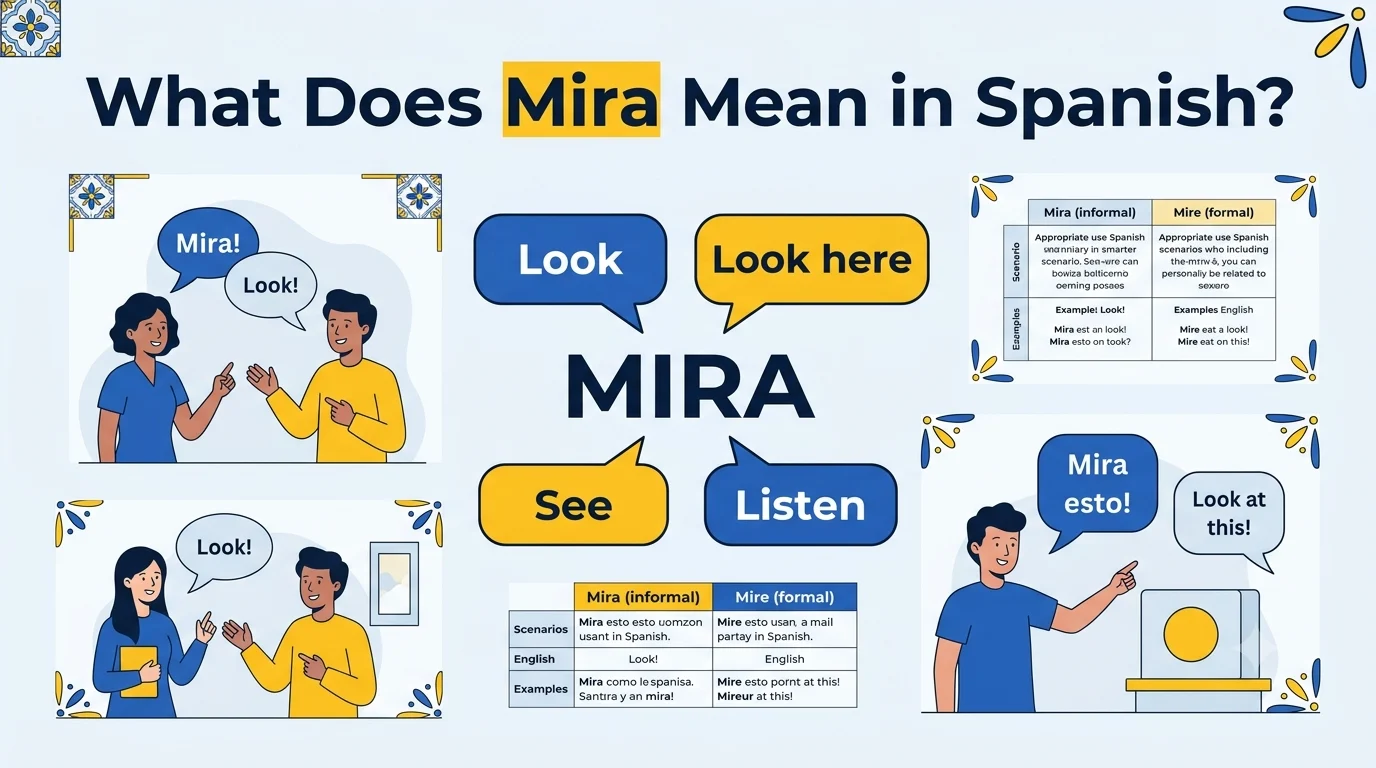
Quick Definition: Mira is a common Spanish word that comes from the verb mirar, meaning “to look” or “to watch.” As a standalone word, mira usually means “look,” “look here,” “see,” or “listen” depending on the context. Native Spanish speakers often use it to get someone’s attention before saying something important, surprising, or interesting.
If you’ve watched Spanish-language TV shows, listened to Latin music, or traveled to a Spanish-speaking country, you’ve probably heard someone say “¡Mira!”
Although its literal translation is “look,” the word mira has several meanings depending on the situation and tone of voice.
Mira = “Look,” “Look here,” “See,” or “Listen” (used to get someone’s attention).
It is the informal singular command of the verb mirar, which means “to look” or “to watch.”
Basic Meaning
| Spanish | English |
| Mira | Look |
| Mira esto | Look at this |
| Mira aquí | Look here |
| Mira bien | Look carefully |
| Mira qué bonito | Look how beautiful |
In everyday conversation, mira is often less about literally looking at something and more about introducing what the speaker wants to say similar to saying “Listen,” “Well,” or “Look,” in English.
Introduction
Language is full of small words that carry a lot of meaning, and mira is a perfect example. At first glance, it simply means “look.” However, in real conversations, it can express excitement, surprise, frustration, affection, warning, or even impatience.
For example, a Spanish speaker might say:
- ¡Mira! Hay un arcoíris.
(Look! There’s a rainbow.)
Or:
- Mira, necesito hablar contigo.
(Listen, I need to talk to you.)
Notice how the second example isn’t asking someone to physically look at anything. Instead, mira functions as a conversational attention-getter.
Because it’s used so frequently in Spain, Mexico, Argentina, Colombia, and nearly every Spanish-speaking country, learning how mira works can make conversations feel much more natural.
Whether you’re studying Spanish, translating dialogue, or simply curious about the word, understanding its different meanings will help you communicate more confidently.
Origin
The word mira comes from the Spanish verb mirar, which originates from the Latin verb mīrārī, meaning “to look at,” “to admire,” or “to wonder.”
Over centuries, mirar evolved into one of the most common verbs in Spanish.
The command mira specifically represents the informal imperative directed toward one person.
For example:
| Verb Form | Meaning |
| Mirar | To look |
| Miro | I look |
| Miras | You look |
| Mira | Look! (command) |
| Miramos | We look |
| Miran | They look |
Today, the word appears countless times in spoken Spanish, literature, films, music, podcasts, and social media.
Popularity
Few Spanish words are as common as mira.
Native speakers use it every day in casual conversations because it’s quick, natural, and versatile.
You’ll frequently hear it in:
- Everyday conversations
- TV shows
- Movies
- Telenovelas
- YouTube videos
- TikTok clips
- Podcasts
- Songs
- Classrooms
- Family discussions
Popular expressions include:
- Mira esto.
- Mira aquí.
- Mira qué pasó.
- Mira bien.
- Mira, te explico.
- Mira nada más.
- Mira quién llegó.
Its flexibility makes it one of the first conversational words many Spanish learners encounter.
How It Is Used
Depending on context, mira can have several different meanings.
1. To Ask Someone to Look 👀
This is the most literal meaning.
Example:
Mira ese perro.
Translation:
Look at that dog.
2. To Get Someone’s Attention
Similar to saying:
- Listen…
- Look…
- Hey…
Example:
Mira, tengo una idea.
Translation:
Listen, I have an idea.
3. To Introduce an Explanation
Spanish speakers often begin explanations with mira.
Example:
Mira, lo que pasó fue esto.
Translation:
Well, here’s what happened.
4. To Express Surprise
Example:
¡Mira quién está aquí!
Translation:
Look who’s here!
5. To Warn Someone
Example:
Mira por dónde caminas.
Translation:
Watch where you’re walking.
6. To Show Excitement
Example:
¡Mira qué hermoso!
Translation:
Look how beautiful!
Examples
Friendly Examples
- Mira este video.
(Look at this video.) - Mira qué lindo.
(Look how cute.) - Mira eso.
(Look at that.) - Mira, ven conmigo.
(Hey, come with me.) - Mira quién vino.
(Look who came.)
Professional Examples
Although mira is informal, it may still appear in polite conversations when speaking to someone familiar.
Examples:
- Mira este informe antes de enviarlo.
(Please look over this report before sending it.) - Mira los resultados cuidadosamente.
(Review the results carefully.) - Mira los documentos adjuntos.
(Please review the attached documents.)
For formal situations, speakers generally prefer mire instead of mira.
Funny Examples
- Mira… otra vez olvidé las llaves.
(Look… I forgot my keys again.) - Mira quién cree que es famoso. 😂
(Look who thinks they’re famous.) - Mira, el perro está manejando.
(Look, the dog is driving.) (A playful exaggeration.) - Mira nada más… ¡qué desastre! 😅
(Well, look at this mess!)
Comparison with Similar Terms
Spanish has several words that are similar to mira, but each has a different nuance.
| Word | Meaning | Typical Use |
| Mira | Look / Listen | Informal attention-getter |
| Mire | Look (formal) | Respectful command |
| Miren | Look (plural) | Addressing multiple people |
| Ve | See / Go (depends on context) | Informal command |
| Observa | Observe | More formal or instructional |
| Fíjate | Notice / Pay attention | Common in conversation |
Mira vs Mire
| Mira | Mire |
| Informal | Formal |
| Used with friends and family | Used with strangers, customers, elders |
| Tú form | Usted form |
Example:
Mira este documento.
(Informal)
Mire este documento, por favor.
(Formal)
Alternate Meanings
Although mira most commonly means “look” in Spanish, it can have other meanings depending on context.
1. As a Girl’s Name
Mira is a feminine given name in several cultures and languages. Depending on the origin, it can mean:
- Wonderful
- Peace
- Ocean
- Admirable
- Princess
The meaning varies by language and culture.
2. Astronomy
Mira is the name of a famous variable star in the constellation Cetus.
3. Company and Brand Names
Several organizations and products use Mira as a brand name because it is short, memorable, and easy to pronounce in many languages.
4. Acronyms
In different industries, MIRA may stand for various abbreviations, though these are unrelated to the Spanish word.
Professional or Polite Alternatives
When speaking respectfully in Spanish, there are alternatives to mira.
| Informal | Formal |
| Mira | Mire |
| Mira esto | Mire esto |
| Mira aquí | Mire aquí |
| Mira bien | Observe cuidadosamente |
| Mira el documento | Revise el documento |
These alternatives are especially useful in workplaces, customer service, and academic settings.
Common Mistakes
Spanish learners often make a few common errors when using mira.
1. Using “mira” with everyone
“Mira” is informal. Use mire when speaking respectfully to someone you address as usted.
2. Translating It Literally Every Time
Sometimes mira means “listen” or “well,” not “look.”
Context determines the best translation.
3. Confusing It with “Mirar”
Mirar is the infinitive (“to look”).
Mira is the command (“look”).
4. Using It Too Frequently
Repeating mira before every sentence can sound unnatural. Native speakers use it naturally and vary their expressions.
5. Ignoring Tone
The same word can sound:
- Friendly 😊
- Excited 😄
- Frustrated 😒
- Serious 😐
- Loving ❤️
Pay attention to tone and context.
Quick Tips
Here are some simple tips to use mira naturally:
- Remember that mira is the informal command for one person.
- Use it to attract attention before speaking.
- Don’t always translate it as “look”; it may mean “listen” or “well.”
- Use mire instead of mira in formal situations.
- Watch Spanish movies and TV shows to hear how native speakers use it.
- Practice common expressions like “Mira esto,” “Mira aquí,” and “Mira qué bonito.”
- Let context guide your interpretation.
FAQ
1. What does mira mean in Spanish?
Mira usually means “look,” “look here,” “see,” or “listen.” It is the informal command form of the verb mirar (“to look”).
2. Does mira always mean “look”?
No. Depending on the context, mira can also mean “listen,” “well,” or simply serve as an attention-getter before making a point.
3. Is mira formal or informal?
Mira is informal and is used with tú. The formal equivalent is mire, used with usted.
4. What is the difference between mira and mire?
Mira is used with friends, family, or people you know well. Mire is used to show respect or when addressing someone formally.
5. Is mira a verb or a noun?
In this context, mira is the imperative (command) form of the verb mirar. However, “Mira” can also be a proper name or refer to other non-linguistic meanings depending on context.
6. Can mira mean “listen”?
Yes. In many conversations, mira is best translated as “listen” or “look” when the speaker wants someone’s attention rather than asking them to physically look at something.
7. How do native Spanish speakers use mira?
Native speakers use mira to point something out, introduce an explanation, express surprise, warn someone, or simply begin a conversation naturally.
8. Is mira common in all Spanish-speaking countries?
Yes. While expressions and pronunciation vary by region, mira is widely understood and commonly used throughout the Spanish-speaking world.
Conclusion
Understanding what mira means in Spanish is about more than memorizing a simple translation. While its literal meaning is “look,” native speakers use it in many everyday situations to attract attention, introduce explanations, express surprise, give warnings, or even mean “listen.” As the informal command form of mirar, it is one of the most frequently used conversational words in Spanish and appears in daily speech across Spain, Latin America, movies, music, and social media.
The key to mastering mira is paying attention to context. Sometimes it refers to physically looking at something, while other times it simply signals that the speaker wants you to pay attention. Learning when to use mira, when to choose the formal mire, and how tone influences its meaning will help you sound more natural and understand Spanish conversations with greater confidence.