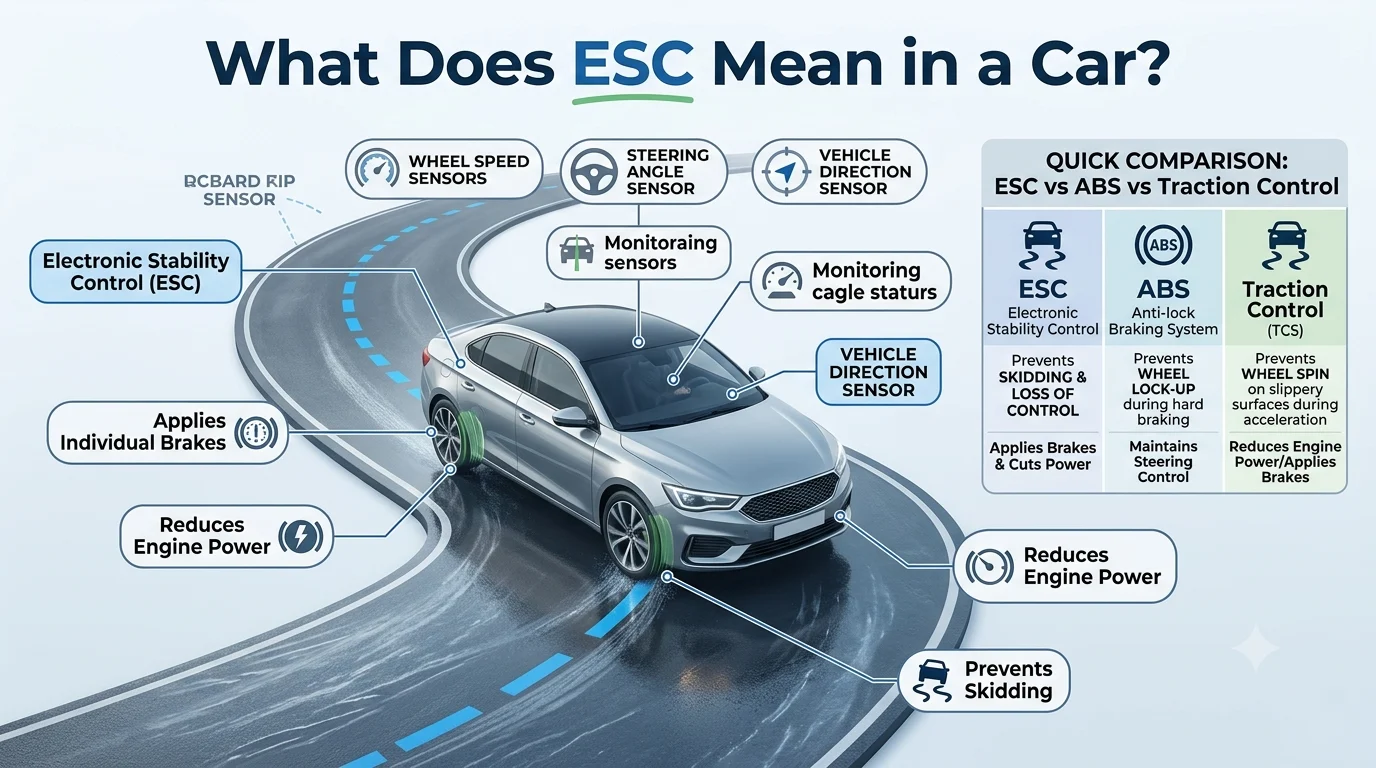
Quick Definition: ESC stands for Electronic Stability Control, an advanced vehicle safety system that helps drivers maintain control during sudden turns, slippery road conditions, or emergency maneuvers. It automatically applies the brakes to individual wheels and may reduce engine power to prevent skidding or losing control.
If you’ve ever noticed an ESC warning light on your dashboard or seen “Electronic Stability Control” listed in your vehicle’s features, you might wonder what it actually does.
Electronic Stability Control (ESC) is a computerized safety system designed to detect when your vehicle begins to lose traction or stability. When this happens, the system automatically intervenes by applying brakes to one or more wheels and, if necessary, reducing engine power to help keep the vehicle traveling in the intended direction.
Simple Definition
ESC (Electronic Stability Control) is a vehicle safety feature that helps prevent skidding and loss of control by automatically adjusting braking and engine power.
Unlike systems that only activate during hard braking, ESC works whenever it detects that your vehicle is beginning to slide, fishtail, or drift away from the direction you’re steering.
How ESC Works
Electronic Stability Control continuously monitors several vehicle sensors, including:
- Steering wheel angle
- Wheel speed
- Vehicle speed
- Yaw rate (rotation of the vehicle)
- Lateral acceleration
If the system detects that the vehicle isn’t following the driver’s steering input, it immediately responds by:
- Applying brakes to one or more individual wheels.
- Reducing engine power if needed.
- Helping restore stability before the driver may even realize there’s a problem.
Introduction
Imagine driving on a rainy highway when another car suddenly changes lanes in front of you. You quickly steer to avoid a collision, but your tires begin to lose grip. Without assistance, your vehicle could skid or spin out of control.
This is exactly the type of situation Electronic Stability Control (ESC) is designed to handle.
ESC is one of the most important automotive safety technologies developed in the last few decades. It works silently in the background, helping drivers stay in control during emergency maneuvers, sharp corners, icy roads, wet pavement, gravel, or other low-traction conditions.
Today, ESC is standard equipment on most modern cars, SUVs, pickup trucks, and commercial vehicles because it has been proven to significantly reduce crashes caused by skidding and rollover.
Whether you’re buying a new vehicle, troubleshooting an ESC warning light, or simply learning about dashboard symbols, understanding what ESC means can help you become a safer and more informed driver.
Origin
Electronic Stability Control was developed during the 1990s as automotive manufacturers looked for ways to reduce accidents caused by loss of vehicle control.
The technology combines several existing safety systems, including:
- Anti-lock Braking System (ABS)
- Traction Control System (TCS)
- Electronic Brakeforce Distribution (EBD)
- Advanced onboard sensors
Mercedes-Benz and Bosch were among the pioneers in developing modern ESC technology, introducing it on luxury vehicles before it gradually became available across the automotive industry.
As research demonstrated its effectiveness in preventing crashes, many countries introduced regulations requiring Electronic Stability Control on new passenger vehicles.
Today, nearly every major automaker includes ESC as standard equipment.
Popularity
ESC has become one of the most widely recognized automotive safety features worldwide.
Its popularity has grown because:
- It helps reduce single-vehicle accidents.
- It lowers rollover risk in SUVs.
- It improves control on slippery roads.
- It works automatically without driver intervention.
- It complements ABS and traction control.
Drivers commonly encounter ESC when:
- Buying a new car
- Reading vehicle specifications
- Seeing the ESC dashboard light
- Driving in rain or snow
- Visiting a mechanic
- Reading owner’s manuals
Many automotive organizations consider ESC one of the greatest advancements in vehicle safety after the seat belt and airbag.
How It Is Used
Although drivers rarely “use” ESC directly, they benefit from it whenever road conditions become challenging.
During Rain 🌧️
ESC detects wheel slip and helps maintain stability while cornering on wet roads.
Example:
“The ESC activated when my car started sliding on the rain-soaked highway.”
On Snow or Ice ❄️
ESC reduces skidding by applying brakes individually.
Example:
“Electronic Stability Control helped keep the vehicle straight on the icy road.”
Emergency Steering
If a driver suddenly swerves to avoid an obstacle, ESC assists in preventing loss of control.
Example:
“ESC kicked in when I avoided a deer crossing the road.”
Sharp Corners
The system helps reduce oversteer and understeer during aggressive turns.
Dashboard Warning Light
Drivers may notice the ESC indicator:
- Flashing = ESC is actively working.
- Staying on continuously = There may be a system fault or the system has been manually turned off.
Examples
Friendly Examples
- “My ESC light flashed during heavy rain.”
- “Thankfully, ESC kept my car from sliding.”
- “I always leave Electronic Stability Control turned on.”
- “That safety feature probably prevented an accident.”
- “Modern cars use ESC automatically.”
Professional Examples
- “Electronic Stability Control improves directional stability during emergency maneuvers.”
- “ESC uses selective wheel braking to reduce vehicle instability.”
- “The technician diagnosed an ESC sensor malfunction.”
- “Vehicle safety ratings often include ESC performance.”
- “ESC should remain enabled during normal driving conditions.”
Funny Examples
- “ESC is like your car whispering, ‘I’ve got this.’ 😄”
- “I thought I was a racing driver ESC politely disagreed.”
- “My tires wanted to drift, but ESC had other plans.”
- “ESC deserves a thank-you card every winter.”
- “It’s the quiet hero you hope never has to work.”
Comparison with Similar Terms
Many people confuse ESC with other vehicle safety systems. While they often work together, each has a different purpose.
| System | Full Form | Main Purpose | When It Works |
| ESC | Electronic Stability Control | Prevents skidding and loss of control | During steering instability |
| ABS | Anti-lock Braking System | Prevents wheel lock during braking | Hard braking |
| TCS | Traction Control System | Prevents wheel spin during acceleration | Accelerating on slippery roads |
| EBD | Electronic Brakeforce Distribution | Optimizes brake force between wheels | Braking |
| ADAS | Advanced Driver Assistance Systems | Driver assistance and collision prevention | Various driving situations |
ESC vs Traction Control
| ESC | Traction Control |
| Helps maintain vehicle direction | Prevents wheels from spinning |
| Works during cornering | Works mainly during acceleration |
| Uses steering sensors | Primarily monitors wheel speed |
| Applies individual wheel brakes | Reduces engine power and brake force |
Alternate Meanings
Although ESC most commonly refers to Electronic Stability Control in the automotive world, it can have different meanings in other contexts.
| ESC Meaning | Industry |
| Electronic Stability Control | Automotive |
| Escape Key | Computers |
| European Society of Cardiology | Medical |
| Engineering Service Center | Engineering |
| Emergency Shutdown Controller | Industrial Systems |
When discussing cars, ESC almost always means Electronic Stability Control.
Professional or Polite Alternatives
Depending on the audience, professionals may use these alternative terms:
| Standard Term | Alternative |
| ESC | Electronic Stability Control |
| ESC | Stability Control System |
| ESC | Electronic Vehicle Stability System |
| ESC | Vehicle Stability Assist (brand-specific) |
| ESC | Dynamic Stability Control (manufacturer-specific name) |
Different automakers use different names for similar technology. For example:
- Vehicle Stability Assist (Honda)
- Vehicle Stability Control (Toyota)
- Dynamic Stability Control (BMW and Mazda)
- StabiliTrak (General Motors)
- Porsche Stability Management (Porsche)
Although the names differ, their primary purpose is the same: helping the driver maintain control.
Common Mistakes
Many drivers misunderstand how ESC works. Here are some common misconceptions.
1. Thinking ESC Prevents All Accidents
ESC greatly improves safety, but it cannot overcome the laws of physics. Excessive speed or extremely poor road conditions can still lead to crashes.
2. Confusing ESC with ABS
ABS helps during braking, while ESC helps maintain directional stability.
3. Ignoring the ESC Warning Light
A continuously illuminated ESC light may indicate a system malfunction that should be inspected.
4. Turning ESC Off for Everyday Driving
Unless you’re in specific situations (such as freeing a vehicle stuck in deep snow or sand, if recommended by the manufacturer), ESC should remain enabled.
5. Assuming ESC Means Better Tire Grip
ESC can only work effectively if your tires have sufficient traction. Worn or damaged tires reduce its effectiveness.
6. Believing ESC Works Instantly Without Limits
Although ESC reacts extremely quickly, it cannot always prevent loss of control in severe conditions or at unsafe speeds.
Quick Tips
Follow these tips to get the most benefit from Electronic Stability Control:
- Keep ESC turned on during normal driving.
- Replace worn tires promptly to maximize traction.
- Check the owner’s manual to understand your vehicle’s ESC features.
- If the ESC warning light stays on, have the system inspected.
- Drive cautiously in rain, snow, or icy conditions even if ESC is active.
- Avoid sudden steering inputs whenever possible.
- Remember that ESC supplements safe driving it doesn’t replace it.
- Maintain your brakes and wheel speed sensors according to the manufacturer’s recommendations.
FAQ
1. What does ESC mean in a car?
ESC stands for Electronic Stability Control, a safety system that helps prevent skidding and loss of control by automatically applying brakes to individual wheels and adjusting engine power when needed.
2. Is it safe to drive with the ESC light on?
If the ESC light flashes briefly, the system is actively working. If it remains on continuously, there may be a fault or the system may be disabled. It’s generally safe to drive cautiously, but you should have the vehicle inspected as soon as possible.
3. Should I turn off ESC?
For everyday driving, it’s best to leave ESC on. Some vehicles allow it to be temporarily disabled for specific situations, such as driving through deep snow or sand, but you should follow the manufacturer’s recommendations.
4. What causes the ESC warning light to come on?
Possible causes include a faulty wheel speed sensor, steering angle sensor issue, damaged wiring, low battery voltage, or a malfunction within the stability control system.
5. Is ESC the same as traction control?
No. Traction control primarily prevents wheel spin during acceleration, while ESC helps maintain overall vehicle stability during steering and cornering.
6. Does ESC work in snow and rain?
Yes. ESC is especially valuable on wet, icy, or snowy roads where vehicles are more likely to lose traction.
7. Can ESC prevent rollovers?
Yes. By helping maintain stability during sudden steering maneuvers, ESC can reduce the risk of certain rollover accidents, particularly in taller vehicles such as SUVs.
8. Does every modern car have ESC?
In many countries, Electronic Stability Control has become a mandatory safety feature on new passenger vehicles, making it standard on most modern cars.
Conclusion
Understanding what ESC means in a car can make you a more informed and safer driver. Electronic Stability Control is a sophisticated safety system that continuously monitors your vehicle’s movement and automatically intervenes when it detects a loss of traction or stability. By selectively applying brakes and adjusting engine power, ESC helps keep your car following the path you intend, especially during emergency maneuvers or on slippery roads.
While ESC is highly effective and has significantly improved road safety, it is not a substitute for careful driving. Safe speeds, proper tire maintenance, and attentive driving remain essential. If your ESC warning light stays illuminated, have the system checked promptly to ensure it can provide protection when you need it most. Knowing how ESC works and trusting it as a safety aid rather than a replacement for good judgment can help you stay safer behind the wheel.
Read More Articles About
- What Does Hyung Mean In Korean Text And Conversation? Full Guide For 2026
- What Does + Mean In Betting? Meaning, Payouts, And Winning Strategies For 2026
- What Does POD Mean In Banking? How Payable On Death Accounts Work In 2026
- What Does Harmony Mean In Interior Design? Why It Matters And How To Use It In 2026