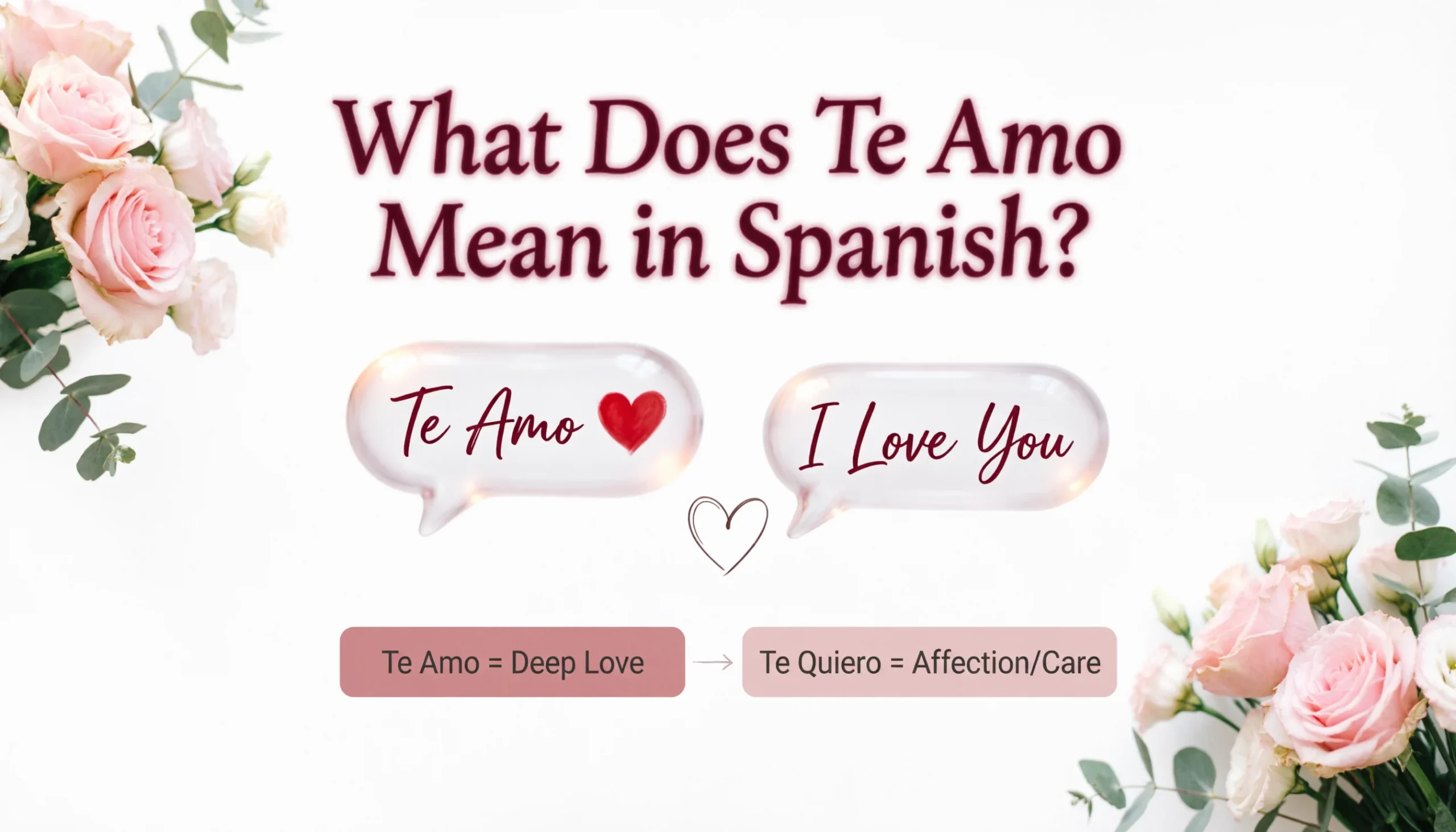
Quick Definition: “Te amo” is a Spanish phrase that translates to “I love you” in English. It expresses deep, sincere, and lasting love and is most commonly used between romantic partners, spouses, and occasionally close family members. Compared to “te quiero,” which often expresses affection or fondness, “te amo” conveys a stronger and more profound emotional commitment.
The Spanish phrase “te amo” literally means “I love you.”
It is one of the strongest ways to express love in the Spanish language and is typically reserved for deep emotional relationships. While English speakers use “I love you” in many situations, Spanish speakers often distinguish between different levels of affection by choosing either te amo or te quiero.
“Te amo” means “I love you” in Spanish. It is a heartfelt expression of deep romantic love and commitment, most commonly used between spouses, long-term partners, and people with profound emotional bonds.
Word-by-Word Meaning
| Spanish Word | English Meaning |
| Te | You |
| Amo | I love (from the verb amar) |
Together:
Te amo = I love you
The phrase comes from the Spanish verb amar, which means to love deeply.
Origin
The phrase te amo originates from the Latin verb amare, meaning to love.
Latin strongly influenced Spanish, and over centuries the verb evolved into amar, which continues to represent deep, enduring love.
Historically, amar has appeared in:
- Classical Spanish literature
- Romantic poetry
- Religious writings
- Love letters
- Songs
- Films
Because of its emotional weight, te amo has traditionally been reserved for expressing profound affection rather than casual appreciation.
Today, it remains one of the most meaningful phrases in the Spanish language.
Introduction
Learning a new language often means discovering that simple phrases can carry powerful emotions. One of the most recognizable expressions in Spanish is “te amo.” Whether you’ve heard it in a romantic movie, a love song, a television series, or from someone special, the phrase immediately conveys strong feelings of love and devotion.
However, many Spanish learners are surprised to discover that te amo isn’t used as casually as the English phrase “I love you.” In many Spanish-speaking cultures, choosing between te amo and te quiero depends on the relationship, the situation, and the intensity of the emotions involved.
Understanding when and how to use te amo can help you communicate naturally and respectfully while avoiding awkward misunderstandings. In this guide, you’ll learn its meaning, origin, cultural significance, examples, comparisons, and practical usage tips.
Popularity
Although every Spanish-speaking country understands te amo, how often it’s used varies by culture and personal preference.
You’ll frequently hear te amo in:
- Romantic relationships
- Marriage proposals
- Wedding vows
- Love songs
- Romantic movies
- Television dramas
- Anniversary messages
- Valentine’s Day cards
Social media has also contributed to its popularity. Many people include te amo ❤️ in captions, comments, and private messages to express heartfelt affection.
Despite its widespread recognition, native speakers often use it thoughtfully because it carries significant emotional meaning.
How It Is Used
The phrase te amo is most commonly used to express deep, genuine love.
Typical situations include:
- Between couples
- Between long-term romantic partners
- During marriage proposals
- In anniversary messages
- In heartfelt conversations
- Occasionally between parents and children in some cultures
Common Examples
- Te amo. ❤️
- Te amo mucho.
- Siempre te amaré.
- Te amo con todo mi corazón.
- Nunca dejaré de amarte.
Tone Guide
| Expression | Tone |
| Te amo ❤️ | Deeply romantic |
| Te amo mucho | Very affectionate |
| Te amo para siempre | Lifelong commitment |
| Te amo con todo mi corazón | Emotional and heartfelt |
| Te amo 😊 | Warm and sincere |
The surrounding words, punctuation, and emojis can strengthen the emotional impact of the phrase.
Examples
Friendly Examples
Although te amo is primarily romantic, it can occasionally express profound family love.
| Spanish | English Translation |
| Te amo, mamá. | I love you, Mom. |
| Te amo, hijo. | I love you, son. |
| Siempre te amaré. | I will always love you. |
| Te amo con todo mi corazón. | I love you with all my heart. |
| Te amo muchísimo. | I love you very much. |
Professional Examples
Te amo is not appropriate in professional communication.
Instead, workplace conversations use respectful expressions such as:
| Informal/Romantic | Professional Alternative |
| Te amo | Muchas gracias. |
| Te amo mucho | Aprecio mucho su ayuda. |
| Siempre te amaré | Espero seguir colaborando con usted. |
Professional settings focus on appreciation rather than declarations of love.
Funny Examples
People sometimes use te amo humorously to exaggerate their appreciation for everyday things.
Examples:
- ¡Te amo, pizza! 🍕
- Te amo, café. ☕
- Te amo, fin de semana. 😄
- Te amo, aire acondicionado. 🌬️
- Te amo después de aprobar el examen. 🎉
These playful expressions aren’t meant literally but add humor and enthusiasm to conversations.
Comparison with Similar Terms
Spanish has several expressions related to love and affection.
| Phrase | English Meaning | Typical Use |
| Te amo | I love you | Deep romantic love |
| Te quiero | I love you / I care about you | Romantic or family affection |
| Me gustas | I like you | Romantic interest |
| Me encantas | I’m mad about you | Strong attraction |
| Te adoro | I adore you | Deep affection |
| Estoy enamorado/a de ti | I’m in love with you | Romantic confession |
Te Amo vs. Te Quiero
This is one of the most common questions among Spanish learners.
| Te Amo | Te Quiero |
| Stronger emotional meaning | Softer expression of affection |
| Often romantic | Romantic, family, or friends |
| Usually used in serious relationships | Used more frequently in everyday life |
| Suggests deep commitment | Suggests love or caring without the same intensity |
In many Spanish-speaking cultures, te quiero is said more often, while te amo is reserved for particularly meaningful moments.
Alternate Meanings
Unlike many internet slang terms, te amo has no major alternate meanings.
Regardless of where you encounter it, whether in a text message, a song, a movie, or a conversation it almost always means “I love you.”
However, people sometimes use it figuratively to express enthusiasm for something they enjoy.
Examples include:
| Expression | Intended Meaning |
| Te amo, chocolate. | I absolutely love chocolate. |
| Te amo, vacaciones. | I love vacations. |
| Te amo, Netflix. | I really enjoy Netflix. |
These expressions are understood as playful exaggerations rather than literal declarations of love.
Professional or Polite Alternatives
Since te amo expresses intimate love, it isn’t appropriate in formal or business settings.
Instead, consider these alternatives:
- Muchas gracias. (Thank you very much.)
- Lo aprecio mucho. (I appreciate it very much.)
- Aprecio su ayuda. (I appreciate your help.)
- Es un placer trabajar con usted. (It’s a pleasure working with you.)
- Estoy muy agradecido/a. (I’m very grateful.)
These phrases communicate respect and appreciation without implying romantic feelings.
Common Mistakes
Many Spanish learners make similar mistakes when using te amo.
1. Confusing Te Amo with Te Quiero
Remember that te amo generally carries a stronger emotional meaning than te quiero.
2. Using It Too Early in a Relationship
Because it expresses deep love, saying te amo too soon may surprise native speakers.
3. Translating Every “I Love You” as Te Amo
In many situations, especially among friends and family, te quiero is the more natural choice.
4. Using It Professionally
Never use te amo in business emails, customer service, or workplace conversations.
5. Ignoring Cultural Differences
Different Spanish-speaking countries may use te amo more or less frequently depending on local customs.
Quick Tips
Use these practical tips when learning te amo:
- Reserve it for deep emotional relationships.
- Learn the difference between te amo and te quiero.
- Pay attention to cultural context.
- Don’t use it in professional communication.
- Listen to native speakers in movies and songs.
- Remember that sincerity matters more than frequency.
- Use it thoughtfully rather than casually.
- Practice pronunciation: te AH-mo.
FAQ
1. What does te amo mean in Spanish?
Te amo means “I love you” and expresses deep romantic or heartfelt love.
2. Is te amo stronger than te quiero?
Yes. In many Spanish-speaking cultures, te amo conveys a deeper level of love and commitment than te quiero.
3. Can you say te amo to family members?
Yes. Some families use te amo between parents, children, or close relatives, although te quiero is often more common.
4. Is te amo always romantic?
Most of the time, yes. However, it can also express profound love between close family members.
5. When should I use te amo?
Use it in serious romantic relationships or when expressing sincere, deep affection.
6. Can I use te amo with friends?
Generally, no. Most native speakers would use te quiero or another expression of affection with friends.
7. Why do Spanish speakers use te quiero more often?
Because te quiero is more versatile and appropriate for a wider range of relationships, including family, friends, and romantic partners.
8. Is te amo understood in every Spanish-speaking country?
Yes. Although usage varies slightly by culture, te amo is universally understood throughout the Spanish-speaking world.
Conclusion
So, what does te amo mean in Spanish? It simply means “I love you,” but its emotional significance goes far beyond a direct translation. Derived from the verb amar, the phrase expresses deep, lasting, and sincere love, making it one of the strongest declarations of affection in the Spanish language.
Understanding the difference between te amo and te quiero is essential for speaking naturally and respectfully. While te quiero is commonly used for friends, family, and many romantic relationships, te amo is typically reserved for moments of profound emotional commitment. By learning when and how to use this beautiful phrase, you’ll communicate with greater confidence and a deeper appreciation for Spanish language and culture.