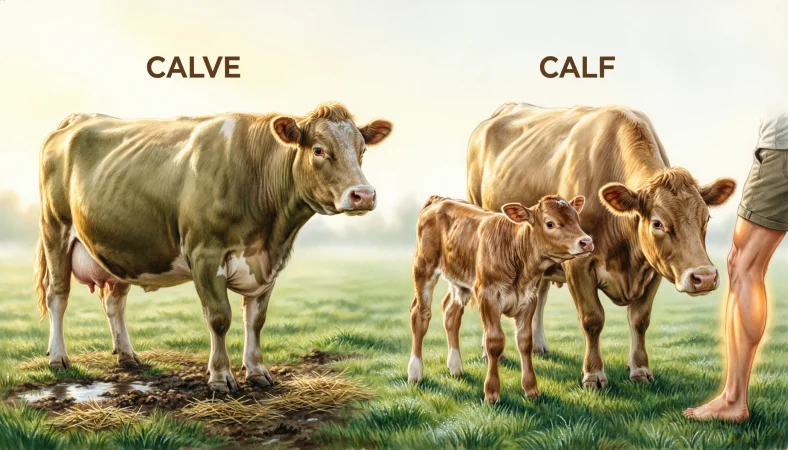
Calve or calf refers to two related but different English words. Calf is a noun for a young bovine animal or the back part of the lower leg, while calve is a verb meaning to give birth to a calf. They are not interchangeable, and confusing them can produce grammatically incorrect or unclear sentences.
The difference between calve or calf is easy to understand once you identify whether a sentence needs a noun or a verb. Calf is primarily a noun. It can describe a young cow, bull, or other large mammal, and it can also refer to the fleshy back portion of the human lower leg. Calve is a verb associated with giving birth, particularly when a cow or another large mammal gives birth to a young animal.
This distinction matters because the words are closely related in meaning. A cow can calve, and the animal it gives birth to is a calf. That connection makes it tempting to treat the two words as interchangeable forms. They aren’t.
The difference becomes especially important in farming, veterinary writing, biology, agriculture, anatomy, education, and everyday English. A sentence such as “The cow will calf next month” uses the wrong grammatical form. The correct sentence is “The cow will calve next month.”
Once you understand the relationship between the noun and the verb, the spelling becomes much easier to remember.
Calve or Calf: What’s the Difference?
Calf is a noun. In its most common agricultural meaning, it refers to the young of a cow or another large animal such as an elephant, whale, giraffe, or deer. Calf also has a separate anatomical meaning: the muscular area at the back of the lower leg.
Calve is a verb. It means to give birth to a calf. It can also be used more broadly for certain large mammals giving birth to their young. In some specialized contexts, calve can describe an iceberg breaking away from a glacier.
| Word | Part of speech | Main meaning | Example |
| Calf | Noun | A young animal or the back of the lower leg | The calf is feeding beside its mother. |
| Calve | Verb | To give birth to a calf or young animal | The cow is expected to calve soon. |
The basic relationship is simple.
A calf is the young animal.
A cow calves when she gives birth.
The word calve describes the action.
The word calf identifies the animal or body part.
This noun and verb relationship is similar to many other English word pairs, but the spelling does not follow a simple rule that applies to every word.
Is Calve or Calf a Grammar, Vocabulary, or Usage Issue?
The distinction between calve and calf is primarily a grammar and vocabulary issue.
The two words have related meanings, but they belong to different grammatical categories. Calf is a noun, while calve is a verb. Because a sentence needs words that perform specific grammatical functions, substituting one for the other can make the sentence incorrect.
They are not interchangeable.
In formal agricultural reports, veterinary records, scientific writing, and academic work, the distinction should be maintained carefully. Casual conversation may contain mistakes that listeners understand from context, but written communication does not provide the same safety net.
Consider these two sentences:
“The farmer expects the cow to calve in April.”
“The farmer expects the calf to arrive in April.”
Both sentences can be correct, but they focus on different things. The first describes the mother’s action. The second identifies the young animal.
Formal and Informal Usage
In professional farming and veterinary communication, calve and calf have precise meanings. Accurate terminology matters because agricultural records may document breeding, pregnancy, birth, animal health, and herd development.
In casual conversation, people may occasionally use the words incorrectly, especially if they are unfamiliar with agricultural vocabulary. However, context usually makes the intended meaning obvious.
Academic Usage
Biology and animal science texts need to distinguish the animal from the reproductive event.
A textbook might say:
“The cow generally calves after a gestation period of approximately nine months.”
It would not say:
“The cow generally calves a calf.”
The latter construction is grammatically awkward because calve already expresses the act of giving birth.
Why the Distinction Matters
The difference isn’t merely about spelling. It affects sentence structure.
If the sentence describes what the mother does, use the verb calve.
If the sentence identifies the young animal, use the noun calf.
That single distinction resolves most usage questions.
How to Use Calve Correctly
Calve is a verb meaning to give birth to a calf. It is most commonly associated with cows, although the verb can be used for other large mammals that give birth to young.
The present tense example is:
“The cow will calve in early spring.”
The past tense is:
“The cow calved yesterday.”
The present participle is:
“The cow is calving.”
These forms are useful because they demonstrate that calve behaves like an ordinary verb.
The noun does not replace the verb.
You would not normally say:
“The cow will calf tomorrow.”
You would say:
“The cow will calve tomorrow.”
Workplace Example
In an agricultural setting, a livestock manager might write:
“The heifer is expected to calve during the first week of May.”
This sentence records a future biological event.
Another example might be:
“The farmer moved the cow to a separate area before she calved.”
Here, calved is the past tense of calve.
Academic Example
A veterinary science paper could state:
“Cows may show behavioral changes shortly before they calve.”
The verb accurately identifies the reproductive event being studied.
Technology Example
Modern farming software can record expected calving dates, pregnancy information, and birth events. A digital herd management system might display a notification such as:
“Cow 184 is expected to calve within seven days.”
The technology does not change the grammar. The animal performs the action, so the verb calve is required.
Usage Recap for Calve
- Use calve when describing the act of giving birth.
- Use calved for an event that happened in the past.
- Use calving for an ongoing or developing event.
- Do not use calf as the verb when you mean giving birth.
How to Use Calf Correctly
Calf is primarily a noun.
Its most familiar meaning is a young cow. More broadly, calf can refer to the young of several large mammals. You can therefore hear phrases such as elephant calf, whale calf, and giraffe calf.
For example:
“The calf stayed close to its mother.”
The word also has an anatomical meaning.
“The athlete injured his calf.”
In that sentence, calf has nothing to do with cattle. It refers to the muscle and surrounding tissue at the back of the lower leg.
This second meaning is important because it can create another source of confusion. The same spelling represents two distinct nouns.
Workplace Example
A farmer might say:
“The calf was moved into a clean pen.”
Here, calf means a young animal.
A physiotherapist might say:
“The patient reported pain in his right calf.”
Here, calf refers to the lower leg.
Academic Example
A zoology textbook could state:
“A newborn calf depends heavily on its mother during the early stages of development.”
An anatomy textbook could instead say:
“The calf contains muscles involved in movement of the ankle and foot.”
The surrounding context determines which meaning applies.
Technology Example
Agricultural databases often use calf as a category for young cattle. A herd management application may record information about a calf’s birth date, sex, weight, health checks, and parentage.
Medical technology uses the word differently. A fitness application might refer to calf exercises or calf muscle activity.
Usage Recap for Calf
Use calf when referring to a young animal.
Use calf when referring to the back part of the lower leg.
Calf is a noun, not the ordinary verb for giving birth.
When You Should NOT Use Calve or Calf
Several common mistakes become easier to avoid when you understand the grammatical role of each word.
- Do not use calf as a verb when you mean that a cow is giving birth.
- Do not write “The cow will calf tomorrow.” Use “The cow will calve tomorrow.”
- Do not use calve when you are simply identifying the young animal.
- Do not write “The farmer fed the calve.” Use “The farmer fed the calf.”
- Do not assume that adding or removing a letter creates a standard verb and noun pair in every situation.
- Do not confuse calf with the past tense of calve. The correct past tense is calved.
- Do not assume calf always refers to cattle. The word can describe the young of several large mammals.
- Do not assume calf always refers to an animal. In anatomy, it commonly refers to part of the lower leg.
Common Mistakes and Decision Rules
| Correct sentence | Incorrect sentence | Explanation |
| The cow will calve soon. | The cow will calf soon. | Calve is the verb meaning to give birth. |
| The calf is healthy. | The calve is healthy. | Calf is the noun for the young animal. |
| The cow calved last night. | The cow calfed last night. | The past tense of calve is calved. |
| The calf is drinking milk. | The calve is drinking milk. | Calf is the correct noun. |
| The farmer is watching the cow calve. | The farmer is watching the cow calf. | The action requires the verb calve. |
| His calf is injured. | His calve is injured. | Calf refers to the lower leg. |
Decision Rule Box
If you mean the action of giving birth, use calve.
If you mean the young animal or the back of the lower leg, use calf.
There is another useful test.
Ask yourself: “Can I replace the word with give birth?”
If yes, calve is probably the word you need.
“The cow will calve.”
“The cow will give birth.”
Now ask whether you are talking about the young animal.
“The calf is sleeping.”
“The young animal is sleeping.”
That substitution test works particularly well for learners.
Calve and Calf in Modern Technology and AI Tools
Agriculture is increasingly dependent on digital systems, and terminology such as calve and calf appears naturally within these technologies.
Precision livestock management platforms can monitor animals, breeding records, health indicators, weight changes, and expected calving dates. A system may flag an animal that is approaching its expected calving period.
Artificial intelligence can also be used to analyze animal behavior. Computer vision systems may monitor movement, posture, feeding patterns, and other signals that could help farmers identify changes associated with approaching birth.
In those contexts, calve still describes the biological action.
The calf remains the young animal produced by that event.
The terminology is therefore stable even as the technology surrounding animal husbandry becomes more sophisticated.
The same principle applies to veterinary software. A database might contain fields for expected calving date and calf identification number. Those fields describe two different concepts and therefore require different words.
Etymology of Calve and Calf
Calf is an old English word with Germanic roots. Historical forms of the word referred to the young of cattle and eventually developed into the modern English noun.
Calve developed from the same general lexical family and became the verb describing the act of giving birth to a calf.
The relationship between the words is therefore genuine. They are historically connected, which helps explain why they look similar.
Interestingly, English also preserves the anatomical meaning of calf. The word has been used for the back part of the lower leg for centuries, creating a second meaning that is now completely ordinary in modern English.
Understanding this history helps explain why one spelling can have multiple meanings while the related verb has a different ending.
Expert Style Guidance
“The safest way to distinguish calve from calf is to identify the grammatical job first and the subject second.”
If the sentence needs an action, look for a verb. If it needs the name of the young animal or a body part, look for a noun.
That approach is more reliable than attempting to remember the words as isolated spellings.
Two Practical Case Studies
Case Study One: Farm Record Keeping
Imagine a digital herd management record containing the sentence:
“The cow is expected to calf on 14 June.”
The intended meaning is obvious, but the grammar is incorrect.
The corrected version is:
“The cow is expected to calve on 14 June.”
The system is describing an anticipated action, so calve is required.
The resulting record is clearer and more professionally written. This matters because agricultural records often contain dates, animal identification information, veterinary notes, and breeding information that need to be interpreted accurately.
Case Study Two: Veterinary Communication
Consider a veterinary note stating:
“The owner reports that the cow calved without assistance and that the calf is feeding normally.”
This sentence uses both words correctly.
Calved describes what the mother did.
Calf identifies the young animal.
The result is a concise record that distinguishes the reproductive event from the animal produced by it. That distinction is especially valuable in veterinary documentation because the health status of the mother and the health status of the newborn animal are separate clinical concerns.
Author Expertise
This guide is written from the perspective of an experienced English language specialist with expertise in grammar, vocabulary, agricultural terminology, search intent, and clear educational content.
Error Prevention Checklist
Always use calve when
- ☑ You mean that a cow is giving birth.
- ☑ You are describing the reproductive action.
- ☑ You need a verb in the sentence.
- ☑ You are referring to an expected or completed birth event.
Never use calf when
- ☑ You mean the action of giving birth.
- ☑ You need a verb after words such as will, may, or should.
- ☑ You are describing what a cow does during birth.
Always use calf when
- ☑ You mean a young cow or another applicable young large mammal.
- ☑ You mean the back part of the lower leg.
- ☑ You are naming the young animal rather than describing the mother’s action.
Related Grammar Confusions You Should Master
The distinction between calve and calf belongs to a broader group of English word problems in which related words have different grammatical functions.
1. Advice and Advise
Advice is a noun, while advise is a verb.
2. Practice and Practise
In British English, practice is generally the noun and practise is generally the verb.
3. Breath and Breathe
Breath is a noun, while breathe is a verb.
4. Choice and Choose
Choice is a noun, while choose is a verb.
5. Loose and Lose
Loose is generally an adjective, while lose is a verb.
6. Affect and Effect
Affect is commonly used as a verb, while effect is commonly used as a noun, although both words have additional uses.
7. Advice and Advise
Their pronunciation and spelling are close, but their grammatical functions differ.
8. Cloth and Clothe
Cloth is a noun referring to material, while clothe is a verb meaning to dress someone.
9. Breath and Breathe
The extra vowel and different pronunciation distinguish the noun from the verb.
10. Bath and Bathe
Bath is generally a noun, while bathe is a verb.
These examples reinforce an important language skill: related words often have distinct grammatical roles. Learning those roles makes spelling and sentence construction much easier.
FAQs
What is the difference between calve and calf?
Calve is a verb meaning to give birth to a calf. Calf is a noun referring to a young animal, especially a young cow, or to the back portion of the lower leg. The words are related but cannot normally replace one another.
Is it correct to say a cow will calf?
No. The standard expression is “A cow will calve.” Calve is the verb used to describe the act of giving birth. Calf is the noun for the young animal.
Is calf the past tense of calve?
No. The past tense of calve is calved. For example, “The cow calved during the night.” Calf is a noun and does not function as the past tense of calve.
What is the past tense of calve?
The past tense is calved. For example, “The cow calved early this morning.” The same form is also used as the past participle.
What is the difference between calving and calf?
Calving is the present participle or gerund of calve and refers to the process or act of giving birth. Calf is a noun referring to the young animal or, in anatomy, the back of the lower leg.
Can calve be used for animals other than cows?
Yes. Calve can be used more broadly for certain large mammals giving birth. The exact usage depends on the animal and context. The noun calf can likewise refer to the young of several large mammals.
Is a baby cow called a calf?
Yes. A young cow or bull is called a calf. The word is also used for the young of various other large mammals, including elephants and whales.
Why is a cow said to calve instead of calf?
Calve is the verb that developed to describe the act of giving birth to a calf. Calf is the noun naming the young animal. The distinction is similar to other English noun and verb relationships in which related words have different forms.
What does calf mean in anatomy?
In anatomy, calf refers to the fleshy and muscular area at the back of the lower leg, between the knee and ankle. This meaning is separate from the agricultural meaning of calf.
How can I remember whether to use calve or calf?
Ask whether you’re describing an action or identifying a thing. If the sentence means “give birth,” use calve. If it refers to the young animal or the back of the lower leg, use calf. For a past birth, use calved.
Conclusion
The difference between calve or calf becomes straightforward when you focus on grammatical function.
Calve is a verb. It describes the action of giving birth, particularly when a cow or another large mammal gives birth to its young.
Calf is a noun. It can refer to the young animal itself or to the back portion of the lower leg.
The easiest rule is therefore simple: the cow calves, and the young animal is the calf.
If you’re writing about farming, veterinary medicine, animal science, anatomy, education, or everyday English, keeping that distinction in mind will prevent the most common errors.
When the question arises, ask yourself what the sentence is actually doing. If you need an action, choose calve. If you need the name of the animal or body part, choose calf. Once that distinction becomes familiar, the two words are rarely difficult to separate.