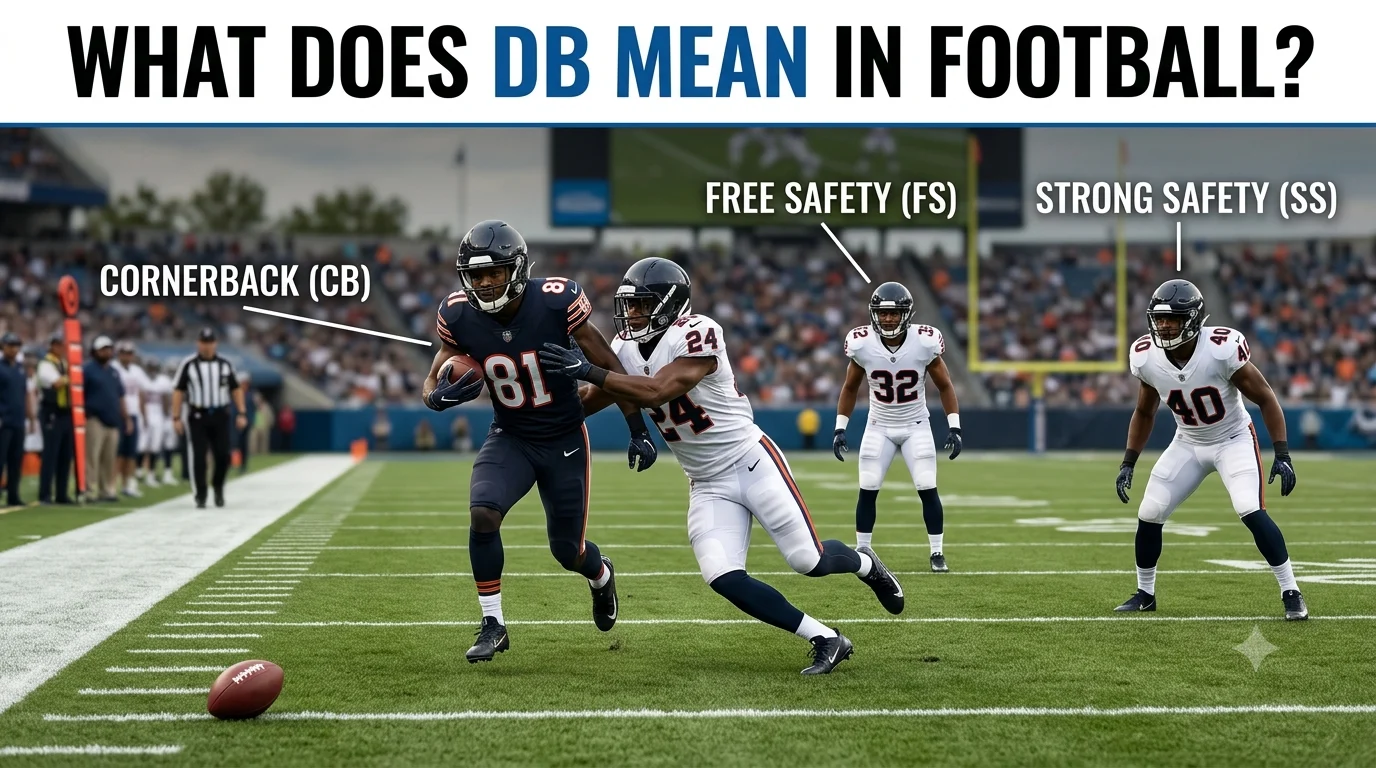
Quick Defination: A DB (Defensive Back) is a defensive player who lines up behind the linebackers and primarily defends against the passing game. Defensive backs include cornerbacks and safeties, who work together to cover receivers, intercept passes, and make tackles.
If you’ve been watching football and hear commentators mention a “DB,” you might wonder what the abbreviation means. In football, DB stands for Defensive Back, a group of defensive players responsible for stopping passes, covering receivers, and preventing big plays.
Understanding what DB means in football helps you follow games more easily, whether you’re watching the NFL, college football, high school games, or playing fantasy football. While “DB” is a broad position group, each type of defensive back has a specific role on the field.
| Detail | Explanation |
| Most Common Meaning | Defensive Back |
| Full Form | Defensive Back |
| Position Group | Defense |
| Main Responsibility | Defend passes and stop receivers |
| Formal or Informal | Official football abbreviation |
What Is a Defensive Back?
A Defensive Back (DB) is a player in the defensive secondary. These players are usually among the fastest and most agile athletes on the team because they must keep up with wide receivers and react quickly to passing plays.
Rather than referring to a single position, “DB” describes an entire group of players that includes:
- Cornerbacks (CB)
- Free Safeties (FS)
- Strong Safeties (SS)
Together, they make up the last line of defense against the offense’s passing attack.
Example
Commentator: “The DB made an incredible interception in the fourth quarter.”
Meaning: The defensive back successfully caught the quarterback’s pass before the intended receiver.
Types of Defensive Backs
Although all defensive backs share similar responsibilities, each position has unique duties.
Cornerback (CB)
Cornerbacks usually line up across from wide receivers.
Their responsibilities include:
- Covering receivers
- Breaking up passes
- Intercepting throws
- Tackling ball carriers near the sidelines
Cornerbacks often play one-on-one coverage against the opposing team’s fastest receivers.
Free Safety (FS)
The free safety generally plays deeper than other defenders.
Common responsibilities include:
- Reading the quarterback
- Providing deep pass coverage
- Helping cornerbacks
- Intercepting long passes
The free safety is often called the “last line of defense.”
Strong Safety (SS)
The strong safety usually lines up closer to the line of scrimmage.
Responsibilities include:
- Supporting the run defense
- Covering tight ends
- Blitzing the quarterback
- Assisting in pass coverage
Strong safeties often combine speed with physical strength.
What Does a DB Do During a Game?
Defensive backs perform several critical tasks throughout every game.
Their responsibilities include:
- Covering wide receivers
- Defending against passing plays
- Intercepting passes
- Knocking down throws
- Tackling runners after completed passes
- Preventing touchdowns
- Supporting run defense
- Communicating defensive adjustments
Because offenses throw the football frequently, defensive backs are involved in nearly every defensive snap.
Why Are Defensive Backs So Important?
Modern football relies heavily on passing offenses.
Without skilled defensive backs, offenses could complete deep passes with little resistance. A talented DB can completely change a game by:
- Forcing incomplete passes
- Creating turnovers
- Returning interceptions
- Limiting explosive plays
- Helping teammates with coverage
Many games are won because defensive backs make key plays late in the fourth quarter.
Football Statistics Associated with DBs
Several statistics help measure a defensive back’s performance.
Some common defensive back stats include:
| Statistic | Meaning |
| INT | Interceptions |
| PD | Passes Defended |
| TKL | Tackles |
| FF | Forced Fumbles |
| FR | Fumble Recoveries |
These numbers help coaches evaluate how effectively a defensive back performs throughout the season.
How Context Changes the Meaning of DB
Although “DB” almost always means Defensive Back in football, the surrounding conversation tells you exactly how it’s being used.
Example 1
“They’re recruiting three DBs this year.”
Meaning: The team wants to add three defensive backs.
Example 2
“He’s the best DB in the conference.”
Meaning: He’s considered one of the top defensive backs in his league.
Example 3
“The DB jumped the route.”
Meaning: The defensive back anticipated the pass and moved into position to defend or intercept it.
Example 4
“Our DBs struggled against their receivers.”
Meaning: The team’s defensive secondary had difficulty defending the passing game.
Does DB Mean the Same at Every Level of Football?
Yes. The abbreviation DB is used consistently across nearly every level of American football, including:
- NFL
- College football
- High school football
- Youth football
- Football video games
- Sports broadcasts
- Coaching discussions
The responsibilities may vary depending on the defensive scheme, but the abbreviation remains the same.
Real Conversation Examples
Example 1
Person A: “Why did they draft another DB?”
Person B: “They needed help defending deep passes.”
Meaning: The team selected another defensive back to strengthen its secondary.
Example 2
Person A: “That DB made an amazing interception.”
Person B: “He read the quarterback perfectly.”
Meaning: The defensive back anticipated the throw and created a turnover.
Example 3
Person A: “Do they play man coverage?”
Person B: “Their DBs are athletic enough to handle it.”
Meaning: The team’s defensive backs have the skills required for one-on-one coverage.
Is DB an Official Football Term?
Yes.
Unlike informal sports slang, DB is an official abbreviation widely used by:
- Coaches
- Broadcasters
- Analysts
- Scouts
- Players
- Team rosters
- Recruiting services
- Sports media
You’ll frequently see “DB” listed on player profiles, roster sheets, and recruiting rankings.
When Should You Use the Term DB?
Using “DB” is appropriate in football conversations where your audience understands common football abbreviations.
Good situations include:
- Talking with football fans
- Fantasy football discussions
- Watching games
- Reading player statistics
- Sports journalism
- Coaching conversations
- Football forums
Using the abbreviation keeps conversations concise without sacrificing clarity.
When Should You Avoid Using DB?
Consider using the full term Defensive Back when speaking with people who may not know football terminology.
Examples include:
- School assignments for general audiences
- Conversations with new football fans
- Educational articles
- Formal presentations
Spelling out the term avoids confusion.
Common Mistakes
| Common Mistake | Correct Understanding |
| Thinking DB is one specific position | DB refers to an entire defensive position group. |
| Assuming every DB plays the same role | Cornerbacks and safeties have different responsibilities. |
| Confusing DB with offensive positions | Defensive backs play exclusively on defense. |
Similar Football Abbreviations
| Term | Meaning | Main Difference |
| DB | Defensive Back | Covers the entire secondary position group. |
| CB | Cornerback | A specific type of defensive back. |
| FS | Free Safety | A deep-coverage defensive back. |
| SS | Strong Safety | A defensive back focused on run support and coverage. |
| LB | Linebacker | Plays closer to the line of scrimmage than a DB. |
Why Coaches Value Great Defensive Backs
Elite defensive backs possess a unique combination of athleticism and football intelligence.
Successful DBs typically have:
- Excellent speed
- Quick reactions
- Strong ball skills
- Good tackling ability
- Awareness of offensive formations
- Effective communication with teammates
A single mistake by a defensive back can lead to a long touchdown, making discipline and consistency essential.
Quick Recap
- DB stands for Defensive Back.
- Defensive backs include cornerbacks and safeties.
- Their primary job is defending against passing plays.
- DB is an official football abbreviation used at every level.
- Context helps determine whether someone is discussing the position group or an individual player.
Frequently Asked Questions
What does DB mean in football?
DB stands for Defensive Back, a defensive position group that covers receivers, defends passes, and helps stop offensive plays.
What does DB stand for in football?
DB is the official abbreviation for Defensive Back, which includes both cornerbacks and safeties.
Is a cornerback the same as a DB?
No, a cornerback is one type of defensive back, while DB refers to the entire secondary position group.
What positions are included in the DB group?
The DB group includes cornerbacks, free safeties, and strong safeties, depending on the team’s defensive scheme.
Is DB used in college and NFL football?
Yes, DB is the standard abbreviation for Defensive Back across youth, high school, college, professional football, and sports media.
Final Thoughts
Understanding what does DB mean in football makes it much easier to follow games, player statistics, and football discussions. A DB, or Defensive Back, plays a crucial role in defending the passing game, creating turnovers, and preventing big plays. Because the abbreviation covers several positions, paying attention to the surrounding context helps you identify whether someone is referring to the entire defensive secondary or a specific player. Once you know what a DB does, you’ll have a deeper appreciation for one of football’s most important position groups.
Read More Articles About
- What Does Hyung Mean In Korean Text And Conversation? Full Guide For 2026
- What Does + Mean In Betting? Meaning, Payouts, And Winning Strategies For 2026
- What Does POD Mean In Banking? How Payable On Death Accounts Work In 2026
- What Does Harmony Mean In Interior Design? Why It Matters And How To Use It In 2026