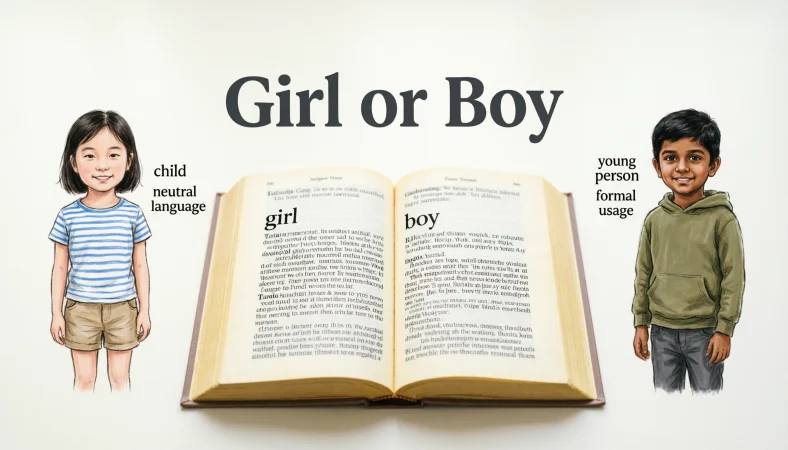
Girl or boy describes a basic distinction between two traditional gender terms used to refer to children or, in some contexts, young people. A girl traditionally refers to a female child, while a boy traditionally refers to a male child. The terms are common, but context, age, identity, and respectful usage can affect which term is appropriate.
The words girl and boy are both nouns, although they can also appear in other grammatical constructions. Traditionally, girl refers to a female child or young female person, while boy refers to a male child or young male person.
In everyday English, the distinction is usually straightforward. A parent might say, “My daughter is a girl,” while another parent might say, “My son is a boy.” However, real world usage can become more complicated when people discuss age, gender identity, formal writing, or situations where the person’s preferred terminology is known.
The two words are not interchangeable. Choosing between them depends on what or whom you are describing and the context in which you are communicating.
A girl traditionally means a female child or young female person.
A boy traditionally means a male child or young male person.
The words are related but not interchangeable.
Context matters when age, gender identity, or formality is important.
Is Girl or Boy a Grammar, Vocabulary, or Usage Issue?
The distinction is primarily a vocabulary and usage issue, not a difficult grammar rule.
Both girl and boy are ordinary English nouns. The grammatical structure of a sentence does not determine which word is correct. Meaning and context do.
For example:
The girl is reading a book.
The boy is reading a book.
Both sentences follow the same grammatical structure. The only meaningful difference is the person being described.
The issue becomes more complicated when a speaker is uncertain about someone’s gender, when the person’s preferred terminology is unknown, or when an adult is being described.
Are Girl and Boy Interchangeable?
No. They traditionally refer to different categories.
You cannot normally replace girl with boy without changing the meaning of the sentence.
Consider:
The girl won the competition.
This identifies the winner as a girl.
Changing the sentence to:
The boy won the competition.
identifies the winner differently.
However, English also provides broader alternatives when gender is not relevant. Words such as child, kid, student, young person, and person can sometimes be more appropriate.
Formal Versus Informal Usage
Both terms are common in everyday speech, but their suitability can depend on the setting.
In casual conversation, people frequently say:
The boys are playing outside.
The girls are getting ready for school.
In formal writing, the words can still be completely appropriate when they accurately describe the people involved. However, professional writers should avoid using gendered terminology when it is unnecessary or potentially misleading.
For example, a medical, educational, or legal document may need to identify a person using more precise terminology depending on the purpose of the document.
Academic Versus Casual Usage
Academic writing often favors precision.
A researcher studying childhood development might write about girls and boys if the study specifically analyzes those groups. In another study, however, the researcher may use terms such as children, participants, or adolescents when gender is not the central variable.
Casual communication allows more flexibility, but accuracy remains important.
How to Use Girl Correctly
The noun girl traditionally refers to a female child or young female person.
For example:
The girl is playing in the garden.
A girl asked me for directions.
The plural form is girls.
Workplace Example
Although girl generally refers to a child or young person, workplace usage involving adults requires care.
Calling adult female employees “girls” can sound informal, patronizing, or dismissive depending on the situation.
For example, saying:
The girls in accounting will handle it.
might be acceptable among close colleagues who use the expression casually, but it can sound unprofessional in formal communication.
A more neutral alternative would be:
The women in accounting will handle it.
Or:
The accounting team will handle it.
Academic Example
In academic writing, girl can be appropriate when the research concerns female children or adolescents.
For example:
The study examined reading habits among girls between the ages of ten and twelve.
Here, the term clearly identifies the population being studied.
Technology Example
Technology platforms may use terms such as girl, female, child, or young user depending on their purpose.
For example, an educational application might ask:
Is the student a girl or a boy?
However, modern software design often avoids unnecessary demographic questions. If gender is irrelevant to the service, simply asking for it can create unnecessary complexity.
Girl Usage Recap
Use girl when referring appropriately to a female child or young female person.
Use girls for the plural.
Be cautious when referring to adult women because girls can sound overly casual or patronizing.
When gender is irrelevant, consider a neutral term such as child, student, or person.
How to Use Boy Correctly
The noun boy traditionally refers to a male child or young male person.
Examples include:
The boy is riding a bicycle.
A boy was waiting outside the classroom.
The plural form is boys.
Workplace Example
Using boy for an adult man can be inappropriate in professional environments.
For example, calling a group of adult male employees “the boys” may be harmless among friends, but it can sound overly informal in a workplace document.
A professional writer might instead use:
The men on the engineering team completed the project.
Or:
The engineering team completed the project.
Academic Example
In academic research, boy is appropriate when researchers are specifically discussing male children or adolescents.
For example:
The researchers compared language development among boys and girls in primary school.
The terms are useful because gender is relevant to the research question.
Technology Example
Digital products may include demographic questions involving boys and girls. Educational software, children’s games, and research applications sometimes collect age and gender information.
However, developers should only request such information when there is a legitimate reason. Clear wording and privacy conscious design are especially important when children use technology.
Boy Usage Recap
Use boy when referring appropriately to a male child or young male person.
Use boys for the plural.
Avoid using boy to describe an adult man in formal contexts.
Use neutral terms when gender does not matter.
When You Should NOT Use Girl or Boy
Knowing when not to use these terms is an important part of precise communication.
- Do not call an adult woman a girl in formal writing unless the context specifically requires the term.
- Do not call an adult man a boy in formal writing unless the context clearly supports it.
- Do not assume someone’s gender based only on appearance.
- Do not use girl or boy when a neutral term would communicate the information more accurately.
- Do not use either term as a substitute for someone’s stated identity or preferred terminology.
- Do not use gendered language when gender has no relevance to the subject.
- Do not use boys or girls as a casual label for adult colleagues if the wording could appear disrespectful.
- Do not rely on stereotypes to decide whether someone should be described as a girl or boy.
The strongest modern writing focuses on relevance, accuracy, and respect rather than using gendered language automatically.
Common Mistakes and Decision Rules
Decision Rule Box
- If you mean a female child or young female person, girl may be appropriate.
- If you mean a male child or young male person, boy may be appropriate.
- If age or gender is irrelevant, choose a neutral term such as child, student, person, or young person.
- If you are describing an adult, consider woman or man when those terms accurately apply.
Girl and Boy in Modern Technology and AI Tools
Search engines, chatbots, voice assistants, educational software, and artificial intelligence systems increasingly process language in contexts where gender terminology matters.
An AI system may receive a prompt such as:
Write a story about a girl.
The system understands girl as a character description.
Likewise:
Write a story about a boy who learns to play chess.
Here, boy supplies information about the character.
However, AI systems should not automatically infer personality, interests, abilities, or behavior from gender. A girl can be interested in engineering, sports, mathematics, or technology, while a boy can be interested in literature, music, art, or fashion.
For search optimization, this distinction is also valuable. A page targeting a query such as “girl or boy meaning” should explain both definitions, usage differences, age considerations, neutral alternatives, and modern context rather than simply providing a dictionary definition.
Etymology of Girl and Boy
The histories of girl and boy are surprisingly interesting because neither word has always carried exactly the same meaning it carries today.
The word girl emerged in Middle English and originally had a broader meaning connected with a young person or child. Over time, its meaning became more strongly associated with a female child.
The word boy also developed historically in Middle English. Its early uses referred to a young male person, servant, or attendant in certain contexts. Its modern central meaning is a male child or young male person.
This historical development demonstrates an important linguistic principle: word meanings change over centuries. Modern speakers generally learn the contemporary meaning rather than the historical range of a word.
An Expert Perspective on Girl and Boy
A useful principle for precise English is this:
“Good word choice depends not only on dictionary meaning, but also on age, context, purpose, and the person being described.”
That principle explains why a word can be grammatically correct yet still be a poor choice for a particular situation.
Case Study One: The School Setting
Imagine a school announcement that says:
Girls and boys should report to the assembly hall.
The wording is understandable when the school is specifically addressing students according to gender.
Now imagine an announcement that says:
Children should report to the assembly hall.
If gender is irrelevant, children is more efficient and inclusive.
The concrete result is clearer communication. The second version gives every student the relevant instruction without dividing the audience according to a characteristic that may not matter to the activity.
This illustrates a broader writing principle: use specific language when the distinction matters and neutral language when it does not.
Case Study Two: The Workplace
Consider a company manager writing:
The boys in sales will attend the conference.
The sentence may be understood, but it can sound overly casual when the people involved are adult men.
A more professional version is:
The sales team will attend the conference.
The second sentence removes unnecessary gender information and focuses on the professional role.
The concrete result is a more neutral and workplace appropriate statement.
Error Prevention Checklist
Always use girl when
- You are accurately referring to a female child or young female person.
- Gender is relevant to the context.
- The term matches the person’s established description.
- The surrounding context makes the intended meaning clear.
Always use boy when
- You are accurately referring to a male child or young male person.
- Gender is relevant to the context.
- The term matches the person’s established description.
- The wording is appropriate for the person’s age and situation.
Never use girl when
- You are referring to an adult woman in a formal context where woman is more appropriate.
- Gender is irrelevant.
- The term conflicts with the person’s known terminology.
Never use boy when
- You are referring to an adult man in a formal context where man is more appropriate.
- Gender is irrelevant.
- The term conflicts with the person’s known terminology.
Related Grammar Confusions You Should Master
Understanding this distinction can lead naturally to several other common English questions.
- Girl versus woman: Learn how age and context influence the appropriate term.
- Boy versus man: Understand when a young male person should be described as a boy or a man.
- Child versus children: Learn the singular and plural forms.
- Person versus people: Understand singular and plural usage.
- Woman versus women: Learn the irregular plural form.
- Man versus men: Recognize another irregular plural.
- Female versus woman: Understand the difference between a descriptive term and a noun referring to a person.
- Male versus man: Learn when each term is appropriate.
- Kid versus child: Compare informal and neutral vocabulary.
- Young person versus teenager: Understand how age related terminology changes according to context.
These distinctions strengthen both everyday communication and formal writing.
FAQs
What is the difference between a girl and a boy?
Traditionally, a girl is a female child or young female person, while a boy is a male child or young male person. The words are different nouns and are not normally interchangeable.
Is girl or boy a grammar question?
It is primarily a vocabulary and usage question. Grammar determines how the noun functions in a sentence, while context determines whether girl or boy accurately describes the person being discussed.
Is a girl the same as a female?
Not exactly. Girl normally refers to a female child or young female person, while female is a broader biological or descriptive term that can apply across different ages and contexts.
Is a boy the same as a male?
Not exactly. Boy generally refers to a male child or young male person. Male is a broader descriptive term that can apply to people of different ages.
When should you use girl instead of woman?
Traditionally, girl refers to a child or young female person, while woman refers to an adult female. In formal contexts, use the term that accurately reflects the person’s age and situation.
When should you use boy instead of man?
Traditionally, boy refers to a child or young male person, while man refers to an adult male. Formal writing should use the term appropriate to the person’s age and context.
Is it correct to say girls for adult women?
It can occur informally, especially when a group of women uses the term about themselves. However, calling adult women girls can sound patronizing or overly casual in professional or formal contexts.
Is it correct to say boys for adult men?
It is common in informal expressions such as “the boys,” particularly among friends. However, it may sound too casual in formal professional communication.
What is a gender neutral alternative to girl or boy?
Depending on the context, alternatives include child, kid, student, young person, or person. The best choice depends on the person’s age and what information is actually relevant.
Why do people ask whether a baby is a girl or boy?
People often ask because they want to know or discuss the baby’s sex or gender. However, the question is not always necessary, particularly when gender has no relevance to the conversation.
Conclusion
The choice between girl and boy is usually straightforward when referring to children or young people, but effective communication requires more than simply knowing two dictionary definitions. Age, context, purpose, formality, and the relevance of gender all influence the best word choice.
If you are describing a female child or young female person, girl is traditionally appropriate. If you are describing a male child or young male person, boy is traditionally appropriate. When discussing adults, woman and man may be more suitable. When gender is irrelevant, neutral words such as child, student, or person can make the writing clearer.
Ultimately, the best approach to the question of girl or boy is to choose language that is accurate, relevant, respectful, and appropriate for the situation.