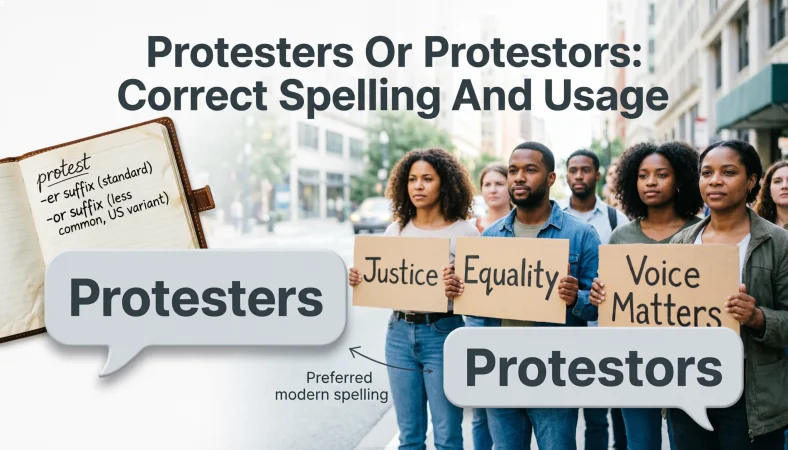
Both spellings are correct, but protesters is the standard and more widely preferred form in modern English. Protestors is a recognized variant with the same meaning. The distinction is therefore mainly one of spelling, frequency, and style rather than grammar or meaning. Major dictionaries recognize both forms.
If you have ever searched for protesters or protestors, you have probably noticed that both forms appear in newspapers, websites, academic writing, and everyday communication. That can make a simple spelling choice surprisingly confusing.
The good news is that the difference is straightforward. Both words are plural nouns referring to people who protest, object, or publicly express disagreement. The main distinction is that protesters is the more common and generally preferred spelling, while protestors is an accepted alternative.
This confusion can cause real mistakes in professional writing. A student may wonder which spelling belongs in an essay. A journalist may need to choose one form for a headline. A business writer may want consistent terminology across a report. Even SEO writers need to understand the difference so they can satisfy the search intent without treating a valid variant as an error.
Oxford defines a protester as a person who makes a public protest, while Cambridge lists protestor as an alternative form. Merriam Webster likewise recognizes protestor as a variant of protester.
Protesters Vs Protestors: What’s The Difference?
The two words have essentially the same meaning.
Protester is a noun referring to a person who protests or takes part in a public demonstration. Protestor is also a noun with the same basic meaning, but it is less commonly used.
The important point is that neither spelling changes the identity of the person being described. A protester and a protestor can be the same type of participant in the same demonstration.
| Feature | Protesters | Protestors |
| Part of speech | Plural noun | Plural noun |
| Singular form | Protester | Protestor |
| Basic meaning | People who protest | People who protest |
| Spelling status | Standard and widely preferred | Correct alternative |
| Modern frequency | More common | Less common |
| Formal writing | Recommended | Acceptable but less usual |
| Academic writing | Usually preferred | Possible, but less common |
| Meaning difference | None | None |
The singular forms are protester and protestor. Their plural forms are created by adding the ordinary plural ending.
For example:
“Several protesters gathered outside the courthouse.”
“Several protestors gathered outside the courthouse.”
Both sentences communicate the same idea.
Quick Recap
Protesters is the preferred modern spelling.
Protestors is a valid alternative spelling.
Neither word has a different basic meaning.
For most professional writing, protesters is the safest choice.
Is Protesters Vs Protestors A Grammar, Vocabulary, Or Usage Issue?
This is primarily a spelling and usage issue, not a difference in grammatical meaning.
Both forms function as nouns. Both can appear as the subject or object of a sentence, and both can be modified by adjectives such as peaceful, student, environmental, political, or angry.
For example:
“The peaceful protesters gathered in the square.”
“The peaceful protestors gathered in the square.”
The grammatical structure is identical.
The real distinction concerns usage frequency and editorial preference. Cambridge lists protestor as an alternative to protester, while Merriam Webster explicitly presents protestor as a variant.
Are They Interchangeable?
Yes, in ordinary meaning they are interchangeable.
You can replace one with the other without changing the central meaning of a sentence.
However, interchangeable does not always mean equally desirable. English contains many accepted variants where one form is considerably more common than another. In this case, protesters is generally the better default for modern readers.
Formal Vs Informal Usage
Neither spelling is inherently grammatically informal.
Still, protesters tends to fit more naturally into contemporary professional, journalistic, educational, and general purpose writing because readers encounter it more frequently.
Protestors can still be used when it is part of a quotation, an established house style, or a source’s preferred spelling.
Academic Vs Casual Usage
Academic writers normally benefit from choosing the form that is clearest and most widely recognized by their intended audience.
For a research paper, essay, thesis, or educational article, protesters is usually the straightforward choice.
In casual writing, either form can be understood, although protesters remains the more natural default.
How To Use Protesters Correctly
Protesters is the spelling to choose when you want the most widely recognized modern form.
It works naturally in journalism, academic writing, workplace communication, public policy discussions, social media, and ordinary conversation.
Workplace Example
“The protesters gathered outside the company headquarters before the meeting began.”
Here, protesters identifies people who are publicly objecting to an issue involving the organization.
Another example is:
“The communications team prepared a statement after protesters arrived outside the office.”
Academic Example
“Researchers interviewed protesters to understand how public demonstrations influence political debate.”
The word works naturally in scholarly discussion because it identifies participants in a protest movement or demonstration.
Technology Example
“Protesters used social media platforms to coordinate meeting points and share updates.”
Technology does not change the meaning of the noun. The word still refers to people who protest.
Usage Recap
Choose protesters when you want the standard modern spelling.
It is especially useful when your audience is broad or international.
It is also the safest choice when you are not following a specific publication style.
How To Use Protestors Correctly
Protestors has the same grammatical function and basic meaning as protesters.
The main reason to choose it is usually stylistic rather than semantic. You might encounter it in an existing document, quotation, publication style, historical source, or personal writing preference.
Workplace Example
“The protestors remained outside the building while negotiations continued.”
This sentence is grammatically correct. The spelling is simply less common than protesters.
Academic Example
“The study examined how protestors responded to changes in public policy.”
Again, the meaning is clear and the sentence is grammatically sound.
Technology Example
“Online messages helped protestors organize the demonstration.”
This is also acceptable, although many editors would choose protesters instead.
Usage Recap
Protestors is not a spelling error.
It means the same thing as protesters.
It is less common, so it should generally not be your first choice unless context or house style supports it.
When You Should Not Use Protesters Or Protestors
Because both words are nouns referring to people, they should not be used when you actually mean the action, the event, or an expression of disagreement.
Here are common misuse scenarios.
- When you mean the action itself
Incorrect: “The protesters increased after the announcement.”
Better: “The protests increased after the announcement.”
- When you mean an individual objection
Incorrect: “She made a protesters against the decision.”
Better: “She made a protest against the decision.”
- When you mean the verb
Incorrect: “The students were protesters the policy.”
Better: “The students were protesting the policy.”
- When you mean a demonstration
Incorrect: “The protesters lasted three hours.”
Better: “The protest lasted three hours.”
- When you are describing a general attitude
Incorrect: “His protesters of the proposal were obvious.”
Better: “His protest against the proposal was obvious.”
- When you mean supporters
A person who supports a proposal is not necessarily a protester. The word specifically concerns opposition or objection.
- When you mean activists in every situation
An activist may campaign for something without participating in a protest. The terms overlap in some contexts but are not perfect synonyms.
- When a source uses a specific spelling
If you are directly quoting a source, do not silently change its spelling. Preserve the original wording unless your editorial policy says otherwise.
Common Mistakes And Decision Rules
| Correct sentence | Incorrect sentence | Explanation |
| The protesters gathered peacefully. | The protest gathered peacefully. | The people are protesters, while the event is a protest. |
| The protestors entered the square. | The protest entered the square. | People enter a place, not the abstract event itself. |
| The students protested the decision. | The students protestors the decision. | Protest is functioning as a verb. |
| The protest attracted thousands of people. | The protesters attracted thousands of people. | The sentence is about the event rather than its participants. |
| Several protesters spoke to reporters. | Several protest spoke to reporters. | The people speaking are protesters. |
| The protestors carried signs. | The protest carried signs. | People carry objects. |
Decision Rule Box
The requested rule “If you mean the action, use X; if you mean the person or tool, use Y” does not accurately apply to these two words because both forms refer to a person.
The accurate rule is:
- If you mean the people who protest, use protesters or protestors.
- If you mean the action or event, use protest or protests.
- If you mean the act of expressing opposition, use protest or protesting according to the sentence structure.
- If you are unsure which spelling to choose for a person, choose protesters.
Protesters And Protestors In Modern Technology And AI Tools
Modern technology has not created a new grammatical distinction between these spellings.
Search engines, grammar checkers, word processors, translation systems, and AI writing tools may encounter both forms because both exist in English. A responsible writing tool should not automatically classify protestors as an outright spelling error.
For SEO content, however, protesters is usually the stronger default because it is the more familiar form and aligns with the primary dictionary entry in sources such as Oxford and Cambridge.
AI generated text can also introduce inconsistency. One paragraph may use protesters while another uses protestors. This does not necessarily create a grammatical error, but unnecessary switching can make an article appear poorly edited.
A professional workflow should therefore establish one preferred spelling before publication.
The Etymology Of Protester And Protestor
Both forms ultimately relate to the verb protest.
Merriam Webster traces protest through Middle English and Anglo French to Latin protestari, meaning to declare or call to witness. The word therefore has a long history connected with public declaration, assertion, and objection.
English commonly forms nouns for people who perform actions by using the ending er. Examples include teacher, worker, speaker, runner, and driver.
Protester fits that productive English pattern naturally:
protest + er = protester
The alternative protestor uses the ending or, a form that appears in many English words with historical influence from Latin and French. English noun formation is not perfectly regular, which helps explain why multiple agent noun forms can coexist.
The existence of protestor does not make protesters incorrect. Instead, both forms survived, while modern usage generally favors protesters.
An Expert Style Perspective
A useful editorial principle is:
“When two accepted forms have the same meaning, the clearest choice is usually the form your audience encounters most often.”
That principle is particularly useful for educational and professional writing. The goal is not to label every less common spelling as wrong. The goal is to select the form that provides maximum clarity and consistency.
Two Practical Case Studies
Case Study 1: Editing An Academic Essay
Imagine a university essay that uses protestors in six places and protesters in four places.
The problem is not grammar. Both forms are legitimate.
The editorial improvement is consistency. An editor can select protesters throughout the essay. The result is a document with one consistent spelling and a form that is widely recognized by general readers.
Case Study 2: Editing A Public Information Article
Consider a public information article intended for an international audience. The writer uses protestors throughout the draft.
An editor changes the terminology to protesters while leaving quotations unchanged.
The concrete result is a cleaner terminology policy: the article uses one standard form in the author’s own prose while preserving the original wording of cited material.
These examples demonstrate an important principle: the choice is generally about editorial consistency and audience expectations, not about correcting a fundamental grammatical error.
Error Prevention Checklist
Always Use Protesters When
- You are writing for a broad general audience.
- You are preparing an academic article.
- You are writing professional or educational content.
- You want the most familiar modern spelling.
- You are unsure which variant your audience expects.
- You want consistent terminology across an SEO article.
Never Use Protestors When
- Your style guide explicitly requires protesters.
- You are quoting a source that uses a different spelling and you are not preserving the quotation accurately.
- You are trying to describe the protest itself rather than the people involved.
- You are using the word as a verb.
- You are treating it as a synonym for every type of activist.
- You are mixing both spellings randomly within the same document.
The final point deserves emphasis. There is nothing inherently wrong with protestors, but careless variation can make writing look inconsistent.
Related Grammar Confusions You Should Master
If you are studying spelling and word usage, several related contrasts are worth learning.
- Adviser or advisor
- Adviser or adviser’s
- Traveler or traveller
- Labeling or labelling
- Labeled or labelled
- Canceled or cancelled
- Theater or theatre
- Center or centre
- Judgment or judgement
- Practice or practise
These examples demonstrate a broader truth about English: spelling differences can arise from regional conventions, historical development, word formation, editorial preference, and frequency of use.
Not every spelling variation represents a right versus wrong distinction.
FAQs
Is Protester Or Protestor The Correct Spelling?
Both are correct. Protester is the more common and generally preferred modern spelling, while protestor is an accepted variant. Merriam Webster lists protestor as a variant, and Cambridge identifies it as an alternative form.
Are Protesters And Protestors The Same Thing?
Yes. Both plural nouns refer to people who protest or publicly express disagreement. The difference is spelling rather than basic meaning.
Which Is More Common, Protesters Or Protestors?
Protesters is more common in contemporary general English. It is also the primary form presented by major learner and general dictionaries such as Oxford and Cambridge.
Is Protestor A Misspelling?
No. Protestor is an accepted spelling. It is simply less common than protester.
Should I Use Protester In Academic Writing?
Yes. Protester is usually the safest choice for academic writing because it is widely recognized and familiar to readers.
Is Protestor British Or American English?
Neither spelling belongs exclusively to British or American English. Both forms can occur in both varieties. The important difference is frequency and editorial preference rather than a strict regional division.
Why Are There Two Spellings Of Protester?
English has more than one productive pattern for forming nouns that identify people who perform actions. The ending er is highly productive in English, while or appears in many words shaped by historical borrowing. Both forms therefore developed and survived.
Can Protestors Be Used In Formal Writing?
Yes. Protestors is grammatically acceptable in formal writing. However, protesters is usually the more natural choice when no specific style requirement calls for the alternative.
Which Spelling Is Better For SEO?
For general SEO writing, protesters is usually the better default because it is the more familiar and widely used form. You can still mention protestors naturally when explaining the spelling variation and answering search queries.
Do Protester And Protestor Have Different Pronunciations?
They are generally pronounced alike or very similarly. The main distinction readers notice is the spelling rather than a meaningful pronunciation difference.
Conclusion
The answer to the question of protesters or protestors is simple once the distinction is understood. Both forms are valid nouns for people who protest, and neither changes the basic meaning of a sentence.
The practical difference is usage. Protesters is the more familiar and generally preferred spelling in modern English. Protestors is an accepted alternative that remains in use.
For students, journalists, professional writers, academic authors, website owners, and SEO specialists, protesters is usually the safest default. It is clear, widely recognized, and supported as the primary form by major dictionary sources.
Remember the most useful distinction: protesters and protestors refer to people, while protest and protests refer to the action or event.
When no house style, quotation, or historical context requires the alternative, choose protesters and use it consistently throughout your writing.