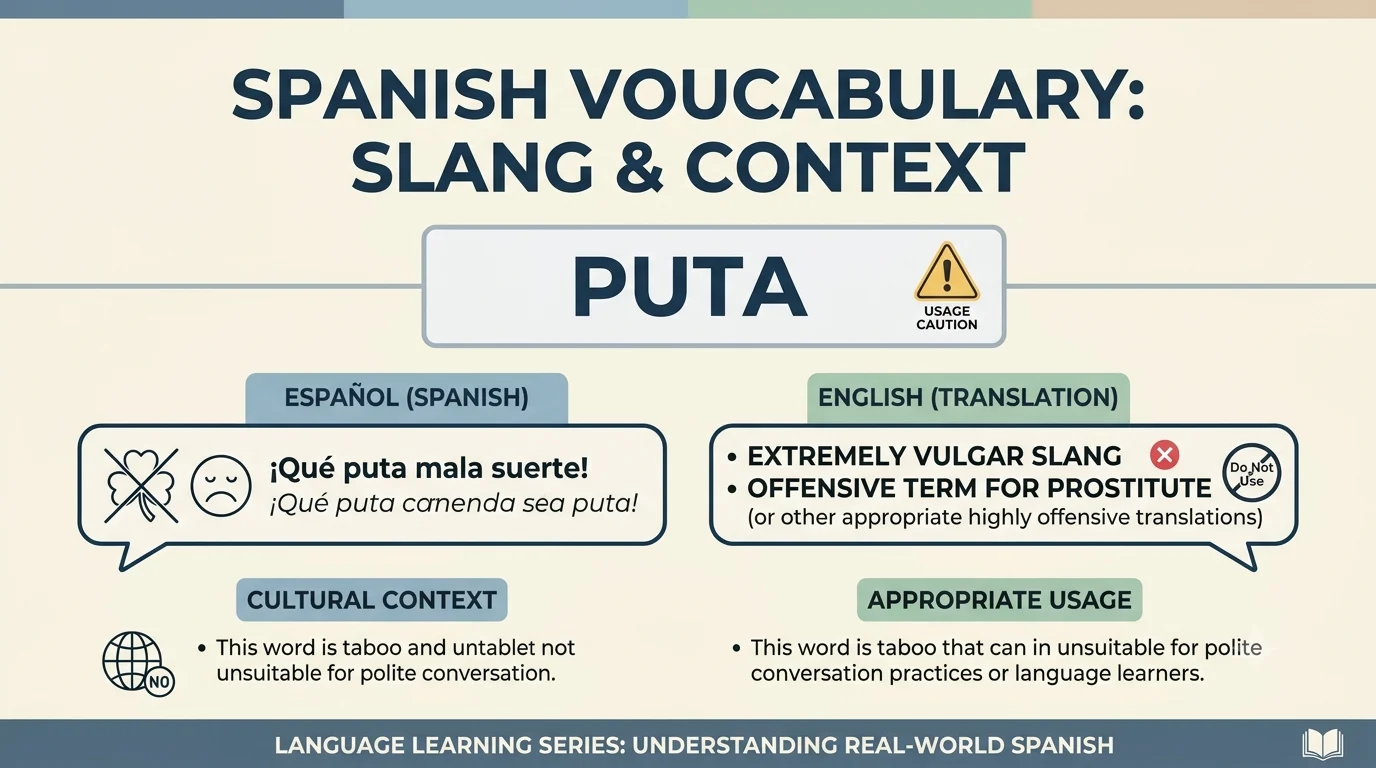
Quick Defination: Puta is a Spanish word that literally translates to “prostitute.” In everyday speech, however, it is often used as a vulgar insult or appears in slang expressions where it acts as an intensifier similar to “damn,” “freaking,” or a stronger English profanity.
You may have seen the word “puta” in a Spanish movie, a song, a social media post, or an online conversation and wondered what it actually means. The short answer is that “puta” literally means “prostitute” in Spanish, but it is also widely used as an insult, profanity, or intensifier, depending on the country and context. Because its meaning changes with tone and regional usage, understanding the situation is just as important as knowing the translation.
This guide explains what puta means in Spanish, how people use it, when it is offensive, and why you should be careful before repeating it.
| Detail | Explanation |
| Most Common Meaning | Prostitute; also a vulgar insult |
| Literal Translation | Prostitute |
| Tone | Usually offensive or vulgar |
| Common Platforms | Text messages, social media, music, movies |
| Formal or Informal | Informal and inappropriate in formal settings |
The Main Meaning of Puta
The primary meaning of puta is a prostitute or sex worker, although in many situations the word is not intended literally.
Instead, speakers may use it to:
- Insult someone.
- Express anger or frustration.
- Emphasize another word.
- Add emotional intensity to a sentence.
Because it is considered profanity in most Spanish-speaking cultures, using it casually can offend people.
Example:
Person A: “¿Por qué dijiste eso?”
Person B: “¡Qué puta mentira!”
Meaning: Here, puta is not referring to a person. Instead, it intensifies the phrase, making it roughly equivalent to “What a damn lie!” with much stronger language.
Alternative Meanings and Regional Usage
Unlike many internet abbreviations, puta is an actual Spanish word whose usage varies across countries.
| Meaning | Context | Tone | Example |
| Prostitute | Literal definition | Neutral dictionary meaning | “La palabra significa prostituta.” |
| Insult | Arguments or fights | Offensive | “No la llames así.” |
| Intensifier | Informal slang | Vulgar | “Hace un puto calor.” |
| Part of common expressions | Regional slang | Depends on country | “Puta madre.” |
In some countries, profanity containing puta is heard more frequently in casual conversations, films, and music than in others. Even where it is commonly used, it is still considered vulgar.
How Context Changes the Meaning
Context is everything when interpreting puta.
Here are a few examples:
Example 1
Message: “¡Puta madre!”
Meaning: An exclamation expressing frustration, surprise, or anger rather than referring to a person.
Example 2
Message: “Ese puto coche no arranca.”
Meaning: The speaker is frustrated with the car. The word intensifies the complaint.
Example 3
Message: “No le digas puta a nadie.”
Meaning: Here the word is being used as a direct insult toward someone.
Example 4
Message: “Escuché esa palabra en una canción.”
Meaning: In music, it may be included for emotional expression, storytelling, or artistic style rather than as a personal insult.
You can usually determine the intended meaning by considering:
- The surrounding words
- Whether someone is being addressed directly
- The speaker’s tone
- Regional dialect
- Emojis or punctuation
- Whether the conversation is playful, emotional, or confrontational
Meaning on Different Platforms
Text Messages and WhatsApp
In private chats, puta is usually either an insult or part of an emotional expression.
Example:
“¡Qué puta mala suerte!”
The speaker is emphasizing bad luck rather than insulting someone directly.
TikTok and Instagram
On social media, the word often appears in:
- Song lyrics
- Memes
- Quotes
- Reaction videos
- Captions
Its meaning usually remains the same, although creators may use it for dramatic or comedic effect.
Gaming Chats and Discord
Players sometimes use the word while reacting to mistakes, losses, or unexpected events.
It generally expresses frustration and should not be considered polite language.
Real Conversation Examples
Friends
Person A: “Perdí mi teléfono otra vez.”
Person B: “¡Qué puta mala suerte!”
Meaning: Expressing sympathy while emphasizing how unfortunate the situation is.
Family
Person A: “No uses esa palabra delante de los niños.”
Person B: “Tienes razón.”
Meaning: A reminder that the word is inappropriate around children.
Social Media
Person A: “¿Qué significa ‘puta’ en esta canción?”
Person B: “Es una palabra vulgar; depende del contexto.”
Meaning: The listener explains that the translation changes with usage.
Tone and Emotional Meaning
The emotional impact of puta depends almost entirely on context.
Is Puta Rude?
Yes. In most situations, puta is considered rude, vulgar, or offensive.
Using it toward another person is generally understood as a serious insult.
Is Puta Offensive?
Often, yes.
Calling someone puta is insulting in nearly every Spanish-speaking culture, although the exact level of offensiveness varies by country and situation.
Can It Sound Less Offensive?
Sometimes the word functions only as an intensifier within a phrase rather than a personal attack.
For example:
- “Hace un puto frío.”
- “Fue un puto desastre.”
These are still vulgar expressions, but they are criticizing a situation rather than insulting a person.
Even then, they are not appropriate in professional or formal conversations.
How to Reply
If someone uses puta, your response depends on how it was intended.
- “Espero que todo salga mejor.”
- “Qué mala suerte.”
- “Entiendo por qué estás molesto.”
- “Prefiero que no uses ese tipo de lenguaje conmigo.”
- “Hablemos con respeto.”
- “No creo que sea necesario insultar.”
- “¿Lo dices como una expresión o como un insulto?”
- “No entendí el contexto.”
When to Use the Term
Most language learners are better off understanding the word than actively using it.
You might encounter it in:
- Movies
- TV shows
- Song lyrics
- Casual conversations
- Online comments
- Social media
- Video games
Knowing its meaning helps you understand native speakers without accidentally causing offense.
When to Avoid the Term
Avoid using puta in situations such as:
- Professional emails
- School assignments
- Job interviews
- Customer service conversations
- Workplace meetings
- Speaking with strangers
- Formal presentations
Even among friends, be aware that what is acceptable in one country or social group may be deeply offensive in another.
Common Mistakes
| Common Mistake | Correct Understanding |
| Thinking it always literally means “prostitute.” | It is often used as profanity or an intensifier. |
| Assuming it is harmless slang. | It is generally considered vulgar language. |
| Using it after seeing it in music. | Lyrics often contain profanity that is inappropriate in everyday conversation. |
Similar Spanish Slang Terms
| Term | Meaning | Main Difference |
| Cabrón | Insult or “jerk” depending on context | Refers to a person rather than an intensifier. |
| Pendejo | Fool or idiot | Common insult with different regional meanings. |
| Mierda | “Shit” | Usually refers to a situation rather than a person. |
| Coño | Vulgar exclamation | Often expresses surprise or frustration. |
| Hijo de puta | Extremely offensive insult | Much stronger than using puta alone. |
Origin and Popularity
Puta has existed in Spanish for centuries as a dictionary word referring to a prostitute. Over time, speakers in many Spanish-speaking regions also adopted it as profanity and as part of common idiomatic expressions.
Its frequency and social acceptability vary widely by country. In some places, it appears regularly in informal conversations and entertainment, while elsewhere it may be viewed as especially offensive.
Because regional differences are significant, learners should avoid assuming that casual use in one country makes it acceptable everywhere.
Quick Recap
- Puta literally means “prostitute” in Spanish.
- It is commonly used as a vulgar insult or profanity.
- In some expressions, it simply intensifies another word rather than referring to a person.
- Context, tone, and regional usage determine the intended meaning.
- Understanding the word is useful, but using it yourself requires caution.
Frequently Asked Questions
What does puta mean in text?
It usually functions as a vulgar insult or profanity, although some messages use it only for emphasis.
Is puta rude?
Yes, the word is generally considered vulgar and can be highly offensive when directed at a person.
What does puta mean on TikTok?
On TikTok it usually appears in captions, comments, or song lyrics with the same vulgar meanings found in everyday Spanish.
How should you reply to puta?
Respond calmly based on context, asking for clarification if needed or setting boundaries if the language is directed at you.
Can puta have different meanings?
Yes, it can literally refer to a prostitute, serve as an insult, or intensify a phrase depending on context.
Final Thoughts
If you’ve been wondering what does puta mean in Spanish, the safest takeaway is that it is a vulgar Spanish word whose literal meaning is “prostitute” but whose everyday usage often extends to insults and profanity. Context, regional speech, and tone determine exactly how it is being used. While recognizing the word can help you understand Spanish conversations, movies, and music, using it yourself should be done with great caution because it can easily offend or be misunderstood.
Read More Articles About:
- What Does Harmony Mean In Interior Design? Why It Matters And How To Use It In 2026
- What Does HYY Mean In Text? Everything You Need To Know In 2026
- What Does + Mean In Betting? Meaning, Payouts, And Winning Strategies For 2026
- What Does Te Amo Mean In Spanish? Everything You Need To Know In 2026