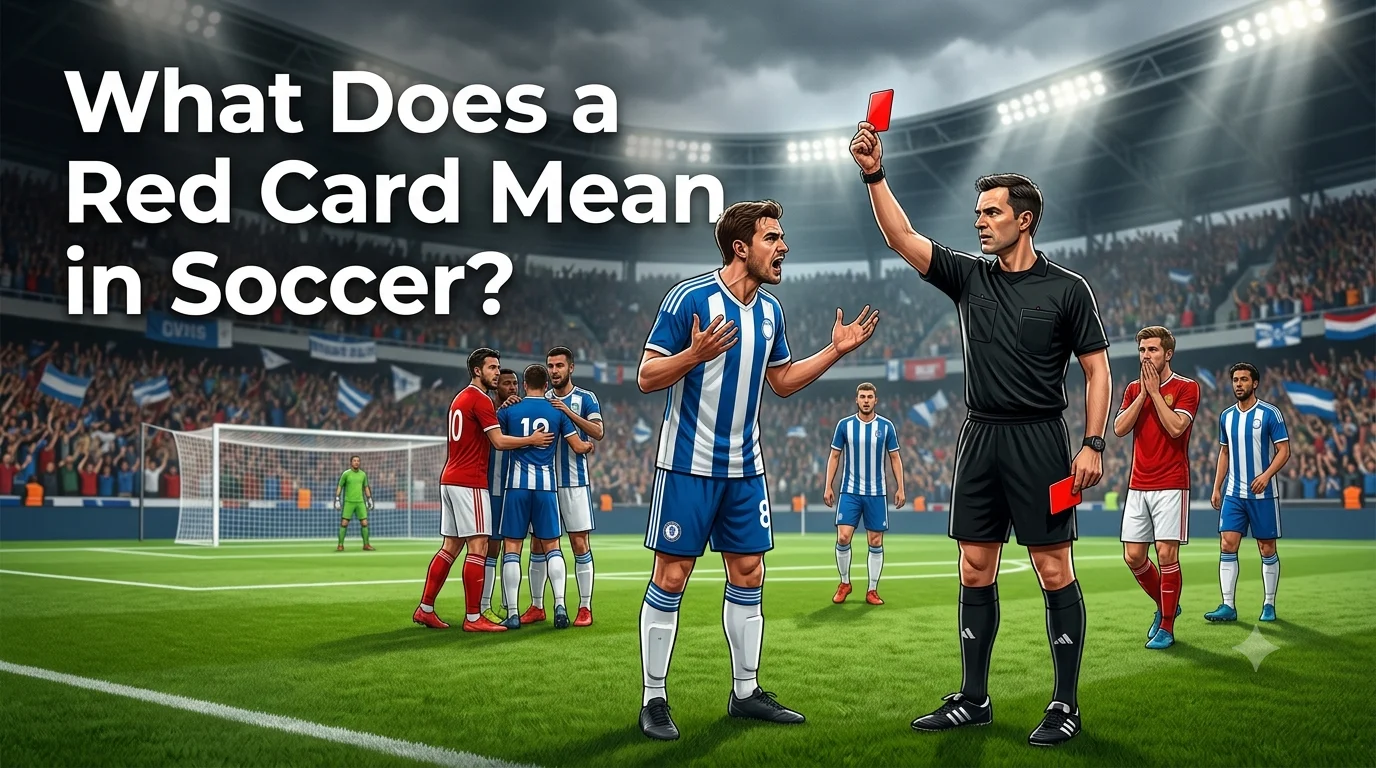
Quick Definition: A red card in soccer is the most serious disciplinary punishment a referee can issue. It means a player or team official is immediately sent off and must leave the field for the remainder of the match. The player’s team must continue with one fewer player, making the game significantly more challenging.
A red card is a disciplinary sanction shown by the referee to indicate that a player has committed a serious offense. Once shown a red card:
- The player is immediately expelled from the match.
- The player cannot be replaced by a substitute.
- The team must continue with one fewer player.
- The player often receives an automatic suspension for future matches, depending on the competition’s rules.
A red card in soccer means a player has been sent off for committing a serious foul, violent conduct, abusive behavior, or receiving two yellow cards in the same match. The player must leave the field immediately, and their team continues with one fewer player.
Introduction
Few moments in soccer create as much drama as a referee reaching into their pocket and pulling out a red card. Whether you’re watching the FIFA World Cup, the English Premier League, UEFA Champions League, Major League Soccer (MLS), or a local youth match, a red card can completely change the outcome of a game within seconds.
Fans often celebrate when an opposing player is dismissed, while coaches and teammates scramble to adjust tactics. For new soccer fans, however, the meaning of a red card may not be entirely clear.
In this complete guide, you’ll learn:
- What a red card means
- Why referees issue red cards
- The rules behind red cards
- Common examples
- The difference between yellow and red cards
- Common misconceptions
- Frequently asked questions
By the end of this article, you’ll fully understand one of soccer’s most important rules.
Origin
The red and yellow card system wasn’t always part of soccer.
Why Were Cards Introduced?
Before cards existed, referees verbally warned or dismissed players. Since many international players spoke different languages, confusion often occurred.
To solve this problem, former English referee Ken Aston developed the card system after the 1966 FIFA World Cup.
He reportedly got the inspiration from traffic lights:
- 🟨 Yellow = Slow down or warning
- 🟥 Red = Stop immediately
The system officially debuted at the 1970 FIFA World Cup in Mexico and has remained one of soccer’s most recognizable features ever since.
Popularity
Today, the red card is universally recognized across every level of soccer.
It is used in:
- FIFA World Cup
- UEFA Champions League
- English Premier League
- La Liga
- Bundesliga
- Serie A
- Ligue 1
- Major League Soccer (MLS)
- Women’s professional soccer
- International youth competitions
- Amateur and recreational leagues
Even people who rarely watch soccer often recognize that a referee holding up a red card means a player has been removed from the game.
Because red cards frequently influence match results, they are heavily discussed by commentators, fans, analysts, and sports journalists.
How It Is Used
A referee shows a red card when a player commits a sending-off offense under the Laws of the Game.
Common Reasons for a Red Card
1. Serious Foul Play
A dangerous tackle that seriously endangers an opponent.
Example:
- Studs-up tackle on an opponent’s ankle.
2. Violent Conduct
Using excessive force away from the ball.
Examples include:
- Punching
- Kicking
- Headbutting
- Elbowing
3. Spitting
Spitting at another player, official, or any person results in an immediate red card.
4. Denying an Obvious Goal-Scoring Opportunity (DOGSO)
If a defender illegally prevents a clear goal-scoring chance, they may receive a red card.
Example:
A defender deliberately pulls down an attacker who is through on goal.
5. Offensive, Insulting, or Abusive Language
Players who direct abusive language or offensive gestures toward referees, opponents, teammates, or spectators can be sent off.
6. Receiving Two Yellow Cards
A player who receives:
- First yellow card ⚠️
- Second yellow card ⚠️
Automatically receives:
➡️ Red card 🟥
This is often called a second yellow red card.
What Happens After a Red Card?
Once shown a red card:
- Player leaves the field immediately.
- Player cannot return.
- Team continues with one fewer player.
- No substitute may replace the player.
- Competition organizers often impose additional suspensions.
Examples
Friendly Examples
Example 1
Commentator:
“That’s a terrible tackle it’s definitely a red card!”
Example 2
Fan:
“The game changed completely after the goalkeeper got a red card.”
Example 3
Friend:
“You can’t argue like that with the referee or you’ll get a red card.”
Professional Examples
Sports Report:
“The defender received a straight red card for serious foul play in the 67th minute.”
Coach Interview:
“Playing with ten men made the second half extremely difficult.”
Referee Explanation:
“The challenge endangered the opponent’s safety and therefore warranted a red card.”
Funny Examples
Friend:
“Mom just gave me a red card for eating the last slice of pizza. 🍕🟥”
Office Joke:
“Being late three days in a row? That’s basically a workplace red card.”
Gaming Chat:
“Camping that corner deserves an instant red card! 😂”
These humorous examples use “red card” metaphorically to mean someone has crossed a line or deserves serious punishment.
Comparison with Similar Terms
| Term | Meaning | Result |
| Red Card | Immediate dismissal | Player leaves game |
| Yellow Card | Official warning | Player stays in match |
| Second Yellow | Second caution in same match | Automatic red card |
| Foul | Rule violation | May result in free kick or card |
| Penalty Kick | Awarded for certain fouls in penalty area | Scoring opportunity |
| Offside | Positioning violation | Play stops, no card unless misconduct occurs |
| Caution | Another name for yellow card | Warning only |
| Sending Off | Official term for red card punishment | Player dismissed |
Yellow Card vs Red Card
| Yellow Card | Red Card |
| Warning | Dismissal |
| Player remains on field | Player leaves match |
| Can accumulate | Immediate removal |
| Less serious offense | Serious misconduct |
| Does not reduce team size | Team plays with one fewer player |
Alternate Meanings
Outside soccer, the phrase red card has several figurative meanings.
Everyday Language
People may say someone has received a “red card” to mean:
- They crossed an important line.
- They behaved badly.
- They are no longer welcome.
- They face serious consequences.
Example:
“After forgetting our anniversary, he got a red card from his wife.”
Other Sports
Some sports also use red cards, although the rules differ.
Examples include:
- Rugby
- Field hockey
- Handball
- Futsal
Each sport has its own disciplinary procedures, so the consequences may vary.
Professional or Polite Alternatives
Instead of casually saying “He got a red card,” commentators and journalists often use more formal expressions.
| Casual | Professional Alternative |
| Got a red card | Was sent off |
| Kicked out | Dismissed from the match |
| Removed | Expelled from play |
| Thrown out | Received a sending-off |
| Ejected | Sent off for misconduct |
These alternatives are commonly used in sports reporting, coaching analysis, and official match summaries.
Common Mistakes
Many new soccer fans misunderstand how red cards work.
1. Thinking a Substitute Can Replace the Player
❌ Incorrect
A substitute cannot replace a player sent off.
✅ Correct
The team plays with one fewer player.
2. Assuming Every Dangerous Tackle Is a Red Card
Some dangerous fouls receive only a yellow card depending on severity and intent.
3. Believing Every Red Card Leads to the Same Suspension
Suspensions vary depending on:
- Competition rules
- Nature of offense
- League regulations
4. Confusing Two Yellow Cards with a Straight Red
Straight Red:
- Immediate dismissal for one serious offense.
Second Yellow:
- Two cautions combine into a red card.
5. Thinking Goalkeepers Cannot Receive Red Cards
Goalkeepers are subject to the same disciplinary rules as outfield players.
Quick Tips
- 🟥 A red card means immediate dismissal.
- 🟨 Two yellow cards equal one red card.
- A red-carded player cannot return.
- No substitute replaces the dismissed player.
- Teams must continue with fewer players.
- Serious foul play often leads to a straight red.
- Red cards can affect future matches through suspensions.
- Understanding the difference between yellow and red cards helps you better follow any soccer match.
FAQ
1. What does a red card mean in soccer?
A red card means a player has been sent off for committing a serious offense or receiving two yellow cards in the same match.
2. What happens after a player gets a red card?
The player must leave immediately, cannot return, and their team continues with one fewer player.
3. Can a substitute replace a player who receives a red card?
No. The team must play with fewer players for the remainder of the match.
4. What offenses lead to a straight red card?
Common reasons include violent conduct, serious foul play, denying an obvious goal-scoring opportunity, spitting, and using offensive or abusive language.
5. Is two yellow cards the same as a straight red card?
Both result in the player being sent off, but two yellow cards come from two separate cautionable offenses, while a straight red is given for a single serious offense.
6. Does a red card always mean a suspension?
In most professional competitions, yes. The length of the suspension depends on the competition rules and the seriousness of the offense.
7. Can goalkeepers receive red cards?
Yes. Goalkeepers can be shown red cards just like any other player if they commit a sending-off offense.
8. Why is the red card so important in soccer?
A red card significantly affects the balance of a match because the dismissed player’s team must continue with one fewer player, often giving the opposition a tactical advantage.
Conclusion
A red card in soccer is the game’s strongest disciplinary action, reserved for serious misconduct or a second yellow card. When a referee shows a red card, the player must leave the field immediately, cannot be replaced, and their team must continue with one fewer player.
Understanding what a red card means helps you appreciate the tactical, emotional, and competitive impact it has on every match. Whether you’re watching professional leagues, international tournaments, or local games, recognizing why a red card is issued makes following the sport much more enjoyable.
Remember that while yellow cards serve as warnings, a red card represents the highest level of in-game punishment. Knowing the difference between these disciplinary actions will help you better understand referee decisions and the flow of soccer matches.
Read More Articles About
- What Does Hyung Mean In Korean Text And Conversation? Full Guide For 2026
- What Does + Mean In Betting? Meaning, Payouts, And Winning Strategies For 2026
- What Does POD Mean In Banking? How Payable On Death Accounts Work In 2026
- What Does Harmony Mean In Interior Design? Why It Matters And How To Use It In 2026