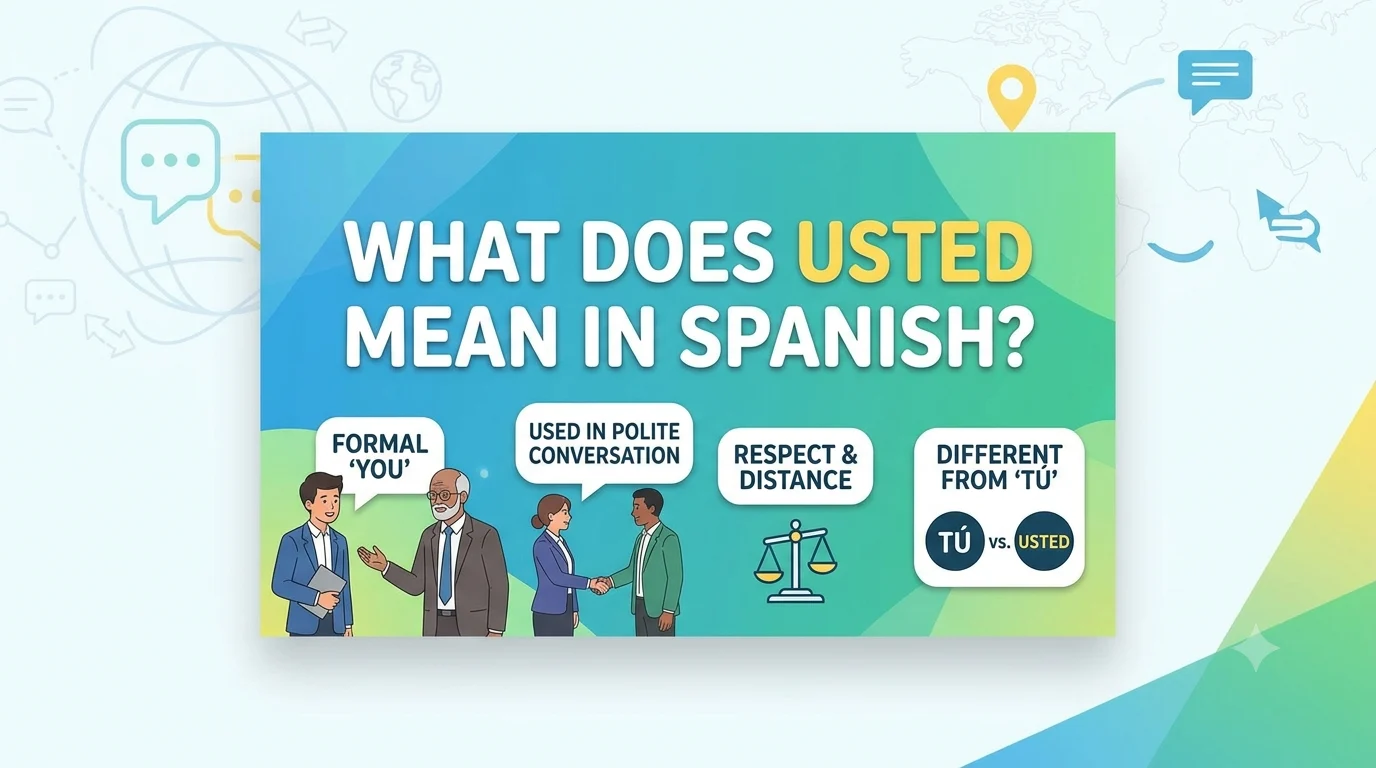
Quick Defination: Usted means “you” in Spanish when addressing one person respectfully or formally. Unlike English, Spanish has different second-person forms depending on the level of familiarity and formality.The most common contrast is tú vs. usted: Tú = you, generally informal or familiar: Usted = you, generally formal or respectful
For example:
¿Cómo estás? = How are you?
¿Cómo está usted? = How are you? (formal/respectful)
| Detail | Explanation |
| Spanish Word | Usted |
| English Meaning | You |
| Main Use | Formal or respectful singular “you” |
| Number | Singular |
| Tone | Formal, respectful, or sometimes distant |
| Common Contrast | Tú |
Although usted is associated with formality, it does not necessarily mean that the speaker is being cold or distant. In many Spanish-speaking communities, it is simply the normal respectful way to address certain people.
If you are learning Spanish and hear someone say usted, you may wonder why they are using it instead of the more familiar tú. The Spanish word usted means “you” in English, but it is generally used when speaking formally, respectfully, or to someone with whom you do not have a familiar relationship. For example, ¿Cómo está usted? means “How are you?” in a formal or respectful way. Understanding usted is important because Spanish changes the way you address someone depending on the relationship and situation. Its use can vary somewhat by country, age, social setting, and personal preference, so context matters.
What Does Usted Stand For?
Unlike an abbreviation such as “you’re” or “U,” usted does not stand for a modern English-style phrase. It is a Spanish pronoun meaning “you” when addressing one person formally or respectfully.
Historically, usted developed from the expression vuestra merced, meaning roughly “your mercy” or “your grace.” Over time, the longer expression changed in pronunciation and form until usted became established.
Today, Spanish speakers generally use usted as a grammatical pronoun rather than thinking about its historical origin.
One important feature is that verbs used with usted take the third-person singular form:
Usted habla español.
You speak Spanish.
The verb habla is the third-person singular form of hablar, even though the sentence is addressing one person directly.
How Usted Is Used In Spanish
You will commonly encounter usted when someone wants to show respect, maintain formality, or address an unfamiliar person politely.
Situations may include:
- Speaking to an older person
- Addressing a customer
- Talking to a professional
- Speaking with someone you have just met
- Formal workplace conversations
- Showing respect to someone in a position of authority
For example:
¿Dónde vive usted?
Where do you live?
The question is directed at one person in a respectful or formal way.
Another example is:
¿Necesita usted ayuda?
Do you need help?
The use of usted makes the formality of the interaction clearer.
Usted vs. Tú: What Is The Difference?
The biggest difference between usted and tú is the level of familiarity or formality.
| Pronoun | English | Typical Use |
| Tú | You | Informal, familiar, friendly |
| Usted | You | Formal, respectful, or unfamiliar |
| Ustedes | You all | Plural “you” |
For example, you might use tú with a close friend:
¿Cómo estás?
How are you?
With someone you are addressing formally, you could say:
¿Cómo está usted?
How are you?
Neither form is inherently more correct. The appropriate choice depends on the relationship, region, situation, and social expectations.
How Context Changes The Meaning Of Usted
The basic translation of usted remains “you,” but the social meaning can change depending on context.
With An Older Person
In some Spanish-speaking communities, usted may be used with an older person as a sign of respect.
¿Cómo está usted, señor?
The phrase communicates politeness.
In A Professional Setting
A customer may address a worker or professional using usted, especially in a formal interaction.
¿Puede ayudarme usted?
This can sound respectful rather than distant.
Between People Who Know Each Other
Some families, couples, friends, or acquaintances may use usted even when they are not strangers.
Regional customs and personal preferences can make this completely natural.
In A More Formal Conversation
A speaker may choose usted when they want to maintain a polite or formal tone.
¿Podría usted repetir la pregunta?
This means “Could you repeat the question?”
The surrounding relationship and setting are therefore more useful than assuming that usted always means the speakers are strangers.
Usted Meaning In Different Spanish-Speaking Countries
The basic meaning of usted remains the same across Spanish-speaking countries: it is a singular formal or respectful form of “you.”
What changes is how frequently people use it.
In some regions, speakers may use usted quite often, including in relationships where English speakers might expect an informal “you.” In other communities, tú may be preferred among friends, younger people, and familiar acquaintances.
There is also vos, used in several Spanish-speaking regions as another singular form of “you.” Its use and conjugation vary by country and region.
This means there is no single social rule that applies to every Spanish-speaking community. When learning Spanish for a particular country, it helps to learn the local expectations around tú, usted, and vos.
Real Conversation Examples
Example 1: Meeting Someone New
Person A: “Mucho gusto. ¿Cómo se llama usted?”
Person B: “Me llamo Carlos.”
Meaning: Person A uses usted to address the new acquaintance politely and formally.
Example 2: Speaking With A Professional
Person A: “¿Necesita usted algún documento más?”
Person B: “No, gracias.”
Meaning: The speaker uses usted to maintain a respectful tone during a formal interaction.
Example 3: Talking To A Friend
Person A: “¿Cómo estás?”
Person B: “Estoy bien, ¿y tú?”
Meaning: The speakers use tú because their relationship is familiar and informal.
Is Usted Rude?
No, usted is generally a respectful or formal way to address one person. However, the emotional effect can vary by region and relationship.
If two close friends normally use tú and one suddenly switches to usted, it could sound unusually formal or distant. In a professional or respectful interaction, the same word may sound completely natural.
Tone can also be affected by facial expression, wording, and the situation.
Is Usted More Respectful Than Tú?
Generally, usted is associated with greater formality or respect than tú, but this is not an absolute rule.
In some Spanish-speaking communities, usted is used routinely and does not necessarily indicate a significant social distance. In other places, switching from tú to usted can make the conversation noticeably more formal.
The best approach is to follow the conventions of the region and the other person’s preferred form of address.
How To Reply When Someone Uses Usted
You do not need a special response simply because someone uses usted. You can answer naturally while choosing the pronoun appropriate for the relationship.
Polite Replies
If someone asks:
¿Cómo está usted?
You could respond:
- Estoy bien, gracias. I’m well, thank you.
- Muy bien, gracias. ¿Y usted? Very well, thank you. And you?
- Estoy bien. ¿Cómo está usted? I’m well. How are you?
When You Are Unsure Which Pronoun To Use
If you are learning Spanish and are unsure whether to use tú or usted, you can politely ask:
¿Prefiere que le hable de tú o de usted?
This means, “Would you prefer that I address you as tú or usted?”
When To Use Usted
Use usted when a formal or respectful form of address is appropriate in your particular Spanish-speaking context.
Common situations include:
- Formal introductions
- Customer-service interactions
- Speaking with certain older people
- Professional conversations
- Addressing someone you do not know well
- Formal requests
- Situations where respect is especially important
When traveling or speaking with native Spanish speakers, listening to how people address one another can help you understand which form is expected.
When To Avoid Usted
There is no universal rule that says usted must be avoided in certain situations. However, using it when a community normally expects tú can sometimes make your Spanish sound unusually formal.
For casual conversations with close friends, family members, or people who clearly use tú with you, tú may be more natural.
In professional settings, however, do not automatically assume that usted is required. Workplace conventions differ across Spanish-speaking countries and individual organizations.
Common Mistakes With Usted
| Common Mistake | Correct Understanding |
| Translating usted as a completely different English word | It generally translates simply as “you.” |
| Assuming usted always means the speaker is distant | It can express respect without emotional distance. |
| Using the same verb form as tú | Usted normally takes third-person singular verb forms. |
A particularly important grammar mistake is saying:
Usted hablas español. ❌
The correct form is:
Usted habla español. ✅
That is because usted takes the third-person singular verb form.
Similar Spanish Pronouns
| Term | Meaning | Main Difference |
| Tú | You | Informal singular |
| Usted | You | Formal or respectful singular |
| Vos | You | Singular form used regionally |
| Ustedes | You all | Plural form of “you” |
| Vosotros | You all | Informal plural form mainly used in Spain |
The choice among these pronouns depends heavily on the Spanish variety and social context.
Origin Of Usted
The word usted has a historical connection to “vuestra merced,” an older respectful expression meaning approximately “your grace” or “your mercy.” The expression gradually became shortened and transformed in speech, eventually producing usted.
The modern word is now an ordinary part of Spanish grammar, although speakers generally use it without thinking about this historical development.
Its exact social use varies across Spanish-speaking regions, which is why learners may notice different preferences depending on where they study or travel.
Quick Recap
- Usted means “you” in Spanish.
- It is generally used for formal, respectful, or unfamiliar singular address.
- Tú is generally the informal singular equivalent.
- Usted normally takes third-person singular verb forms.
- Regional customs affect when speakers choose usted instead of tú.
- Using usted does not automatically mean the relationship is cold or distant.
Frequently Asked Questions
What does usted mean in Spanish?
Usted means “you” in Spanish and is generally used when addressing one person formally or respectfully.
Is usted formal or informal?
Usted is generally formal or respectful, although some Spanish-speaking communities use it more frequently in familiar relationships.
What is the difference between tú and usted?
Tú is generally informal and familiar, while usted is generally used for formal, respectful, or unfamiliar address.
Does usted mean you in English?
Yes, usted normally translates to the singular English pronoun “you,” with added formality or respect from context.
Why does usted use third-person verbs?
Usted takes third-person singular verb forms because of its grammatical structure, despite directly addressing one person.
Final Thoughts
Usted means “you” in Spanish, but it carries an important social distinction because it is generally associated with formality, respect, or unfamiliarity. Unlike English, Spanish gives speakers several ways to address another person, and choosing between usted and tú depends on the relationship, region, and situation. Remember that usted normally takes third-person singular verb forms, such as usted habla rather than usted hablas. If you are unsure which form to use, pay attention to how people around you speak and follow the conventions of the Spanish-speaking community you are communicating with.
Read More Articles About
- What Does Hyung Mean In Korean Text And Conversation? Full Guide For 2026
- What Does + Mean In Betting? Meaning, Payouts, And Winning Strategies For 2026
- What Does POD Mean In Banking? How Payable On Death Accounts Work In 2026
- What Does Harmony Mean In Interior Design? Why It Matters And How To Use It In 2026