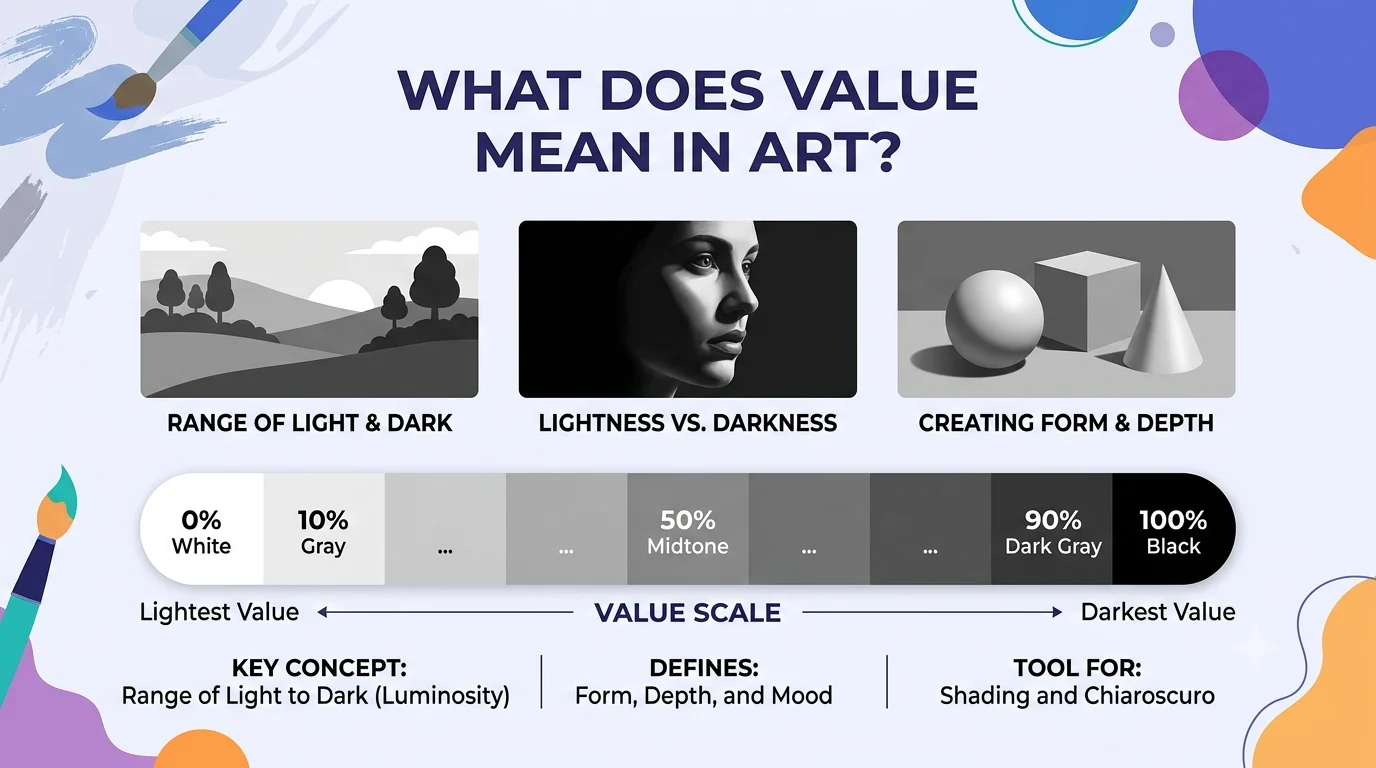
Quick Meaning: In art, value is the relative lightness or darkness of a color or area. White has a very light value, black has a very dark value, and gray tones fall between them.Artists use value to create the illusion of light, shadow, form, and depth, even when an artwork uses only black and white.
| Detail | Explanation |
| Definition | The lightness or darkness of a color or area |
| Light Value | Closer to white |
| Dark Value | Closer to black |
| Main Purpose | Create contrast, form, and depth |
| Used In | Drawing, painting, photography, and digital art |
For example, a white ball sitting on a table is not drawn as one solid white shape. An artist adds light gray areas, darker gray shadows, and sometimes nearly black cast shadows to make the ball look round and three-dimensional.
If you have ever looked at a drawing that seemed surprisingly realistic even without color, value was probably doing much of the work. In art, value refers to how light or dark a color, shape, or area appears. Artists use changes in value to create contrast, show three-dimensional form, suggest depth, and guide the viewer’s attention. Understanding what value means in art is one of the most important steps for beginners because it applies to drawing, painting, photography, and digital art. Once you learn to see values instead of only colors, it becomes much easier to understand why some artworks look convincing and others appear flat.
Why Is Value Important In Art?
Value is one of the fundamental elements of art because it helps viewers understand what they are looking at.
Without changes in value, an image often appears flat. With carefully arranged light and dark areas, an artist can suggest:
- Form how an object turns in space.
- Depth which objects are closer or farther away.
- Light source where the light is coming from.
- Texture whether something looks smooth, rough, shiny, or soft.
- Mood whether a scene feels bright, calm, dramatic, or mysterious.
Even highly colorful paintings depend on value. If all the colors are equally light or equally dark, the composition may become difficult to read.
What Is A Value Scale?
A value scale is a sequence of tones arranged from lightest to darkest.
A basic grayscale value scale might include:
- White
- Very light gray
- Light gray
- Medium gray
- Dark gray
- Very dark gray
- Black
Artists often practice drawing value scales because they train the eye to notice subtle differences in lightness and darkness.
For example, instead of thinking, “This apple is red,” an artist may ask:
- Which part is the lightest?
- Which part is the darkest?
- Where are the middle tones?
That way of seeing is essential for realistic drawing.
Light Values, Midtones, And Dark Values
Most artworks contain three broad groups of values.
Light Values
These are the brightest parts of the artwork. They often represent areas receiving the strongest light.
Examples include:
- Highlights on glass.
- Sunlit parts of a face.
- White fabric.
- Reflections on metal.
Midtones
Midtones sit between the lightest and darkest areas. They usually make up much of an object’s surface and help connect highlights with shadows.
Dark Values
Dark values represent shadows, deep recesses, or areas receiving little light.
Examples include:
- The underside of an object.
- Cast shadows.
- Dark hair.
- Open doorways.
A balanced range of light, middle, and dark values often makes an artwork easier to understand.
How Value Creates Three-Dimensional Form
One of value’s most important jobs is making flat shapes appear solid.
Imagine drawing a circle.
If you leave it as a simple outline, it looks like a flat shape.
Now imagine adding:
- A bright highlight.
- A gradual transition into medium gray.
- A dark shadow along one side.
- A cast shadow underneath.
The circle now appears to be a sphere.
Nothing about the outline changed. The illusion came from changes in value.
Artists use the same principle to draw faces, hands, buildings, landscapes, and nearly every other subject.
How Context Changes The Meaning Of Value In Art
The word value can have several meanings in everyday English, but in art it has a specific visual meaning.
Value In Drawing
In drawing, value often refers to graphite tones created by pencils, charcoal, or ink.
A darker pencil can create a darker value than a harder, lighter pencil.
Value In Painting
In painting, value refers to how light or dark a color appears, regardless of its hue.
A yellow paint can have a light value, while a dark blue paint can have a much darker value.
Value In Photography
Photographers also think in terms of value because photographs contain areas of light and dark that influence contrast and mood.
Value In Digital Art
Digital artists adjust values through brightness, shadows, highlights, and tonal ranges to create readable images.
Although the medium changes, the basic concept remains the same.
Value And Color: What Is The Difference?
Color and value are related, but they are not the same thing.
Color describes characteristics such as red, blue, green, or yellow.
Value describes how light or dark that color appears.
For example:
- Pale yellow has a light value.
- Navy blue has a dark value.
- Medium red has a middle value.
Artists often check an image in grayscale to see whether the values work well. If the artwork still reads clearly without color, the value structure is usually strong.
This is why a painting can have beautiful colors but still feel flat if its values are too similar.
Value vs. Contrast
These terms are closely related but have different meanings.
| Term | Meaning | Main Difference |
| Value | Lightness or darkness | Describes a single tone |
| Contrast | Difference between values | Describes how tones relate |
| Hue | The color itself | Red, blue, green, etc. |
| Saturation | Color intensity | How vivid or muted a color appears |
For example, placing a white object against a black background creates high contrast because the values are very different.
Placing a medium gray object against a slightly darker gray background creates low contrast because the values are similar.
Real Art Examples
Example 1: Pencil Portrait
An artist draws a face using only graphite.
The forehead and cheeks contain light values, the sides of the face contain midtones, and the eye sockets and hair contain dark values.
Meaning: The different values create the illusion of a three-dimensional face.
Example 2: Landscape Painting
A mountain painting has dark trees in the foreground, medium-value hills in the middle distance, and lighter mountains farther away.
Meaning: The value changes help create depth and make the landscape feel spacious.
Example 3: Still Life
A white cup sits beside a dark book.
The bright cup immediately attracts attention because its light value contrasts with the darker object.
Meaning: Value is being used to create emphasis and guide the viewer’s eye.
How Artists Use Value To Create Mood
Value also affects the emotional feeling of an artwork.
High-Key Artwork
A high-key artwork contains mostly light values.
It often feels:
- Bright
- Peaceful
- Airy
- Gentle
Low-Key Artwork
A low-key artwork contains mostly dark values.
It often feels:
- Dramatic
- Mysterious
- Serious
- Intimate
A night scene, for example, may use mostly dark values with a few bright highlights from streetlights or windows. Those bright areas become especially noticeable because of the surrounding darkness.
How To See Value More Easily
Beginners often focus on identifying colors rather than values. Learning to notice value takes practice.
Try these techniques:
- Squint at an object until details become less visible. The large light and dark shapes often become easier to see.
- Look at black-and-white photographs.
- Convert a photo to grayscale and identify the lightest and darkest areas.
- Practice shading simple objects such as spheres, cubes, and cylinders.
- Compare two areas and ask which one is lighter rather than trying to name the exact gray.
Over time, your eyes become better at recognizing subtle value differences.
How To Practice Value In Art
A few simple exercises can improve your understanding.
Draw A Value Scale
Create a smooth transition from white to black using a pencil or charcoal.
Try to make each step noticeably different from the next.
Shade A Sphere
Draw a circle and add:
- Highlight
- Light area
- Midtone
- Core shadow
- Reflected light
- Cast shadow
This exercise teaches how value describes form.
Copy A Black-And-White Photo
Removing color lets you focus entirely on value relationships.
Simplify A Scene
Choose a photograph and reduce it to just three values:
- Light
- Medium
- Dark
This helps you understand the overall structure before adding details.
Common Mistakes With Value
| Common Mistake | Correct Understanding |
| Thinking value means color | Value describes lightness and darkness, not hue. |
| Using only middle values | A wider value range often creates stronger depth and contrast. |
| Making shadows completely black | Most shadows contain a range of values and reflected light. |
Another common mistake is outlining every object with dark lines. In many realistic artworks, value changes define edges more naturally than heavy outlines.
Similar Art Terms
| Term | Meaning | Main Difference |
| Value | Lightness or darkness | Focuses on tone |
| Hue | The color name | Red, blue, yellow, etc. |
| Saturation | Intensity of a color | Vivid versus muted |
| Contrast | Difference between values | Compares tones |
| Chiaroscuro | Strong use of light and dark | A dramatic lighting technique |
These terms often appear together in art classes, but each describes a different visual quality.
Why Teachers Emphasize Value
Art teachers frequently encourage students to study value before concentrating on color because value provides the underlying structure of an image.
If the value relationships are accurate, a drawing can often look convincing even without color. If the values are incorrect, adding more color usually does not solve the problem.
Many artists therefore begin with a grayscale sketch or tonal study before creating a finished painting.
This approach allows them to check the composition, lighting, and overall readability before adding color.
Can Value Be Used In Abstract Art?
Yes. Value is just as important in abstract art as it is in realistic art.
An abstract artist may arrange light and dark shapes to create balance, movement, rhythm, or emphasis without depicting recognizable objects.
For example, a composition with one very dark shape surrounded by lighter areas immediately creates a focal point because of the value contrast.
This shows that value is not only about realism. It is also a powerful design tool.
Quick Recap
- Value in art means how light or dark a color or area appears.
- Artists use value to create form, depth, contrast, and mood.
- A value scale moves from white through grays to black.
- Value is different from color, although every color has a value.
- Strong value relationships can make an artwork readable even without color.
- Practicing grayscale drawing is one of the best ways to improve your understanding of value.
Frequently Asked Questions
What does value mean in art?
Value in art refers to the relative lightness or darkness of a color, shape, or area within an artwork.
Why is value important in art?
Value creates contrast, form, depth, lighting, and mood, helping viewers understand the structure and focus of an artwork.
What is a value scale in art?
A value scale is a sequence of tones arranged from white through gray to black, showing changes in lightness.
What is the difference between value and color?
Color identifies a hue like red or blue, while value describes how light or dark that color appears.
How do artists use value?
Artists arrange light, middle, and dark tones to suggest three-dimensional form, create depth, and guide the viewer’s attention.
Final Thoughts
Understanding what value means in art gives you a foundation for nearly every visual medium. Value is simply the lightness or darkness of a color or area, but artists use it to create realistic forms, convincing depth, strong contrast, and emotional mood. Whether you are drawing with a pencil, painting with oils, taking photographs, or creating digital illustrations, learning to recognize highlights, midtones, and shadows will make your work clearer and more effective. With regular practice, seeing value becomes a natural part of observing and creating art.
Read More Articles About
- What Does Hyung Mean In Korean Text And Conversation? Full Guide For 2026
- What Does + Mean In Betting? Meaning, Payouts, And Winning Strategies For 2026
- What Does POD Mean In Banking? How Payable On Death Accounts Work In 2026
- What Does Harmony Mean In Interior Design? Why It Matters And How To Use It In 2026